Venice with kids can be one of the most memorable family trips in Italy, but it requires a different approach from visiting Rome, Florence or Milan. In Venice’s historic center, canals interrupt walking routes, bridges frequently have steps, and boats perform many of the jobs that buses, taxis and delivery trucks handle elsewhere.
For children, that difference is part of the adventure. A water bus becomes a lesson in transportation, a bridge reveals how neighborhoods connect, and a canal-side doorway raises questions about how people live in a city built around water.
For parents, however, the same features create practical challenges. Where should you stay? Is a gondola worth the money? Can you visit with a stroller? How many days do you need? And which experiences are genuinely worth prioritizing when children are tired of walking?
This guide helps families make those decisions before arriving, then gives children simple ways to explore Venice with curiosity rather than treating the city as a checklist of famous landmarks.
Is Venice Worth Visiting with Kids?
Yes, particularly if your family enjoys unusual cities, boats, history and exploring on foot. Venice offers something children can understand immediately: it does not work like the cities they are accustomed to.
That makes it appealing even to children who have little interest in museums or traditional sightseeing. They can watch boats deliver supplies, compare bridges, discover small squares and notice how buildings meet the water.
The challenge is physical rather than intellectual. Venice can involve considerable walking, repeated bridge crossings, crowds and complicated luggage transfers. A family that plans around those realities may enjoy the city much more than one that attempts to cover every famous attraction in a single day.
Quick Answer: What Should Families Do in Venice?
| Family interest | Experience to consider | Planning note |
|---|---|---|
| First-time highlights | St Mark’s Square and Basilica area | Visit strategically around crowds |
| Boats and transportation | Grand Canal vaporetto ride | A practical way to experience the city |
| Venetian history | Doge’s Palace | Best for children ready for a substantial historic visit |
| Unique architecture | Rialto Bridge and surrounding streets | Combine with a neighborhood walk |
| Traditional crafts | Murano | Consider a suitable glassmaking demonstration |
| Colorful neighborhoods | Burano | Allow time for the boat journey |
| Quiet exploration | Cannaregio or Castello | Choose a smaller area rather than rushing across the city |
| Outdoor breaks | Giardini or suitable campi | Useful between major attractions |
| A special experience | Gondola ride | Optional, not essential |
| Curiosity and discovery | Venice Water Detective | Observe bridges, boats, canals and former wells |
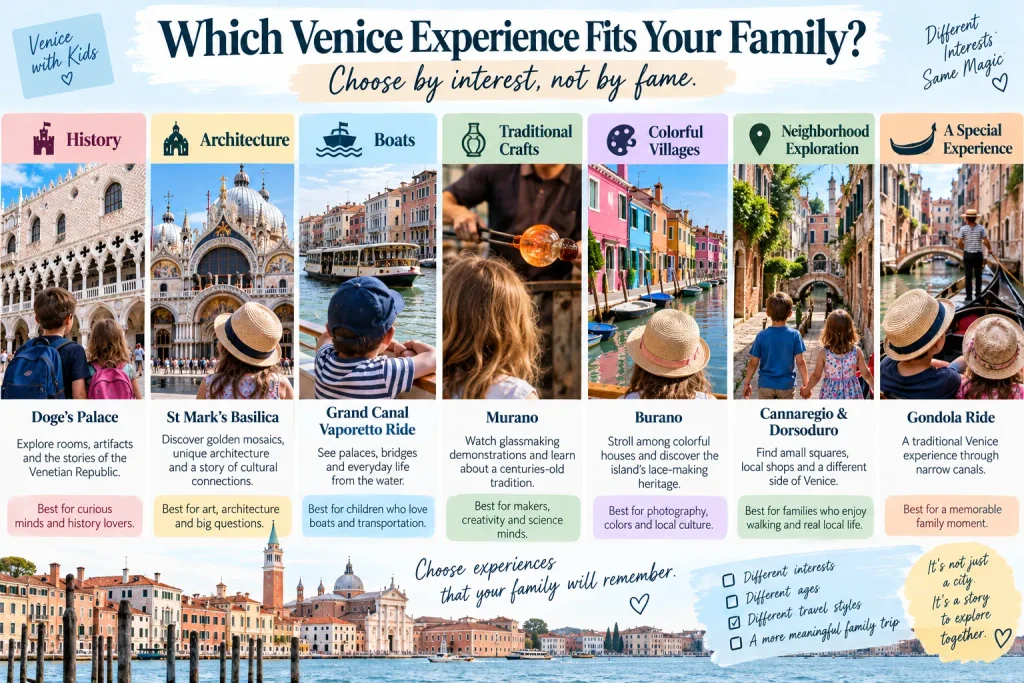
These experiences are not ranked from best to worst. For many families, a Grand Canal ride followed by a relaxed neighborhood walk will be more memorable than visiting three palaces in one afternoon.
How Many Days Do You Need in Venice with Kids?
For a first family visit, two full days is a useful starting point, while three days provides more room for lagoon islands, slower exploration and unexpected discoveries.
A one-day visit is possible, particularly when Venice is part of a broader northern Italy itinerary. But families should understand that the day will involve transport into the city, walking and returning to their accommodation, leaving less time than the calendar suggests.
One Day in Venice
With one day, prioritize the experience of Venice itself. Choose a walking route through the historic center, see St Mark’s Square and the Rialto area if they fit your route, and include a water-bus journey if practical.
Avoid booking several timed attractions. A day spent constantly checking the clock defeats much of the pleasure of exploring a city where getting from one place to another is already part of the experience.
Two Days in Venice
Two days allows families to divide the historic center into manageable areas.
One day can focus on St Mark’s Square, the Doge’s Palace area and the Grand Canal. The other can explore Rialto, Cannaregio, Castello or another neighborhood according to your accommodation and interests.
This structure also gives children time to notice Venice’s everyday life rather than remembering only its most crowded landmarks.
Three Days in Venice
A third day makes Murano, Burano or another lagoon experience easier to include without sacrificing the historic center.
It also creates valuable flexibility. If the children are tired after a major attraction, the family can spend the afternoon exploring a nearby neighborhood rather than rushing toward another reservation.
Three days does not mean three days of museums. It means enough time for Venice to feel like a place rather than a sightseeing obstacle course.
Where Should Families Stay in Venice?
Accommodation location may influence your experience more than almost any individual attraction.
Venice has no conventional road network through its historic center, so the last part of the journey to your accommodation may involve walking, bridges and boats. This is particularly important with luggage, strollers or children who become tired after a long travel day.
Before booking, check the exact route from your arrival point to the property. A hotel that looks conveniently central on a map may still require several bridge crossings.
San Marco: Convenient for Major Landmarks
San Marco places families near some of Venice’s most famous sights, including St Mark’s Square and the Doge’s Palace.
The advantage is convenience for a landmark-focused itinerary. The disadvantages can include crowds, higher accommodation costs and busy pedestrian routes.
San Marco may suit a short stay where visiting the major sights is the priority, but it is not automatically the best choice for every family.
Cannaregio: A Different Side of Venice
Cannaregio offers historic streets, canals, residential areas and a variety of accommodation options. Some locations are convenient for arrivals near Venezia Santa Lucia railway station, although the district is extensive and individual properties vary considerably.
For families interested in walking, food and observing everyday Venetian life, Cannaregio can be appealing.
The exact location still matters. Check the number of bridges and the walking route rather than assuming every property in the district is equally convenient.
Dorsoduro: Art, Canals and a Different Pace
Dorsoduro can work well for families interested in art, waterfront walks and a somewhat different atmosphere from the busiest central sightseeing corridors.
Its attractions include major cultural institutions and historic public spaces, but families do not need to fill every day with museum visits to enjoy the district.
Consider it when your itinerary includes this side of the Grand Canal and you value a location that encourages neighborhood exploration.
Castello: Worth Considering for a Longer Stay
Castello stretches east from the St Mark’s area and includes both busy tourist routes and quieter residential sections.
Some areas offer access to open spaces that can be useful for families needing a break from dense sightseeing.
However, the district is large. A hotel in eastern Castello may involve a different daily journey from one close to St Mark’s Square.
Mestre: Is Staying on the Mainland a Good Idea?
Mestre can provide a less expensive accommodation alternative, with rail and other transport connections to Venice.
For some families, that saving is worthwhile. For others, traveling into and out of the historic center each day reduces flexibility and makes evening exploration less convenient.
Compare the total cost, not only the nightly room price. Include transportation, travel time and the practical difficulty of returning to accommodation when children become tired.
My recommendation: For a short first visit, staying in Venice’s historic center can be worth considering if the budget allows. For a longer trip or families prioritizing accommodation value, Mestre may be a sensible alternative.
How to Get to Venice with Children
Your arrival route depends on whether you come by train, car or plane. Each option leads to a different entry point and different luggage considerations.
Arriving by Train
Venezia Santa Lucia railway station is located at the edge of the historic center beside the Grand Canal. It is an especially memorable arrival because families step out of a railway station and immediately see Venice’s waterways.
From the station, you can walk or use water transportation to reach your accommodation.
Check the actual route before arrival. A property that appears close in straight-line distance may require a longer walk because of canals and bridges.
For train planning, consult Trenitalia or Italo for applicable routes and services.
Arriving by Car
Cars cannot drive through the pedestrian-and-canal network of historic Venice. Families arriving by road generally use designated parking areas such as Piazzale Roma or Tronchetto before continuing on foot or by water transport.
Parking arrangements, availability and prices should be checked before departure, especially during busy travel periods.
If your accommodation is in the historic center, do not assume you can unload luggage directly outside the hotel.
Arriving by Plane
Venice Marco Polo Airport is connected with Venice through land and water transport options. The most convenient choice depends on your accommodation, luggage, arrival time and budget.
Water transport may provide a memorable arrival, but it is not automatically the fastest or cheapest option for every family.
Compare the complete route to your hotel rather than choosing a transfer simply because it looks attractive in photographs.
Official transport information is available through Venice Marco Polo Airport and Alilaguna.
How Does Public Transport Work in Venice?
Venice’s public transportation system is one of the city’s most distinctive features.
Instead of assuming a water bus is a tourist attraction, think of it as part of the infrastructure residents and visitors use to move through the lagoon.
Vaporetto: Venice’s Water Bus
The vaporetto is an essential part of many Venice visits. Services operate along important waterways and connect different parts of the city and lagoon.
For families, a vaporetto ride can serve two purposes: transportation and sightseeing. A journey along the Grand Canal, for example, lets children observe buildings, boats and the relationship between Venice’s waterways and its urban life.
However, routes can be busy, and not every journey is scenic or comfortable. During crowded periods, children may have limited visibility, and families should be prepared to stand when necessary.
Use the official ACTV website for current routes, fares and ticket conditions.
Are Venice Water Buses Free for Children?
Do not assume every child travels free.
Ticket rules depend on age and the applicable transport product. Reduced fares, family offers and other conditions can change.
Before purchasing tickets, check the official operator’s current conditions and calculate the cost for your actual party rather than using a generic family estimate.
Should You Buy a Vaporetto Pass?
That depends on how often you plan to use the boats.
If your family expects to walk most of the time and take only one or two water-bus journeys, individual tickets may be more appropriate.
If you plan several journeys across multiple days, a time-based pass may offer better value.
The correct comparison is between your planned journeys and the actual ticket options available for your travel dates.
Don’t buy a pass merely because an itinerary article calls it essential.
What Are the Best Things to Do in Venice with Kids?
Venice offers plenty of famous attractions, but families do not need to visit all of them to enjoy the city. Some children will be fascinated by the Doge’s Palace, while others may remember watching delivery boats on the Grand Canal more vividly than any museum.
The most useful approach is to choose one major experience and build the rest of the day around it. In Venice, even traveling between attractions can become part of the adventure.
1. St Mark’s Square: The Best Starting Point for First-Time Visitors
Piazza San Marco is one of Venice’s most recognizable public spaces. St Mark’s Basilica, the Doge’s Palace, the Campanile and the surrounding historic buildings make it a natural starting point for families visiting the city for the first time.
Instead of rushing immediately into a ticketed attraction, spend a few minutes looking around the square. Ask children which building they think is the oldest, why the basilica looks different from many other Italian churches, and what the square might have looked like centuries ago.
St Mark’s Square is also a useful place to introduce Venice’s maritime history. The city developed extensive connections with the eastern Mediterranean, and those connections influenced its art, architecture and political identity.
For younger children, the square itself may be enough. Older children may be ready to explore the buildings surrounding it.
Family planning note: The area can become extremely crowded. Visit with realistic expectations, keep younger children close and avoid scheduling several major attractions here back-to-back.
2. St Mark’s Basilica: For Children Curious About Art and Cultural Exchange
St Mark’s Basilica is unlike many churches families may have encountered elsewhere in Italy. Its domes, mosaics and architectural influences reflect Venice’s long relationship with Byzantine and eastern Mediterranean traditions.
Children may notice the golden mosaics before understanding anything about the building’s history. That is a good starting point.
Ask them to find a detail that looks different from the churches they have seen in Rome or Florence. Older children can investigate how trade, religion and political power influenced the appearance of the basilica.
The famous bronze horses associated with St Mark’s also provide an opportunity to discuss how artworks can travel between cities through conquest, political change and collecting.
Families should remember that this is an active religious site, not simply a tourist attraction. Dress requirements, visitor access, ticket options and restrictions may apply.
For current information, consult the official St Mark’s Basilica website.
Is it worth entering with young children? It depends on their attention span and the day’s crowds. Families with older children interested in mosaics or history may find the interior particularly rewarding, while families with toddlers may prefer to appreciate the exterior and move on.
3. Doge’s Palace: For Children Who Like Castles, Secrets and Political History
The Doge’s Palace, or Palazzo Ducale, is one of Venice’s most important historic buildings. It served as a center of government and political power during the Venetian Republic.
Despite its elegant appearance, the palace was not simply a royal residence. Venice was governed through a complex republican political system, and the doge’s authority operated within institutions designed to distribute and constrain power among the ruling elite.
For children, the palace can become an investigation into how a powerful maritime republic governed itself.
Rather than attempting to explain every institution, focus on three questions:
- Who made decisions for Venice?
- Why did a government building need such enormous and decorated rooms?
- Why were prisons connected to the palace?
The famous Bridge of Sighs connects part of the palace complex with the historic prison buildings. Its popular name and associated stories can capture children’s imagination, but the history should not be reduced to romantic legends about prisoners.
Who should visit? The Doge’s Palace is particularly suitable for school-age children and teenagers who enjoy history, impressive interiors and stories about political power. Younger children may find a long interior visit demanding.
Check current exhibitions, tickets and visitor information through the official Doge’s Palace website.
4. Rialto Bridge: Discover How Venice Connects Its Neighborhoods
The Rialto Bridge is one of the most famous crossings over the Grand Canal. Its present stone structure dates from the late 16th century, replacing earlier crossings that served this important commercial area.
For families, the bridge is interesting for more than its appearance. It demonstrates how a city organized around waterways still depends on carefully placed pedestrian connections.
Stand somewhere safe and ask children to observe the traffic below. How many different boats can they identify? Why might a bridge at this location have been so important for trade?
The surrounding Rialto area also connects naturally with Venice’s commercial history. Markets, merchants and waterways helped make this part of the city a center of economic activity.
Family planning note: The bridge can be crowded, especially during busy sightseeing periods. Avoid stopping in the middle of pedestrian traffic for lengthy photographs, and keep children close near steps and busy approaches.
5. Rialto Market: Where Venice Becomes a Working City
The Rialto market area provides a different experience from Venice’s churches and palaces. Rather than focusing on monumental architecture, children can investigate food, trade and the practical needs of a city surrounded by water.
Market activity varies by day and time, so check current arrangements before making it the centerpiece of a morning.
When stalls are operating, ask children to look for seafood, fruit, vegetables and other products. Then connect the experience with the boats they have seen on the canals.
How does fresh food reach Venice? How did markets function before refrigeration and modern transport? Why was the Rialto area historically important to merchants?
A short market visit can create a surprisingly useful lesson about geography and everyday life.
For families, this is often more effective as part of a neighborhood walk than as a separate major attraction.
6. A Grand Canal Vaporetto Ride: One of Venice’s Most Useful Family Experiences
The Grand Canal is not merely a scenic waterway. It has long been one of Venice’s principal transportation routes, lined with buildings that reveal the city’s commercial and political history.
A vaporetto journey allows children to see Venice from a perspective that walking cannot provide. Palaces face the water, boats cross the canal, and buildings reveal entrances and façades designed to be approached by boat.
Rather than treating the journey as a passive sightseeing ride, give children a few things to notice. Ask them to identify different types of boats, count bridges and look for buildings with water-facing entrances.
Families should not assume that every water bus will provide an unobstructed view. Services can become crowded, and seating availability varies.
For routes, fares and ticket conditions, consult ACTV’s official website.
My recommendation: Include at least one meaningful water-bus journey if it fits your route and budget. For many children, understanding Venice from the water is more valuable than adding another indoor attraction.
Is a Gondola Ride Worth It with Kids?
A gondola ride is one of Venice’s most recognizable experiences, but it is not essential to a successful family visit.
The decision should depend on your budget, children’s interests and what you hope to experience.
A gondola offers a different perspective from a vaporetto. It is smaller, moves at a different pace and can travel through narrower canals depending on the route. Children may enjoy watching the gondolier maneuver through confined waterways and beneath bridges.
However, a gondola ride is generally a short experience, and families should not expect it to function as a comprehensive city tour.
Gondola vs. Vaporetto: Which Is Better for Families?
| Consideration | Gondola | Vaporetto |
|---|---|---|
| Main purpose | Traditional sightseeing experience | Public transportation |
| Experience | Smaller boat, often quieter canals | Larger waterways and transport routes |
| Cost structure | Fare generally applies to the gondola ride | Tickets or transport passes |
| Flexibility | Route and duration depend on service arrangements | Scheduled routes and stops |
| Best for | A special family experience | Transport plus city observation |
A family choosing a vaporetto instead of a gondola is not missing the essence of Venice. The city’s waterways can be understood through several different experiences.
How Much Does a Gondola Ride Cost?
Official gondola fares are regulated locally, but prices and service conditions should be verified close to the visit. The standard fare generally applies to the boat rather than being calculated as a separate full fare for each passenger.
Before boarding, confirm the current price, duration, passenger limit and whether any additional services are included. Do not assume that a longer ride, evening service or special request will cost the same as a standard daytime journey.
For official tourism information and current visitor guidance, start with Venezia Unica.
Can Young Children Ride a Gondola?
Families should discuss age, seating, boarding and safety arrangements with the operator before committing to a ride.
Children should remain seated as directed, and adults should supervise them closely throughout boarding and travel. Do not assume that every child will enjoy being on a small open boat.
For some families, a larger public water bus will be a more comfortable choice.
What About the Traghetto?
A traghetto is a traditional gondola-style ferry service used at certain Grand Canal crossings. It is different from booking a private sightseeing gondola.
Availability and operating arrangements can vary, so families should not build an itinerary around a particular crossing without checking whether the service is operating.
For children, a short crossing can be an interesting experience, but it should be approached as local transportation rather than a guaranteed substitute for a full gondola ride.
Murano with Kids: Is the Glass Island Worth Visiting?
Murano is one of the most recognizable lagoon destinations beyond Venice’s historic center. It is strongly associated with glassmaking, a craft that became central to the island’s identity over many centuries.
For children, the most engaging question is simple: how can something that looks like a solid rock become a delicate glass object?
A suitable glassmaking demonstration can make that transformation easier to understand. Children may see how skilled craftspeople shape heated glass using specialized tools and techniques.
However, families should choose demonstrations carefully. Not every commercial presentation offers the same educational experience, and some are closely connected with showroom visits or sales.
What Should Children Look for During a Glassmaking Demonstration?
Encourage children to notice how the material changes when heated and shaped. They can observe the tools, the craftsperson’s movements and the precision required to control the final form.
Glassmaking also creates a useful discussion about traditional crafts. Why did particular skills become associated with specific places? How are those skills passed between generations? What changes when objects can be manufactured industrially?
Safety is essential. Glass furnaces and tools can be extremely hot, and children must follow the workshop’s instructions and remain in designated visitor areas.
Should Families Visit the Murano Glass Museum?
The Museo del Vetro provides a more historical perspective on glassmaking, including techniques, objects and the development of the craft.
For children who enjoyed a demonstration, the museum can provide useful context. For younger children with limited museum tolerance, the demonstration and a short island walk may be enough.
Check current exhibitions, tickets and visitor information through the official Murano Glass Museum website.
Family decision: Murano is worth considering when the children are interested in making things, crafts, design or science. It is less compelling if the family is visiting only because every Venice itinerary seems to include it.
Burano with Kids: Colorful Houses and Island Life
Burano is famous for its brightly colored houses and its lace-making tradition. For families, the island offers a different visual experience from the monumental architecture of central Venice.
The colorful streets are easy for children to notice, but Burano should not be treated simply as a collection of photo backgrounds.
People live there. The houses, canals and public spaces are part of a functioning community.
A respectful family visit should avoid blocking residential doorways, entering private areas or treating people’s homes as photography props.
Why Are Burano’s Houses So Colorful?
The island’s colorful façades are part of its distinctive local identity. Popular stories sometimes explain the colors as a way for fishermen to recognize their homes in fog, but that explanation should not be presented as a firmly established historical fact without supporting evidence.
Instead, use the houses to begin a discussion about how communities create recognizable visual identities.
Ask children which colors they notice most and whether the colors change how the streets feel compared with central Venice.
Discover Burano’s Lace Tradition
Burano is also associated with lace-making, a craft requiring considerable skill and patience.
Children who enjoy art, textiles or making things may find the tradition interesting. It provides a useful contrast with Murano’s glassmaking: two lagoon islands became famous for very different specialized crafts.
The official Lace Museum website provides information about the island’s lace heritage and museum visits.
Murano or Burano: Which Should Families Choose?
Murano is usually the more natural choice for children fascinated by glassmaking, workshops and how objects are made.
Burano may appeal more to families interested in colorful streets, photography, lace-making and a slower island walk.
Visiting both can work, but boat travel takes time. Families should check current connections and avoid assuming the islands are quick stops that can be added effortlessly to an already full Venice day.
If your family has only one full day in Venice, I would generally prioritize the historic center rather than spending much of that limited time traveling between lagoon islands.
Should You Visit Torcello with Kids?
Torcello offers a quieter perspective on the lagoon’s early settlement history. It is historically important because communities developed on lagoon islands long before Venice became the monumental city visitors recognize today.
For older children interested in history, Torcello can help answer a question that the Grand Canal alone cannot explain: what did the lagoon look like before Venice became powerful?
However, Torcello is not necessarily the best use of time for every family. Its appeal is more historical and atmospheric than entertainment-focused.
Consider it when your family has sufficient time and a genuine interest in the lagoon’s early history.
Beyond the Famous Sights: Explore Venice’s Neighborhoods
One of the easiest mistakes families make is treating Venice as a route between St Mark’s Square and Rialto Bridge.
Those places matter, but Venice contains many neighborhoods where the city feels different.
A slower walk through Cannaregio, Dorsoduro or Castello can reveal small canals, local shops, quiet squares and the everyday infrastructure that supports residents.
Children may notice delivery boats, former wells, laundry, unusual street signs and bridges that serve ordinary neighborhood routes.
These observations are not less authentic than visiting a famous palace. They are part of understanding how Venice functions.
Find a Campo and Look Around
A campo is a Venetian term used for many of the city’s squares. Some contain cafés, churches, former wellheads or open spaces where people meet.
Choose one and spend a few minutes observing.
What do people use the square for? How is it connected to the surrounding streets and canals? Why might open space have been valuable in a densely developed city?
Children do not need a formal tour to begin answering these questions.
Find a Former Venetian Well
Venice is surrounded by lagoon water, but that water is not suitable for ordinary drinking.
Historically, Venetians developed systems to collect and store rainwater, including cisterns beneath public spaces. The stone wellheads visible in some squares are reminders of that infrastructure.
Ask children why a city surrounded by water still needed to collect rain.
The answer introduces a distinction between having water nearby and having usable freshwater.
This is one of the most memorable Venice questions because the apparent contradiction is easy for children to understand.
Venice with Toddlers and Preschoolers
For younger children, Venice works best when the day is organized around short explorations rather than long sequences of major attractions.
Boats, bridges, fountains, open squares and colorful buildings provide plenty to observe without requiring extensive historical explanations.
The practical challenge is managing walking, naps, meals and crowds. A toddler who is fascinated by boats may enjoy Venice enormously, but that does not mean the child will tolerate hours inside a palace or museum.
Choose accommodation carefully and avoid placing several demanding activities on the same day.
What About Strollers?
Venice’s bridges can make stroller travel physically demanding, particularly when the route includes repeated steps.
A lightweight stroller may still be useful for children who cannot walk long distances, but parents should research the exact routes they expect to use.
Accessible itineraries and transport arrangements vary. The official City of Venice website is a useful starting point for current accessibility information.
Do not assume that Venice is entirely inaccessible with a stroller, but do not expect ordinary city-stroller convenience either.
Venice with Elementary-School Kids
School-age children are often ready to understand Venice as an engineering and geography puzzle.
They can investigate why canals function as streets, how bridges connect neighborhoods, where drinking water once came from and how boats support everyday services.
This age is also well suited to Murano glassmaking, carefully selected palace visits and short observation challenges.
Rather than explaining the entire Venetian Republic, choose one question for each major experience.
At the Doge’s Palace, investigate political power. On the Grand Canal, investigate transportation. At a former wellhead, investigate freshwater.
Each question gives the child a reason to look more carefully.
Venice with Teenagers
Teenagers may respond more strongly when given a role in choosing the itinerary.
One may be interested in photography, another in architecture, art, fashion, traditional crafts or maritime history.
Offer meaningful alternatives. Would they rather visit the Doge’s Palace or spend more time exploring neighborhoods? Would Murano glassmaking interest them more than another church? Would they prefer a longer walk or a boat journey?
Venice is particularly good for independent observation, but crowded areas and canals without protective barriers still require appropriate family safety arrangements.
A teenager who helps choose the day is more likely to engage with the experience than one following an itinerary designed entirely around adult priorities.
Venice with Kids: A Realistic 1-Day, 2-Day and 3-Day Itinerary
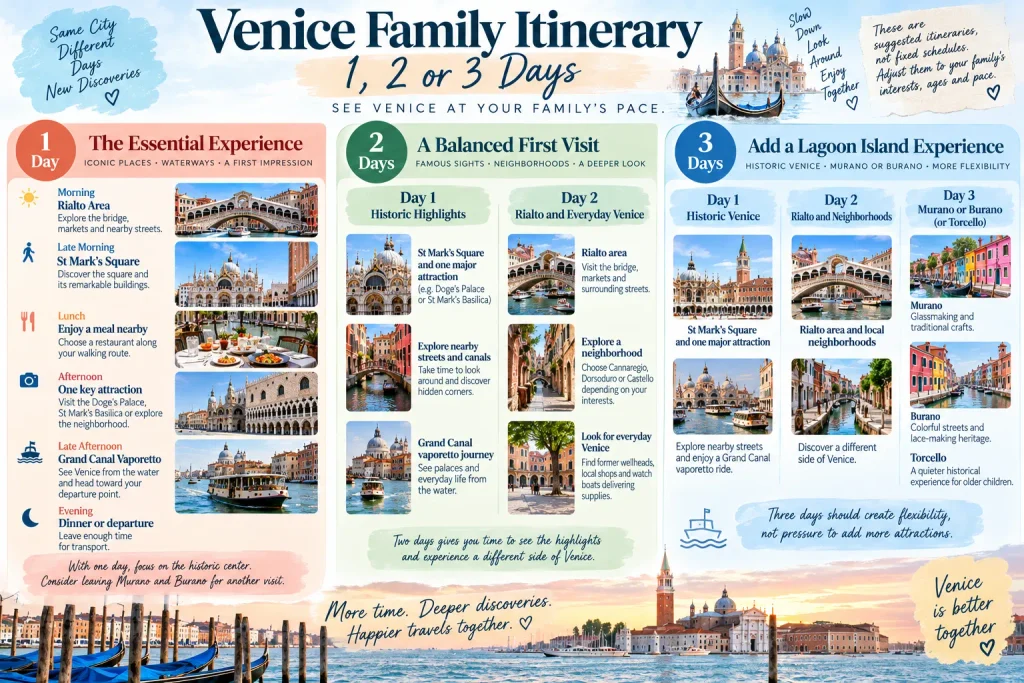
The best Venice itinerary with kids is not necessarily the one that includes the most landmarks. It is the one that allows your family to enjoy the city’s unusual layout without spending the entire visit rushing between reservations.
The following itineraries are flexible starting points rather than fixed schedules. They assume that your family can manage moderate walking distances and that transport services and attractions are operating normally. Adjust each route according to your children’s ages, accommodation, weather, mobility needs and arrival or departure times.
One Day in Venice: Focus on the Historic Center
If you have only one day in Venice, prioritize the historic center rather than trying to combine several lagoon islands with every major landmark. The journey through the city is already part of the experience, so allow time for bridges, canals and unexpected discoveries.
| Time of Day | Suggested Experience | Family Planning Note |
|---|---|---|
| Morning | Arrive and explore the Rialto area | Allow time for bridges and photographs |
| Late morning | Walk toward St Mark’s Square | Explore the streets along the way |
| Lunch | Eat near your walking route | Avoid unnecessary journeys across the city |
| Afternoon | St Mark’s Square and one chosen attraction | Keep other activities flexible |
| Late afternoon | Grand Canal vaporetto journey | Choose a route useful for your departure |
| Evening | Dinner or departure | Leave enough time for transport |
Families arriving at Venezia Santa Lucia railway station may find it convenient to walk toward Rialto and San Marco, then use a vaporetto for part of the return journey. The route can also be reversed depending on your accommodation or arrival point.
With only one day, I would normally skip Murano and Burano unless one of those islands is the main reason your family is visiting Venice. Trying to include both the historic center and several lagoon islands can turn a memorable visit into a day dominated by transportation.
A single day cannot reveal everything about Venice, but it can give children a lasting understanding of a city where waterways function as streets.
Two Days in Venice: A Balanced First Visit
Two days provides enough time to divide the city into distinct experiences without scheduling every hour.
Day 1: Famous Venice and the Grand Canal
Begin around St Mark’s Square and choose one major cultural attraction, such as the Doge’s Palace or St Mark’s Basilica, if it suits your children. Rather than booking both automatically, consider how much time your family genuinely wants to spend indoors.
After lunch, explore the surrounding streets and canals. Later, include a Grand Canal vaporetto journey and encourage children to observe the buildings and boats from the water.
Day 2: Rialto and Everyday Venice
Use the second day to explore the Rialto area and one or two neighborhoods according to your accommodation and interests. Cannaregio, Dorsoduro and Castello all offer different experiences, but there is no need to cross the entire city to visit them all.
Look for former wellheads, small bridges, local shops and boats delivering supplies. These details help children understand that Venice is a functioning city rather than an outdoor museum.
The advantage of a two-day itinerary is flexibility. If the first day becomes tiring or crowded, the second can be adjusted without losing the entire trip.
Three Days in Venice: Add the Lagoon Islands
A third day allows families to explore beyond the historic center without sacrificing the city’s major experiences.
Murano is a natural choice for children interested in glassmaking, traditional crafts or how objects are produced. Burano may appeal more to families who enjoy colorful streets, photography and lace-making heritage.
Torcello can provide a quieter historical experience for older children interested in the lagoon’s early settlements.
Visiting multiple islands is possible, but boat travel, waiting times and the distances between stops need to be considered. Check current connections through the official ACTV website before finalizing the route.
If the weather is poor or the children are tired, the third day can instead become a slower neighborhood or museum day within Venice.
Three days should create flexibility, not pressure to add more attractions.
How Much Does Venice Cost for a Family?
Venice has a reputation for being expensive, but family travel costs depend heavily on accommodation, season, transportation choices and the number of paid experiences.
Instead of giving a fixed daily budget that may quickly become outdated, it is more useful to understand which decisions have the greatest influence on spending.
| Expense | What Affects the Cost? | How Families Can Manage It |
|---|---|---|
| Accommodation | Location, season, room size and availability | Compare historic-center convenience with mainland accommodation |
| Water transport | Ticket type, number of journeys and children’s ages | Calculate expected journeys before buying a pass |
| Gondola | Official fare, duration and service conditions | Treat it as optional rather than essential |
| Museums | Admission prices, concessions and number of visits | Prioritize attractions that match children’s interests |
| Food | Restaurant location, menu and dining preferences | Review menus and prices before ordering |
| Transfers | Airport, station, luggage and hotel location | Compare the complete door-to-door journey |
A centrally located hotel may cost more per night but reduce daily transportation and walking. A vaporetto pass may be excellent value for one family and unnecessary for another.
Similarly, a gondola may be the highlight of the trip for children fascinated by traditional boats, while another family may enjoy the waterways just as much using public transportation.
The goal is not to make Venice as cheap as possible. It is to spend money on experiences that genuinely improve the family’s visit.
Is Venice Worth Visiting on a Limited Budget?
Yes. Many of Venice’s most distinctive experiences involve walking through the historic center, observing canals, crossing bridges and exploring public squares.
Families do not need to enter every palace or museum to understand the city. A carefully chosen paid attraction combined with neighborhood exploration can create a memorable visit.
The most important budget decision may be where you stay. Compare the total cost of accommodation, transport and time rather than judging hotels by their nightly rates alone.
Venice Access Fee: What Families Need to Know
Venice operates an access-fee system for certain day visitors on designated dates and during specified hours. The scheme does not apply in the same way to every visitor, and exemptions or registration requirements may apply.
Families should not assume that every visitor must pay on every day of the year.
Before traveling, check whether your visit falls within the current scheme, whether your accommodation affects the requirements and whether your children qualify for an exemption.
The official information and registration portal is Venice Access Fee.
Because applicable dates, charges and procedures can change, verify the rules for your actual travel date. Families staying outside Venice’s historic center and visiting for the day should pay particular attention to the requirements.
Eating in Venice with Kids
Food is an important part of experiencing Venice, but restaurant choice can influence both the family budget and the pace of the day.
Rather than searching only for restaurants described as family-friendly, consider what your children actually need: suitable food, manageable waiting times, comfortable seating and a location that does not require a long walk when everyone is already hungry.
Venetian food traditions also provide an opportunity to introduce children to the relationship between geography and cuisine.
What Are Cicchetti?
Cicchetti are small food preparations associated with Venetian bars, often known as bacari. They can feature different ingredients and are commonly enjoyed as part of the city’s local food culture.
For families, the small-portion format may make it easier for children to try unfamiliar foods. However, not every bacaro has the same atmosphere, menu or seating arrangements.
Some are more suitable for a quick stop than a relaxed meal with young children. Choose an establishment according to your family’s needs rather than assuming every cicchetti experience is identical.
What Should Children Try in Venice?
Instead of creating a rigid list of dishes every child must eat, encourage children to notice how Venetian cuisine differs from food elsewhere in Italy.
Venice’s relationship with the lagoon and maritime trade influenced its food traditions. Seafood, rice dishes and regional preparations can provide a contrast with foods families may encounter in Rome, Florence or Bologna.
A simple activity is to let each child choose one unfamiliar dish and investigate its ingredients. Where do they come from? Is the dish associated with Venice or the wider Veneto region? How is it different from something the child already knows?
Children do not need to enjoy every new food for the experience to be worthwhile.
For food allergies or dietary restrictions, confirm ingredients and preparation directly with the restaurant.
Avoid Restaurant Surprises
Restaurants around Venice’s busiest tourist areas can vary considerably in price and style.
Review menus before ordering and check whether any cover or service charges are disclosed. If the family is particularly hungry or tired, choosing a convenient restaurant with a suitable menu may be more valuable than walking another thirty minutes to reach a famous recommendation.
Food should help the family recover between activities, not become another exhausting task.
Is Venice Safe for Children?
Venice is a living city with the usual considerations of a busy tourist destination, but its waterways create additional safety concerns.
Many canal edges have no continuous protective barrier. Families with younger children should remain particularly attentive near water, on bridges and while boarding boats.
The aim is not to make children afraid of Venice. It is to establish sensible safety rules before exploring.
Water Safety Around Canals
Venice’s canals are working waterways, not swimming areas.
Young children should remain under close adult supervision near unprotected canal edges. Families should follow operator instructions when boarding vaporetti, gondolas or other boats.
Children should not climb railings, lean dangerously over canal edges or run ahead in unfamiliar waterside areas.
Crowds and Busy Bridges
Rialto Bridge, St Mark’s Square and major transport stops can become crowded.
Agree on simple family procedures before entering busy areas. Older children should know what to do if separated from the group, while younger children need closer supervision.
Keep important belongings secure and allow enough time for boarding and transfers without rushing.
Getting Lost in Venice
Venice’s irregular street network can make navigation confusing even for adults.
Getting slightly lost can be enjoyable when the family has time to explore, but it becomes stressful when children are exhausted or a timed transport connection is approaching.
Save your accommodation address, identify nearby transport stops and leave extra time for important journeys.
Wandering is part of Venice’s appeal. Missing the last convenient connection to your accommodation is not.
What Should Families Pack for Venice?
Venice’s walking conditions make practical footwear particularly important. Children may spend hours crossing bridges and walking on stone surfaces, so comfortable shoes should take priority over fashionable sightseeing footwear.
A compact day bag can carry water, snacks, weather-appropriate clothing and other essentials without making every bridge crossing more difficult.
Families with younger children should consider stroller weight and portability carefully. A lightweight stroller may be easier to manage on stepped bridges, although individual mobility needs vary.
Packing should also reflect the season. Waterproof clothing may be useful in wet conditions, while sun protection and water become especially important during hot weather.
Avoid packing for an imaginary perfect day. Pack for the conditions your family is actually likely to encounter.
When Is the Best Time to Visit Venice with Kids?
The best season depends on your family’s priorities and tolerance for crowds, heat, cold and changing weather.
Spring: Comfortable Walking with Variable Crowds
Spring can offer pleasant conditions for exploring Venice on foot, although rain and temperature changes remain possible.
Popular holiday periods can still be busy, so do not assume spring guarantees empty streets or inexpensive accommodation.
Summer: Long Days but More Heat
Summer provides long daylight hours and opportunities for extended evening exploration, but heat and visitor numbers can make the historic center tiring.
Families may benefit from scheduling major attractions earlier, taking proper breaks and allowing more flexible afternoons.
Autumn: A Different Atmosphere
Autumn can be appealing for walking and cultural attractions, but rain and changing conditions need to be considered.
Venice’s high-water events are influenced by tides and meteorological conditions rather than a simple rule that the city floods throughout one particular season.
Winter: Quieter Periods and Special Events
Winter brings shorter daylight hours and potentially cold, damp conditions.
Venice Carnival can also change the atmosphere significantly during its scheduled period, increasing visitor numbers and accommodation demand.
Check the current event calendar and travel conditions rather than assuming every winter week will be quiet.
Venice Water Detective: A Simple Family Activity
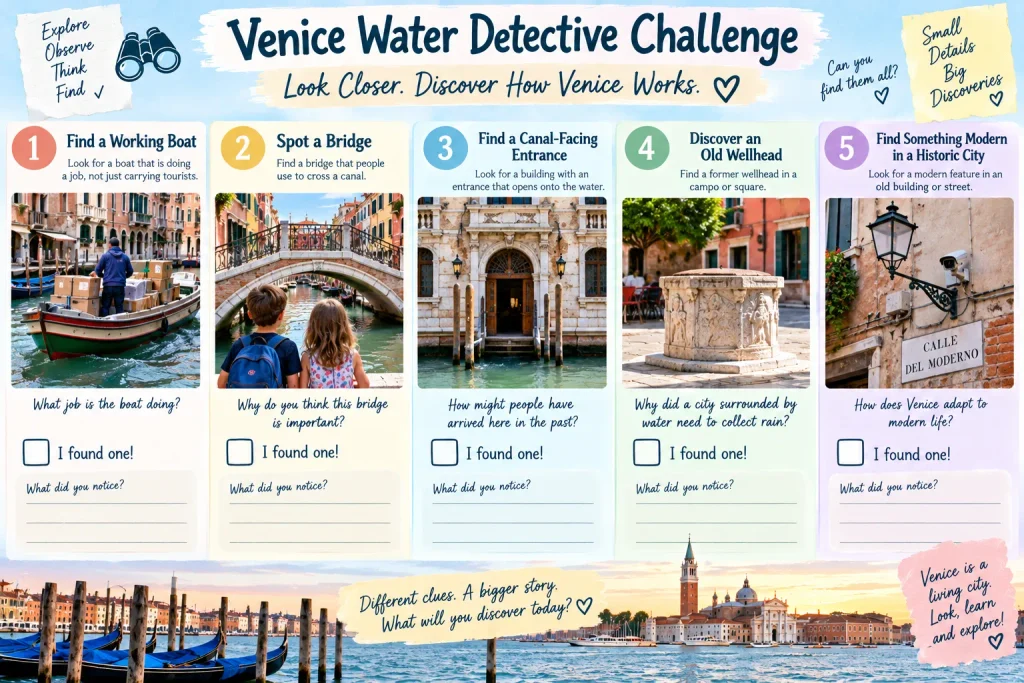
Venice becomes much more interesting when children understand that its canals, bridges and public spaces solve real problems.
During one walk, invite children to find five clues about how the city works.
| Mission | What to Find | Question to Ask |
|---|---|---|
| 1 | A boat delivering goods or providing a service | What vehicle would do this job at home? |
| 2 | A bridge connecting pedestrian routes | Why is this bridge necessary? |
| 3 | A building entrance facing a canal | How might people have arrived here in the past? |
| 4 | A former wellhead in a campo | Why did a city surrounded by water need to collect rain? |
| 5 | A modern feature in an old building or street | How does Venice adapt to modern life? |
The activity does not need to be completed in one afternoon. Children may find only two clues before becoming interested in something else.
That is perfectly fine.
The goal is to encourage observation, not complete a worksheet.
For a deeper explanation of the lagoon, foundations, canals and engineering, our companion article Why Is Venice Built on Water? The Floating City Explained for Kids explores the questions children are likely to ask while visiting.
Common Mistakes Families Make in Venice
Trying to Complete Venice in a Few Hours
A short visit can be worthwhile, but attempting every famous landmark leaves little time to understand the city.
Booking Accommodation Without Checking the Route
A hotel may look close to a station or attraction while requiring several bridge crossings with luggage.
Treating Every Boat as a Tourist Attraction
Venice has a working transportation system. Water buses and service boats are part of everyday life.
Visiting Too Many Lagoon Islands in One Day
Murano, Burano and Torcello require transportation and waiting time. Choose according to interests rather than treating them as compulsory stops.
Scheduling Too Many Museums and Palaces
Children often enjoy Venice more when cultural attractions are balanced with outdoor exploration.
Assuming Venice Is Easy with a Stroller
The exact route matters because many bridges have steps.
Buying Transport Passes Without Calculating Usage
Compare current ticket products with the journeys your family actually expects to make.
Ignoring Residential Life
Venice is home to residents. Respect private property, residential doorways and neighborhood spaces.
Forgetting the Access-Fee Rules
Check official requirements for your travel date and visitor category.
Leaving No Time for Breaks
An unplanned hour in a quiet campo may improve the trip more than another famous attraction.
FAQ: Venice with Kids
Is Venice worth visiting with children?
Yes. Venice offers an unusual environment where canals, bridges, boats and historic buildings create opportunities for discovery. The main challenges are walking, transportation, crowds and choosing attractions that suit the children’s ages.
How many days should you spend in Venice with kids?
Two full days is a useful starting point for many families. Three days allows more time for lagoon islands and slower exploration, while one day can provide a memorable introduction if the itinerary remains focused.
Is Venice stroller-friendly?
Venice can be challenging with a stroller because many bridges have steps. Some accessible routes and transport options exist, but families should check their exact itinerary rather than assuming every part of the city is equally accessible.
Is a gondola ride worth it with kids?
It depends on the family’s budget and interests. A gondola can provide a memorable traditional boat experience, but families can also enjoy Venice’s waterways through public transportation and walking.
Should families visit Murano or Burano?
Murano is especially appealing for children interested in glassmaking and traditional crafts. Burano offers colorful streets and lace-making heritage. The better choice depends on the family’s interests and available time.
Can you visit Venice without staying overnight?
Yes. Venice can be visited as a day trip, but transportation, walking and crowds reduce the usable time. Families should choose a limited number of priorities and check any applicable access-fee requirements.
Is Venice expensive for families?
Costs vary by season, accommodation, transport choices and paid attractions. Families can manage spending by choosing accommodation carefully, comparing transport tickets and prioritizing experiences rather than attempting every famous attraction.
Do children need to pay the Venice access fee?
Children below the applicable age threshold may qualify for an exemption, but families should check the current rules and any registration requirements through the official access-fee portal.
Can children swim in Venice’s canals?
No. Venice’s canals are working waterways and are not appropriate swimming areas. Families should follow local rules and supervise children carefully near canal edges.
Is Venice better than Rome for kids?
Neither city is universally better. Rome offers monumental ancient history, archaeology and museums, while Venice provides a uniquely water-based urban environment. The better destination depends on children’s interests and the wider Italy itinerary.
Final Thoughts: Let Venice Be Different
Venice can be challenging to plan because it does not behave like a conventional city. Distances are deceptive, bridges interrupt walking routes, boats replace many road vehicles, and even reaching accommodation can become an adventure.
But those differences are also what make Venice extraordinary for children.
A family does not need to complete every major attraction to understand the city. Watching a delivery boat, crossing a small bridge, finding a former wellhead or noticing a canal-side entrance can reveal something important about how Venetians adapted to their environment.
Choose a few meaningful experiences. Give the family enough time to walk without rushing. Use the waterways as part of the journey, and allow children to ask questions about what they see.
If they become tired of palaces, explore a quieter neighborhood. If they are fascinated by boats, spend more time observing the canals. If they enjoy making things, consider Murano. If they want to understand the lagoon, investigate the city’s foundations and water systems.
The best Venice family trip is not the one that includes the most landmarks. It is the one that helps children understand why Venice developed in this extraordinary place.
Continue Exploring Italy with Kids
15 Best Places to Visit in Italy with Kids
Still deciding where Venice belongs in your family trip? Read 15 Best Places to Visit in Italy with Kids: Which Destination Is Right for Your Family? to compare Venice with Rome, Florence, Lake Garda, the Dolomites and other Italian destinations.
Italy Family Itinerary: 7 Days, 10 Days & 2 Weeks
Venice is often part of a longer family trip through Italy. Our Italy Family Itinerary: 7 Days, 10 Days & 2 Weeks with Kids helps you connect Venice with Rome, Florence, Lake Garda, the Dolomites and other destinations without spending too much of your vacation changing hotels or traveling between cities.
The guide includes realistic route options for families interested in classic Italian cities, northern lakes and mountains, or slower regional exploration.
Rome with Kids: A Family Guide to Italy’s Eternal City
If your family is also visiting Rome, explore our Rome with Kids: A Family Guide to Italy’s Eternal City for practical advice on choosing attractions, planning sightseeing days and helping children understand ancient Roman history.
Rome and Venice offer very different experiences. Rome reveals the layers of an ancient capital, while Venice shows how a city can develop around waterways instead of conventional roads. Visiting both can give children two contrasting perspectives on Italian history and urban life.
Why Is Venice Built on Water? The Floating City Explained for Kids
For children who want to know why Venice has canals, how its buildings remain standing and where residents once obtained drinking water, our companion article Why Is Venice Built on Water? The Floating City Explained for Kids explores the engineering, geography and history behind the lagoon city.
It also includes a Venice Water Detective Challenge, encouraging children to investigate bridges, boats, former wells and other clues while exploring the historic center.