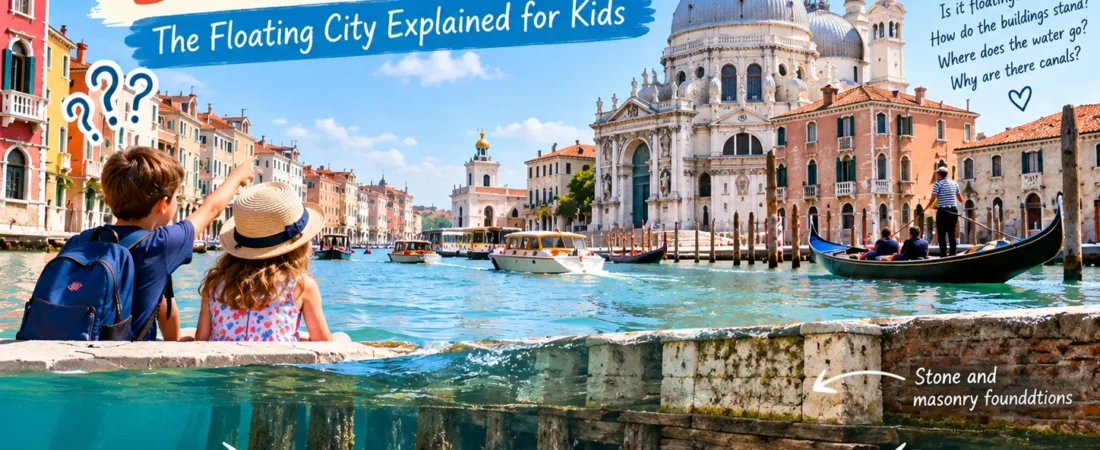
Why is Venice built on water? The answer begins with a group of small islands in a shallow coastal lagoon, where people gradually developed settlements that would become one of Europe’s most remarkable cities.
Venice was not originally designed as a floating city. Its early communities adapted to the landscape around them, building on islands, strengthening unstable ground and using waterways as essential transportation routes. Over centuries, these settlements grew into a powerful maritime republic whose buildings, bridges and canals still fascinate visitors today.
For children, Venice raises questions that seem almost impossible at first. How can heavy stone buildings stand on muddy ground? Why are there canals instead of ordinary roads? Why do wooden foundations survive beneath buildings that are hundreds of years old?
These are not simply questions about architecture. They connect geography, engineering, history and the practical decisions people make when building a city in an unusual environment.
Understanding Venice begins with one important distinction: Venice is not floating on the water. It is built on islands within a lagoon.
Is Venice Really Floating?
Despite its famous nickname, Venice is not a floating city in the literal sense.
Its buildings do not float like boats or rest on giant platforms moving with the tides. They stand on foundations supported by the ground beneath the lagoon, with historic construction methods designed to deal with soft, waterlogged conditions.
The illusion comes from the way buildings rise directly beside canals. From a boat, the stone walls can appear to emerge from the water, sometimes with no visible pavement or shoreline separating the two.
For children, a useful comparison is a house built beside a river. The building may stand close to the water, but it still needs a foundation connected to the ground.
Venice takes that principle much further because so much of its historic urban landscape developed across small islands and waterways.
What Is a Lagoon?
A lagoon is a shallow body of coastal water separated from the open sea by natural barriers such as barrier islands or sand formations, while remaining connected to the sea through inlets.
The Venetian Lagoon lies along the northern Adriatic coast. It contains islands, tidal channels, shallow waters, mudflats and areas of marshland.
This environment is very different from building on a large area of firm, dry land.
The distinction matters because Venice’s geography shaped almost every major decision in its development.
Where could people build? How could they travel? How would goods arrive? How could buildings remain stable? Where would residents find freshwater?
The lagoon created difficulties, but it also offered opportunities.
Why Did People Settle in the Venetian Lagoon?
The story of Venice’s origins is often simplified into a dramatic account of refugees escaping invaders and building a city in the water.
There is truth behind parts of that tradition, but the historical development was more gradual and complicated.
Communities lived and worked around the lagoon before Venice became a major city. Fishing, salt production, trade and other activities connected people to the coastal environment.
During the late Roman period and early Middle Ages, political instability, warfare and changing conditions on the mainland contributed to shifts in settlement patterns. Some people moved toward lagoon communities, while existing settlements continued developing.
Over time, these communities became increasingly connected through trade, political institutions and maritime activity.
Did People Move to Venice to Escape Invaders?
Invasions and insecurity on the mainland were important parts of the historical background, especially during the centuries following the decline of Roman authority in the western empire.
However, it would be misleading to suggest that everyone fled to the lagoon on one particular day and immediately began constructing Venice.
The lagoon’s settlements developed across generations. Different islands and communities had different histories, and the emergence of Venice as a political and commercial center took centuries.
For children, this is an opportunity to distinguish between a memorable origin story and the more complicated process historians reconstruct from archaeological and written evidence.
A city rarely begins with a single decision.
More often, it grows because many people make practical choices over a long period.
Why Was the Lagoon a Useful Place to Live?
At first, a muddy coastal lagoon might seem like a terrible place to build a city.
There was limited firm ground, access could be difficult, and freshwater required careful management.
But the lagoon also provided access to fishing, salt production and maritime trade. Its channels and shallow waters created a distinctive environment that could make access difficult for unfamiliar large land-based forces.
As maritime activity expanded, the location helped connect communities with the Adriatic and wider Mediterranean trading world.
The same geography that complicated construction eventually became part of Venice’s economic strength.
How Did Small Islands Become the City of Venice?
Venice did not begin as one continuous piece of land.
Its historic center developed across numerous islands separated by waterways. Some areas were naturally more suitable for settlement than others, and the landscape changed through construction, reclamation and modifications to channels and shorelines.
Over time, buildings, pedestrian routes, bridges and public spaces created a more connected urban environment.
This is why Venice can feel like a maze to modern visitors. Its layout was not created as a regular grid of streets designed around cars.
It evolved around existing islands, waterways, historic routes and centuries of urban development.
Why Are There So Many Bridges?
Bridges allow people to cross the canals separating parts of the city.
That sounds obvious, but it reveals an important feature of Venice’s development. Waterways were not simply obstacles to movement; they were also transportation routes.
A canal could connect buildings by boat while separating them for pedestrians.
Bridges made it possible to develop walking routes across the islands without eliminating the waterways that supported commerce and everyday life.
The historic center now contains hundreds of bridges, ranging from major crossings over the Grand Canal to small neighborhood bridges.
When visiting Venice with children, ask them to compare two bridges. Do they have the same width, steps, railings and shape? What kind of pedestrian traffic does each bridge serve?
Children begin to understand that bridges are practical infrastructure, not merely picturesque landmarks.
Why Didn’t Venetians Fill in All the Canals?
Filling every canal would have changed the transportation system around which Venice developed.
Historically, waterways provided essential access for people and goods. Buildings could face canals because arriving by boat was an important part of urban life.
Canals also form part of the lagoon’s interconnected tidal water system.
Some Venetian waterways were modified or filled over time, and certain streets preserve evidence of former canals. However, Venice never became a conventional road-based city.
Its canals remained central to its urban structure and identity.
This helps explain why a narrow canal can be just as important to understanding Venice as a famous bridge or palace.
How Were Venice’s Buildings Constructed on Soft Ground?
The most famous engineering question about Venice concerns its foundations.
Many historic Venetian buildings stand on ground containing soft, waterlogged sediments. Such conditions create difficulties because heavy structures can settle unevenly if their foundations do not distribute loads adequately.
Venetian builders developed foundation techniques suited to these conditions, including the use of closely spaced wooden piles beneath important structures.
The precise construction method varied depending on the building, location, period and ground conditions. Not every building in Venice has an identical foundation.
Nevertheless, timber-supported foundations became one of the defining features of the city’s historic construction.
Why Did Venetians Use Wooden Piles?
Wooden piles helped builders support structures on difficult ground.
In traditional Venetian construction, timber elements could be driven into the underlying sediments to strengthen the foundation system and help distribute the weight of buildings.
The piles worked together with the surrounding soil and the structural layers above them. Their effectiveness depended on the ground conditions and the design of the foundation.
It is tempting to imagine every Venetian building standing on enormous wooden poles reaching all the way down to solid bedrock.
That is not an accurate general description.
Foundation depths and arrangements varied, and many piles relied on interaction with the surrounding sediments rather than functioning as isolated columns resting on deep rock.
For children, a simple comparison is trying to stand a heavy object on soft mud. A small point of contact may sink or shift, while a carefully designed supporting structure can spread the load and improve stability.
Venetian builders had to solve a much more complicated version of that problem.
What Is Beneath a Venetian Building?
A simplified historic foundation arrangement might include several elements:
- Lagoon sediments: The natural ground beneath the building.
- Wooden piles: Timber driven into the ground where the foundation design required them.
- Timber foundation elements: Structural layers helping distribute loads above the piles.
- Stone and masonry foundations: Materials providing a supporting base for the walls.
- The building itself: Brick, stone and other construction materials forming the structure above.
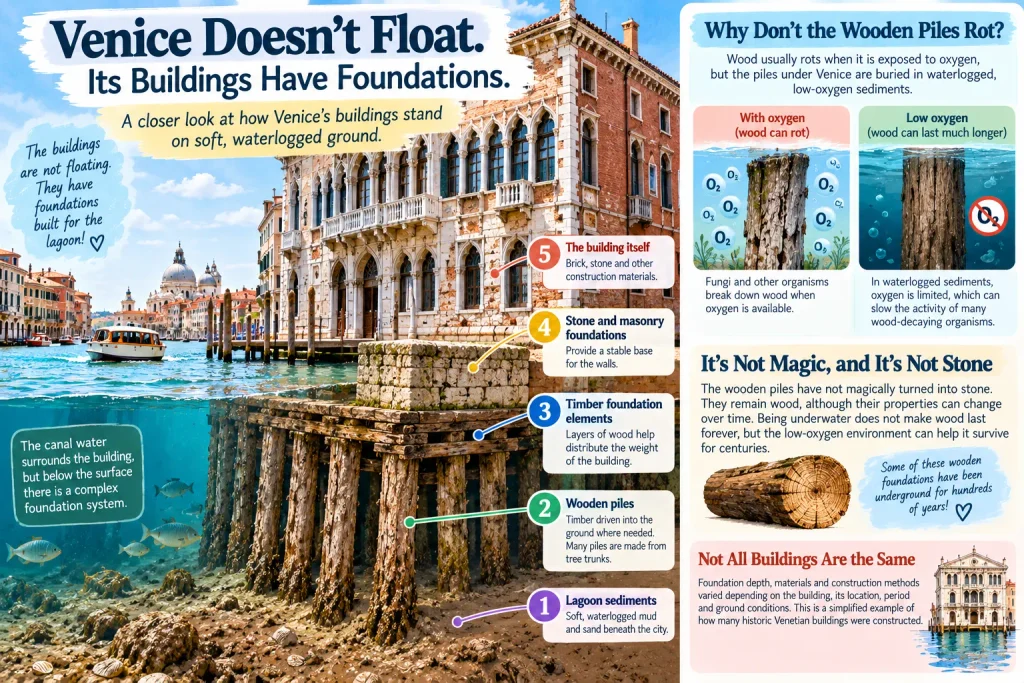
This is a simplified explanation, not a universal cross-section of every Venetian building.
The important engineering principle is that the foundation must transfer the building’s weight into the ground while limiting damaging settlement.
A large palace, small house and historic church may require different structural solutions.
What Kind of Wood Did Venetians Use?
Historical Venetian foundations used several types of timber, with species and availability varying across construction periods and projects.
Timber could be transported from mainland forests and other supplying regions through the commercial networks available to Venice.
Wood was a practical material because it could be shaped into piles and driven into suitable ground.
But the surprising part of the story is not simply that Venetians used wood.
It is that some of this timber has survived for centuries beneath heavy masonry buildings.
That leads to another question children almost always ask.
Why Doesn’t the Wood Under Venice Rot Away?
Wood can decay when fungi and other organisms break down its structure.
In ordinary conditions, moisture combined with oxygen and suitable temperatures can encourage biological deterioration. This is why wooden structures exposed to alternating wet and dry conditions may require considerable maintenance.
However, timber permanently embedded in waterlogged, low-oxygen sediments can behave differently.
When oxygen availability is limited, the activity of many wood-decaying organisms is restricted. This can allow buried timber to survive for remarkably long periods.
That helps explain the preservation of some historic Venetian foundation piles.
Does Being Underwater Make Wood Last Forever?
No. This is an important misconception to avoid.
Waterlogged conditions do not make wood indestructible. Certain microorganisms can degrade submerged timber, and changes in environmental conditions can affect its preservation.
The durability of historic foundations depends on several interacting factors, including oxygen availability, microbial activity, water conditions, surrounding sediments and structural loads.
Some historic timber has survived exceptionally well, while other foundation materials can deteriorate and require investigation or intervention.
So the accurate explanation is not that water magically turns wood into stone.
It is that particular underground conditions can greatly slow some forms of wood decay.
Did Venetian Wood Turn into Stone?
A popular explanation sometimes claims that Venice’s wooden piles became petrified over time.
That is misleading.
Petrification is a geological process in which original organic material may be replaced or filled by minerals under particular conditions. The ordinary survival of Venetian timber foundations should not be described as wood turning into solid stone.
Mineral interactions and changes in timber properties may occur, but the central explanation for the preservation of many historic piles is their environmental setting.
For children, this distinction is useful because it separates two very different ideas: preserving a material and replacing it with another material.
How Can Venice Support Such Heavy Buildings?
Once children understand that buildings have foundations, another question appears.
How can those foundations support enormous churches and palaces?
The answer involves more than wooden piles.
Venetian construction developed through generations of practical experience with building materials, foundation systems, structural loads and the behavior of the lagoon’s ground.
Brick was widely used in Venetian buildings, often combined with stone elements in important structural and decorative locations. The weight of the building had to be transferred through walls and foundations into the supporting ground.
Builders also needed to consider settlement, because uneven movement can damage masonry structures.
Venice’s historic buildings have survived through a combination of original engineering, later modifications, repairs and ongoing conservation.
Their continued existence should not be interpreted as proof that the structures never move or deteriorate.
Why Do Some Venetian Buildings Lean?
Buildings can lean when different parts of their foundations settle by different amounts or when structural and ground conditions change over time.
Venice has examples of visibly leaning historic structures, including bell towers.
However, it would be incorrect to assume that every leaning building has the same cause or that all such structures are necessarily in immediate danger.
The stability of an individual building requires specific engineering assessment.
For children, the useful concept is differential settlement: one part of a structure moves differently from another.
Imagine placing a heavy object on unevenly compressed ground. If one side settles more than the other, the object may tilt.
Historic masonry buildings can experience much more complicated versions of that process.
Did Venice’s Builders Know Modern Engineering?
Venetian builders did not possess modern geotechnical engineering theories, computerized structural models or today’s laboratory testing methods.
They developed techniques through accumulated experience, observation, craft knowledge and adaptation.
Successful methods could be repeated and refined, while failures and repairs also contributed to understanding.
This does not mean that every historic construction technique was perfect. Buildings required maintenance, and some structures suffered damage, alteration or collapse.
What makes Venice remarkable is the long history of people developing practical solutions for difficult environmental conditions.
The city demonstrates that sophisticated engineering can emerge through generations of experience, even without modern scientific instruments.
Why Did Venice Become So Powerful?
By the Middle Ages, Venice had developed into a major maritime and commercial power.
Its position in the northern Adriatic helped connect it with trading networks extending across the Mediterranean and beyond.
Venetian merchants transported goods, established commercial relationships and participated in complex political and economic systems.
The city also developed important shipbuilding capabilities, including the famous Venetian Arsenal, which became a major center of naval construction and organization.
Over time, Venice expanded its influence across parts of the Adriatic and eastern Mediterranean.
Its history also included warfare, conquest, competition and unequal political relationships. Maritime wealth was not simply the result of peaceful trading activity.
For children, the key connection is between geography and opportunity.
A place that initially seemed difficult for building could become advantageous for people skilled at using waterways and maritime connections.
Why Were Boats So Important to Venice?
Boats were essential for transportation, commerce and communication.
In a city organized around waterways, boats could bring goods directly toward buildings and commercial areas. Maritime vessels also connected Venice with distant ports and trading partners.
This relationship shaped the city’s architecture.
Some historic palaces have prominent canal-facing façades because approaching from the water was an important part of their original function.
A building that appears unusual from a pedestrian street may make much more sense when viewed from a boat.
That is why understanding Venice from the water is not simply a sightseeing activity.
It helps explain how the city was designed to function.
What Makes Venice Different from Other Historic Italian Cities?
Rome, Florence and Venice all preserve extraordinary architectural and historical heritage, but their urban environments developed in different ways.
Rome grew around the ancient capital of a vast empire and continued changing through medieval, Renaissance, Baroque and modern periods.
Florence became a major center of commerce, banking, politics and Renaissance culture within the landscape of Tuscany.
Venice developed in a coastal lagoon where waterways shaped transportation, construction, trade and everyday life.
These differences matter for families because they create different questions.
In Rome, children may ask how ancient engineers constructed the Colosseum.
In Florence, they may wonder how Brunelleschi built the cathedral dome.
In Venice, they ask why the buildings do not sink and how a city functions without ordinary roads through its historic center.
Each question opens a different part of Italian history.
If you are deciding which destinations belong in your family trip, our 15 Best Places to Visit in Italy with Kids compares Italy’s major cities, lakes, mountains, islands and coastal regions.
The Biggest Lesson from Venice’s Foundations
Venice’s buildings reveal something larger than an unusual construction technique.
People do not always reshape the environment completely before settling somewhere. Sometimes they develop ways of living and building that respond to the conditions already present.
The lagoon made construction difficult, but it also influenced the city’s transportation, economy and political development.
Wooden piles, masonry foundations, bridges and canals were parts of a broader process of adapting to the environment.
For children, that is a valuable engineering lesson: the best solution to a problem often depends on understanding the place where the problem occurs.
Venice was not built by ignoring the water.
It developed because generations of Venetians learned how to live and build within a lagoon environment.
For families planning to explore the city in person, our Venice with Kids: A Practical Family Guide to the Floating City covers where to stay, how to get around, family-friendly attractions and realistic itineraries.
That achievement also created challenges that continue today. Understanding Venice’s remarkable foundations is only the beginning of its story. The city’s freshwater supply, canal-based transportation, seasonal flooding and modern flood-protection systems reveal how generations of Venetians have continued adapting to life in the lagoon—and why protecting Venice remains an ongoing engineering challenge.
How Did Venetians Get Fresh Drinking Water?
One of the most surprising things about Venice is that a city surrounded by water once had to work extremely hard to obtain enough water for drinking.
The Venetian Lagoon contains brackish water, a mixture influenced by seawater and freshwater. Although the canals may look like an endless supply, their water is not suitable for ordinary drinking.
For centuries, Venetians therefore needed ways to collect, store and distribute freshwater without relying on the modern water infrastructure that serves the city today.
Their solution was ingenious: they turned parts of the city itself into rainwater collection systems.
The Hidden Cisterns Beneath Venetian Squares
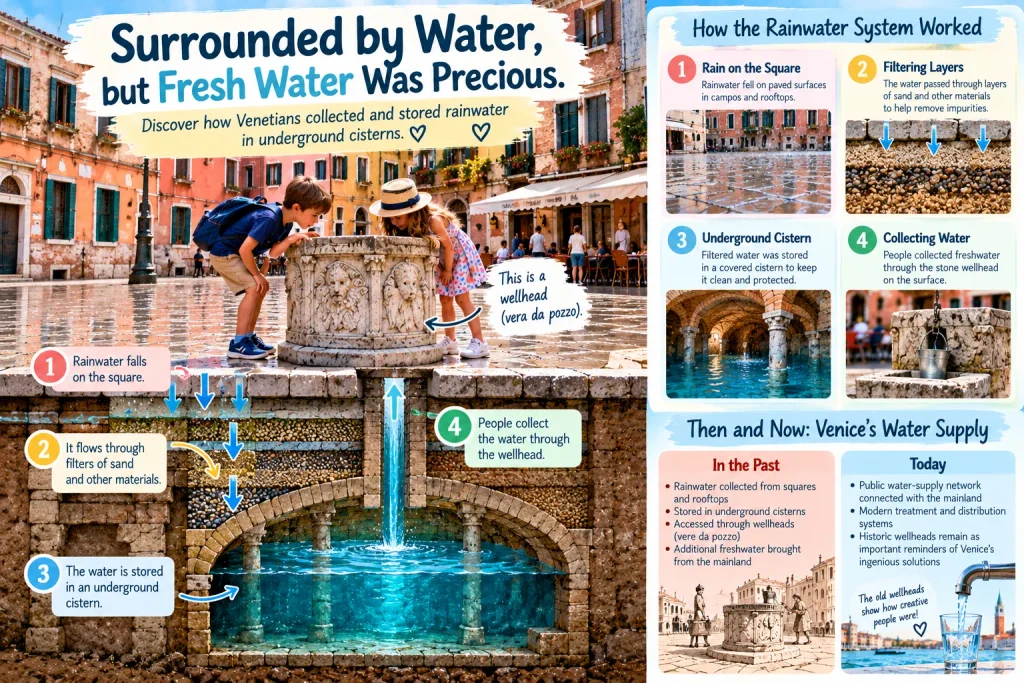
Walk through Venice with children and you may notice a stone structure in the middle of a small square. It looks like a traditional well, sometimes decorated with carvings or symbols.
These structures are known as vere da pozzo, or wellheads.
Many were connected to underground rainwater cisterns rather than conventional wells drawing directly from a freshwater aquifer.
Traditional Venetian systems collected rainwater from surrounding paved surfaces and directed it into underground filtering and storage arrangements. Sand and other materials helped filter the water before it accumulated in a protected reservoir.
The visible wellhead provided access to the stored water.
This means that an ordinary-looking Venetian square could also function as part of the city’s freshwater infrastructure.
For children, the discovery changes the meaning of the entire space. What looks like a decorative stone object may be evidence of a system designed to help a community survive.
Why Couldn’t Venetians Simply Dig a Normal Well?
In many towns, digging a well provides access to groundwater. Venice’s lagoon environment created a more complicated situation because the surrounding water and shallow ground conditions did not provide a simple, dependable source of potable freshwater.
Collecting rainfall offered an alternative.
The systems required suitable construction, maintenance and protection from contamination. They were not perfect, and Venice also obtained freshwater through other means, including supplies transported from the mainland.
The important lesson is that having water everywhere does not mean having drinking water everywhere.
This is a useful concept far beyond Venice. Coastal communities, islands and regions with limited freshwater resources have developed many different solutions to the same problem.
Where Does Venice Get Drinking Water Today?
Modern Venice uses a public water-supply network connected with mainland infrastructure. Residents no longer depend on historic square cisterns as their ordinary source of drinking water.
The old wellheads remain valuable reminders of how earlier generations managed an essential resource.
Families can consult Veritas, the local utility provider, for current information about water services and quality.
A question for kids: If you had to design a city surrounded by saltwater, how would you make sure everyone had enough freshwater?
Let children suggest solutions before explaining the historical system. Rainwater collection, storage tanks, transporting water and modern treatment technologies may all enter the discussion.
Why Does Venice Have Canals Instead of Ordinary Roads?
The canals of Venice are not simply scenic features added to make the city attractive.
They developed as essential transportation routes in an urban environment spread across lagoon islands.
Historically, boats moved people, food, building materials and commercial goods through the city. Water access could be as important to a building as street access is in many modern cities.
Venice also has an extensive pedestrian network, but its streets and canals developed together rather than following the road-based layout familiar to visitors from other cities.
Understanding that relationship makes the historic center easier to interpret.
The Grand Canal Is More Than a Beautiful Waterway
The Grand Canal curves through the historic center and has long served as one of Venice’s principal urban routes.
Many important buildings face the canal because arriving by water was historically significant. Their elaborate façades were designed to be seen from boats as well as from nearby public spaces.
Today, water buses, taxis, service boats and other vessels continue using Venice’s waterways.
For children, a Grand Canal journey can become a lesson in how geography influences city planning.
Ask them to imagine replacing the canal with a road. Which vehicles would be needed to perform the jobs they can see happening on the water?
The exercise helps children understand that transportation systems can look very different while serving similar purposes.
How Do Deliveries Work Without Trucks?
Venice’s historic center still needs food, furniture, construction materials and everyday supplies.
Goods can arrive through road and rail connections at the edges of the historic city before being transferred through its pedestrian and water-transport networks.
Boats and handcarts play important roles in moving supplies to their destinations.
This makes ordinary activities more complicated than they may appear in a road-based city.
A restaurant still needs ingredients. A hotel still needs clean linen. A shop still needs deliveries, and historic buildings still require maintenance.
Children watching a delivery boat are observing part of Venice’s modern infrastructure.
How Do Ambulances and Emergency Services Work?
Venice requires emergency services adapted to its unusual geography.
Specialized boats form part of the city’s emergency-response arrangements, while land-based access and pedestrian movement remain important in appropriate areas.
This is another reason not to describe Venice as an outdoor museum. It is a functioning city where residents need medical care, fire protection, utilities and other essential services.
Ask children how emergency responders might reach a building with an entrance facing a narrow canal.
The answer depends on the location, but the question encourages them to think beyond tourist transportation.
Why Are Venice’s Buildings So Close to the Water?
In many cities, roads and pavements separate buildings from rivers or canals.
Venice developed differently because water access was historically central to transportation and commerce.
Some palaces and other buildings have entrances facing canals, reflecting the importance of arriving by boat. Other buildings are organized around pedestrian streets, courtyards or public squares.
This relationship between architecture and water is one of the most distinctive features of the historic center.
Why Do Some Buildings Have Doors Facing Canals?
A water-facing entrance could provide access for people or goods arriving by boat.
For merchants and wealthy households, proximity to an important waterway could be particularly valuable.
The design of a building therefore reflected how its occupants expected to move through the city.
A palace that appears difficult to approach from a narrow pedestrian street may make much more sense when viewed from the canal.
This is why a vaporetto journey can reveal architectural details that are difficult to appreciate from land.
Are Venice’s Canals Natural or Artificial?
The answer is a mixture of natural geography and human intervention.
The lagoon contained natural channels and waterways long before the historic city reached its present form. Over centuries, people modified, maintained and reorganized parts of this environment through construction and hydraulic works.
Some canals were altered, while certain waterways were filled to create pedestrian routes.
The result is not an entirely natural landscape or a completely artificial system created in one project.
Venice developed through a long interaction between human engineering and the lagoon environment.
Why Does Venice Sometimes Flood?
Venice’s relationship with water brings another challenge: the level of the lagoon changes.
Tides, weather conditions and broader changes in relative sea level influence the height of water around the city.
When unusually high water levels affect low-lying urban areas, flooding can occur.
Venetians commonly use the expression acqua alta, meaning high water, to describe these events.
However, Venice does not flood continuously, and not every high tide produces significant flooding in the historic center.
What Causes Acqua Alta?
High-water events can result from several interacting factors.
Astronomical tides influence the regular rise and fall of sea levels. Weather conditions, including winds and atmospheric pressure, can raise water levels further.
When these effects combine, lagoon water may reach unusually high levels.
Some low-lying areas are affected before others. Piazza San Marco is particularly well known for its vulnerability to high water.
For children, this can be explained through a simple observation: if the water level rises while the ground remains at the same height, places closest to the water surface are affected first.
The actual situation is more complex because local elevation, weather and water movement all matter.
Does Venice Flood Every Day?
No.
Ordinary tidal changes are part of the lagoon’s natural behavior, but they do not mean that the city’s streets are continuously underwater.
The frequency, extent and severity of flooding vary according to conditions.
Visitors should check current forecasts and local guidance rather than relying on dramatic photographs that may show exceptional events.
The City of Venice provides access to municipal information, including resources related to high-water conditions.
What Happened During the Great Flood of 1966?
On 4 November 1966, Venice experienced one of the most severe high-water events in its modern recorded history.
The water level reached approximately 194 centimeters above the local reference datum used for Venice’s tide measurements.
The event caused extensive flooding and damage, drawing international attention to the vulnerability of the city’s historic heritage.
It became an important reference point in discussions about protecting Venice from future high-water events.
For older children, the flood provides an example of how a natural event can influence public policy, engineering decisions and conservation priorities for decades.
Is Venice Really Sinking?
The phrase “Venice is sinking” contains an element of truth, but it is too simple to explain the city’s long-term challenges.
Venice is affected by changes in the elevation of land relative to the surrounding water.
Two processes are particularly important: land subsidence and sea-level rise.
Subsidence means that the land surface moves downward relative to a reference level. Sea-level rise means that the average level of the sea increases.
When both processes contribute to a change in relative sea level, low-lying areas become more vulnerable to flooding.
What Is Subsidence?
Subsidence is the gradual lowering of the ground.
It can occur through natural geological processes and can also be influenced by human activities.
In the Venice region, historical groundwater extraction contributed to subsidence during parts of the twentieth century. Restrictions on such extraction helped reduce that human-induced component.
Natural processes and other ground movements remain relevant.
For children, the simplest distinction is between the ground moving downward and the water moving upward.
Both can change the distance between a street and the water surface.
Is Sea-Level Rise Making Venice More Vulnerable?
Yes. Long-term sea-level rise is an important concern for Venice and other low-lying coastal cities.
As average sea levels rise, high-water events can reach levels that threaten buildings and public spaces more frequently, depending on local conditions and protective measures.
Climate change is therefore a significant part of Venice’s long-term conservation challenge.
However, the city’s future cannot be reduced to a single prediction that Venice will disappear on a particular date.
Flood protection, maintenance, environmental conditions and future decisions all influence what happens.
The UNESCO World Heritage designation covers Venice and its Lagoon, recognizing the importance of the city and its surrounding environment as a connected heritage system.
More information is available through the UNESCO Venice and its Lagoon World Heritage page.
How Does Venice Protect Itself from Flooding?
Venice has developed different responses to flooding over time, from local adaptations around buildings and public spaces to major modern engineering projects.
One of the most significant is the MOSE flood-barrier system.
MOSE was designed to help protect the Venetian Lagoon from exceptional high-water events entering from the Adriatic Sea.
What Is the MOSE System?
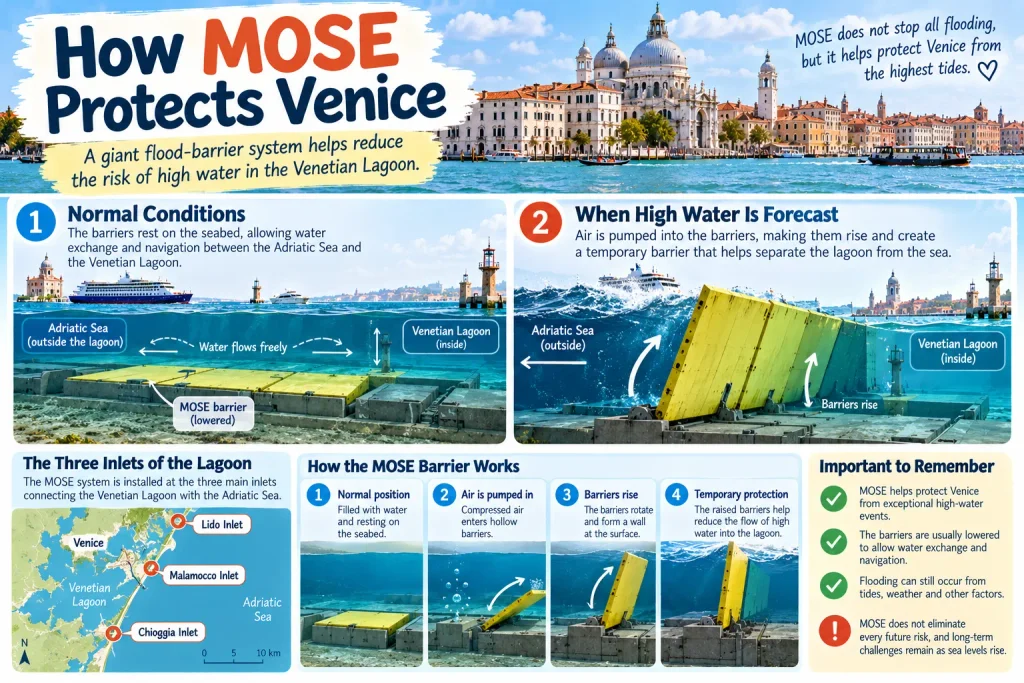
MOSE is a system of mobile barriers installed at the lagoon’s three main inlets connecting it with the Adriatic.
Under ordinary conditions, the barriers remain lowered, allowing water exchange and navigation according to operating arrangements.
When forecast conditions require protection, the barriers can be raised to temporarily separate the lagoon from the sea.
The system began operating in flood-protection events in 2020.
For children, imagine a set of enormous gates normally resting underwater. When a dangerous high-water event is expected, the gates rise to create a temporary barrier.
The real engineering is considerably more complex, but the comparison helps explain the basic purpose.
Does MOSE Mean Venice Will Never Flood Again?
No.
MOSE is an important flood-protection system, but no major infrastructure project should be described as eliminating every possible future risk.
Its operation involves forecasting, maintenance and decisions about when barriers should be raised.
The lagoon is also an environmental system, so flood protection must be considered alongside water exchange, navigation and ecological conditions.
As sea levels change over the long term, operating requirements and environmental trade-offs may also change.
The lesson for children is that engineering can reduce risk without making a complex natural system completely predictable.
Why Can’t Venice Simply Build a Giant Wall?
Children may suggest surrounding the city with a permanent wall to keep the sea out.
That sounds straightforward until we remember that Venice is part of a tidal lagoon.
The lagoon needs water exchange with the Adriatic, and its waterways support navigation, ecological processes and everyday activities.
A permanent barrier could create significant environmental and practical consequences.
This is why protecting Venice involves more than stopping water.
Engineers, environmental scientists, conservation specialists and public authorities must consider how different parts of the system interact.
Venice demonstrates that solving one problem can create new questions elsewhere.
Venice Water Detective Challenge for Kids
After learning how Venice works, children can investigate the city for themselves.
This activity is designed for a family walk through the historic center. It does not require special equipment, paid admission or a fixed route.
The goal is to find evidence of how Venetians adapted to life in a lagoon.
Mission 1: Find a Working Boat
Look for a boat carrying goods, transporting passengers or performing another practical service.
Ask what kind of vehicle would perform the same job in a city with ordinary roads.
Mission 2: Find a Bridge That Solves a Problem
Choose a small pedestrian bridge and observe what it connects.
Why is the bridge needed? What would pedestrians have to do if it did not exist?
Mission 3: Find a Canal-Facing Entrance
Look for a building with an entrance directly facing the water.
Ask why this entrance might have been useful when boats were a major means of transportation.
Mission 4: Find an Old Wellhead
In a campo, look for a historic stone wellhead.
Remember that many such structures provided access to underground rainwater cisterns.
Ask why Venice needed to collect freshwater even though canals surrounded the city.
Mission 5: Find Evidence of Modern Venice
Look for modern infrastructure integrated into historic streets or buildings.
It might be electrical equipment, accessibility improvements, communication systems or a service boat.
Ask how a city preserves historic architecture while continuing to meet residents’ modern needs.
Mission 6: Find Something You Cannot Explain
Let each child choose one object or feature that raises a question.
Instead of immediately searching for the answer, encourage them to observe carefully and make a hypothesis.
Later, use reliable information to investigate whether the explanation was correct.
The challenge is not a competition. Children do not need to complete every mission.
A successful investigation is one that makes them notice something they would otherwise have walked past.
What Can Children Learn from Venice?
Venice connects several subjects that are often taught separately.
Geography explains why the lagoon influenced settlement and transportation.
History reveals how small communities developed into a maritime republic.
Engineering helps explain foundations, bridges, canals and flood barriers.
Environmental science introduces tides, sea-level rise and the relationship between cities and ecosystems.
Everyday life reveals how people obtain drinking water, transport goods and provide essential services in an unusual urban environment.
The value of visiting Venice with children is not that parents can teach all these subjects during one walk.
It is that children can see how the subjects connect.
A question about a canal can lead to transportation. A question about a well can lead to freshwater. A question about flooding can lead to climate and engineering.
Venice rewards curiosity because almost every part of the city has a practical story behind it.
To include Venice in a longer family vacation, explore our Italy Family Itinerary: 7 Days, 10 Days & 2 Weeks with Kids for practical routes connecting Venice with Rome, Florence, Lake Garda and the Dolomites.
Common Myths About Venice
Venice Is Floating on Water
False. Its buildings stand on foundations supported by the ground beneath the lagoon.
Every Building Stands on Identical Wooden Piles
False. Historic construction methods and foundation arrangements vary.
Wooden Foundations Turned into Stone
Misleading. The survival of historic timber is largely associated with environmental conditions that can slow decay, not ordinary wood magically becoming stone.
Venice Was Built in One Project
False. The city developed gradually over centuries.
The Canals Exist Mainly for Tourists
False. Waterways have long been essential to transportation and urban life.
Venice Has Always Obtained Drinking Water from Its Canals
False. Lagoon water is not suitable for ordinary drinking, and historic Venetians developed freshwater collection and supply systems.
Venice Floods Every Day
False. Significant high-water events depend on tides, weather and other conditions.
MOSE Has Permanently Solved Flooding
False. The system reduces risk from particular high-water events but does not eliminate every future challenge.
Venice Is an Outdoor Museum
False. Venice remains a living city with residents, businesses and essential public services.
Venice Will Definitely Disappear in a Specific Year
Unsupported as a simple prediction. Venice faces serious long-term challenges, but its future depends on environmental processes and human responses.
FAQ: Why Is Venice Built on Water?
Why is Venice built on water?
Venice developed across islands in the Venetian Lagoon. Early communities adapted to the coastal environment, and the settlements gradually grew into a major maritime city. The lagoon offered both practical challenges and advantages for trade, transportation and protection.
Is Venice actually floating?
No. Venetian buildings stand on foundations supported by the lagoon’s ground. Many historic structures use timber foundation elements, but construction methods vary.
Why don’t Venice’s wooden foundations rot?
Timber embedded in waterlogged, low-oxygen sediments can decay much more slowly than wood exposed to ordinary wet and dry conditions. However, submerged wood is not indestructible and can still deteriorate.
How old is Venice?
Settlement in the lagoon developed during late antiquity and the early Middle Ages, with important communities emerging over many centuries. The traditional founding date of 421 is part of Venice’s historical identity, but it should not be treated as proof that the entire city was founded on one specific day.
Why does Venice have canals instead of roads?
Venice developed across lagoon islands where waterways served as important transportation routes. The historic city also has pedestrian streets and bridges, but its urban structure evolved around water access rather than a modern road network.
Where did Venetians get drinking water?
Historically, Venetians collected and stored rainwater using underground cistern systems and obtained freshwater through other supply arrangements. Modern Venice uses a public water network connected with mainland infrastructure.
Is Venice sinking?
Venice experiences relative sea-level changes influenced by land subsidence and rising sea levels. These processes contribute to long-term flood risk, but the situation is more complicated than buildings simply sinking into the lagoon.
What is acqua alta?
Acqua alta refers to unusually high-water conditions that can cause flooding in low-lying parts of Venice. Such events are influenced by tides, weather and other factors.
What is MOSE in Venice?
MOSE is a mobile flood-barrier system at the lagoon’s main sea inlets. Its barriers can be raised during forecast high-water events to help protect Venice from flooding.
Will Venice disappear underwater?
Venice faces significant challenges from relative sea-level rise, flooding and environmental change. However, assigning a definite disappearance date oversimpl