The best places to visit in Italy with kids are not necessarily the same places every family should visit.
That sounds obvious.
But first-time Italy itineraries often look surprisingly similar:
Rome → Florence → Venice
There is nothing wrong with that route.
It connects three extraordinary cities.
But Italy can also mean:
a child walking through the remains of Pompeii,
a family taking boats across Lake Garda,
a mountain trail beneath the Dolomites,
a beach day in Sardinia,
trulli houses in Puglia,
Greek temples in Sicily,
or a food-focused afternoon beneath Bologna’s porticoes.
Italy’s official tourism site itself presents family travel across mountains, coastlines, cities and islands rather than treating the country as one type of vacation. Italia.it
So this guide will not rank Italy from:
#15 → #1
and announce one destination as the winner.
Instead, we are going to answer a more useful family question:
What kind of Italy does your family actually want?
Ancient history?
Art?
Mountains?
Beaches?
Food?
Boats?
Archaeology?
Theme parks?
Small towns?
Or a little of everything?
Choose that first.
Then choose the destination.
Quick Answer: Where Should Your Family Go in Italy?
| If Your Family Wants… | Start With… |
|---|---|
| Ancient history on a huge scale | Rome |
| A city unlike anywhere else | Venice |
| Renaissance art and a compact historic center | Florence |
| Countryside and hill towns | Tuscany |
| A modern city mixed with history | Milan |
| Lake days + villages + family attractions | Lake Garda |
| Mountains and outdoor adventure | Dolomites |
| Food + an easy-to-explore historic city | Bologna |
| Pompeii + pizza + southern city energy | Naples & Pompeii |
| Trulli + white towns + coastline | Puglia |
| Archaeology + volcanoes + beaches | Sicily |
| Beaches + nature | Sardinia |
| Coastal villages + train travel | Cinque Terre & Ligurian Coast |
| A compact historic city | Verona |
| Museums + royal history | Turin |
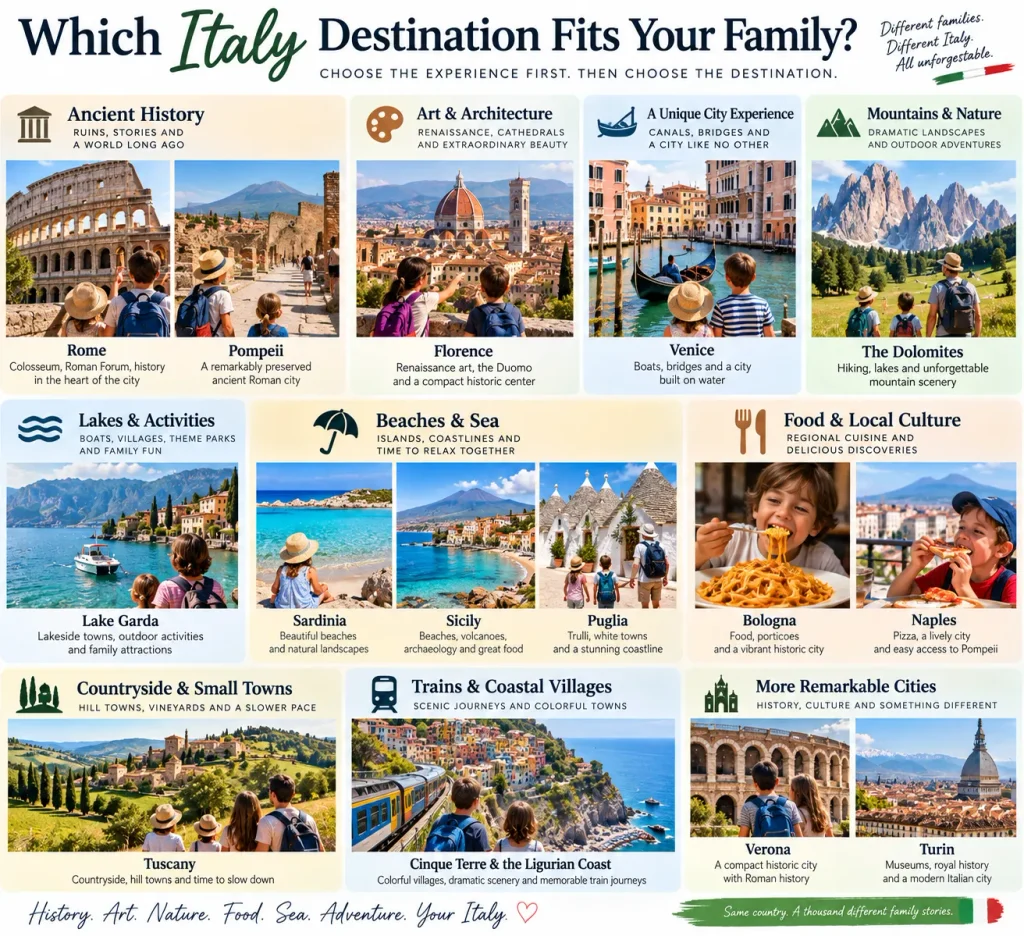
These are not ranked from best to worst.
A family fascinated by ancient Rome may build the entire trip around Rome and Pompeii.
Another family with younger children may prefer Lake Garda and the Dolomites.
A family traveling in summer primarily for the sea may choose Sardinia, Sicily or Puglia.
And a family whose children love trains and boats may discover that Venice and the Ligurian coast are more exciting than another famous museum.
Italy does not have one correct family itinerary.
Before Choosing: Don’t Try to “Do Italy”
This is the first mistake I would avoid.
Look at a map.
Italy appears manageable.
Then you begin adding places.
Rome.
Florence.
Venice.
Milan.
Lake Garda.
Cinque Terre.
Naples.
Pompeii.
Amalfi.
Maybe Sicily?
Suddenly the family vacation becomes a transportation project.
Children experience Italy differently from adults racing through a bucket list.
Every travel day can involve:
- packing
- checking out
- station transfers
- waiting
- luggage
- finding accommodation
- learning another neighborhood
- unpacking again
That is travel too.
So before choosing destinations, ask:
“How many times do we actually want to move?”
For many families, fewer bases + deeper exploration will produce a better trip than collecting famous city names.
Italy Is Long
This sounds ridiculously obvious.
But it matters enormously when planning.
Northern Italy and Sicily are not neighboring destinations.
Venice and Naples are not a casual afternoon combination.
Sardinia requires an island journey.
The Dolomites create different transport questions from Rome.
So instead of starting with:
“Which 15 places are best?”
start with:
“Which part of Italy are we actually traveling through?”
That one decision eliminates a huge amount of unnecessary movement.
1. Rome — For Kids Who Want to Walk Into Ancient History
Rome is the easiest place to understand why Italy can be extraordinary with children.
You do not need to convince them that history happened here.
It is everywhere.
The Colosseum.
Roman Forum.
Pantheon.
Ancient roads.
Columns appearing beside modern streets.
Fountains.
Churches.
The Vatican.
But Rome’s greatest strength can also become its biggest family-travel problem.
There is too much.
Don’t Teach Rome Chronologically
You could try explaining:
Roman Kingdom
→ Roman Republic
→ Roman Empire
→ Medieval Rome
→ Renaissance
→ Baroque
→ Modern Italy
Good luck keeping a six-year-old with you.
Instead, begin with questions.
At the Colosseum:
“How did 50,000 people get inside without modern ticket scanners?”
At the Forum:
“Why is the ancient city lower than the modern street?”
At the Pantheon:
“Why doesn’t the giant concrete roof fall down?”
At an aqueduct:
“How did water travel without electric pumps?”
Now history is solving mysteries.
Rome Works Particularly Well for…
Families whose children enjoy:
- Romans
- gladiators
- engineering
- mythology
- archaeology
- giant monuments
- asking how old something is
But younger children do not need every ruin.
One excellent Roman site plus gelato and a park can teach more than six exhausted archaeological sites.
2. Venice — For Kids Who Want a City That Breaks the Rules
Venice wins one thing immediately.
Children notice it.
You do not have to explain:
“This city is different.”
They can see that.
No ordinary road traffic through the historic center.
Boats doing jobs trucks perform elsewhere.
Bridges everywhere.
Doors facing canals.
Narrow pedestrian routes.
Water buses.
And eventually:
“Why is Venice built on water?”
That question is so good that we’ve already developed an entire Why Is Venice Built on Water? guide for children—which we’ll publish as part of this Italy series.
Venice Is an Everyday-Life Puzzle
Forget gondolas for a moment.
Ask children:
How does rubbish leave?
How does an ambulance arrive?
How does a supermarket receive food?
How does someone move a sofa?
Where does drinking water come from?
Suddenly Venice becomes a giant engineering and logistics lesson.
That’s much more interesting than telling children:
“Venice has 400-plus bridges.”
Make them understand why bridges are necessary.
The Main Family Challenge: Walking
Venice looks compact.
Your feet may disagree.
Canals interrupt direct routes.
Bridges add steps.
Strollers can require repeated lifting.
Getting lost is remarkably easy.
So build time into the itinerary for:
walking + stopping + wrong turns + looking at boats
rather than scheduling Venice like a conventional city grid.
3. Florence — For Kids Ready to Discover That Art Has Stories
Florence can intimidate parents.
Renaissance.
Michelangelo.
Botticelli.
Medici.
Uffizi.
Duomo.
Suddenly adults feel responsible for delivering an art-history curriculum.
Don’t.
Start outside.
The Duomo Is Already a Question
Stand in front of Florence Cathedral.
Ask:
“How did people build that enormous dome hundreds of years ago?”
Now Brunelleschi matters.
Not because children need to memorize his name.
Because somebody solved an engineering problem.
Art history becomes engineering history.
Turn Florence Into a Detail Hunt
Instead of:
“We need to see the Uffizi.”
try:
“Today we’re looking for three things.”
Maybe:
- a painting with a strange animal
- the funniest facial expression
- a sculpture that looks as though it might move
Then let children choose.
A museum visit becomes observation rather than endurance.
4. Tuscany — For Families Who Need Italy to Slow Down
Florence is in Tuscany.
But Florence and a Tuscany countryside trip are not the same family experience.
Once families leave the major city, the rhythm can change.
Hill towns.
Vineyards.
Olive groves.
Farms.
Country roads.
Smaller historic centers.
Longer meals.
Views.
This can be exactly what a family needs after several intense city days.
Tuscany Can Turn Food Into Geography
Children see:
olive trees.
grapes.
fields.
farms.
Then food appears on the table.
Ask:
“Where did this come from?”
That simple question can connect:
landscape → agriculture → food → culture
which gives us future Travel With Kids World topics such as:
How Is Olive Oil Made?
and:
What Happens in an Italian Vineyard?
These are precisely the kinds of family-learning experiences we want this Italy cluster to develop.
5. Milan — For Families Who Want Modern Italy Too
Italy travel content can accidentally suggest that the entire country stopped developing around 1600.
Milan fixes that.
The city combines:
- Gothic architecture
- historic churches
- museums
- modern business
- fashion
- design
- contemporary neighborhoods
- extensive public transportation
Children can see that Italy is not simply an archaeological park.
Start with the Duomo
The Milan Cathedral gives children another scale challenge.
Do not begin with dates.
Ask:
“How many statues do you think are on this building?”
Then look.
Really look.
Roof.
Spire.
Wall.
Another spire.
Another statue.
Children begin noticing how much human work can be concentrated into one building.
Milan Also Works as a Transport Base
For families building a Northern Italy trip, Milan’s transport connections can make it strategically useful.
From the broader region, families can build routes toward:
- Lake Garda
- other northern lakes
- Verona
- Venice
- Turin
- mountain areas
That does not mean you should sleep in Milan simply because trains exist.
It means Milan can play two roles:
destination + gateway.
6. Lake Garda — For Families Who Want Everyone to Have a Different Kind of Day
Lake Garda is one of the reasons this article needs 15 destinations rather than 15 cities.
It is not one city.
It is an entire family-travel environment.
Italy’s official tourism site highlights historic villages, castles, Roman remains, water sports and Gardaland around the lake. Italia.it
That gives families unusual flexibility.
One day:
lake + boat
Another:
castle + village
Another:
theme park
Another:
nothing ambitious at all
This flexibility can be extremely valuable with children.
Lake Garda Is Not One Base
This matters.
The lake is large.
Where you stay changes:
- transportation
- travel times
- which towns are convenient
- access to attractions
- the feel of the trip
So do not book:
“a hotel at Lake Garda”
before deciding which part of the lake best fits your itinerary.
We will eventually build a dedicated Lake Garda with Kids guide for exactly this reason.
7. The Dolomites — For Families Who Need Mountains More Than Museums
After Rome, Florence and Venice, some children may be finished with:
old building → church → museum → another old building.
Then show them the Dolomites.
The Italian national tourism site specifically promotes the mountain regions for family travel, including trails, cycling, climbing experiences and child-oriented outdoor activities. Italia.it
The learning changes immediately.
Instead of:
“Who built this?”
children ask:
“How did these mountains form?”
Different landscape.
Different questions.
You Don’t Need a Huge Hike
A mountain vacation with children does not need to prove anything.
You do not receive extra family-travel points for choosing the longest trail.
Depending on the area, families may combine:
- shorter walks
- cable transport where operating
- mountain huts
- lakes
- villages
- cycling
- playgrounds
- nature activities
The exact activity needs to match:
child + weather + altitude + route + season.
Not an internet label saying:
“Easy family hike.”
Which of These First Seven Fits Your Family?
Already, there is no sensible #1.
Choose Rome if ancient history can drive the trip.
Choose Venice if your children love transportation, water and cities that work differently.
Choose Florence if art, architecture and Renaissance stories interest the family.
Choose Tuscany if you need countryside and a slower rhythm.
Choose Milan if you want a major northern city that also works well within a broader route.
Choose Lake Garda if the family wants variety.
Choose the Dolomites if mountains are the experience.
And we still have:
Bologna, Naples & Pompeii, Puglia, Sicily, Sardinia, Cinque Terre, Verona and Turin
to explore.
That’s why 15 is the right number for this pillar.
Not because Italy has exactly fifteen worthwhile family destinations.
It obviously doesn’t.
But because fifteen gives us enough variety to show families that Italy can be city + mountain + lake + island + coast + countryside + archaeology + food without turning the opening guide into a directory of everything in the country.
8. Bologna — For Families Who Want to Understand Italy Through Food
Emilia-Romagna
Bologna gives families something slightly different from Rome, Florence and Venice.
Its historic center is important.
Its towers are memorable.
Its university history is extraordinary.
But food can become the easiest doorway into the city for children.
This is the region associated with foods and culinary traditions that travelers may already recognize in some form.
That makes Bologna a perfect place to ask:
“Does Italian food actually mean the same thing everywhere in Italy?”
The answer is no.
And understanding that can completely change a family trip.
“Italian Food” Is Really Many Regional Food Cultures
Children may arrive expecting:
pizza + pasta + gelato
everywhere.
They will certainly find plenty of all three.
But Italy’s food traditions are deeply regional.
Ingredients change.
Pasta shapes change.
Sauces change.
Cheeses change.
Bread changes.
Even familiar dishes may belong much more strongly to one region than another.
So in Bologna, turn lunch into geography.
Ask:
“What are people eating here that we didn’t see as much in Venice?”
Now food becomes evidence of place.
Look Up: Bologna’s Porticoes
Bologna also gives children an architectural feature they can understand immediately.
Porticoes.
Covered walkways extend through large parts of the city, and Bologna’s porticoes were inscribed on UNESCO’s World Heritage List in 2021. UNESCO describes the listed components as a collection representing centuries of development of this distinctive architectural feature.
Ask:
“Why would a city want so many covered walkways?”
Possible answers:
Rain.
Sun.
More usable space.
Movement.
Commerce.
Then let the children observe how people use them today.
Historic architecture is still doing a job.
9. Naples & Pompeii — For Families Who Want a City and an Ancient Disaster Story
Campania
I am deliberately putting Naples and Pompeii together in this first Italy pillar.
They are not the same destination.
But for many families, they form a natural travel combination.
Naples provides:
living southern Italian city + food + waterfront + museums + streets
while Pompeii provides:
archaeology + Roman daily life + Vesuvius + one extraordinary historical event.
The contrast is powerful.
Pompeii Is Much More Than “The City Destroyed by a Volcano”
Children usually know the dramatic part.
Mount Vesuvius erupted in AD 79.
Pompeii was buried.
But if we only tell children about death and destruction, we miss much of what makes Pompeii valuable.
The archaeological site preserves evidence of:
- streets
- houses
- shops
- public buildings
- baths
- temples
- political life
- entertainment
- everyday Roman society
The Archaeological Park of Pompeii describes the site as an exceptional record of ancient Roman urban and social life preserved by the eruption.
So instead of beginning with:
“Thousands of people died here.”
begin with:
“What was an ordinary day like here before the volcano erupted?”
That gives children an entire city to investigate.
Pompeii Detective Questions
Try:
“How can you tell this was a street?”
“Where did people buy food?”
“Where did water come from?”
“How do archaeologists know what this room was used for?”
“What evidence survived that normally disappears?”
Now archaeology becomes detective work.
And eventually this Italy series should include:
Why Did Pompeii Disappear? The Story of Vesuvius for Kids
That will become the WHY companion to the destination guide.
Naples Gives Pompeii Context
Do not treat Naples simply as:
the hotel near Pompeii.
Naples has its own enormous identity.
It offers:
- historic streets
- churches
- castles
- archaeological collections
- waterfront
- food culture
- views toward Vesuvius
And, of course, pizza.
But even pizza can become a Travel With Kids World question:
“Why is Naples famous for pizza?”
Now food leads to:
history,
ingredients,
urban life,
migration,
and how local dishes become global foods.
That is exactly the kind of question we want children asking.
10. Puglia — For Trulli, White Towns and a Different Southern Italy
Puglia
Puglia stretches along the heel of Italy’s boot.
For families, its appeal can combine:
- coastline
- beaches
- historic towns
- countryside
- distinctive architecture
- food
- slower road-trip travel
And then there are the trulli.
Why Do the Houses Look Like That?
In and around Alberobello, children encounter buildings with distinctive conical roofs.
The Trulli of Alberobello are UNESCO-listed, and UNESCO describes them as traditional dry-stone dwellings constructed using a prehistoric building technique still represented in the area.
Do not begin with:
“These are UNESCO World Heritage buildings.”
Begin with:
“Why are the roofs shaped like cones?”
Then:
“How do you build a wall without mortar?”
Now architecture becomes the question.
Puglia Works Better as a Region Than a Checklist
Trying to reduce Puglia to:
Alberobello → photo → leave
misses the point.
Families may combine different parts of the region according to the route:
- towns
- countryside
- coast
- beaches
- food
- archaeological or historic sites
This is another destination where where you stay matters enormously.
Puglia is long.
Do not assume everything is twenty minutes apart because it belongs to the same region.
11. Sicily — For Families Who Want Several Civilizations on One Island
Sicily
Sicily could easily support an entire family-travel website by itself.
Greek temples.
Roman remains.
Norman architecture.
Arab influence.
Baroque cities.
Mount Etna.
Beaches.
Markets.
Food.
Different parts of the island can feel like entirely different trips.
That makes Sicily fascinating.
It also makes it dangerous to overpack.
Sicily Is Where “Italian History” Becomes Much Bigger
Children may arrive thinking:
Italy = Romans.
Then Sicily complicates the story.
The island’s position in the Mediterranean brought it into contact with—and under the control of—many different political and cultural powers over centuries.
So a Sicily trip can lead naturally to questions about:
- ancient Greeks
- Romans
- Byzantines
- Islamic Sicily
- Normans
- later kingdoms
- Mediterranean trade
One island can become a history map.
Mount Etna Changes the Story Again
Then there is the volcano.
Mount Etna is one of the world’s most active volcanoes and forms part of a UNESCO World Heritage Site recognized for its geological importance and continuing volcanic activity.
For children:
“Is it still a volcano if it hasn’t disappeared into history?”
Absolutely.
Now geology is not something that only happened millions of years ago.
Earth is still changing.
Any family Etna experience, however, needs to be planned around current volcanic, weather and access conditions, not an old blog itinerary.
12. Sardinia — For Families Who Want the Beach to Be the Main Event
Sardinia
Not every Italy trip needs to be:
museum → cathedral → archaeological site → palace.
Sometimes the family wants the sea.
Sardinia earns its place in this list because it offers a fundamentally different kind of Italy vacation.
Beaches and coastal landscapes may be the main attraction.
But Sardinia is not only a beach resort.
The island also contains distinctive archaeological heritage, including thousands of structures associated with the Nuragic civilization.
What Is a Nuraghe?
Excellent child question.
A nuraghe is a type of ancient stone tower found particularly in Sardinia.
The UNESCO-listed archaeological site of Su Nuraxi di Barumini is one of the most famous examples and represents the island’s Bronze Age Nuragic culture.
That means a Sardinia family trip can combine:
morning beach
with:
“Who built this giant stone tower thousands of years ago?”
That’s a pretty good travel day.
Sicily or Sardinia with Kids?
Do not decide based on:
Which island is better?
Ask what kind of trip you want.
Sicily may fit better if…
Your family wants a dense mixture of:
cities + archaeology + volcano + food + beaches + layers of history.
Sardinia may fit better if…
The trip is primarily about:
beaches + coastal nature + slower island travel
with history added around it.
Both islands contain far more than these summaries.
The point is to choose the role the island plays in your trip.
13. Cinque Terre & the Ligurian Coast — For Families Who Love Trains, Villages and Sea Views
Liguria
Cinque Terre is visually irresistible.
Colorful villages.
Steep slopes.
Sea.
Trains disappearing into tunnels.
Boats.
Walking paths.
But families need to distinguish between:
beautiful
and:
effortless.
They are not synonyms.
The Train Can Be Part of the Adventure
For children who like trains, Cinque Terre has an immediate advantage.
Rail connects the villages and can become part of the experience rather than simply transportation between attractions.
Ask:
“Why do you think the railway uses so many tunnels here?”
Look at the terrain.
Mountains meet the sea.
There is not much flat land.
Again:
geography shapes transportation.
Don’t Promise a Big Hike Just Because the Photos Look Easy
The landscape is steep.
Trails differ.
Conditions and closures can change.
Heat matters.
Children’s walking ability matters.
So choose the exact route based on current official information rather than assuming:
Cinque Terre = easy coastal family walk.
For some families, the better day may be:
train → village → gelato → short exploration → train → next village
with no ambitious hike at all.
That’s still Cinque Terre.
14. Verona — For Families Who Want a Manageable Historic City
Veneto
Verona can be overshadowed by nearby Venice.
For families, that may actually be part of its appeal.
It offers:
- Roman history
- historic streets
- river views
- piazzas
- an arena
- medieval architecture
within a city that can feel more manageable than Italy’s largest tourist centers.
Don’t Make Romeo and Juliet the Whole City
Yes, Verona is internationally associated with Shakespeare’s Romeo and Juliet.
And yes, families will encounter tourism built around that connection.
But Shakespeare’s characters are literary.
They are not documentary proof that Romeo and Juliet lived in the famous buildings marketed around the story.
That distinction makes Verona another perfect:
LEGEND / LITERATURE vs. HISTORY
destination.
Ask older children:
“Can a fictional story become part of a real city’s identity?”
Clearly, yes.
That’s fascinating in itself.
The Arena Gives You Another Roman City
Verona’s Roman amphitheater provides a useful comparison with Rome.
Ask:
“Does every Roman amphitheater look exactly like the Colosseum?”
No.
Now children begin recognizing that the Roman world contained many cities with shared forms of infrastructure and entertainment.
Rome was the capital.
It was not the only Roman city.
15. Turin — For Families Who Think Italy Is Only Ancient and Renaissance
Piedmont
Turin gives us another kind of Italy.
Royal history.
Grand avenues.
Museums.
Industrial history.
Chocolate.
And several museums capable of becoming the main reason a child wants to visit.
The Egyptian Museum Changes the Geography Lesson
One of Turin’s most famous institutions is the Museo Egizio, devoted to ancient Egyptian culture.
That immediately gives children a strange question:
“Why is one of the world’s important Egyptian museums in Italy?”
Excellent.
Museums reveal how objects, archaeology, scholarship, collecting and European history became internationally connected.
It also reminds children:
A museum’s subject does not have to come from the city where the museum stands.
Turin Can Also Work for Kids Who Love Machines
Turin’s history is strongly connected with Italian industry and automobiles.
That makes the city useful for families whose children respond more strongly to:
cars + technology + engineering
than another Renaissance painting.
Again, the best destination depends on the child.
Which Italy Destination Fits Your Child’s Interest?
Now we can stop thinking geographically for a moment.
“My Child Loves Ancient History”
Start with:
Rome + Pompeii
Then consider:
Sicily + Verona
depending on the route.
“My Child Loves Art”
Consider:
Florence + Venice
with Rome and Milan adding completely different artistic layers.
“My Child Loves Mountains”
Look toward:
Dolomites
rather than forcing another city.
“My Child Loves Beaches”
Start investigating:
Sardinia + Sicily + Puglia
before automatically building a city-heavy itinerary.
“My Child Loves Boats”
Venice + Lake Garda + coastal destinations
can make transportation itself part of the experience.
“My Child Loves Trains”
Italy’s rail network can become part of the trip, with Cinque Terre offering an especially visible connection between railway engineering and difficult coastal geography.
“My Child Loves Food”
That doesn’t narrow Italy very much.
But Bologna, Naples, Sicily and Puglia can produce completely different food stories.
Best Places in Italy with Toddlers?
I would not create a fixed national ranking.
A toddler in a carrier and a toddler who refuses the stroller are different travelers.
Instead evaluate:
- number of hotel changes
- walking
- stairs
- stroller practicality
- heat
- nap possibilities
- transportation
- access to open space
- meal flexibility
A slower Tuscany or Lake Garda stay may work beautifully for one family.
Another family may find Rome easier because everything they need is close to their accommodation.
The logistics matter more than the destination’s toddler star rating.
Best Places in Italy with Elementary-School Kids?
This age opens up a lot.
Children can begin engaging with:
- Romans
- volcanoes
- knights
- Renaissance inventions
- boats
- archaeology
- food production
- geography
Rome and Pompeii become giant history lessons.
Venice becomes an engineering puzzle.
Florence becomes art and invention.
The Dolomites become geology.
Sicily becomes several civilizations on one island.
This is the age when Italy can feel like an enormous classroom without anyone needing to call it school.
Best Places in Italy with Teenagers?
Teenagers can participate more actively in destination selection.
Give them the fifteen choices.
Ask each teenager to choose:
one place
and explain why.
Maybe they choose:
Milan for fashion.
Florence for art.
Sardinia for beaches.
Naples for food.
Turin for museums.
Dolomites for hiking.
Then give that choice real weight in the itinerary.
Family travel improves when older children are not simply passengers in somebody else’s bucket list.
First Italy Trip: Should We Still Do Rome, Florence and Venice?
Possibly.
There is a reason the route is popular.
It provides three dramatically different experiences:
Rome → ancient world + monumental city
Florence → Renaissance + art + compact center
Venice → water + maritime history + unique urban form
And Italy’s high-speed rail network makes the major-city route practical compared with many cross-country itineraries.
But popularity does not make it mandatory.
A family that hates art museums and loves mountains may prefer:
Rome → Lake Garda → Dolomites
A summer family may choose:
Rome → Puglia
or:
Sicily only
or:
Sardinia only.
Your first Italy trip does not have to look like somebody else’s first Italy trip.
How Many Bases for a Family Trip?
This matters more than how many places appear on your wish list.
As a general planning principle, I would rather give children enough time to recognize where they are than move accommodation every night.
For example:
7 Days
Think roughly:
1–2 major bases
rather than trying to collect northern, central and southern Italy.
10 Days
Perhaps:
2–3 bases
depending on distances and travel style.
2 Weeks
Now you can begin connecting several distinct experiences without turning every second morning into checkout day.
These are planning principles, not rules.
A road-trip family may enjoy moving more frequently.
A family with toddlers may strongly prefer fewer moves.
Our next Italy pillar will be a dedicated Italy Family Itinerary: 7 Days, 10 Days & 2 Weeks with Kids, where we’ll build realistic routes rather than squeezing all fifteen destinations into one impossible vacation.
City + Nature Is Often Better Than City + City + City
This is one of the strongest ways to build an Italy family itinerary.
Instead of:
Rome → Florence → Venice → Milan
consider:
city → countryside → city
or:
city → lake → mountains
or:
archaeology → beach
Why?
Because children experience contrast.
Museum day.
Outdoor day.
Big city.
Small town.
Train.
Boat.
Beach.
Mountain.
Variety can prevent travel fatigue better than adding another famous monument.
Don’t Let Italy Become a Museum Marathon
Italy contains an almost unfair amount of art, archaeology and architecture.
That does not mean children need to consume all of it.
A family can visit Florence without seeing every major museum.
Rome without entering every church.
Venice without visiting every palace.
Sicily without completing every archaeological site.
Try:
one major cultural experience + one completely different experience
in the same day.
Maybe:
Colosseum + park
Uffizi highlights + gelato hunt
Pompeii + pool
Venice palace + boat ride
The second activity is not wasted time.
It may be what allows children to enjoy the first one.
Italy’s Seasons Can Change the Best Destination
A destination does not provide the same experience all year.
Summer can bring:
- significant heat
- crowds
- strong beach appeal
- mountain opportunities
Winter changes:
- daylight
- mountain conditions
- seasonal services
- coastal atmosphere
Spring and autumn can change:
- temperatures
- crowds
- hiking conditions
- opening patterns
So there is no meaningful answer to:
“What is the best place in Italy with kids?”
without also asking:
“When?”
Don’t Choose from Instagram Alone
This applies especially to:
- Cinque Terre
- Venice
- Dolomites
- Tuscany
- Amalfi Coast
- beaches
A photograph shows a beautiful moment.
It does not show:
- the stairs behind the camera
- the midday heat
- the crowded train
- the ferry timetable
- the parking problem
- the toddler who stopped walking
- the luggage being carried over a bridge
- the trail closure
- the two-hour transfer required to reach the viewpoint
So whenever an Italy destination enters your itinerary because of one photograph, ask:
“What does the family actually have to do to stand there?”
That question can save an entire travel day.
What About the Amalfi Coast?
You may have noticed something surprising.
The Amalfi Coast is not one of our main fifteen.
That does not mean families should avoid it.
It means this guide is trying to identify fifteen destinations that create clearly different family-travel roles, not list every famous place in Italy.
The Amalfi Coast is spectacular, but families should understand its practical side:
- steep terrain
- stairs
- busy roads
- seasonal crowds
- transportation logistics
- boat and bus connections
- accommodation location
For the right family, it can be extraordinary.
For another, nearby Naples and Pompeii—or a completely different coastal region—may fit the trip better.
The Amalfi Coast deserves its own family guide, where those logistics can be explained properly rather than squeezed into a paragraph simply because it is famous.
What About Matera?
Matera is another destination that could easily have made a longer list.
Its Sassi, ancient cave dwellings and extraordinary urban landscape make it one of southern Italy’s most distinctive historic destinations.
UNESCO describes the Sassi and Park of the Rupestrian Churches of Matera as an outstanding example of a rock-cut settlement with a long history of human occupation.
For children, the obvious question is:
“Did people really live inside caves?”
Yes—but the full story is far more complicated than simply calling Matera a “cave city.”
Matera will therefore work better as a dedicated future destination guide and WHY story.
Leaving it outside the fifteen does not mean:
not worth visiting.
It means:
not every worthwhile place needs to be in the opening pillar.
What About the Italian Lakes Besides Garda?
Lake Como gets enormous international attention.
Lake Maggiore is another important destination.
There are many smaller lake experiences too.
So why choose Lake Garda for the opening fifteen?
Because for a first family-travel overview it provides a particularly broad combination of:
lake + towns + boats + outdoor activities + family attractions
including the major theme-park cluster around the southern lake.
That makes Garda useful for illustrating an entire category of Italian family vacation.
Later, our Italy content should absolutely compare:
Lake Garda vs Lake Como with Kids
and potentially expand to the wider Italian Lakes.
Again:
15 is a starting map, not the final borders of the website.
What About Smaller Italian Towns?
They matter enormously.
In fact, some families may remember them more fondly than the major cities.
Italy is full of places where the attraction is not:
“Here are eight famous monuments.”
It is:
- walking
- eating
- sitting in a piazza
- finding a castle
- noticing old doors
- watching local life
- discovering a market
- looking over the surrounding countryside
As the Italy cluster grows, we should create a separate guide to:
Beautiful Small Towns in Italy to Visit with Kids
That article can include places that do not need to compete with Rome or Venice at all.
How to Choose Your Italy Destinations in Five Questions
If fifteen options still feel overwhelming, forget the list.
Ask these five questions.
1. What Does Your Child Actually Like?
Ancient history?
Art?
Trains?
Boats?
Beaches?
Mountains?
Food?
Volcanoes?
Start there.
2. What Season Are You Traveling?
A Dolomites experience depends heavily on season and conditions.
A southern beach trip changes between February and August.
Summer Rome creates different pacing needs from spring Rome.
Season can eliminate options before you ever compare attractions.
3. How Many Times Do You Want to Change Accommodation?
Write down the number.
Not the destinations.
Just:
“We are willing to change hotels twice.”
Now build around that constraint.
This is much easier than creating an eight-city itinerary and later discovering that nobody wants to pack eight times.
4. What Is the One Experience Everyone Cares About?
Maybe:
Colosseum
gondola
Pompeii
Dolomites
Sardinian beach
pizza in Naples
Give that experience a secure place in the itinerary.
Everything else can organize around it.
5. What Will You Deliberately Skip?
This is the hardest question.
And perhaps the most useful.
Say it out loud:
“We are going to Italy and we are not visiting ______.”
Florence?
Venice?
Rome?
Sicily?
Whatever it is.
The country will still be there.
A good family itinerary requires saying no to excellent places.
A Simple Italy Family Decision Map
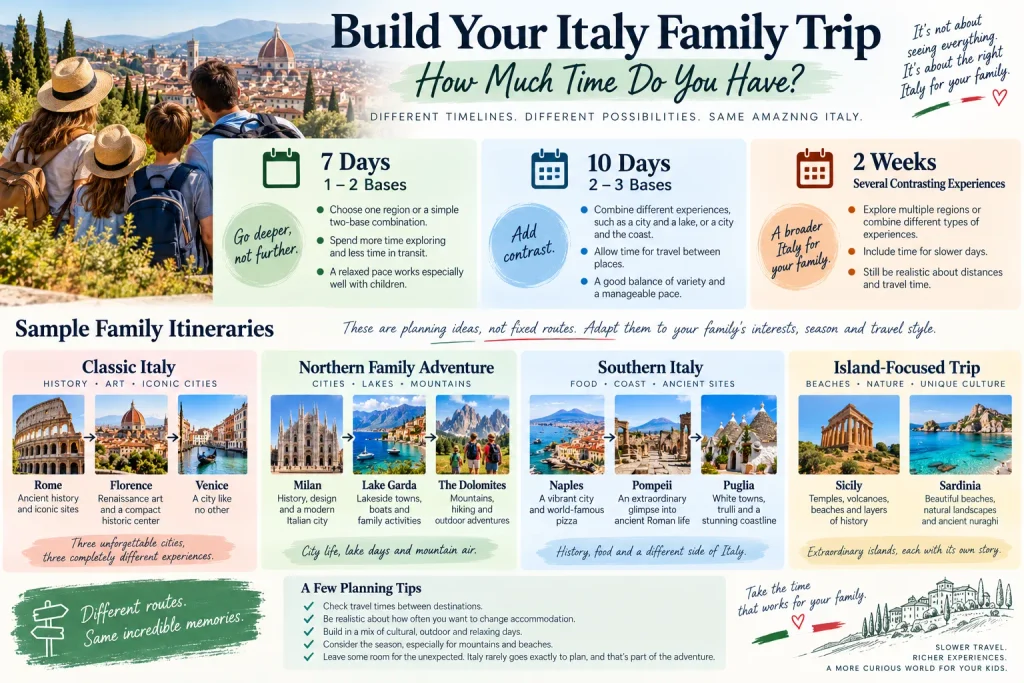
If you still cannot decide, start here.
We Have 7 Days
Choose one region or a very simple two-base combination.
Examples might include:
Rome + Florence
Venice + Lake Garda
Naples + Pompeii
one focused Sicily trip
one focused Sardinia trip
The point is not that these are the only possibilities.
The point is to avoid spending a short trip crossing the entire country.
We Have 10 Days
Now you can create contrast.
For example:
Rome + Florence + Venice
or:
Milan + Lake Garda + Dolomites
or:
Naples + Pompeii + Puglia
depending on transportation and family pace.
We Have 2 Weeks
Now several different versions of Italy become realistic.
You could build:
Classic Italy
Rome → Florence/Tuscany → Venice
or:
Northern Family Adventure
Milan → Lake Garda → Dolomites → Venice
or:
Southern Italy
Naples/Pompeii → Puglia
or spend the entire time exploring:
Sicily
without feeling that you failed to see Italy.
Our upcoming itinerary guide will build these routes in detail.
Let Every Destination Have a Job
This is one of the easiest ways to prevent travel fatigue.
Give each destination a role.
For example:
Rome = Ancient World
Florence = Art
Tuscany = Slow Down
Venice = Water City
Dolomites = Mountains
Now ask:
“Do two consecutive destinations have exactly the same job?”
If the answer is yes, maybe one can go.
This is especially useful when choosing between multiple historic cities.
Children do not care that adults understand the subtle architectural difference between six consecutive cathedrals.
To them, eventually:
“Another old church.”
Contrast restores attention.
Give Every Child One Italy Pick
If children are old enough, show them the fifteen destinations.
Do not explain which ones adults think are important.
Let each child choose one.
Then ask:
“Why?”
You may get:
“Venice because there are boats.”
“Pompeii because of the volcano.”
“Sardinia because I want to swim.”
“Bologna because I want pasta.”
Those are legitimate travel priorities.
Give at least one child-selected experience real weight in the itinerary.
That changes children from:
passengers
into:
participants.
Italy Destination Challenge for Kids
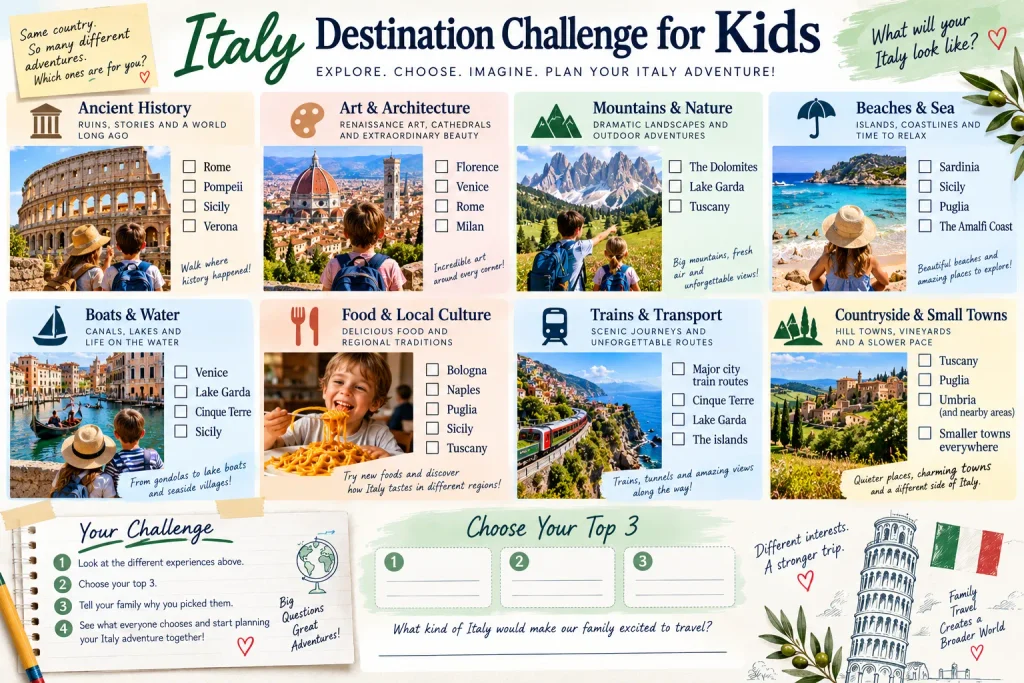
Instead of deciding the entire itinerary for your children, let them help choose what Italy should look like for your family.
Show them a few different kinds of experiences and ask a simple question:
“Which three things would you most like to do in Italy?”
A child fascinated by ancient history might choose Rome, Pompeii, Sicily or Verona, where Roman ruins, archaeological sites and stories from the ancient world can become part of the trip.
If art is more exciting, Florence is an obvious starting point, while Venice, Rome and Milan offer completely different ways to encounter architecture, paintings, sculpture and design.
Children who would rather be outside may choose very differently. The Dolomites can make mountains and nature the focus of the trip, while Sardinia, Sicily and Puglia offer opportunities to combine cultural exploration with time by the sea.
Water itself can become part of the adventure. Venice shows children a city organized around canals, while Lake Garda adds boats, lakeside towns and outdoor activities. Along the Ligurian coast, trains, villages, mountains and the Mediterranean all meet within the same journey.
Food-loving children have an even harder choice. Bologna, Naples, Puglia, Sicily and Tuscany each provide a different introduction to Italian food culture. Rather than asking which destination has the “best Italian food,” encourage children to notice how dishes and ingredients change as the family moves from one region to another.
And if transportation is what excites them, make that part of the decision too. High-speed trains between major cities, local rail journeys along the Ligurian coast, boats in Venice and ferries or other connections to the islands can become experiences rather than simply ways of getting from A to B.
Once everyone has chosen, compare the answers.
Perhaps one child wants Pompeii because of the volcano, another wants Venice because of the boats, and a parent wants Tuscany because everyone could use a slower few days.
That is useful information.
You are no longer asking:
“What are we supposed to see in Italy?”
You are asking:
“What kind of Italy would make this trip interesting to our family?”
There does not need to be a winner. The purpose of the challenge is to give children a voice in the itinerary and help parents identify the experiences the family genuinely cares about.
A family trip becomes much more interesting when children help choose the questions they want Italy to answer.
What Children Can Learn from Italy
Italy is particularly powerful for family travel because the same trip can cross enormous stretches of human and natural history.
A child can encounter:
ancient Greek temples
then:
Roman cities
then:
medieval towers
then:
Renaissance art
then:
modern trains
then:
an active volcano
then:
a beach
within one country.
But do not try to teach all of it.
Let each destination create one question.
Rome:
How did an ancient city this large work?
Venice:
How do you build a city on a lagoon?
Florence:
How did people build that dome?
Pompeii:
How can archaeology reconstruct an ordinary day?
Puglia:
Why do trulli look like that?
Sicily:
Why did so many civilizations want this island?
Sardinia:
Who built the nuraghi?
Dolomites:
How did these mountains form?
That is enough.
Questions travel better than lectures.
Common Mistakes Families Make When Planning Italy
1. Trying to Visit the Entire Country
Italy is bigger in travel time than it looks on a wish list.
2. Changing Hotels Constantly
Every move consumes part of a day.
3. Choosing Only Famous Cities
Italy also offers lakes, mountains, islands, countryside and beaches.
4. Choosing Only Child Attractions
Children can enjoy real cities, archaeology, art and landscapes when adults give them a reason to engage.
5. Planning Every Hour
Italy will interfere.
A long lunch happens.
A train changes.
A child finds a fountain.
Leave room.
6. Scheduling Too Many Museums and Churches
Cultural importance does not prevent cultural fatigue.
7. Ignoring Heat
Summer conditions can completely change a sightseeing day.
8. Underestimating Walking
Rome, Venice, Florence and archaeological sites can involve substantial walking.
9. Choosing an Island as Though It Were a City
Sicily and Sardinia need regional planning.
10. Thinking the First Trip Must Include Rome, Florence and Venice
It doesn’t.
FAQ: Best Places to Visit in Italy with Kids
What are the best places to visit in Italy with kids?
The right destinations depend on your children’s interests and your itinerary.
Rome is especially strong for ancient history, Venice for its unique canal-based city environment, Florence for Renaissance art, Lake Garda for varied family activities, the Dolomites for mountains, and Sardinia for beach-focused trips.
Is Italy good for a family vacation?
Italy offers an unusually broad range of family experiences, including historic cities, archaeological sites, beaches, lakes, mountains, islands, food traditions and extensive rail connections between many major destinations.
The challenge is usually choosing less, not finding enough to do.
Where should we go in Italy with young children?
There is no universal toddler destination.
Consider walking, heat, hotel changes, stroller practicality, transportation and the child’s normal routine.
A slower regional stay may work better than a rapid multi-city itinerary.
Is Rome or Venice better with kids?
They provide completely different experiences.
Rome offers ancient history and monumental archaeological sites.
Venice offers canals, boats, bridges and a city structure children are unlikely to encounter elsewhere.
Choose according to the child’s interests and the wider route.
How many cities should we visit in Italy in one week?
There is no fixed rule, but many families will benefit from limiting a seven-day trip to one or two main bases rather than spending much of the week checking in and out of accommodation.
Is northern or southern Italy better for families?
Neither is universally better.
Northern Italy can combine major cities, lakes and the Alps.
Southern Italy offers destinations including Naples, Pompeii, Puglia, Sicily and extensive coastlines.
Season, transportation and family interests matter more than a north-versus-south ranking.
Is Italy easy to travel around by train with kids?
Many major Italian cities are connected by rail, including high-speed services on important routes.
However, islands, countryside, mountain regions and some coastal destinations require different transportation planning.
Check the actual route rather than assuming every Italy destination is equally convenient by train.
What is the best first trip to Italy with kids?
Rome, Florence and Venice remain a logical first itinerary for families who want Italy’s most famous historic cities.
But a family interested primarily in mountains, beaches, archaeology or slower travel may be better served by a completely different route.
Final Thoughts: Don’t Try to Give Your Kids All of Italy
Italy makes restraint difficult.
Every time you remove something from the itinerary, another extraordinary place appears.
Skip Milan?
What about the Duomo?
Skip Naples?
But Pompeii.
Skip Sicily?
Greek temples and Etna.
Skip Sardinia?
Those beaches.
Skip the Dolomites?
Look at those mountains.
This is how a family vacation becomes:
18 destinations in 14 days.
Don’t do that.
The goal is not to show children everything Italy contains.
It is to give them enough time to notice where they are.
Let Rome be ancient.
Let Venice be strange.
Let Florence become an art puzzle.
Let Tuscany slow everyone down.
Let Lake Garda be easy.
Let the Dolomites be enormous.
Let Bologna taste different.
Let Pompeii create questions.
Let Puglia surprise them.
Let Sicily complicate their idea of Italian history.
Let Sardinia be the sea.
Let Liguria show them how mountains meet the coast.
Let Verona mix literature with history.
Let Turin prove Italy is not only Rome and Renaissance art.
And leave something for next time.
Because the best family trip to Italy is not the one that contains the most famous places.
It is the one in which your children can still remember why each place felt different.
Continue Exploring Italy with Kids
Italy Family Itinerary
Next, our Italy Family Itinerary: 7 Days, 10 Days & 2 Weeks with Kids will turn these destinations into realistic routes without trying to cross the entire country in one vacation.
Venice with Kids
Our upcoming Venice with Kids: A Family Guide to the Floating City will cover the practical side of visiting Venice with children, including walking, boats, neighborhoods, pacing and family logistics.
Why Is Venice Built on Water?
And for the question children almost inevitably ask once they arrive, Why Is Venice Built on Water? The Floating City Explained for Kids explores the foundations, lagoon, canals, freshwater, flooding and engineering behind one of the world’s most unusual cities.