Rome with kids can be extraordinary, but only if you accept one fact before arriving: your family is not going to see everything.
The Colosseum is famous enough to feel compulsory. The Roman Forum sits beside it. The Pantheon is free to admire from the piazza but deserves more than a passing photograph. The Vatican Museums can consume much of a day. St Peter’s Basilica is another experience entirely.
Then there are fountains, piazzas, churches, underground sites, parks, museums, gelato shops and ancient ruins that appear almost casually between modern buildings.
Adults look at the list and think:
“How can we fit all of this in?”
With children, a better question is:
“Which parts of Rome will they actually remember?”
That is what this guide is designed to answer.
Rather than ranking attractions from best to worst, we will build Rome around different kinds of children: the one fascinated by gladiators, the child who loves engineering, the museum lover, the reluctant walker, the teenager who wants a city rather than a history lesson, and the younger child who simply needs enough space between monuments.
Because Rome is not difficult for families because there is too little to do.
Rome is difficult because there is too much.
Quick Answer: What Should Families Prioritize in Rome?
If this is your family’s first visit, start with a small number of experiences that show children different versions of Rome.
| If Your Child Loves… | Start With… | Why |
|---|---|---|
| Gladiators & Ancient Rome | Colosseum | The easiest Roman story for many children to visualize |
| Archaeology | Roman Forum & Palatine | Children walk through parts of the ancient city itself |
| Engineering | Pantheon | An enormous ancient dome creates an immediate question |
| Fountains & City Life | Trevi Fountain + historic center | Easy to combine with walking, food and piazzas |
| Art & Religion | Vatican Museums + St Peter’s area | Extraordinary, but needs careful pacing |
| Castles | Castel Sant’Angelo | Fortress-like experience with a very different history |
| Parks & Space | Villa Borghese | Useful contrast after intensive sightseeing |
| Hidden History | Underground / archaeological Rome | Shows that modern Rome literally sits above earlier layers |
| Food | Markets, pizza, pasta and gelato | Everyday culture children can participate in |
| Simply Exploring | Piazza Navona–Pantheon area | Rome can work without another ticketed attraction |
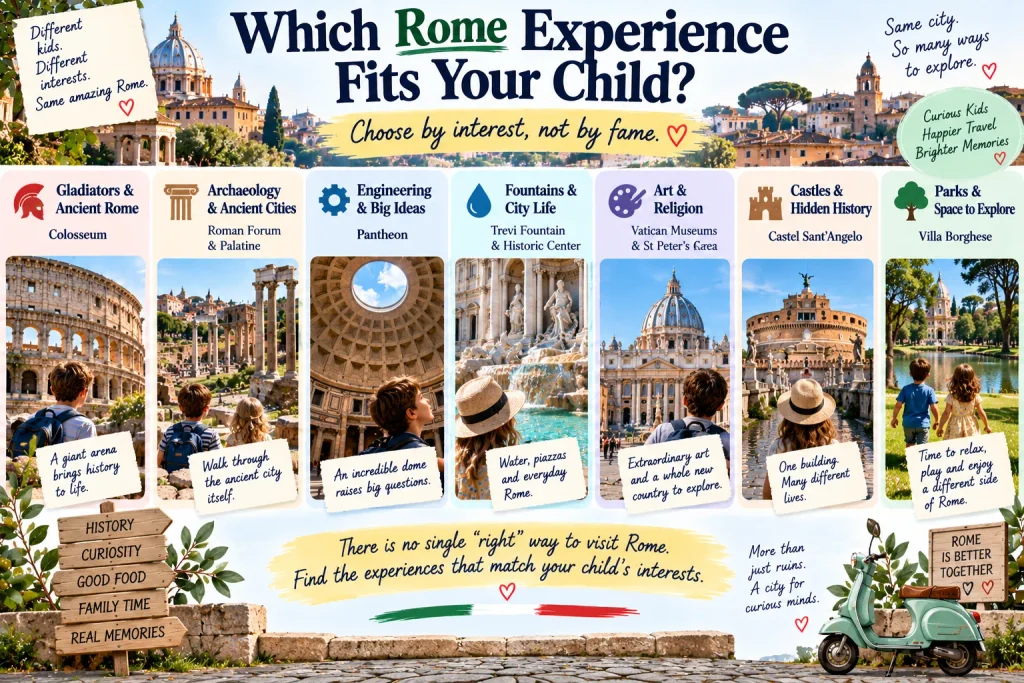
The point is not to complete the table.
Choose two or three themes that fit your children.
Rome becomes much easier after that.
The Best Way to Explain Rome to Kids: Think in Layers
Children often hear:
“Rome is really old.”
That is true but not particularly useful.
Instead, tell them:
“Rome is a city built on top of earlier versions of itself.”
Ancient Roman structures survive beside medieval buildings. Renaissance and Baroque architecture transformed other parts of the city. Modern streets, shops and homes continue around all of them.
Sometimes archaeologists literally excavate downward to find earlier Rome.
That gives children a simple mental model:
Modern Rome
sits above and beside:
Renaissance and Baroque Rome
which overlaps:
Medieval Rome
which grew around:
Ancient Rome
The layers are not perfectly stacked like a cake, but the idea helps children understand why one street can contain buildings separated by many centuries.
Rome Detective Question: Why Is Ancient Rome Sometimes Lower Than the Street?
Children may notice this around archaeological areas.
Modern Rome can sit at a different ground level from ancient structures.
Why?
Because cities change.
Buildings collapse or are demolished. New construction occurs. Materials accumulate. Streets are rebuilt. Urban levels can rise and change over centuries.
Do not give children the simplistic explanation:
“People just built another city on top.”
Rome’s development was much more complicated.
Instead ask:
“How many versions of this city might be underneath our feet?”
Now the pavement itself becomes interesting.
1. The Colosseum — Best for Making Ancient Rome Feel Real
For many families, the Colosseum is the obvious first major attraction.
That is not merely because it is famous.
Children can understand what it was for.
A giant amphitheater filled with spectators watching public spectacles is easier to visualize than the fragmented foundations of many ancient buildings.
But avoid turning the visit into a lecture about gladiator statistics.
Start with the building.
Ask This Before You Go Inside
Stand outside and ask:
“How would tens of thousands of people get into this building and find their places without phones, escalators or electronic tickets?”
Now look at the entrances.
Look at the internal circulation.
Look at the shape.
The Colosseum becomes an engineering problem.
The amphitheater was designed to manage enormous crowds using a sophisticated system of entrances, corridors, stairs and seating areas.
Children who thought they were visiting:
“the gladiator place”
are suddenly investigating crowd engineering.
Gladiators: Keep the Story Accurate
Gladiators are fascinating enough without turning them into movie characters.
They came from different backgrounds and circumstances. Some were enslaved, some prisoners, and others entered gladiatorial life under different conditions. Their experiences also varied across the long history of Roman spectacle.
Likewise, not every gladiatorial fight necessarily ended with one combatant dying.
For younger children, there is no need to dwell on graphic violence.
A better question is:
“Why would thousands of Romans want to watch these spectacles?”
That opens conversations about:
- entertainment
- politics
- status
- public life
- Roman values
- power
Now gladiators become a doorway into society rather than merely swords and helmets.
Should Families Book the Colosseum in Advance?
For a major attraction like the Colosseum, families should check the current official ticketing system and entry conditions for their exact dates.
Do not rely on an old travel article telling you tickets always open a certain number of days ahead or that one specific ticket type will always exist.
Ticket products, procedures and access conditions can change.
The useful rule is simpler:
If the Colosseum matters to your family, do not leave the ticket decision until you arrive in Rome.
Check the official system while planning the trip.
For current ticket options, availability and entry requirements, check the official Colosseum ticketing website before your visit.
Colosseum + Forum + Palatine: One Day or Separate?
They are geographically connected, which makes them look like one neat sightseeing package.
For adults interested in archaeology, that can work.
For children, it can also become:
ancient stone → ancient stone → ancient stone → ancient stone
for several hours.
Consider the children’s age, weather and enthusiasm before assuming that every family should explore all three intensively on the same day.
One strategy is to make the Colosseum the major commitment and treat the archaeological areas around it according to the family’s remaining energy.
Remember our Italy itinerary rule:
one major commitment does not mean only one activity.
It means only one activity gets to control the day.
2. Roman Forum — Best for Playing Ancient City Detective
The Roman Forum is simultaneously extraordinary and difficult for children.
Adults know they are standing in one of the most important spaces of ancient Rome.
Children may see:
broken columns and rocks.
The solution is not more dates.
Give them jobs.
Ask them to find evidence that this was once a functioning city center.
Look for:
- roads
- temples
- arches
- columns
- stairs
- public spaces
- different building levels
Then ask:
“What is missing?”
Ask children to imagine what has disappeared from the ruins around them. The original buildings had roofs, walls, painted surfaces and furnishings, while the streets were filled with people, voices and everyday activity. What survives today is only part of the ancient city, and understanding the rest requires imagination supported by archaeological evidence.
The archaeological remains are only part of the original city.
Children have to reconstruct the rest mentally.
That’s archaeology.
Don’t Tell Kids Ancient Rome Was White
This is one of the easiest misconceptions to create.
Modern children see pale stone ruins and imagine an ancient world of white buildings and statues.
Ancient Roman architecture and sculpture could include substantial color and decoration.
Weathering, burial, damage, reuse and centuries of change have altered what survives.
So when children look at a pale ruin, ask:
“Do you think it always looked like this?”
The answer is often no.
Ancient Rome was probably much more visually intense than the modern ruin suggests.
3. Palatine Hill — Best for Asking Why Powerful People Wanted a View
The Palatine is one of Rome’s most historically important hills and became strongly associated with imperial residences.
But with children, geography may be more useful than another list of emperors.
Look outward.
Ask:
“Why would powerful people want to live up here?”
Children may suggest:
- views
- security
- breeze
- status
- distance from crowded streets
Some answers may fit better than others historically, but the exercise teaches them to read landscape.
Power is not expressed only through crowns and statues.
Where someone builds can communicate power too.
The Heat Changes Everything
The Colosseum, Forum and Palatine can become much harder in hot weather.
There may be substantial walking and exposed areas.
That means the correct family plan in comfortable spring conditions may be the wrong plan during extreme summer heat.
Check current weather conditions and official visitor guidance, carry appropriate water, use shade where available and adjust the day when conditions demand it.
A prepaid ticket is not more important than sensible decisions about children and heat.
4. The Pantheon — Best Engineering Question in Rome
The Pantheon may be one of the easiest major Roman monuments to turn into a child’s question.
Walk inside.
Look up.
Then ask:
“Why doesn’t that roof fall down?”
The enormous concrete dome has survived for almost two thousand years.
At its center is the oculus, the circular opening to the sky.
Children do not need an engineering degree to understand that building such a huge dome without modern machinery was an extraordinary challenge.
Does Rain Come Through the Pantheon Roof?
Yes.
There is an opening.
Rain can enter through the oculus.
Then comes the better question:
“So where does the water go?”
Look at the floor.
The Pantheon includes drainage designed to deal with water entering the building.
One architectural feature has now created three questions:
Why is there a hole?
How does the dome stay up?
Where does the rain go?
That’s exactly how we want children to explore Rome.
5. Trevi Fountain — Best for Showing That Infrastructure Can Become Art
Children know the obvious part.
Throw a coin.
Make a wish.
But the more interesting story begins with water.
Rome has a long history of aqueduct engineering, and the Trevi Fountain is connected with the terminal area of the Acqua Vergine, whose ancient predecessor dates back to Roman times.
That means a spectacular Baroque fountain can lead backward to a Roman engineering question:
“How did ancient Rome move so much water without electric pumps?”
Now the fountain is more than decoration.
Don’t Make the Coin the Entire Experience
The coin-throwing tradition is fun.
But first ask children to look at the fountain itself.
What figures can they see?
Where is the water coming from?
How does the sound change as they approach?
Why build something this enormous around water?
Then explain the tradition.
Rituals are more interesting when children understand the place before performing the ritual.
Trevi Fountain with Kids: Expect Crowds
The Trevi area can become extremely busy.
That changes the family experience.
Keep younger children close, decide where adults will stand, and do not expect a peaceful photo session simply because you saw one online.
Current access arrangements around major Rome attractions can also change, so check official information close to your visit.
Rome is a real city managing enormous visitor numbers.
The travel plan has to acknowledge that.
6. Piazza Navona — Best for a No-Ticket Rome Experience
Not every memorable Rome experience requires a reservation.
Piazza Navona gives families a chance to observe the city without entering another attraction.
Walk around.
Look at the shape of the square.
Then tell children something surprising:
“This shape is a clue.”
The piazza follows the form of the ancient Stadium of Domitian, which once occupied the site.
Modern public space preserves the outline of an ancient structure.
This is Rome’s layers idea again.
The old city has not completely disappeared.
Sometimes its shape survives inside the new one.
A Shape Detective Game
Before telling children what was there, ask:
“Why do you think this piazza is so long and narrow?”
Let them guess.
Market?
Road?
Race track?
Palace courtyard?
Then reveal the ancient stadium connection.
This is much more memorable than:
“The Stadium of Domitian was built in…”
A question creates a reason to care about the answer.
7. Villa Borghese — Best for When Everyone Needs Rome to Stop Being Ancient
At some point, children may need:
After several hours of monuments and archaeological sites, children may simply need somewhere to move freely, enjoy open space and take a break from historical explanations. Villa Borghese provides that contrast, allowing families to slow down without leaving Rome.
Villa Borghese provides an important contrast to the dense historic center.
Families can use the park differently depending on age and interests, but its most important role in an itinerary may simply be allowing everyone to change pace.
This is not time stolen from sightseeing.
This is what makes more sightseeing possible later.
Should You Visit the Borghese Gallery with Kids?
That depends on the children.
The Galleria Borghese contains extraordinary art, but its fame does not automatically make it appropriate for every family itinerary.
If your children enjoy sculpture, mythology or art, it can become one of the trip’s major cultural experiences.
If they have already spent several days in museums, the park may be more valuable.
The correct decision is not:
“Is the Borghese Gallery worth visiting?”
Of course it is.
The correct question is:
“Is this the best use of our family’s limited Rome time?”
Those are very different questions.
8. Castel Sant’Angelo — Best for Kids Who Want Something That Looks Like a Fortress
Rome’s history rarely stays in one period.
Castel Sant’Angelo demonstrates that beautifully.
The structure began as the Mausoleum of Hadrian in the Roman imperial period and later took on defensive and papal roles over its long history.
So ask:
“Can one building have several completely different jobs?”
Absolutely.
Over the centuries, Castel Sant’Angelo evolved from an imperial mausoleum into a fortress and papal stronghold before eventually becoming the museum visitors explore today. Its changing functions make it an excellent example of how historic buildings can acquire new purposes over time.
The building becomes a timeline.
Find the Building’s Different Lives
Instead of explaining everything before entering, give children a mission.
Look for evidence that the structure was designed or adapted for:
burial
defense
power
residence
Then compare.
A building can survive precisely because later generations keep finding new uses for it.
That idea will appear again and again across Italy.
9. Vatican City — Is It Rome?
Here comes a geography question children usually enjoy.
You are visiting Rome.
Then you enter Vatican City.
Are you still in Italy?
No.
Vatican City is an independent sovereign state located within Rome.
That makes it an extraordinary opportunity to talk about:
- countries
- borders
- sovereignty
- religion
- geography
without needing a conventional border crossing.
Ask:
“How can one country fit inside one city?”
Now the map becomes part of the trip.
Vatican Museums with Kids: Less Can Be More
The Vatican Museums contain an overwhelming amount of art and history.
That is exactly why families should not approach them as:
“We paid for this, so we need to see everything.”
Choose a few things children can follow.
Maybe:
- maps
- animals
- mythology
- unusual details
- the Sistine Chapel
- one artist or story
The museum is too large for completion to be a useful family goal.
Success is leaving with two or three things children actually remember.
Before planning your visit, check the official Vatican Museums ticketing website for current admission options, reservations and visitor information.
The Sistine Chapel Problem
Adults may spend months telling children:
“We’re going to see Michelangelo’s Sistine Chapel!”
Then the child arrives tired after a long museum route.
That is not a moral failure.
It is itinerary design.
If the Sistine Chapel matters to the family, manage the day so children still have enough attention when they reach it.
And before entering, explain what they are looking for.
A child who knows one detail to find often looks much more carefully than a child instructed:
“Appreciate this masterpiece.”
St Peter’s Basilica Is a Different Experience
Do not mentally merge:
Vatican Museums
and:
St Peter’s Basilica
into one attraction simply because they belong to the same Vatican visit in your planning spreadsheet.
They involve different spaces, visitor flows and experiences.
For families, that matters.
Trying to complete an enormous museum visit and a major basilica experience while everyone is already exhausted can reduce both.
Decide what actually matters most to your family.
10. Rome’s Churches — Don’t Visit Ten Just Because They’re Important
Rome contains an extraordinary number of churches.
Many contain major works of architecture and art.
That does not mean children need to enter every famous one encountered during a walk.
Instead, give each church you deliberately visit a reason.
Maybe:
one has an extraordinary ceiling
one contains an artwork you want to find
one shows a different architectural period
one contains an unusual historical story
Now churches stop becoming interchangeable.
The same rule applies to adults, frankly.
The One-Church Challenge
Choose one church during the day.
Before entering, tell the children:
“Find one thing inside that you would show someone else.”
After leaving, everyone chooses.
It might be:
a painting,
a tomb,
a ceiling,
a sculpture,
a tiny detail,
or something completely unexpected.
There is no correct answer.
The exercise changes children from passive visitors into observers.
Rome Is Already Becoming a Detective City
By this point, notice what we have done.
The Colosseum became a crowd-engineering question.
The Forum became an archaeology puzzle.
The Pantheon became a dome experiment.
Trevi became a water story.
Piazza Navona became a shape clue.
Castel Sant’Angelo became a building with several lives.
Vatican City became a geography question.
That is the Travel With Kids World approach to Rome.
We are not simplifying Rome until nothing remains.
We are giving children a way into the complexity.
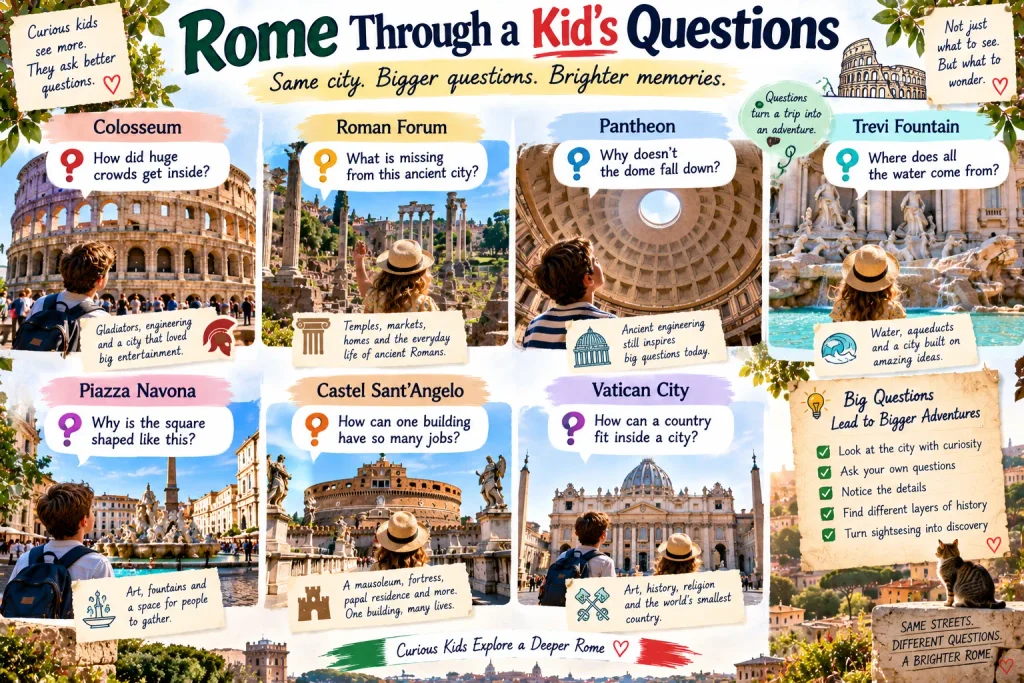
And now, we can move from Rome’s major monuments into something equally important: how to make the city actually work with children.
Rome with Kids by Age: The Same City Can Feel Completely Different
There is no meaningful answer to:
“Is Rome good for kids?”
without asking how old the children are.
A four-year-old, nine-year-old and fifteen-year-old can stand in front of the same Roman ruin and experience three completely different places.
That does not mean Rome needs separate itineraries for every age. It means parents should adjust the depth, pace and number of major attractions, rather than assuming children either “like history” or do not.
Rome with Toddlers and Preschoolers
With younger children, Rome is often less about explaining Roman emperors and more about making the physical city manageable.
Shorter sightseeing blocks matter. So do food breaks, shade, open space and accommodation location.
The good news is that Rome offers plenty that does not require a child to understand history first. Fountains move. Piazzas have space. The Colosseum looks enormous. Street life provides constant things to notice.
A preschooler does not need to understand the Roman Empire to think:
“That building is huge.”
Start there.
Don’t Build a Toddler Day Around Three Ticketed Attractions
Imagine:
Colosseum at 9:00.
Forum immediately afterward.
Museum after lunch.
Timed attraction in the afternoon.
On paper, that looks efficient.
With a young child, every reservation reduces flexibility.
Instead, anchor the day around one important experience and surround it with places where the family can adjust the pace.
For example, a Colosseum morning can be followed by lunch and a much looser afternoon rather than another demanding reservation.
Is Rome Stroller-Friendly?
The answer is neither a simple yes nor a simple no.
Rome contains smooth modern streets as well as cobbles, uneven surfaces, steps, archaeological areas and crowded historic spaces. Some routes are much easier with a stroller than others.
A lightweight stroller may be extremely useful for a child who cannot comfortably walk long distances, but parents should expect situations where lifting or navigating uneven surfaces becomes necessary.
For specific archaeological sites and museums, check current accessibility information before visiting rather than assuming the stroller can go everywhere.
Rome with Elementary-School Kids
This may be one of the easiest ages for turning Rome into a giant investigation.
Children can understand:
- gladiators
- emperors
- aqueducts
- roads
- gods and mythology
- archaeology
- ancient engineering
- volcanoes when Rome is combined with Pompeii
But resist the temptation to turn their interest into a history course.
Give them questions rather than chapters.
At the Pantheon:
“How would you build this roof?”
At the Forum:
“Which part of this ruined city would you most like to reconstruct?”
At a fountain:
“Where did all this water come from?”
The child begins doing the intellectual work.
Rome with Teenagers
Teenagers deserve more control.
Instead of announcing the entire itinerary, give them meaningful choices.
Would they rather explore:
Ancient Rome or the Vatican Museums?
Castel Sant’Angelo or another major museum?
A food-focused neighborhood walk or another archaeological site?
Some teenagers will love Roman history. Others may care much more about photography, food, fashion, football, contemporary neighborhoods or simply experiencing a major European city.
Rome does not need to be presented entirely as a school subject.
It is also a living capital.
How Many Days in Rome with Kids?
For many first-time families, three to four nights is a useful starting point, but the correct answer depends heavily on arrival time and priorities.
Three full sightseeing days can already support very different experiences. Four or more nights provide more flexibility for slower pacing, parks, museums or a day that does not need to justify itself with a famous monument.
Do not count a late arrival as a full Rome day.
Likewise, a morning departure does not magically contain another half-day of sightseeing.
Count usable time, not just hotel nights.
A 2-Day Rome Itinerary with Kids
Two days requires choices.
Do not attempt to create a compressed four-day itinerary.
A reasonable framework might be:
Day 1: Ancient Rome
Choose the Colosseum as the day’s major commitment, then explore the surrounding ancient area according to the children’s remaining energy.
Later, shift toward a less structured experience: dinner, a piazza or an evening walk.
Day 2: Historic Center + One Major Choice
Explore a route connecting places such as the Pantheon, Piazza Navona and Trevi Fountain, then choose either a substantial Vatican experience or another attraction that genuinely fits the family.
Trying to complete every major Rome icon in 48 hours will produce more movement than understanding.
A 3-Day Rome Itinerary with Kids
Three days creates a much better balance.
Day 1: Ancient Rome
Colosseum plus selected Forum/Palatine exploration.
Day 2: Vatican or Another Major Cultural Experience
Make this the day’s major commitment. Keep the remainder flexible.
Day 3: Rome as a City
Pantheon, piazzas, Trevi Fountain, Castel Sant’Angelo, Villa Borghese or another combination based on the family.
The third day is important because children finally experience Rome without every hour being dominated by a giant attraction.
A 4-Day Rome Itinerary with Kids
Four days allows each major experience to breathe.
One possible structure is:
| Day | Main Focus | Keep Flexible |
|---|---|---|
| 1 | Ancient Rome | Evening walk |
| 2 | Historic center | Food + piazzas |
| 3 | Vatican area | Rest of day according to energy |
| 4 | Family-choice Rome | Park, museum, castle or neighborhood |
The fourth day is deliberately not called:
“Everything We Forgot.”
Let the family choose.
That is what makes the extra day valuable.
Where Should Families Stay in Rome?
Do not choose accommodation solely by asking:
“What is the best neighborhood in Rome?”
The better question is:
“What will this location make easier for our particular itinerary?”
Families usually benefit from balancing three things: access to the places they want to visit, convenient transportation and an environment they are comfortable returning to after a long day.
A cheaper room that creates long, complicated journeys every morning and evening may not actually improve the family budget.
Historic Center: Best for Walking to Famous Rome
Staying around the broad historic-center area can make places such as the Pantheon, Piazza Navona and Trevi Fountain easier to reach on foot, depending on the exact accommodation.
The advantage is obvious: families can step outside and already be inside the sightseeing experience.
The trade-off can be price, crowds and the practical limitations of historic buildings.
Always evaluate the exact street and property rather than assuming a neighborhood label guarantees a particular experience.
Monti: Useful for Ancient Rome
Monti can appeal to families who want convenient access to the Colosseum area while still staying within a lived-in urban neighborhood.
Again, the exact accommodation matters more than the neighborhood name.
A property on one street may feel very different from another only a few blocks away.
When traveling with children, check the real walking route to transportation and attractions rather than relying on a map pin alone.
Prati: Useful for the Vatican Side of the City
Families prioritizing the Vatican may consider Prati and nearby areas.
This can make Vatican-focused mornings easier and provides a different atmosphere from the densest parts of the historic center.
But if most of your itinerary is around the Colosseum and southern parts of central Rome, the same location may create more daily travel.
There is no universally best family neighborhood.
There is only a location that fits the itinerary better or worse.
Near Termini: Transport Convenience Comes First
Accommodation around Roma Termini can make rail arrivals, departures and public transport connections convenient.
That can be particularly useful for families using Rome as part of a larger Italy itinerary.
However, do not book solely because the hotel says:
“Five minutes from Termini.”
Check the exact street, current reviews, walking environment and how often your family will actually need the station.
Station convenience is useful only if it solves a problem you genuinely have.
Rome’s Public Transport with Kids
Rome has metro, bus, tram and urban rail services, but families should not assume public transport removes the need to walk.
Many of Rome’s most rewarding historic-center experiences happen on foot.
The best approach is often to use transportation strategically for longer movements, then explore individual areas by walking.
Ticket rules, fares and age-based concessions can change, so check current official transport information before the trip rather than relying on a fixed fare quoted in an evergreen article.
For current public transport fares, routes and service information, visit ATAC Rome Public Transport.
Walking Is Part of the Rome Experience
A strange thing happens when planning Rome.
Walking is treated as the inconvenient space between attractions.
In reality, walking is one of the attractions.
This is when children encounter:
a column embedded in a later building,
a tiny fountain,
an unexpected church,
an ancient wall,
a street performer,
a strange inscription,
or a ruin nobody had planned to visit.
Do not optimize every walk out of the itinerary.
Just make sure children are physically capable of the amount you are asking them to do.
Rome Family Rule: Explore by Area
One of the easiest ways to create unnecessary exhaustion is crossing Rome repeatedly because attractions were chosen independently.
Instead, group experiences geographically where practical.
For example, Ancient Rome can form one cluster. The Pantheon–Piazza Navona area can become another walking period. Vatican-area attractions naturally create another part of the trip.
This reduces transportation and gives children a better sense of place.
Rome stops being:
“attraction → taxi → attraction → metro → attraction”
and starts becoming a city.
Eating in Rome with Kids
Food can provide the rhythm that holds the sightseeing day together.
Instead of treating meals as interruptions, use them to divide demanding activities.
A substantial morning attraction followed by lunch creates a natural reset. Gelato can become a reason to walk another few streets. Dinner can be the moment when everyone decides what they actually remember.
And children do not need a separate “kids’ Italy” menu to participate in Roman food culture.
They can explore ordinary local foods in manageable ways.
Don’t Tell Kids Every Italian Pasta Is the Same
One of the easiest cultural lessons in Italy is that food changes by region and city.
Rome has dishes strongly associated with its own culinary tradition.
Older children can compare what they eat in Rome with what appears later in Bologna, Naples, Tuscany or Sicily.
Ask:
“Why do different parts of one country eat differently?”
Geography, agriculture, history and local traditions all begin entering the conversation.
Food becomes another map.
The Rome Food Challenge
Instead of giving children a list of ten foods they “must” eat, let each child choose three discoveries during the trip.
For example:
one pasta dish they have never tried
one Roman snack or street-food experience
one dessert or gelato flavor
Afterward, ask them to rank only their own three choices.
This avoids pretending there is an objective:
“Best food in Rome for kids.”
Children have different tastes.
That is fine.
What About Picky Eaters?
Italy can feel reassuring because children may recognize foods such as pasta, pizza and bread.
But familiar names do not guarantee familiar preparation.
Do not turn every meal into a cultural test.
Let children try something new without requiring them to love it.
A useful family rule is:
one familiar element + one optional discovery
That creates participation without making dinner a negotiation about cultural authenticity.
Water in Rome: Look for the Nasoni
Children may notice small public drinking fountains around Rome, commonly called nasoni, or “big noses,” because of the shape of their spouts.
These can become one of the simplest recurring discoveries in the city.
Instead of buying another plastic bottle every time someone is thirsty, families can learn about Rome’s public drinking-water culture while following current local guidance on potable fountains.
More importantly, the fountains connect modern Rome with the city’s much older obsession with supplying water.
From Nasoni to Aqueducts
Ask children:
“Why has water been such a big deal in Rome for thousands of years?”
A large city needs enormous quantities of it.
Ancient Roman aqueduct systems transported water over long distances using carefully engineered gradients and infrastructure.
That water supported:
- drinking
- fountains
- baths
- households
- public facilities
Not every ancient Roman had a private tap.
But water infrastructure was one of the technologies that helped a huge city function.
Trevi Fountain suddenly belongs to a much bigger story.
Rome’s Best Free Activity: Look Up
Children spend a surprising amount of time looking at pavement, phones and adults’ backs.
In Rome, ask them to look up.
Find:
- domes
- balconies
- statues
- inscriptions
- coats of arms
- unusual windows
- rooftop details
- ancient fragments reused in later structures
Then choose the strangest thing.
This costs nothing.
It also teaches one of the most useful travel skills:
attention.
Rome Ancient City Detective: A Mini Challenge
We will eventually build this into a standalone DO article, but families can begin with a small version now.
During one day in Rome, see if the children can find:
- Something older than 1,000 years.
- A building that changed purpose.
- Evidence that modern Rome sits above ancient Rome.
- A source of public water.
- A Roman arch.
- Something with Latin writing.
- A dome.
- A place designed for a large crowd.
- Something ancient reused by later Rome.
- One thing nobody in the family can explain.
The tenth clue is the most important.
Photograph it where appropriate.
Investigate later.
Travel does not require parents to know every answer.
What If Your Child Says, “I Don’t Care About Roman History”?
Good.
Now you know something useful.
Do not spend the next four days trying to prove that the child is wrong.
Rome also contains:
- food
- parks
- fountains
- contemporary city life
- football culture
- art
- unusual transportation
- markets
- street scenes
- architecture
Find the child’s doorway into the city.
Then history may enter naturally through it.
A child interested in football can still walk past Roman walls.
A child interested in food can still discover ancient water systems.
A teenager interested in photography may notice architecture more carefully than someone completing a history worksheet.
What Should Families Skip in Rome?
This is one of the most important sections of the guide.
Skip anything that is on the itinerary only because somebody said it is essential.
That might be a famous museum.
Another church.
A distant attraction.
An extra archaeological site.
Even a world-famous monument can be skipped on a particular trip if reaching it damages the rest of the family’s experience.
Rome will survive your decision.
So will you.
Don’t Queue for a Photograph Your Children Don’t Want
Travel can become strange around famous sights.
Families wait.
Children get hot.
Someone becomes hungry.
Everyone reaches the front.
Parents say:
“Smile!”
Nobody is smiling.
If the photograph matters more than the experience leading to it, reconsider the plan.
Sometimes the better memory is eating gelato on a side street five minutes away.
A Good Rome Day Has Contrast
One useful pattern is:
major history → food → walking → something lighter
rather than:
museum → monument → church → archaeological site → museum
For example, a Colosseum morning can be followed by lunch and an unstructured historic-center evening.
A Vatican morning can be followed by Villa Borghese or neighborhood exploration.
The specific combination matters less than the contrast.
Children’s attention is a limited travel resource.
Spend it carefully.
Rome in Summer with Kids
Heat can fundamentally change the itinerary.
Exposed archaeological areas can become much harder during hot conditions, particularly around the middle of the day.
Families should check current forecasts and official health or site guidance, carry water, use shade and reconsider demanding outdoor plans during extreme heat.
This is not a small optimization.
Weather can determine whether a carefully planned Rome day works at all.
Rome in Rain
Rain does not automatically ruin Rome.
But wet surfaces, crowds and outdoor archaeological plans can become more complicated.
Keep alternative indoor experiences available without overbooking them in advance solely as backup.
A rainy day might shift attention toward a museum, church, food experience or another indoor site.
The useful skill is flexibility, not predicting the weather perfectly months in advance.
Rome with Kids: Common Mistakes
Trying to See Rome in One Day
You can see several famous things.
You cannot meaningfully experience Rome.
Booking Too Many Timed Attractions
Every reservation reduces flexibility.
Making Every Ruin a History Lesson
Let children observe before explaining.
Underestimating Walking
Map distance does not measure child energy.
Ignoring Heat
Summer pacing may need to be completely different.
Treating the Vatican as One Small Attraction
It can become a substantial part of a day.
Visiting Too Many Churches
Choose them for a reason.
Forgetting Parks and Unstructured Time
Children need changes of pace.
Making Food Another Checklist
Let children discover rather than complete.
Refusing to Skip Something Famous
Skipping can improve the trip.
FAQ: Rome with Kids
Is Rome good for kids?
Yes, particularly for children interested in ancient history, engineering, mythology, archaeology, art or food. The main challenge is pacing because Rome contains far more major attractions than most families can comfortably visit in one trip.
How many days should families spend in Rome?
Three to four nights is a useful starting point for many first-time families, but arrival times, children’s ages and sightseeing priorities matter. Families who prefer slower travel may benefit from longer.
Is the Colosseum worth visiting with children?
For many families, yes. Its scale and purpose are relatively easy for children to understand, and it can introduce Roman engineering, entertainment and public life.
Check current official ticketing and access information before visiting.
Is the Vatican suitable for kids?
It can be, but the Vatican Museums are extensive. Families usually benefit from choosing a limited number of things for children to notice rather than attempting to see everything.
Can you visit Rome with a stroller?
Yes, but families should expect uneven paving, steps and some routes or sites where stroller use is less convenient. Check accessibility information for specific attractions.
Is Rome too hot for kids in summer?
Rome can experience significant summer heat, and exposed sightseeing can become demanding. Families should monitor current conditions and adjust timing and activities accordingly.
What is the best area to stay in Rome with kids?
There is no single best neighborhood. The historic center can reduce walking to major sights, Monti can work well for Ancient Rome, Prati can be convenient for the Vatican, and areas near Termini can prioritize transport connections.
The exact property and itinerary matter more than the neighborhood name alone.
Do families need a car in Rome?
Most families visiting central Rome do not need a car for everyday sightseeing. Walking and public transportation are generally more practical for the historic center, while driving introduces parking and restricted-traffic considerations.
A car may become useful later if Rome is followed by countryside or regional travel, but there is usually little reason to rent one simply to move between Rome’s major central attractions.
Should You Take a Day Trip from Rome with Kids?
Rome has enough to fill several days, so a day trip should solve a specific travel goal rather than simply add another destination.
If your family has only two or three usable days in Rome, I would usually stay in the city. With four or five days, a day trip becomes easier to justify—particularly if it provides an experience that feels different from central Rome.
The important question is:
“What will this day trip give our children that we are not already getting in Rome?”
If the answer is simply “another famous place,” it may not be worth sacrificing a full Rome day.
Pompeii from Rome: Possible Does Not Mean Ideal
Pompeii is sometimes presented as an easy box to tick from Rome because fast trains connect Rome and Naples.
But families need to calculate the entire journey.
You still need to reach the Rome station, travel to Naples, continue toward Pompeii, enter and explore a very large archaeological site, then reverse the journey.
That can become a substantial day.
If Pompeii is one of the experiences your children are most excited about, I would rather give it enough time and consider incorporating Naples into the broader Italy itinerary than treat Pompeii as a rushed excursion simply because it is technically possible.
Ostia Antica Can Tell a Different Roman Story
Families interested in archaeology can also investigate Ostia Antica, the ancient port city associated with Rome.
This offers a useful question:
“What did a Roman city need besides temples and emperors?”
Children can begin thinking about trade, housing, streets, commerce and how goods reached a huge population.
It does not need to compete with Pompeii.
The two archaeological sites tell different stories.
The decision depends on the rest of your Italy route and how much archaeological time your children actually want.
The Appian Way: When the Road Becomes the Attraction
The Via Appia Antica offers another way to approach Ancient Rome.
Instead of standing inside one monument, families can investigate a road.
Ask:
“Why were roads so important to the Romans?”
The answer reaches far beyond travel.
Road networks supported military movement, administration, communication and trade across Roman territory.
For children who have already seen the Colosseum and Forum, this can broaden the story from:
Rome the city
to:
Rome connected to an empire.
Rome Doesn’t Need to Be Educational Every Minute
This point matters for Travel With Kids World.
We want children to understand what they see.
That does not mean parents need to turn every gelato, fountain and street corner into a lesson.
Sometimes a fountain is just fun.
Sometimes lunch is just lunch.
Sometimes children should run around a park without hearing:
“Did you know that in 1471…”
Curiosity works better when it has space.
If children ask a question, follow it.
If they do not, let Rome happen around them for a while.
A Simple Rome Family Day Formula
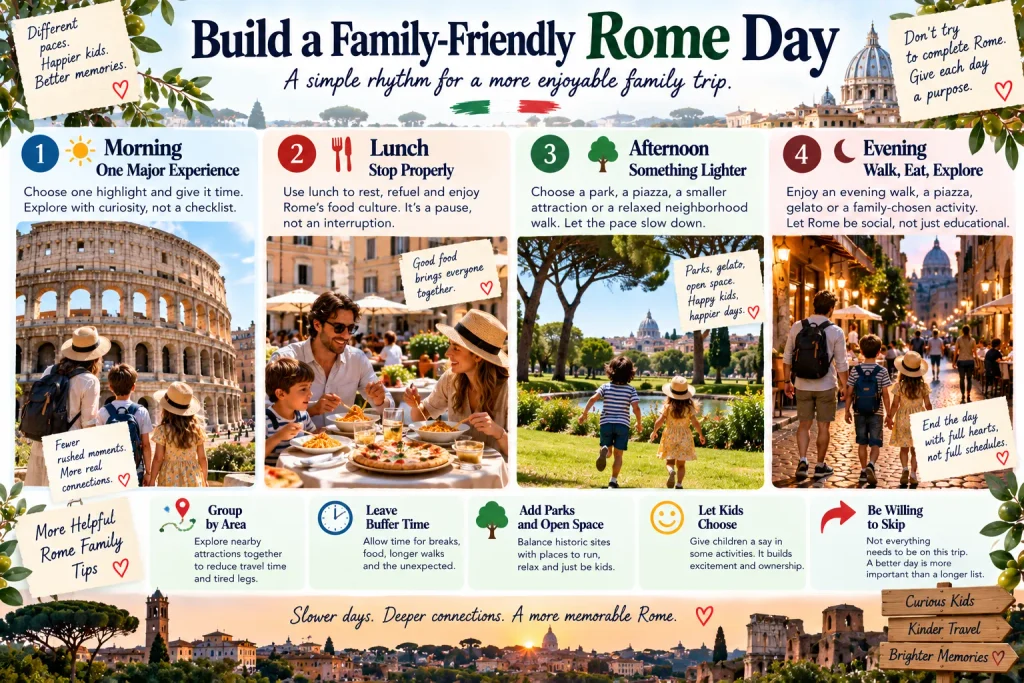
If the amount of planning still feels overwhelming, use this structure as a starting point:
Morning
Choose the day’s one major experience.
That could be the Colosseum, Vatican Museums, a major museum or another high-priority attraction.
Lunch
Stop properly.
Do not make food something consumed while rushing to the next reservation.
Afternoon
Choose something lighter or more flexible: a piazza, park, neighborhood walk, fountain, smaller attraction or family-selected activity.
Evening
Let Rome become social rather than educational.
Walk.
Eat.
Find gelato.
Return to a piazza everyone liked.
This is not the only way to visit Rome.
It is simply a useful antidote to the urge to schedule four major attractions every day.
The Rome “One Big Question” Challenge
At the beginning of each day, give the children one question.
Not ten.
For example:
Ancient Rome Day
How did a city this large work without modern technology?
Vatican Day
Why did people spend so much time and money creating this art?
Historic Center Day
How many different versions of Rome can we find in one walk?
Food Day
What makes Roman food different from food elsewhere in Italy?
At dinner, return to the question.
Nobody needs a perfect answer.
The goal is to give children something to notice during the day.
Create a Rome Time-Layer Challenge
Rome is particularly good for another game.
During one walk, try to find evidence from different periods.
Children might encounter:
Ancient Rome
then:
Medieval Rome
then:
Renaissance or Baroque Rome
then:
Modern Rome
Do not expect them to identify every building correctly from appearance alone.
Instead, use plaques, museum information and reliable sources to investigate.
The challenge is not:
“Guess the century.”
It is:
“Can we prove that several different Romes exist on the same street?”
That is a much more useful historical skill.
Let the Child Become the Rome Guide
At the end of the trip, reverse roles.
Ask each child to choose one Rome place and explain it to the family.
They can choose anything.
The Colosseum.
Pantheon.
A fountain.
A piazza.
A church.
A park.
A food they tried.
Even a strange object they noticed on a wall.
Give them three questions:
What is it?
Why was it interesting?
What should another child notice there?
Now you find out what actually survived from the trip.
The answer may surprise you.
What Is Actually Worth Paying for in Rome with Kids?
There is no universal list.
A family fascinated by gladiators may consider the Colosseum essential.
An art-focused teenager may get far more value from a museum.
Another child may remember a paid attraction less vividly than exploring fountains and piazzas for free.
So evaluate tickets using three questions:
Does this provide something we cannot experience simply by walking around Rome?
Does it match something our children actually care about?
Do we have enough energy and time to enjoy it properly?
If the answer to all three is yes, the ticket probably has a meaningful role in the itinerary.
Free Rome Is Still Real Rome
Families sometimes worry that skipping expensive attractions means they are not experiencing enough.
Rome is unusually generous in this respect.
Simply walking through the city can reveal monumental architecture, public squares, fountains, ancient fragments and layers of urban history.
A family can spend meaningful time around places such as Piazza Navona, the Trevi area and many historic streets without turning every hour into another admission fee.
That can also help the budget.
More importantly, it creates space for observation.
How to Prevent “Old Building Fatigue”
Eventually a child may say:
“It’s another old building.”
That is useful feedback.
Stop categorizing attractions by importance.
Categorize the next experience by difference.
After ruins, choose a park.
After a museum, choose food.
After a church, investigate a fountain.
After a long walk, sit in a piazza.
After a history-heavy morning, let the children choose the afternoon.
The solution to cultural fatigue is not always a better explanation.
Sometimes it is simply contrast.
Rome with Siblings of Different Ages
This is where family travel becomes more complicated.
The younger child may need a park.
The older child may want the Vatican Museums.
A teenager may want time away from another guided history experience.
You do not always need one activity that perfectly satisfies everyone.
Sometimes the better strategy is alternating priorities.
One major adult/older-child cultural experience can be followed by something easier for the younger child. Where appropriate for the family, adults can occasionally divide activities and meet again later.
Fair does not have to mean identical.
Don’t Judge the Trip by How Much You Completed
At the end of Rome, you may have missed:
a museum,
three churches,
a famous viewpoint,
another archaeological site,
and something somebody on social media called:
“ABSOLUTELY UNMISSABLE.”
That’s fine.
Ask instead:
Did the children understand why the Colosseum was extraordinary?
Did they notice that ancient Rome exists inside modern Rome?
Did they discover something about water?
Did they find a favorite piazza?
Did they try something new?
Did they ask a question you had not expected?
If yes, Rome worked.
Final Thoughts: Rome Is Better When Children Have Something to Look For
Rome can overwhelm adults because we know how important everything is supposed to be.
Children do not arrive with that burden.
They see:
a broken column,
a giant dome,
a fountain,
a strange inscription,
a castle,
a hole in a roof,
an enormous amphitheater.
And they ask much simpler questions.
“Why is that broken?”
“How did they build that?”
“Where does the water come from?”
“Why is there a country inside Rome?”
Those questions are not interruptions to the sightseeing.
They are the sightseeing.
The goal of visiting Rome with kids is not to compress 2,000 years of history into a family vacation.
Choose a few important places.
Give each one a question.
Leave room between them.
Let the children notice things you did not put on the itinerary.
And when they become tired of ancient ruins, stop looking at ancient ruins.
Rome will still be there tomorrow.
A child who remembers why one building fascinated them has taken more from the city than a child dragged through twelve monuments whose names have already blended together.
So do not ask:
“Did we see everything?”
Ask:
“What did you notice?”
That is where Rome becomes theirs.
Continue Exploring Italy with Kids
15 Best Places to Visit in Italy with Kids
Still deciding where Rome belongs in the wider trip? Start with 15 Best Places to Visit in Italy with Kids: Which Destination Is Right for Your Family? to compare Rome with Venice, Florence, Lake Garda, the Dolomites, Sicily, Sardinia and other family destinations.
Italy Family Itinerary with Kids
Use Italy Family Itinerary: 7 Days, 10 Days & 2 Weeks with Kids to connect Rome with Florence, Venice, Tuscany, Naples or other regions without turning the vacation into constant hotel changes.
Why Is Venice Built on Water?
Heading north after Rome? Why Is Venice Built on Water? The Floating City Explained for Kids turns Venice’s canals, foundations, bridges and lagoon into the next big question children can investigate.
Coming Next: Rome Ancient City Detective Challenge
Our upcoming Rome Ancient City Detective Challenge for Kids will turn the Colosseum, Roman roads, aqueducts, Latin inscriptions and Rome’s historical layers into a city-wide observation game families can use while exploring.