
The most useful Spain family travel tips are not about finding one more attraction.
They are the small things that prevent a good family itinerary from becoming unnecessarily difficult.
Spain is generally straightforward to travel around as a family, but some parts of the trip may work differently from what you expect at home.
Dinner can happen later.
A famous attraction may require advance booking.
A train journey that looks simple on a map may leave from a station you did not expect.
Barcelona can feel culturally different from Madrid.
The weather in Bilbao can have very little in common with the weather in Seville.
And a perfectly reasonable sightseeing plan can become miserable if you ignore the afternoon heat.
Before traveling to Spain with kids, I would spend less time trying to memorize every attraction and more time understanding how the trip will actually work.
These are the things I would want sorted out before departure.
Quick Answer: What Should Families Know Before Visiting Spain?
If your flight leaves tomorrow, start with these.
- Book priority attractions before the trip.
- Do not assume Spain has one climate.
- Expect meals—especially dinner—to run later than in some countries.
- Keep children’s hunger separate from Spanish restaurant schedules.
- Use trains strategically rather than automatically renting a car.
- Check child-seat requirements before renting a vehicle.
- Plan around heat in warmer regions and seasons.
- Keep valuables controlled in crowded tourist areas.
- Know what your travel insurance actually covers.
- Do not expect every region of Spain to look, sound, or identify in exactly the same way.
- Leave space in the itinerary.
- Confirm current opening hours, transport schedules, and entry rules shortly before visiting.
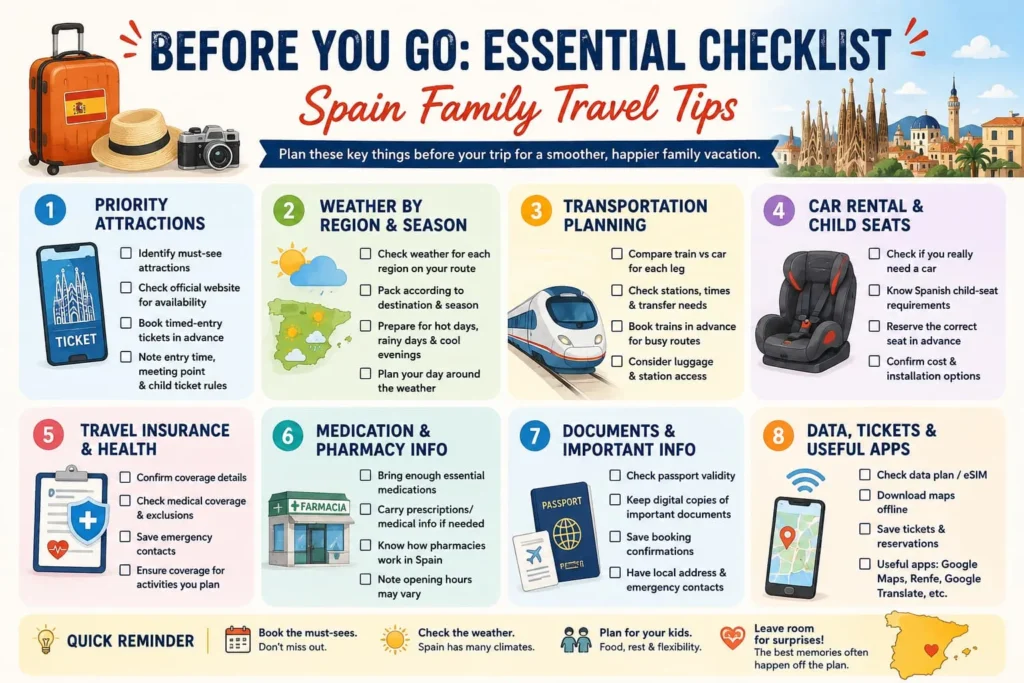
You do not need to become an expert on Spain before taking your children there.
You just want to eliminate the avoidable surprises.
1. Book the Attractions Your Family Would Be Genuinely Upset to Miss
Do not reserve every hour of the vacation.
But do not leave your family’s most important attraction entirely to chance either.
Spain has several famous places where timed entry or limited availability can shape the day.
The exact booking situation can change, so I would identify the two or three experiences that actually matter most before departure and check their official booking systems.
For example, if your entire family has been talking about the Alhambra, that should influence which day you are in Granada.
If Sagrada Família is the reason your child is excited about Barcelona, check availability before building the rest of that Barcelona day.
The mistake is going to either extreme:
Nothing booked → important attraction unavailable
or:
Everything booked → family trapped inside a timetable
I prefer a few anchor reservations surrounded by flexible time.
2. Use Official Websites for Important Tickets
When an attraction is important enough to organize the itinerary around, I would start with its official website.
Search results can contain:
- official tickets
- authorized sellers
- guided tours
- third-party resellers
- advertisements that look very similar to official results
Third-party tours can be useful when you deliberately want a tour.
The problem is accidentally paying a premium because you thought you were buying ordinary admission.
Before paying, check:
Who am I actually buying this from?
Also check:
- cancellation conditions
- child ticket rules
- required identification
- entry time
- meeting point
- whether the ticket includes the part of the attraction you actually want
Five minutes of reading before payment can prevent a much more annoying conversation at the entrance.
3. Spain Does Not Have One Climate
Do not pack or schedule the trip based on the word Spain.
A summer family itinerary through Andalusia requires different planning from a summer route through the Basque Country and Galicia.
Likewise, winter in Madrid is not a beach vacation simply because Spain is in Southern Europe.
Before departure, check the weather for the actual destinations on your route.
Not just Madrid.
Not just Barcelona.
And not a generic national forecast.
This is also why our Spain Family Packing List: What to Pack for Spain with Kids (2026) changes the packing strategy according to region, season, and itinerary rather than treating the entire country as one climate zone.
4. In Hot Weather, Change the Day—not Just the Clothes
When temperatures become intense, especially in inland Southern Spain, I would change the itinerary itself.
A practical family rhythm can look more like:
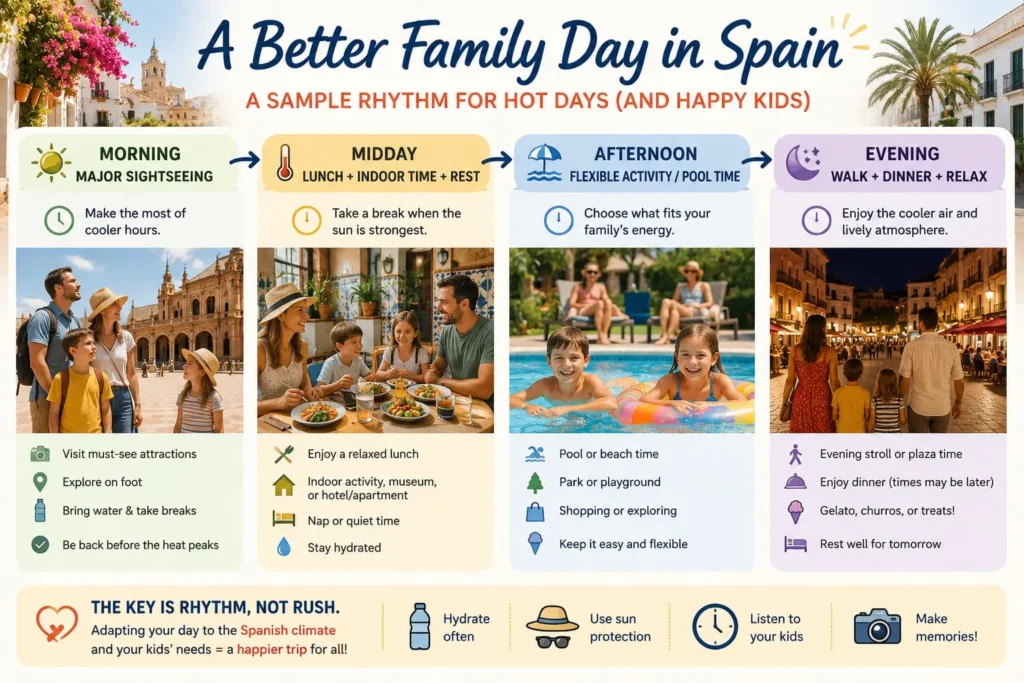
Morning → important sightseeing
Middle of the day → lunch / indoor time / hotel / pool / rest
Later afternoon and evening → return outside
That does not mean every Spanish family follows one identical schedule or that every summer day will be extremely hot.
It means your itinerary should react to actual conditions.
If the forecast is uncomfortable for a long outdoor afternoon, move the outdoor activity.
Do not insist on following a schedule created three months earlier because the spreadsheet says 2:00 PM — walking tour.
Our Southern Spain Family Itinerary: 4 Days, 7 Days & 2 Weeks with Kids goes deeper into building a family route that can adapt to heat rather than merely enduring it.
5. Spanish Meal Times Can Surprise Families
One of the first practical differences many visiting families notice is timing.
Lunch can happen later than some international visitors expect.
Dinner can happen considerably later.
That does not mean you need to force a hungry seven-year-old to wait until late evening because you want to “eat like a local.”
Separate the cultural experience from the child’s biological reality.
A family can:
- have a substantial afternoon snack
- eat when the children need to eat
- choose cafés or restaurants serving food at a convenient time
- let children eat something earlier and adults eat more later
- use an apartment kitchen when useful
Hungry children do not become culturally enlightened because dinner is delayed.
Build the food schedule around the family.
Then enjoy Spanish dining culture where it fits naturally.
6. Carry Emergency Snacks—but Don’t Pack a Supermarket
A few familiar snacks can save a travel day.
They are useful during:
- flights
- train journeys
- attraction queues
- delayed meals
- road trips
- the first hours after arrival
But you do not need two weeks of snacks in the suitcase.
Spain has supermarkets, bakeries, cafés, markets, and ordinary food shops.
Bring enough to survive the awkward moments.
Then buy more locally.
If a child has significant allergies or medically necessary dietary restrictions, that is different. Research the specific food situation and communication needs before traveling rather than relying on generic snack advice.
7. A Kitchen Can Be More Valuable Than a Bigger Hotel Lobby
For longer family trips, I would at least compare apartments and aparthotels with conventional hotels.
A kitchen can solve:
- breakfast
- early child meals
- snacks
- fruit
- drinks
- simple dinners
- food for picky eaters
And a washing machine can change how much luggage you need.
That does not mean apartments are always better.
A well-located hotel with breakfast, housekeeping, and useful facilities may be worth paying more for.
Compare what actually makes the family trip easier rather than choosing accommodation by category.
Our Spain Family Travel Budget: How Much Does a Trip to Spain Cost with Kids? (2026) explains why accommodation location, room configuration, kitchen access, and laundry can affect the total cost far beyond the nightly rate.
8. Do Not Change Hotels Just Because Another City Is Famous
Spain makes this mistake very easy.
Madrid sits near Toledo and Segovia.
Barcelona connects naturally with other Catalan destinations.
Andalusia seems to offer another extraordinary city every couple of hours.
But every additional overnight destination creates:
packing → checkout → station/parking → transportation → luggage → check-in → unpacking
For adults traveling alone, that may be manageable.
With children, the hidden time becomes significant.
Ask:
Does sleeping here improve the trip?
Sometimes the answer is yes.
Other times, a day trip or simply skipping the destination creates a better vacation.
If you are still deciding which places genuinely deserve part of the route, our Best Places to Visit in Spain with Kids guide can help you narrow the list before you start booking hotels.
9. Trains Are Excellent—but Check the Actual Journey
Spain’s rail network makes many family routes practical without a car.
But do not plan based only on:
“There is a train between these cities.”
Check:
- departure station
- arrival station
- journey time
- transfer requirements
- ticket conditions
- luggage needs
- how you reach the station from your accommodation
- how you reach the next hotel after arrival
For a family, hotel-to-hotel time matters more than train time.
A fast train can still create a long transfer if both stations are inconvenient for your itinerary.
And a slightly slower direct journey can sometimes be easier than a theoretically faster route involving changes and luggage.
10. Do Not Rent a Car for the Entire Trip by Default
A rental car can be extremely useful in Spain.
It can also spend several expensive days sitting in a city garage.
I would divide the itinerary into:
sections where a car solves problems
and:
sections where a car creates problems.
A car can make sense for:
- rural areas
- some coastal exploration
- white villages
- certain road trips
- flexible regional travel
It may add much less value while you are staying in central Madrid or Barcelona.
Rent it when you need it.
Return it when you don’t.
That approach can reduce both cost and stress.
11. Check Child-Seat Rules Before Renting the Car
Do not leave this until you reach the rental desk.
Spain has legal requirements concerning child-restraint systems, and the correct restraint depends on the child and circumstances.
Before the trip:
- check the current Spanish rules
- confirm what the rental company provides
- reserve the required seat if necessary
- check whether the quoted rental price includes it
- verify that the seat is appropriate for the child
Do not rely on an old travel-blog summary for a safety requirement.
Use current official guidance.
If you bring your own child seat, also consider airline handling and whether the seat is suitable for the vehicle and use you are planning.
12. Do Not Assume Every Taxi or Transfer Solves the Child-Seat Question
This is another area where families should check rather than assume.
Rules, exemptions, vehicle types, and available child restraints can vary depending on the service and journey.
If having a specific child seat is important for your family, arrange it in advance with the transport provider rather than discovering the situation when the vehicle arrives.
For airport transfers in particular, I would rather resolve this before the flight than negotiate it outside the terminal with tired children and luggage.
13. Keep the First Day Deliberately Easy
Arrival day is not a bonus sightseeing day.
Even when the flight lands at noon, the family still has to:
- get off the plane
- collect luggage
- travel into the city
- find accommodation
- check in or store bags
- eat
- orient themselves
Add jet lag when relevant.
Then ask whether the family really needs a timed museum reservation that afternoon.
I would use arrival day for something flexible:
a neighborhood walk, park, plaza, waterfront, early meal, or simply settling in.
Arriving in Spain is already an activity.
14. Protect One Flexible Block Every Few Days
This is one of the most useful things you can put into a family itinerary:
nothing.
Not an attraction.
Not a tour.
Not a train.
Just an uncommitted morning or afternoon.
That space can become:
- the beach everyone loved
- a missed attraction
- a rainy-day replacement
- pool time
- shopping
- laundry
- a nap
- a playground
- absolutely nothing
A flexible block makes the rest of the itinerary stronger because every small disruption no longer creates a chain reaction.
It is not wasted vacation time.
It is itinerary insurance.
15. Spain Is Multilingual—and Kids Will Notice
Your child may learn Spanish before the trip and then arrive in Barcelona to see Sortida instead of Salida.
In Bilbao, the words can look completely different again.
That is normal.
Spanish is the official language of the state, while several regions also use co-official regional languages, including Catalan/Valencian, Basque, and Galician.
You do not need to learn all of them before traveling.
But understanding why they appear makes Spain much easier—and more interesting—to understand.
Our Languages in Spain: Why Does Spain Have So Many Languages? guide explains why Barcelona, Bilbao, Santiago, Valencia, and other parts of the country can sound linguistically different even though your family never crossed an international border.
16. Learn the Two-Name City Problem Before It Confuses You
Regional languages can also affect place names.
For example:
San Sebastián / Donostia
Girona / Gerona
Lleida / Lérida
A Coruña / La Coruña
València / Valencia
You may encounter one form on a map and another on a sign or transport system.
That does not necessarily mean you have found a different destination.
If a place name looks unfamiliar, check whether you are seeing its regional-language form before panicking about the reservation.
This is a tiny piece of knowledge that can remove a surprising amount of travel confusion.
17. Do Not Treat Spain’s Regional Differences as Inconveniences
The food changes.
Languages change.
Architecture changes.
Climate changes.
Regional identities change.
Even football culture changes.
That is one of the reasons Spain works so well for a longer family trip.
Madrid is not Barcelona with different monuments.
Bilbao is not Madrid with more rain.
Seville is not Valencia without a beach.
Let the regions be different.
Children often notice those differences faster than adults because they are not trying to force every destination into a preconceived image of Spain.
Use that curiosity.
It can turn the trip into something much richer than a series of attractions.
18. Keep Valuables Controlled in Crowded Tourist Areas
Spain is not a destination where I would want families spending the entire vacation worrying about crime.
But ordinary travel precautions still matter.
Crowded public transportation, stations, major attractions, busy plazas, and heavily visited areas are exactly where distracted travelers can become easier targets for theft.
With children, distraction is almost guaranteed.
Someone needs water.
Someone drops something.
Someone wants to know where the bathroom is.
Meanwhile, a phone may be sitting on the edge of a table and a backpack may be hanging open.
I would keep the system simple:
- close bags properly
- keep wallets and phones controlled
- avoid putting valuables in easy-to-access outer pockets
- do not leave phones unattended on café tables
- keep passports secure when you do not need them
- pay extra attention during crowded boarding and transfers
The goal is not fear.
It is making basic precautions automatic enough that you can concentrate on the trip.
19. Have a Plan for Passports and Important Documents
Do not carry every important family document loose in one backpack.
Before departure, decide:
what stays with you
and:
what can remain securely stored
Keep access to:
- passport details
- insurance information
- transportation bookings
- accommodation details
- emergency contacts
- any essential medical documentation
Secure digital copies can also be useful if the originals are lost, although copies do not replace original travel documents where originals are required.
The important part is having a recovery plan before you need one.
20. Know What Your Travel Insurance Actually Covers
Buying travel insurance and understanding travel insurance are not the same thing.
Before departure, check the policy for the things that actually matter to your family.
That may include:
- emergency medical treatment
- trip cancellation or interruption
- delayed or lost baggage
- transportation disruption
- activities you plan to do
- existing exclusions
- deductibles or excess
- how to contact the insurer
- what documentation is required for a claim
Do not assume that having a policy means every travel problem is covered.
Likewise, travelers with access to European health coverage should understand what that coverage does and does not replace.
The correct preparation depends on where your family lives and the coverage you already have.
21. Know How Pharmacies Work Before You Need One
You will see pharmacies throughout Spain, typically marked by a green cross.
For minor travel health needs, a pharmacy can be an important first stop.
But do not assume that:
- every medication uses the same brand name as at home
- every medicine available at home is available the same way in Spain
- a pharmacist can replace every prescription
- opening hours are identical everywhere
If your child relies on an important medication, bring an appropriate supply rather than planning to replace it after arrival.
Keep relevant prescription or medical information where appropriate.
And for an urgent or serious medical situation, seek appropriate medical care rather than treating a pharmacy as a substitute for emergency services.
22. Save 112 in Your Phone
The general emergency number in Spain and across the European Union is:
112
It can be used for urgent situations requiring services such as police, ambulance, or fire assistance.
You hopefully will never use it.
Save it anyway.
Parents already keep enough information in their heads during a trip.
An emergency number does not need to be one more thing to remember under stress.
23. Do Not Build Beach Safety Around the Word “Safe”
A beach that worked beautifully yesterday can have different conditions today.
Weather changes.
Waves change.
Currents change.
Beach services can also vary by location and season.
So instead of searching for the “safest beach in Spain,” I would teach the family to look at the beach they are actually visiting.
Check:
- posted flags
- local warnings
- weather and sea conditions
- lifeguard information where available
- swimming zones
- any instructions posted on site
And do not assume that because many families are in the water, conditions are automatically appropriate for your child.
Current local information matters more than a permanent label in a travel article.
24. Build Beach Days Around the Child, Not the Sun
A family can be at the Mediterranean without spending six continuous hours exposed to the sun.
Depending on conditions and the children, a better beach day may be:
morning at the beach → lunch → rest/pool/indoor time → evening walk
or another rhythm that works for you.
Bring appropriate sun protection and water, but also use shade and timing.
Young children do not need to endure the hottest part of the day because the family reserved a “beach day” on the itinerary.
The beach will still be there later.
25. Sunday and Holiday Plans Deserve a Quick Check
Do not assume every shop, attraction, market, restaurant, or service operates on the same schedule every day.
Opening patterns can vary by:
- city
- attraction
- season
- day of the week
- public holiday
- local holiday
This matters particularly when one specific attraction or shop is important to your itinerary.
Before the trip—and again shortly before the visit—check the official information.
The same applies to transportation schedules.
A beautifully planned Sunday morning does not help if the place you built it around is closed.
26. Local Festivals Can Improve—or Complicate—the Trip
A festival can become one of the most memorable parts of a family trip.
It can also change:
- accommodation prices
- traffic
- public transportation
- opening hours
- crowds
- road access
- restaurant availability
If your dates coincide with a major local event, do not automatically avoid it.
Just understand what it changes.
Sometimes the festival is exactly why you should go.
Other times, a family with young children may prefer a quieter date.
The important thing is knowing before you arrive.
27. Download the Things You Will Need Before You Need Them
Do not make every travel function dependent on perfect mobile data.
Before leaving the hotel or while you have reliable Wi-Fi, consider having access to:
- transportation tickets
- attraction tickets
- hotel address
- booking confirmations
- useful maps
- airline information
- rental-car details
- insurance contact information
Screenshots or offline access can be useful when an app logs you out, reception disappears, or someone else’s phone has the reservation.
This is especially useful when one parent’s phone has somehow become the family’s:
map + wallet + camera + ticket office + translator + restaurant guide + entertainment system.
Spread critical information where sensible.
28. Give Older Kids a Role in the Trip
Family travel becomes easier when children are not simply passengers being transported through an adult itinerary.
Depending on age, let them take responsibility for something manageable.
A child might:
- find the next attraction on the map
- choose between two lunch options
- check which metro stop you need
- choose one souvenir
- decide between beach and park time
- learn a regional word
- photograph one thing they found interesting
Teenagers can take on more.
The goal is not free labor.
It is ownership.
A child who helped choose the day is often much more interested in living the day.
29. Do Not Make Every Day Educational
Spain gives parents endless opportunities to teach children things.
Roman history.
Islamic architecture.
Medieval kingdoms.
Art.
Language.
Religion.
Food.
Regional identity.
That does not mean every building requires a lecture.
Sometimes children need to run through a park.
Sometimes they want ice cream.
Sometimes the castle is interesting because it looks like a castle—not because they understand the political history behind it.
Let learning happen naturally.
A few good stories can be more memorable than an hour of facts.
That is also why we will continue adding family-friendly stories and cultural explainers to Travel With Kids World: material parents can use when children actually become curious, rather than turning the entire vacation into school.
30. Let Children Remember a Different Spain Than You Do
Adults may return home remembering the Alhambra.
A child may remember the hotel breakfast machine.
You may remember Gaudí.
They may remember a pigeon in Plaça de Catalunya.
You may remember the Prado.
They may remember the playground after the museum.
That is not a failed cultural experience.
It is how childhood memory works.
Build the important experiences into the itinerary.
Then leave enough ordinary life around them for children to create their own version of Spain.
What I Would Arrange Before Leaving Home
If I were reducing all of this to one pre-departure checklist, I would confirm these before the flight.
Essential
- passports and required travel documents
- travel insurance / health coverage
- essential medication
- first accommodation
- airport or station arrival plan
- important transportation bookings
- priority attraction reservations
Strongly Worth Checking
- weather for each region
- rental-car and child-seat arrangements
- major train journeys
- local events during your dates
- opening days for must-see attractions
- phone/data plan
- payment cards
- luggage allowances
Useful but Flexible
- restaurant ideas
- secondary attractions
- beach choices
- shopping
- detailed daily schedules
Do not give all three categories equal emotional importance.
A restaurant choice can change.
A missing passport cannot.
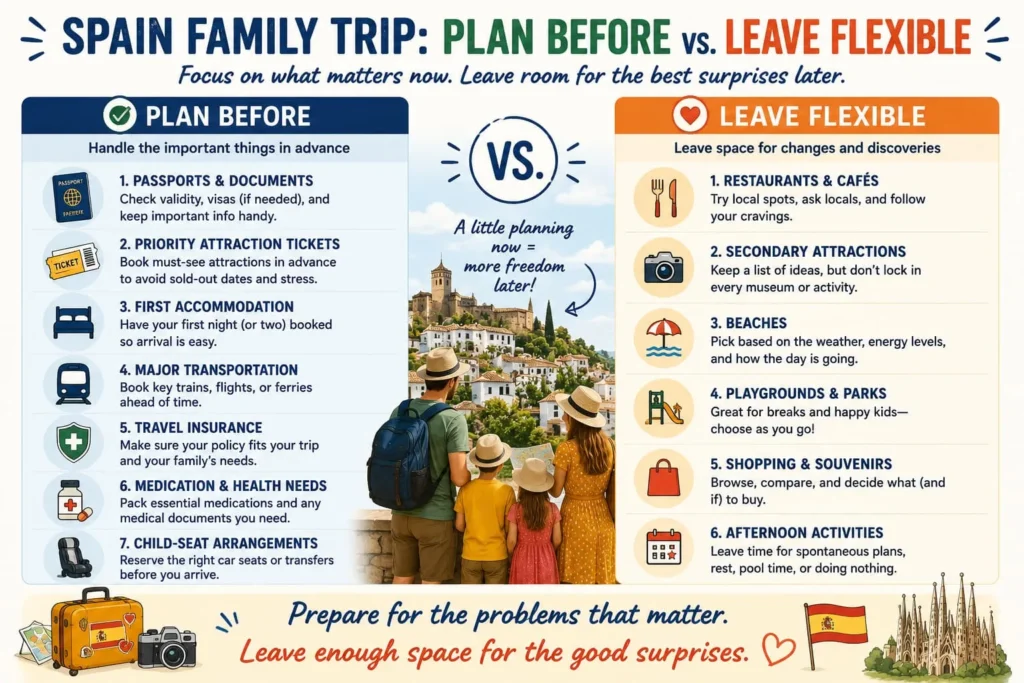
What I Would NOT Plan Before Leaving Home
You do not need to know:
- every restaurant
- every café
- every beach
- every playground
- every meal time
- every souvenir shop
- every afternoon activity
Leave something for Spain to decide.
Weather changes.
Children change their minds.
You discover places.
You get tired.
A recommendation from someone you meet may be better than the one you saved six months earlier.
Planning should remove stress, not remove spontaneity.
Common Spain Family Travel Mistakes Before Departure
1. Booking Every Hour
A few anchor reservations are useful.
A vacation made entirely of timed entries is fragile.
2. Assuming Spain Is Always Hot
Check your actual destinations and dates.
3. Expecting Children to Adapt Instantly to Late Meals
Use snacks and flexible meal planning.
4. Renting a Car Before Deciding Whether You Need One
Build the route first.
5. Ignoring Child-Seat Logistics
Resolve this before arriving at the rental desk or transfer pickup.
6. Changing Hotels Too Often
Every additional base has a logistical cost.
7. Treating Every Region Like the Same Spain
Language, climate, food, identity, and travel rhythm can change substantially.
8. Packing Too Much
If this is becoming a problem before departure, use our Spain Family Packing List: What to Pack for Spain with Kids (2026) to reduce the luggage before it begins controlling the itinerary.
9. Planning Without a Working Budget
Accommodation, transportation, attractions, and restaurant habits can change the cost dramatically.
Our Spain Family Travel Budget: How Much Does a Trip to Spain Cost with Kids? (2026) provides realistic planning ranges for a family of four rather than pretending every Spain trip costs the same amount.
10. Leaving No Empty Space
One flexible afternoon every few days can save the entire itinerary when something changes.
FAQ: Spain Family Travel Tips Before You Go
Is Spain a good destination for families with kids?
Yes. Spain offers major cities, beaches, historic destinations, parks, food, islands, and varied regional experiences that can work for many different family travel styles.
The key is matching the pace and route to your children’s ages and interests.
Do I need to book attractions in Spain in advance?
Not every attraction.
But if a particular high-demand attraction is essential to your trip, check its official booking system before departure rather than assuming tickets will be available when you arrive.
Do children need to eat dinner late in Spain?
No.
Spanish dining patterns may be later than your family is used to, but children do not need to follow a schedule that makes them miserable.
Use snacks, earlier meals, cafés, accommodation kitchens, or whatever combination works.
Do we need a rental car for a family trip to Spain?
Not necessarily.
Major city-to-city routes can work very well using trains and public transportation, while a rental car becomes more useful for certain rural, coastal, and road-trip itineraries.
Is English widely spoken in Spain?
English is commonly encountered in many tourism-facing environments, particularly in major destinations, but proficiency varies.
Learning a few Spanish phrases can still be useful and appreciated.
Regional languages such as Catalan, Basque, Galician, and Valencian may also appear depending on where you travel.
What emergency number should I know in Spain?
112 is the general emergency number in Spain and throughout the European Union.
How much should a family budget for Spain?
It varies significantly by destination, season, accommodation, transportation, and travel style.
As a planning starting point, our Spain family budget guide uses approximate family-of-four ground-budget ranges rather than one universal daily cost.
Final Thoughts: Prepare the Important Things, Leave the Rest Flexible
A good family trip to Spain begins before the plane leaves.
But not because you successfully planned every hour.
It begins because the important things are already handled.
The passports are valid.
The first hotel is booked.
The children have what they need.
The priority attraction has a ticket.
You know how you are getting from the airport.
You understand whether the next region will be hot, cool, rainy, Spanish-speaking, Catalan-speaking, or something else entirely.
And then you leave some room.
Room for a beach you did not plan.
A restaurant you discovered while walking.
A playground that destroys the afternoon schedule.
A child who suddenly becomes fascinated by a Roman aqueduct.
Or a day when everyone simply needs to stop.
If you are still at the very beginning of planning—not just Spain, but the wider journey—our How to Plan a Family Trip to Europe guide can help you decide trip length, destinations, accommodation, transportation, and pacing before the individual reservations take over.
Prepare for the problems that matter. Leave enough space for the good surprises.
That is what I would want to know before taking kids to Spain.
Continue Planning Your Spain Family Trip
Once the essential pre-trip decisions are handled, these guides can help you finish the practical planning.
Spain Family Packing List
Our Spain Family Packing List: What to Pack for Spain with Kids (2026) helps you pack according to the region, season, children’s ages, transportation, and activities instead of preparing for every possible version of Spain.
Spain Family Travel Budget
Use our Spain Family Travel Budget: How Much Does a Trip to Spain Cost with Kids? (2026) to estimate accommodation, food, transportation, attractions, and a realistic family buffer before departure.
Best Places to Visit in Spain with Kids
Still changing the route? Our Best Places to Visit in Spain with Kids guide can help you compare destinations before the final hotels and transportation are locked in.