
Planning a family trip to Europe can become overwhelming surprisingly quickly.
Knowing how to plan a family trip to Europe in the right order can save time, reduce unnecessary costs, and make the entire journey easier for both parents and children.
You start with a simple idea: Let’s take the kids to Europe.
Then the questions begin.
Which countries should we visit? How many cities can we realistically fit into ten days? Should we travel by train or rent a car? Is it better to stay near the historic center or save money farther outside the city? Which attractions need reservations months ahead? How much luggage should we bring? And how do you build an itinerary that adults enjoy without exhausting the children?
The biggest mistake is trying to answer all of those questions at once.
A much easier approach is to plan the trip in the right order.
This guide walks through that process step by step, from choosing your travel dates to the final checks before leaving home.
The goal isn’t to create the most ambitious European itinerary possible.
It’s to create one your family can actually enjoy.
Before You Start: Plan the Trip in the Right Order
Many travel-planning problems begin because decisions are made in the wrong sequence.
A family finds a cheap flight to Barcelona, books three nights, sees an interesting hotel in Paris, adds that too, and then realizes the transportation between everything is expensive or inconvenient.
Or they reserve accommodations first and discover later that the attractions they wanted to visit are already sold out.
A better sequence is:
Dates → Trip Length → Destinations → Budget → Transportation → Accommodation → Major Attractions → Daily Itinerary → Packing
Each decision narrows the choices for the next one.
That makes planning considerably easier.
It also reduces expensive changes later.
Step 1: Decide How Many Days You Really Have
Start with the total trip length, but don’t confuse vacation days with usable sightseeing days.
A ten-day vacation does not necessarily give you ten full days in Europe.
Consider:
- international flight days,
- arrival-day fatigue,
- airport transfers,
- hotel check-in and check-out,
- travel between cities,
- and the final journey back to the airport.
A trip that looks like ten days on the calendar may contain only seven or eight meaningful sightseeing days.
Count Nights, Not Just Days
When planning accommodation, it is often easier to think in nights.
For example:
10-day trip / 9 nights
might realistically become:
Barcelona — 3 nights
Madrid — 3 nights
Seville — 3 nights
That already involves two intercity transfers.
Adding Valencia and Granada may look possible on a map, but now the family is repeatedly packing, checking out, traveling, finding the next hotel and checking in again.
The itinerary gets more complicated very quickly.
A Useful Starting Point
For a first European family trip, a practical rule of thumb is:
7 days: 1–2 bases
10 days: 2–3 bases
14 days: 3–4 bases
21 days: 4–6 bases
These are not rules.
A road trip through small towns works differently from a Paris-London vacation.
But if your first draft contains significantly more destinations than these ranges, examine every transfer carefully.
Step 2: Choose Destinations Before Booking Flights
This sounds obvious, but cheap airfare can easily reverse the planning process.
Instead of asking:
Where can we find the cheapest flight?
start with:
What kind of trip does our family actually want?
Europe can mean completely different vacations.
A family interested in museums and historic cities might choose Madrid, Paris or Rome.
A family that wants beaches and slower afternoons might prefer Mallorca, the Costa del Sol, the Algarve or a Greek island.
A family interested in mountains might build a trip around Switzerland, Austria, northern Italy or northern Spain.
Another family may want castles, trains and medieval towns.
There is no universally best European destination for children.
There is only a destination that fits your family’s interests, season, budget and travel style.
Start With Three Questions
Before choosing cities, ask:
1. What do the adults most want from this trip?
Art? Food? History? Beaches? Mountains? Architecture?
2. What will the children genuinely enjoy?
Swimming? Trains? Castles? Animals? Theme parks? Football? Outdoor activities?
3. What will the weather realistically allow?
This last question is often underestimated.
Rome in April and Rome in August are technically the same destination.
They are not the same family travel experience.
Don’t Choose Every Destination Because It’s Famous
First-time visitors understandably gravitate toward Europe’s biggest names:
London.
Paris.
Rome.
Barcelona.
Amsterdam.
Venice.
All can be excellent family destinations.
But famous does not automatically mean easy.
Large cities often mean more transportation, larger crowds, timed reservations and longer walking days.
Smaller destinations can provide something different: shorter distances, easier evenings, more spontaneous exploration and less pressure to constantly “see” something.
A strong itinerary can combine both.
For example:
Madrid → Segovia → Seville
or
Rome → smaller Tuscan town → Florence
or
Paris → Loire Valley → Paris
The point is not to avoid major cities.
It is to create contrast.
If you’re still deciding where to go, our guide to 15 Places in Spain Worth Visiting at Least Once is a useful starting point for seeing how major cities and smaller destinations can work together.
Step 3: Build a Realistic Family Travel Budget
Once you know roughly where and when you are going, build the budget before booking the trip.
Do not start with a single number such as:
“We have €5,000.”
Break it into categories.
A European family trip normally includes:
| Expense | What to Include |
|---|---|
| International transportation | Flights, baggage, seat selection |
| Accommodation | Hotels, apartments, resort fees, local taxes |
| Intercity transportation | Trains, flights, rental car, fuel, tolls |
| Local transportation | Metro, buses, taxis, airport transfers |
| Attractions | Museums, monuments, tours, activities |
| Food | Breakfast, lunch, dinner, snacks |
| Travel insurance | Coverage appropriate for the trip |
| Miscellaneous | Laundry, souvenirs, pharmacy, unexpected costs |
Then add a buffer.
Families almost always encounter expenses that were not obvious during planning.
Airport food.
Extra taxi rides.
Laundry.
Another checked bag.
A child who suddenly needs different shoes.
A train you miss.
An attraction everyone decides they really want to visit.
A budget with no flexibility creates unnecessary stress.
Where Families Can Usually Save
Saving money does not necessarily mean choosing the cheapest option in every category.
Often the biggest savings come from structural decisions:
Stay in fewer cities.
Every additional destination can add transportation costs and sometimes higher one-night accommodation rates.
Book major train journeys early when appropriate.
Advance fares can be considerably better on some European rail routes.
Choose accommodation strategically.
A slightly more expensive apartment with a kitchen may reduce breakfast and occasional dinner costs.
Use public transportation where practical.
Many European cities have excellent metro, tram and bus networks.
Prioritize paid attractions.
A family does not need tickets for everything.
Parks, beaches, plazas, neighborhoods, markets and viewpoints can become some of the most enjoyable parts of the trip.
Step 4: Compare Flights by Total Trip Cost, Not Ticket Price
A €70 flight is not always cheaper than a €110 train.
And a €400 international ticket is not necessarily cheaper than a €450 ticket.
Families need to compare the real cost.
For flights, check:
- checked baggage,
- cabin baggage rules,
- seat selection,
- airport location,
- transportation to and from the airport,
- departure time,
- arrival time,
- and connection length.
This becomes increasingly important as family size increases.
A €25 baggage fee may look small.
For several passengers, in both directions, it isn’t.
Airport Location Matters
Some low-cost airlines use airports located far from the city travelers actually want to visit.
The airfare may be excellent.
Then you add a long bus or train transfer for the entire family.
The cheapest ticket can suddenly become less attractive.
Before booking any European flight, check:
Airport → accommodation travel time
and
Airport → accommodation total family cost
not merely the airfare.
Direct Flight or Connection?
With children, a direct flight has value beyond the time saved.
Every connection introduces another point where something can go wrong:
delay,
missed connection,
luggage problems,
another security process,
another meal at an airport,
or several more hours of keeping tired children entertained.
That does not mean families should always pay significantly more for direct flights.
It means the connection should provide enough savings to justify the inconvenience.
A useful question is:
How much would I pay to remove this connection from the trip?
Sometimes the answer is surprisingly high.
Step 5: Decide How You Will Move Between Destinations
Once the destinations are selected, compare the actual transportation between them.
Do not assume trains are always best in Europe.
Do not assume flying is always faster.
And do not assume renting a car provides the most freedom.
Each works well in different situations.
Train: Often Best Between Major European Cities
High-speed rail can be excellent for families because it usually connects city centers.
You avoid many airport procedures and can often keep luggage with you.
Children can move around more easily than on an airplane.
And the journey itself can become part of the experience.
For routes such as:
Madrid → Barcelona
Madrid → Seville
Paris → London
Rome → Florence
rail can be extremely competitive with flying once the entire door-to-door journey is considered.
For families who enjoy the journey itself, some rail routes are attractions in their own right. Our guide to the Best Scenic Train Journeys in Spain explores several examples where getting there becomes part of the day’s adventure.
Rental Car: Best When the Route Needs Flexibility
Cars become much more useful when the trip involves:
small villages,
rural accommodation,
beaches with limited public transportation,
mountain areas,
or several stops between major cities.
They can also make luggage management easier for larger families.
But cars create different problems.
Parking.
Historic-center restrictions.
Tolls.
Fuel.
Narrow streets.
Car-seat requirements.
And the possibility of paying for a vehicle that remains parked for three days while you explore a city on foot.
A good strategy is sometimes to combine transportation types.
For example:
Train between major cities → rental car for a rural section → return car before entering another large city.
You do not need one transportation solution for the entire vacation.
Short-Haul Flights: Useful, but Compare Door-to-Door Time
A one-hour flight does not create a one-hour journey.
Add:
travel to the airport,
early arrival,
security,
boarding,
flight time,
baggage collection,
and transportation into the next city.
A one-hour flight can easily become a five-hour transfer.
Before booking, compare:
hotel door → hotel door
rather than:
departure time → arrival time.
This simple comparison often changes the answer.
Step 6: Choose Accommodation by Location Before Luxury
For a family, accommodation location can affect the vacation more than many hotel amenities.
A beautiful hotel far outside the center may save money.
But if reaching every attraction requires forty minutes of transportation each way, the family pays for that saving in time and energy.
When comparing accommodation, look at:
walking distance to transportation
distance to the attractions you will visit most
nearby restaurants
supermarkets
pharmacies
safe and practical evening access
and, for younger children,
how easily you can return for a midday break.
The Hidden Value of Being Able to Walk Home
Imagine finishing dinner at 9 p.m.
Option A requires:
ten-minute walk → metro → transfer → another walk.
Option B requires:
twelve-minute walk back to the accommodation.
With children, those two hotels are not equally convenient.
Location becomes even more valuable after several days of traveling.
Saving twenty minutes twice a day for ten days means recovering more than six hours of vacation time.
That is worth including in the accommodation calculation.
Hotel or Apartment?
Neither is automatically better.
Hotels can offer:
daily housekeeping,
reception,
breakfast,
luggage storage,
and fewer responsibilities.
Apartments can offer:
more space,
separate sleeping areas,
washing machines,
kitchens,
and greater flexibility for meals.
For longer family trips, having access to laundry can be particularly valuable because it allows everyone to pack less.
For shorter city stays, a centrally located hotel may be simpler.
Choose based on the trip rather than assuming one accommodation type is always more family-friendly.
Step 7: Book the Things That Can Break the Trip First
Once transportation and accommodation are secured, identify the experiences that have limited availability.
These should be booked before filling the daily itinerary.
Depending on the destination, this may include:
- famous monuments,
- major museums with timed entry,
- popular guided tours,
- theme parks,
- special trains,
- ferries,
- performances,
- sporting events,
- or activities with limited capacity.
The exact booking window varies enormously, so always check the attraction’s official website rather than relying on an old travel article.
Build the Day Around Fixed Reservations
Suppose you have Alhambra tickets at 10:00.
That becomes the day’s anchor.
Do not then create:
8:00 attraction
10:00 Alhambra
13:00 museum
15:00 cathedral
17:00 viewpoint
Instead, build around the fixed experience.
Morning: Alhambra
Lunch: nearby
Afternoon: rest or flexible exploration
Evening: optional activity
This is where planning a family trip differs from simply collecting reservations.
Reservations create structure.
They should not consume the entire day.
For a deeper look at why slower itineraries often produce better family trips, read our guide to Family Travel in Europe: How to Plan Trips Your Kids Will Actually Remember.
Step 8: Build the Itinerary Backward From the Fixed Points
At this stage, you finally have enough information to create the daily itinerary.
Not earlier.
You now know:
where you are going,
where you are staying,
how you are moving,
and which experiences have fixed times.
Place those fixed points on the calendar first.
Then fill the gaps.
A useful framework is:
Morning — Primary experience
Lunch — Real break
Early afternoon — Low-energy period
Late afternoon — Optional activity
Evening — Dinner + easy exploration
The word optional matters.
Not every activity should have the same priority.
A simple system is to label activities:
A — Must do
B — Would like to do
C — Only if everyone still has energy
If the family is tired, C disappears first.
Nothing has gone wrong.
The itinerary was designed to allow it.
Step 9: Plan for Children Without Making the Entire Trip About Children
A family trip does not need to become a tour of playgrounds, zoos and theme parks.
Parents should get to see places they care about too.
The trick is balance.
A museum in the morning can work perfectly well if the afternoon includes something active.
A historic city walk becomes easier when children know there is a beach afterward.
A cathedral can be followed by gelato.
A long train journey can lead to a hotel with a pool.
Think in contrasts:
culture → movement
indoors → outdoors
structured → flexible
parent choice → child choice
This works better than trying to find attractions that every family member loves equally.
Those attractions are rare.
Give Children a Role Before the Trip
Children can participate in planning long before departure.
For younger children, show them pictures of two activities and let them choose one.
School-age children can select a castle, beach, train ride or restaurant.
Teenagers can research an entire afternoon.
They can also navigate a train journey, find a lunch stop or calculate how long it will take to reach the next attraction.
The objective is not to transfer planning responsibility to children.
It is to give them ownership.
A child who chose tomorrow’s castle has a very different relationship with that visit from a child who has simply been told to put their shoes on because the family is leaving again.
Step 10: Check the Geography of Every Day
This is one of the simplest itinerary checks and one of the most useful.
Open your map.
Place every planned attraction for one day on it.
Do they make geographic sense?
If your morning attraction is in the north of the city, lunch is in the south, the afternoon museum is back north and dinner is across town again, the itinerary may technically work.
But you are spending a significant part of the vacation commuting.
Instead, organize sightseeing into neighborhood clusters.
For example:
Morning: major attraction
Lunch: same neighborhood
Afternoon: nearby park or secondary attraction
Dinner: either nearby or close to the accommodation
This reduces transportation and creates more time for spontaneous exploration.
It also makes the itinerary much more resilient when someone gets tired.
Google Maps Times Are Not Family Times
A map may say:
18-minute walk
That assumes continuous walking.
Family reality might include:
bathroom stop,
water,
photographs,
traffic lights,
someone tying a shoe,
someone looking at a souvenir shop,
and a child who has suddenly decided walking is humanity’s greatest injustice.
An 18-minute walk may become 30 minutes.
That is not a planning failure.
It is simply why family itineraries need margins.
When timing important reservations, never assume every transfer will happen at maximum efficiency.
Step 11: Create a Transportation Plan for Arrival Day
Arrival day deserves its own plan.
After a long flight, this is not the moment to stand at an airport deciding how to reach the hotel.
Before leaving home, know:
Which airport are we arriving at?
How will we reach the accommodation?
Where do we buy tickets?
Does public transportation still operate if the flight is delayed?
What is our backup option?
Approximately how much should a taxi or transfer cost?
Then save the accommodation address somewhere accessible offline.
Do not rely entirely on an internet connection becoming available immediately after landing.
Keep Arrival Day Deliberately Easy
Unless the flight arrives early and everyone is well rested, avoid putting an important timed attraction on arrival day.
Flights are delayed.
Immigration can take longer than expected.
Luggage can be slow.
Children can be exhausted.
Instead, arrival day can be:
check in,
eat,
walk around the neighborhood,
buy water and snacks,
find the nearest supermarket,
and sleep.
If everyone feels great, you can always do more.
Starting a vacation behind schedule is much harder than starting with unexpected free time.
Step 12: Make a Simple Food Strategy
You do not need to choose every restaurant before leaving home.
But having no food strategy at all can create surprisingly stressful moments.
Hungry families make poor committees.
Before the trip, identify a few options around:
your accommodation
major attractions
train stations on transfer days
and
areas where you expect to spend evenings.
You do not necessarily need reservations.
You simply need to know that reasonable options exist.
Don’t Plan Every Meal as a Culinary Event
Some meals can be memorable local experiences.
Others should be quick and easy.
Breakfast from a bakery.
A supermarket picnic.
Sandwiches before a train.
Pizza because everyone is exhausted.
There is nothing wrong with any of these.
Family travel becomes expensive and tiring if every meal requires restaurant research, reservations and a two-hour commitment.
Choose the meals that matter.
Keep the others flexible.
Step 13: Pack for Mobility, Not Every Possible Scenario
Packing becomes much easier when you remember one thing:
Everything you pack has to travel with you.
This matters particularly on multi-city European trips.
Large suitcases become much less appealing after:
train platforms,
cobblestone streets,
stairs,
small elevators,
metro stations,
and multiple hotel changes.
The objective is not extreme minimalist packing.
It is mobility.
Build Around Repeatable Clothing
Choose clothing that can be mixed and matched rather than packing a completely different outfit for every day.
For longer trips, access to laundry can dramatically reduce luggage.
A family traveling for fourteen days does not necessarily need fourteen days of clothing.
Keep Critical Items With You
Important documents, essential medication, electronics and anything the family absolutely needs during the first day should generally remain accessible rather than disappearing into checked luggage.
For children, it can also help to keep one basic clothing change accessible during long travel days.
Lost luggage is inconvenient.
Lost luggage when every child’s clothes are inside the same suitcase is considerably more inconvenient.
A Family Carry-On Should Solve Problems
A useful family carry-on is not simply a smaller suitcase.
Think of it as the family’s problem-solving bag.
Depending on your children’s ages, it may include:
- travel documents,
- medications,
- chargers and power bank,
- headphones,
- water bottles once permitted,
- snacks,
- wipes or tissues,
- a basic change of clothes,
- a small entertainment option,
- and anything needed immediately after landing.
Do not bury the most frequently used items at the bottom.
The best-packed travel bag is not necessarily the one that holds the most.
It is the one where you can find what you need quickly.
Step 14: Prepare Documents and Digital Backups
Before departure, create one place where essential travel information can be accessed easily.
That might include:
Passports
Check validity requirements well before travel.
Visas or travel authorizations
Requirements depend on nationality and destination, so verify them through official government sources.
Travel insurance
Keep the policy number and emergency contact details accessible.
Accommodation confirmations
Especially the address of the first accommodation.
Transportation tickets
Flights, trains, rental-car reservations and airport transfers.
Attraction reservations
Timed tickets and booking confirmations.
Emergency information
Important contact numbers and relevant medical information.
Don’t Keep Everything in One Phone
Phones fail.
Batteries die.
Devices get lost.
Internet connections disappear.
Keep important information available in more than one way.
For example:
primary phone,
second adult’s phone,
cloud storage,
and selected offline copies.
You do not need to print an enormous travel folder.
You simply need redundancy for the things that could seriously disrupt the trip.
Step 15: Check Entry Rules From Official Sources
This deserves its own step because entry requirements change.
Before international travel, verify requirements for your family’s specific nationality and destination.
Check:
passport validity,
visa requirements,
travel authorizations,
rules affecting minors,
and any documentation required when a child travels with only one parent or another adult.
Do not rely exclusively on an old blog post, social media video or forum answer for immigration requirements.
Travel blogs are useful for understanding experiences.
Government and official border authorities should be used for determining whether your family can legally enter a country.
The same principle applies to health documentation, customs restrictions and other regulated requirements.
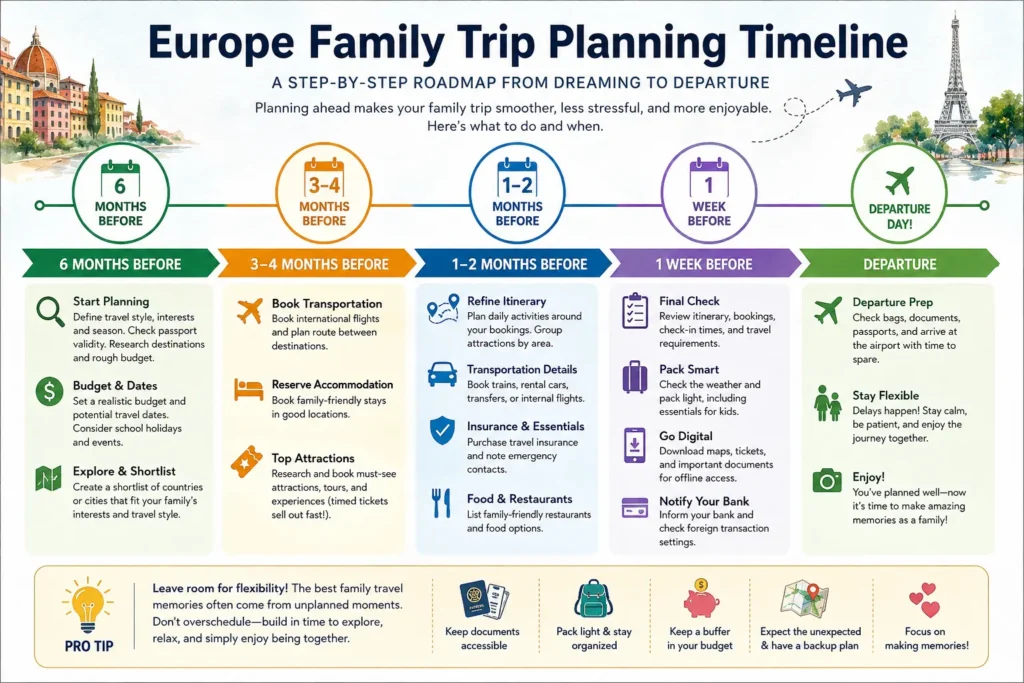
Step 16: Create a Family Trip Planning Timeline
Not everything needs to be planned on the same day.
Breaking preparation into stages makes the entire process easier.
Around 6 Months Before
Start with:
- approximate dates,
- destination shortlist,
- rough budget,
- passport validity,
- international airfare research,
- and major seasonal considerations.
For high-demand summer travel, Christmas markets, school holidays or major events, some decisions may need to happen even earlier.
Around 3–4 Months Before
Focus on:
- major transportation,
- accommodation,
- rental car if required,
- high-priority attractions,
- and the basic city-to-city route.
At this stage, the trip should have a skeleton.
It does not need a detailed daily schedule yet.
Around 1–2 Months Before
Now refine:
- attraction reservations,
- neighborhood plans,
- restaurant shortlist,
- airport transportation,
- travel insurance,
- luggage strategy,
- and activities the children want to choose.
This is also a good time to identify which days are becoming too crowded.
Delete things before the trip rather than during it.
Around 1 Week Before
Check:
- weather forecast,
- transportation changes,
- attraction opening information,
- reservations,
- documents,
- roaming/eSIM arrangements,
- banking and payment preparation,
- medication,
- and packing.
Download useful information for offline access.
Do not completely rebuild the itinerary because the weather forecast shows one cloud eight days from now.
Adjust what actually needs adjusting.
The Day Before Departure
The planning should essentially be finished.
Check:
passports,
wallet,
phones,
chargers,
medication,
tickets,
first-night accommodation,
airport transportation,
and baggage.
Then stop planning.
You are going on the trip.
Step 17: Build a Backup Plan, Not a Second Itinerary
A backup plan does not mean creating another complete vacation.
You only need alternatives for situations likely to cause problems.
For each destination, identify:
one indoor option
for bad weather,
one easy option
for a tired day,
and
one free or inexpensive option
for when you want to slow down.
That might be:
a museum,
a food market,
a park,
a beach,
a neighborhood walk,
a shopping street,
or simply returning to the accommodation.
This prevents the classic vacation problem of spending an hour searching phones for “things to do with kids near me” while everyone is already tired.
Step 18: Do a Final Reality Check
When the itinerary looks finished, don’t ask whether everything fits.
Ask whether everything fits comfortably.
Look for warning signs.
Too Many One-Night Stays
One night usually means arriving, unpacking, sleeping and immediately packing again.
Sometimes it is necessary.
Repeated throughout a trip, it becomes exhausting.
Too Many Fixed Reservations
If being thirty minutes late could destroy several days of your itinerary, there is not enough flexibility.
Too Many Long Transfer Days
A three-hour train every few days may be manageable.
A five-hour transfer followed by sightseeing followed by another early departure may not be.
No Unscheduled Time
If every morning and afternoon already contains a reservation, something will eventually have to be sacrificed.
No Child Input
If every activity exists because an adult chose it, add something the children helped select.
An Itinerary That Only Works When Everything Goes Right
This is perhaps the biggest warning sign.
Real trips include delays, weather, fatigue and changed minds.
A good itinerary bends.
It should not break.
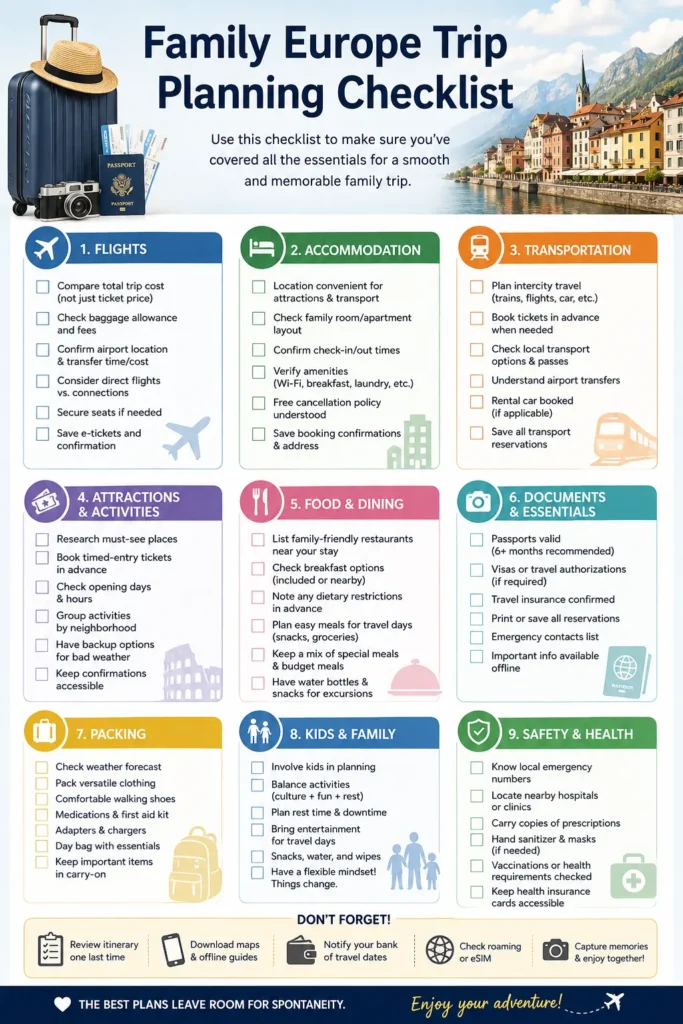
A Simple Europe Family Trip Planning Checklist
Before calling the trip finished, run through this list.
Route
- Travel dates confirmed
- Number of destinations realistic
- Transfer times checked door-to-door
- Arrival and departure days kept manageable
Money
- Overall budget established
- Transportation costs included
- Local taxes and baggage costs considered
- Emergency buffer available
Transportation
- International flights booked
- Intercity transport planned
- Airport transfers understood
- Rental-car logistics checked if applicable
Accommodation
- Location checked on a map
- Public transportation nearby
- Family sleeping arrangements confirmed
- Check-in/check-out times known
- Laundry access considered for longer trips
Activities
- High-priority attractions identified
- Timed tickets booked where necessary
- Activities grouped geographically
- Flexible time preserved
Children
- Age-appropriate pace
- Rest opportunities
- Familiar food options
- Each child has some input
- Entertainment planned for long journeys
Documents
- Passport validity checked
- Entry requirements verified
- Insurance information accessible
- Reservations backed up
- Essential information available offline
Packing
- Weather checked
- Luggage kept manageable
- Essential medication accessible
- Chargers/adapters packed
- First-day necessities in carry-on
Example: How the Planning Process Comes Together
Imagine a family has 10 days in Spain.
Instead of immediately booking five cities, they work through the steps.
Step A — Define the Trip
9 nights.
Children want a beach and something involving trains.
Parents want architecture, food and history.
Step B — Limit the Route
Instead of:
Barcelona → Valencia → Madrid → Córdoba → Seville
they choose:
Barcelona — 3 nights
Madrid — 3 nights
Seville — 3 nights
Three bases.
Two major transfers.
Step C — Choose Transportation
Barcelona → Madrid by high-speed train.
Madrid → Seville by high-speed train.
No rental car needed.
Step D — Choose Accommodation
Walking distance or easy public transport to the areas the family expects to visit most.
Step E — Add Fixed Experiences
Barcelona: one major architectural attraction.
Madrid: one museum or major family experience.
Seville: one major historic attraction.
Step F — Fill Around Them
Parks.
Neighborhoods.
Food.
Markets.
Viewpoints.
Flexible afternoons.
Now compare that with beginning the process by booking random attractions across five cities.
The second approach may contain more places.
The first produces a trip that is much easier to execute.
That is the entire point of planning in the right order.
The Planning Rule That Prevents Most Problems
When you’re uncertain about adding another destination, attraction or reservation, ask:
Does this make the trip better, or does it simply make the itinerary fuller?
Those are not the same thing.
Another city may be worth it.
Another museum may be worth it.
Another day trip may become everyone’s favorite experience.
But every addition has a cost in:
time,
money,
energy,
and flexibility.
Good travel planning is not primarily about finding more things to do.
It is about deciding which things deserve the family’s limited time.
Final Thoughts: Build the Framework, Then Leave Room for the Trip
The best family itineraries are planned carefully without becoming rigid.
Know where you are sleeping.
Know how you are getting there.
Book the experiences that genuinely require reservations.
Understand the budget.
Prepare the documents.
Have a plan for arrival.
Know what matters most each day.
Then leave some space.
Because once your family arrives in Europe, the spreadsheet stops being the trip.
A child may want to spend another hour at the beach.
You may discover a neighborhood you had never heard of.
Lunch may last much longer than expected.
The train ride may become more memorable than the destination.
Or everyone may simply need an afternoon off.
A good plan makes those changes possible.
That is what family travel planning should accomplish.
Not a vacation where everything happens exactly as expected.
A vacation where, when something doesn’t, the trip still works.