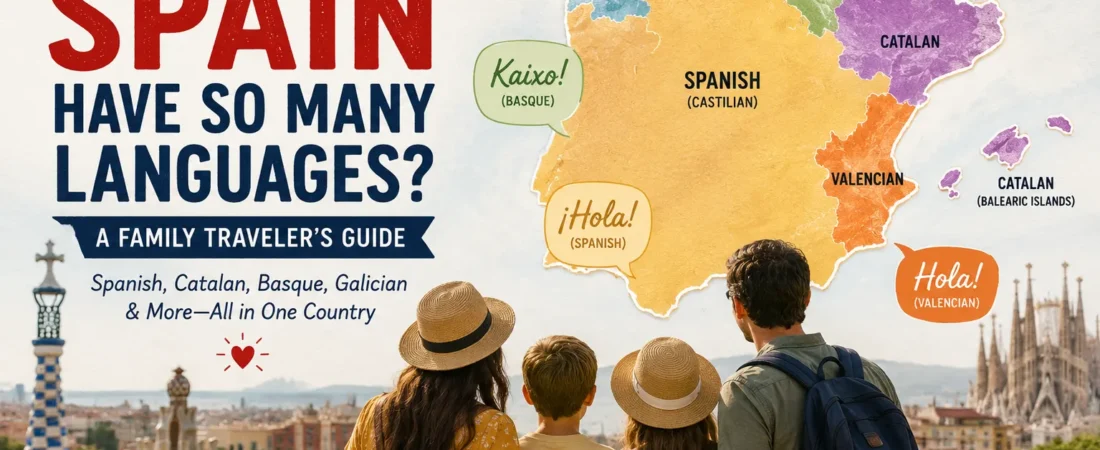
The languages in Spain can be one of the first surprises families notice while traveling around the country.
You arrive in Barcelona with your kids, look at a street sign, and notice something unexpected.
You know you are in Spain.
But some of the words do not look like the Spanish you expected.
Then you travel north to Bilbao and it happens again—except this time the language looks completely different.
Continue to Galicia and you may notice yet another language appearing beside Spanish.
So what is going on?
Spain does not have just one language.
Spanish—more precisely, Castilian Spanish—is the official language of the Spanish state, but several other languages have official or protected status in different parts of the country.
The most important ones families are likely to encounter while traveling are:
- Spanish (Castilian / castellano)
- Catalan (català)
- Basque (euskara)
- Galician (galego)
- Valencian (valencià)
There are also other regional languages and varieties, including Aranese in the Val d’Aran and Asturian, among others.
This is not simply a linguistic curiosity.
Spain’s languages are connected to geography, history, politics, education, and regional identity.
Understanding even a little of that story can completely change the way your family sees Spain.
A sign written in Catalan stops looking like “Spanish spelled strangely.”
A Basque word stops being something impossible to pronounce.
And children begin to understand that modern countries do not always have one culture, one history, and one language.
Quick Answer: Why Does Spain Have Several Languages?
Because the country we now call Spain developed from different medieval kingdoms, territories, and linguistic communities rather than beginning as one culturally uniform state.
Languages evolved in different parts of the Iberian Peninsula over centuries.
Political unification did not make those languages disappear.
Today, the Spanish Constitution establishes Castilian Spanish as the state’s official Spanish language and allows Spain’s other languages to be official within their respective autonomous communities according to their statutes.
That is why traveling through Spain can sometimes feel linguistically different from one region to another.
| Where You Travel | Languages You May Commonly Notice |
|---|---|
| Madrid / much of Central Spain | Spanish |
| Barcelona / Catalonia | Catalan + Spanish |
| Valencia | Valencian + Spanish |
| Bilbao / Basque Country | Basque + Spanish |
| Santiago / Galicia | Galician + Spanish |
| Val d’Aran | Aranese + Catalan + Spanish |
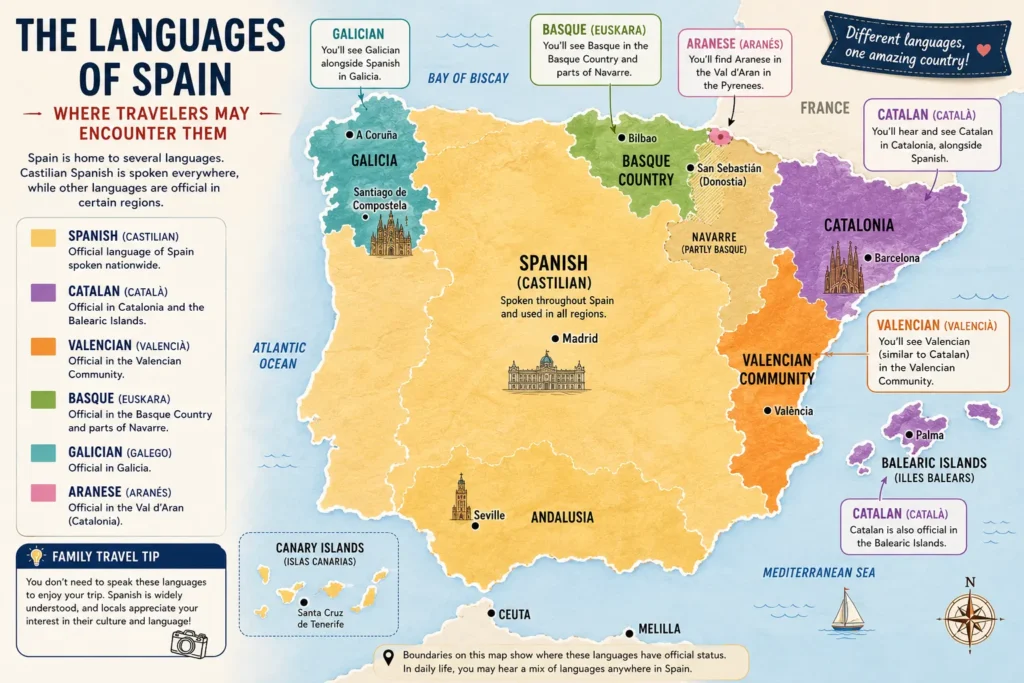
The exact balance you hear in daily life varies enormously by place and context.
A language appearing on an official sign does not necessarily mean every person around you uses it as their main everyday language.
First: Is “Spanish” Actually Called Spanish?
Yes.
But there is a useful distinction.
You will encounter both:
español
and
castellano
when people refer to what English speakers usually call Spanish.
Castellano means Castilian and reflects the language’s historical connection with Castile.
Both terms are widely used, although preferences and nuances can vary depending on country, region, and context.
For a child learning Spanish at school, this can initially be confusing.
They may think:
“I thought I was learning Spanish. What’s Castilian?”
In most everyday travel situations, they are talking about the language your child recognizes as Spanish.
Spain Did Not Begin as One Uniform Country
To understand the languages, look at the map historically rather than politically.
The Iberian Peninsula spent centuries divided among different kingdoms and political territories.
Among them were:
- Castile
- Aragon
- Navarre
- León
- various Muslim-ruled territories collectively associated with al-Andalus at different periods
The political map changed repeatedly.
So did borders, alliances, dynasties, and centers of power.
Languages and linguistic varieties developed alongside those histories.
Castilian eventually expanded enormously and became the dominant language across Spain and, through the Spanish Empire, much of the Americas.
But Catalan, Galician, Basque, and other languages did not simply vanish.
That historical background explains something children can observe today:
crossing a regional boundary inside Spain can sometimes change the language on the road signs even though you never crossed an international border.
Catalan: Why Barcelona Doesn’t Look Entirely Spanish-Speaking
Barcelona is where many international families first notice Spain’s linguistic diversity.
You might see:
Sortida
instead of the Spanish:
Salida
for “Exit.”
You may encounter:
Carrer
where you expected:
Calle
for “Street.”
And signs may appear primarily in Catalan or in more than one language.
Catalan is not a dialect of Spanish.
It is a Romance language in its own right.
Like Spanish, French, Italian, Portuguese, and Romanian, it developed from Latin.
Catalan is spoken not only in Catalonia but also in other territories in different varieties and contexts.
For families visiting Barcelona, you do not need to learn Catalan before the trip.
Spanish will remain extremely useful, and tourism-facing environments often accommodate international visitors.
But learning even two Catalan words can help children understand that they have entered a region with its own linguistic identity.
Try:
Hola — Hello
and:
Gràcies — Thank you
That small observation can become a geography and history lesson without anyone opening a textbook.
For the practical side of exploring the city as a family, our Barcelona with Kids: A Family Travel Guide can help you plan attractions, neighborhoods, parks, beaches, and realistic sightseeing days.
Valencian: Is It Spanish, Catalan, or Something Else?
This question can become politically and linguistically complicated very quickly.
For a family traveler, the simplest accurate explanation is this:
Valencian is the traditional and official name used in the Valencian Community for the language that linguistics generally places within the same language system as Catalan.
That does not mean regional identity around the name is unimportant.
Quite the opposite.
Language names can carry history, culture, and identity.
So when traveling in Valencia, you may see both Valencian and Spanish on signs and public information.
For example, the city itself may appear as:
València
in Valencian.
Rather than telling children:
“That’s just another way of spelling Spanish,”
a better explanation is:
“People in this part of Spain have another regional language too.”
That is both simpler and closer to what they are actually seeing.
Our Valencia with Kids: A Family Travel Guide can help you plan the family side of the city while giving those linguistic details a real place and context.
Basque: The Language That Changes the Story Completely
Then you arrive in the Basque Country.
And the language looks nothing like Spanish.
That is because Basque—or Euskara—is fundamentally different from Spanish, Catalan, and Galician.
Those languages belong to the Indo-European language family.
Basque does not.
Basque is a language isolate, meaning it has no demonstrated genealogical relationship to another living language.
Its origins have fascinated linguists for generations.
That is why words on signs around Bilbao and elsewhere in the Basque Country can look so unfamiliar to travelers who know Spanish.
You may see:
Kalea — street
or:
Eskerrik asko — thank you
Even the Basque name for the Basque Country:
Euskal Herria
looks nothing like España.
For children, this may be the most fascinating language stop in Spain.
Ask them to compare a Basque sign with a Spanish one.
They do not need to understand either language perfectly.
They can simply look.
The visual difference is immediate.
And suddenly the idea of regional identity becomes much easier to understand.
Our Bilbao with Kids: A Family Travel Guide can help families explore the city itself while noticing how Basque language and identity appear throughout everyday surroundings.
Galician: Why It May Look a Little Like Portuguese
Travel west to Galicia and the linguistic landscape changes again.
Galician—galego—is another Romance language.
But its history is particularly closely connected with Portuguese.
During the medieval period, the linguistic ancestor commonly described as Galician-Portuguese developed in the northwest of the Iberian Peninsula.
Over time, Galician and Portuguese followed different historical paths.
Modern Galician is spoken primarily in Galicia, while Portuguese became the language of Portugal and later spread globally.
This historical connection explains why travelers who know some Portuguese may occasionally look at Galician and think:
“I almost understand that.”
Galician and Spanish are both official in Galicia.
And if your family reaches Santiago de Compostela, you are likely to encounter Galician alongside Spanish in the city and surrounding region.
That makes Santiago more than the endpoint of the Camino.
It can also become another stop in the linguistic journey across Spain.
For families traveling there, our Santiago de Compostela with Kids: A Family Travel Guide covers the cathedral, Old Town, parks, food, and practical ways to experience the city with children.
What About Mallorca and the Balearic Islands?
The language story does not stop on the mainland.
Catalan is also an official language in the Balearic Islands alongside Spanish.
Local varieties are associated with Mallorca, Menorca, Ibiza, and Formentera.
So families traveling from Madrid to Mallorca may once again notice unfamiliar words appearing on signs, menus, place names, or public information.
This is another reason Spain becomes more interesting when you stop thinking of regional differences as inconveniences.
They are part of what you traveled to see.
If your trip includes Mallorca or Ibiza, our Balearic Islands Family Itinerary: 4 Days, 7 Days & 2 Weeks with Kids can help you decide how many islands actually belong in the trip without turning island hopping into the main activity.
Did Franco Ban Spain’s Regional Languages?
This part of the story matters because it helps explain why language remains emotionally and politically important today.
During Francisco Franco’s dictatorship from 1939 to 1975, Castilian Spanish was heavily privileged by the state, while the public and institutional use of languages such as Catalan, Basque, and Galician was restricted, particularly during the regime’s earlier years.
The degree and form of repression changed over the decades, so reducing the entire period to one simple sentence such as “nobody was allowed to speak Catalan” would be inaccurate.
People continued using regional languages privately and socially.
But their use in government, education, public administration, media, and other official or public contexts faced serious restrictions at different points.
This history matters.
Because after Spain’s transition to democracy, restoring regional languages was not simply about translating street signs.
For many communities, it became connected to:
- cultural recovery
- education
- regional autonomy
- historical memory
- identity
That helps explain why language questions in Spain can carry much more emotional weight than a visitor might initially expect.
What Changed After Spain Became a Democracy?
Spain’s 1978 Constitution created the framework for the modern system.
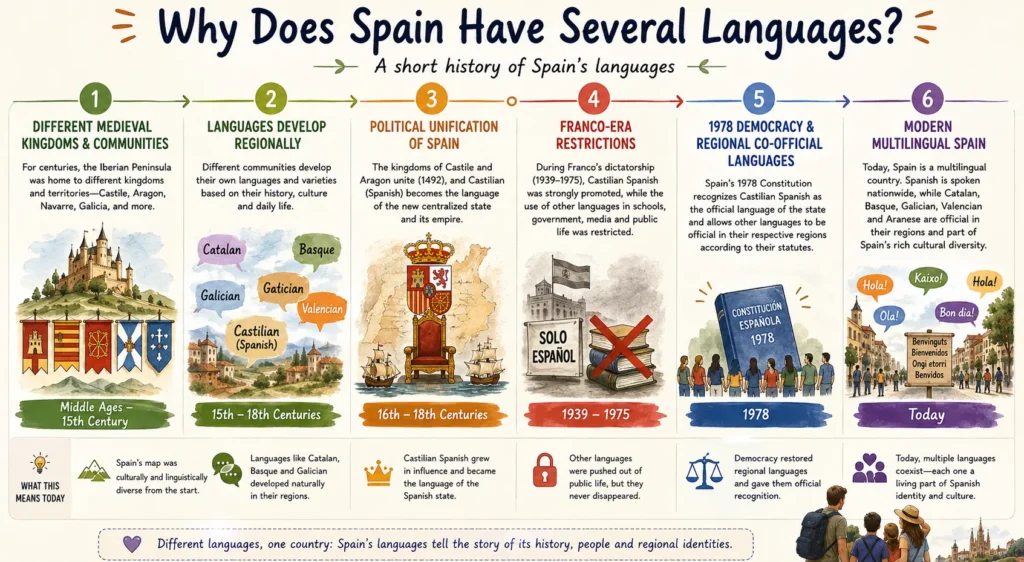
Castilian Spanish is the official language of the state.
At the same time, other Spanish languages can have official status in their respective autonomous communities.
That is why children may encounter bilingual education, bilingual public signs, regional-language television, and government information in more than one language depending on where the family travels.
The result is not a country where everyone speaks every language.
It is a country where language geography still matters.
And once your family understands that, many things you see while traveling begin to make more sense.
Will My Family Need to Speak Catalan, Basque, or Galician?
For most international families traveling around Spain, no.
You do not need to learn several new languages before your vacation.
Spanish remains enormously useful across the country, and in major tourist destinations you will also frequently encounter people working in tourism who speak English or other languages.
But that practical answer should not become:
“The regional languages don’t matter.”
They do.
There is a difference between needing a language to order lunch and understanding why that language appears around you.
A child does not need to speak Catalan to notice that Barcelona has signs in Catalan.
They do not need to speak Basque to realize that Donostia and San Sebastián refer to the same city.
And they do not need to speak Galician to recognize that Santiago de Compostela sits within a region with its own language and cultural identity.
For a family traveler, awareness is enough.
Why Does San Sebastián Sometimes Say Donostia?
This is one of the easiest examples to show children.
The city widely known internationally as San Sebastián is called Donostia in Basque.
So you may see:
Donostia / San Sebastián
on signs, transportation information, maps, or official material.
It is not two different cities.
It is the same place represented through two languages.
This happens elsewhere in multilingual Spain too.
Once children understand the pattern, road signs can become a game:
“Which language is that?”
Instead of:
“Why is Google Maps giving this place two names?”
For families spending time there, our San Sebastián with Kids: A Family Travel Guide can help you plan beaches, viewpoints, food, and family activities while seeing this bilingual environment firsthand.
Why Do Some Spanish Cities Have Two Names?
Because official or commonly used place names can differ between Spanish and a regional language.
Depending on where you travel, you may encounter forms such as:
| Spanish / Common English Form | Regional-Language Form |
|---|---|
| San Sebastián | Donostia |
| La Coruña | A Coruña |
| Orense | Ourense |
| Gerona | Girona |
| Lérida | Lleida |
| Alicante | Alacant |
| Valencia | València |
Official naming practices vary, and in some cases the regional-language form is the official place name.
This can matter when searching for:
- train stations
- bus routes
- road signs
- accommodation
- attractions
- maps
If the spelling looks slightly different from the name you originally searched, do not immediately assume you are going to the wrong place.
Check whether you are simply seeing another language.
Why Are Languages So Connected to Regional Identity?
Because language is rarely only vocabulary.
It can represent:
- family
- childhood
- education
- literature
- music
- local government
- history
- political autonomy
- cultural memory
Imagine being told that the language your grandparents spoke was unsuitable for school or government.
Then imagine a later generation being educated in that language and seeing it on official signs again.
That history gives language a meaning that a visitor may not immediately see.
This is particularly important when trying to understand Catalonia and the Basque Country.
But we should also avoid the opposite mistake.
Not every Catalan, Basque, or Galician speaker has the same political views.
Speaking Catalan does not automatically mean supporting Catalan independence.
Speaking Basque does not automatically tell you someone’s politics.
Regional identity, language preference, Spanish identity, and political opinion can overlap in many different ways.
That nuance matters.
Are Catalonia and the Basque Country “Against Spain”?
That is too simple.
Both regions have strong identities, distinct histories, and nationalist political traditions.
Both have also experienced serious political conflict with the Spanish state at different points in history.
But millions of people live in these regions, and their identities and political views are diverse.
Someone can feel:
Catalan and Spanish
or:
Basque and Spanish
or primarily one identity, or something more complicated.
The same family can contain different opinions.
So when children ask:
“Do Catalonia and Spain not like each other?”
I would not answer yes.
I would say:
“Some people disagree strongly about how much independence or political power the region should have, and those arguments come from a long history.”
That is more accurate and leaves room for the complexity.
This subject deserves its own article because language is only one part of it.
Why Didn’t Spain Simply Make Everyone Speak One Language?
Governments have certainly tried to promote linguistic uniformity at different times.
But languages are difficult to erase because they live in families and communities.
People speak them at home.
They write songs and books in them.
Children hear grandparents using them.
They become part of local identity.
And in democratic Spain, several regional languages now have institutional protection and official roles.
So modern Spain has largely developed around multilingual coexistence rather than complete linguistic uniformity.
That coexistence is not always politically simple.
Debates continue over education, language requirements, public administration, identity, and the appropriate balance between Spanish and regional languages.
But the presence of several languages is now a visible part of modern Spain.
What Language Do Children Learn at School in Spain?
There is no single answer for the entire country.
Education policy varies by autonomous community.
In Madrid, schooling will look linguistically different from schooling in Catalonia, the Basque Country, Galicia, Valencia, or the Balearic Islands.
Depending on the region and education model, children may study in Spanish, a co-official regional language, or a combination.
Foreign languages such as English may also be part of the curriculum.
This is one reason debates over language education can become politically sensitive.
The question:
“What language should children learn?”
can also mean:
“What culture and identity should the next generation preserve?”
That is much bigger than grammar.
A Simple Language Game to Play with Kids While Traveling
You can turn all of this history into something children notice themselves.
When you arrive in a new region, ask them to find:
one word that looks different from Spanish.
For example:
Barcelona
Look for:
Sortida
Basque Country
Look for:
Kalea
Galicia
Look for:
Rúa
Valencia
Look for:
Carrer
Then compare them with Spanish:
Salida
Calle
Calle
Calle
You do not need a formal language lesson.
The point is simply to make children observe.
By the end of the trip, they may begin noticing the language change before you mention it.
That is exactly the kind of learning travel can do particularly well.
Useful Words Families May Notice
Here is a small comparison.
| English | Spanish | Catalan | Basque | Galician |
|---|---|---|---|---|
| Hello | Hola | Hola | Kaixo | Ola |
| Thank you | Gracias | Gràcies | Eskerrik asko | Grazas |
| Street | Calle | Carrer | Kalea | Rúa |
| Exit | Salida | Sortida | Irteera | Saída |
| Good morning | Buenos días | Bon dia | Egun on | Bos días |
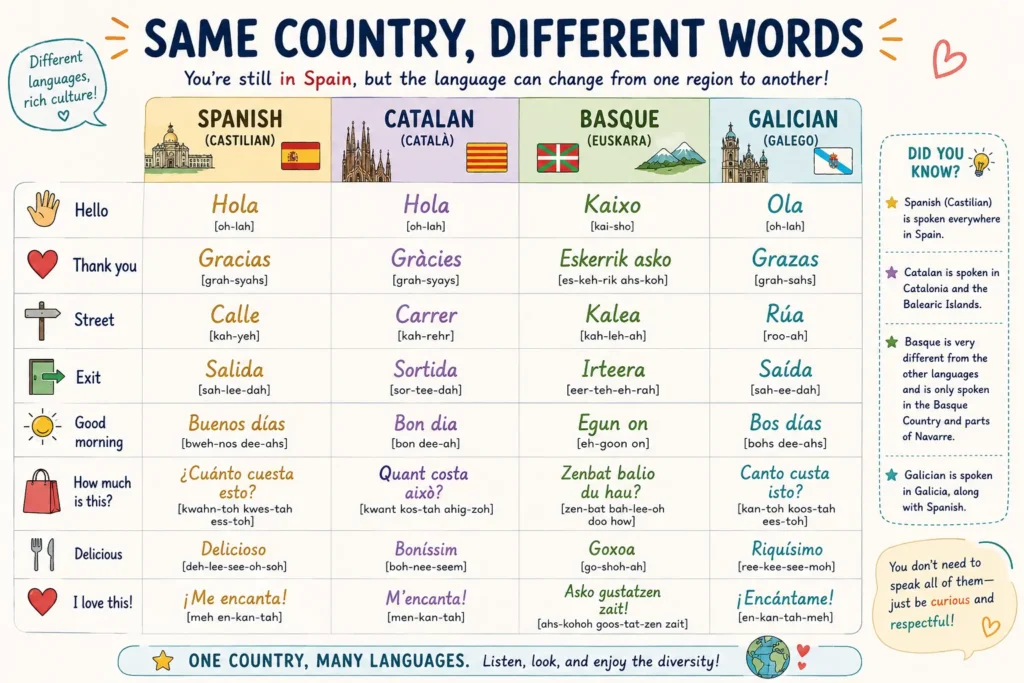
You do not need to memorize this table.
Use it as a reminder that these are genuinely different languages, not decorative variations of Spanish.
Basque makes that particularly obvious.
What Should Parents Tell Kids About Spain’s Languages?
Keep it simple without making it inaccurate.
For younger children:
“Spain has different regions, and some regions have their own languages as well as Spanish.”
For older children:
“Modern Spain developed from different historical territories and communities, so several languages survived and became important parts of regional identity.”
For teenagers, you can go further:
“Language is also connected to politics, autonomy, historical repression, and debates about national identity.”
The explanation can grow with the child.
You do not need to turn lunch in Barcelona into a lecture on constitutional law.
But if they ask why the menu says pa amb tomàquet instead of the Spanish words they learned at school, that is a perfect moment to explain what they are seeing.
Does This Matter for Family Travel?
More than you might expect.
Understanding Spain’s linguistic geography helps explain:
- why road signs change
- why cities sometimes have two names
- why menus contain unfamiliar words
- why football crowds use regional flags
- why some museums emphasize regional history
- why local festivals feel culturally distinct
- why political symbols differ between regions
It also prevents a common travel mistake:
assuming every regional difference is simply a quirky version of Madrid.
Spain becomes much more interesting once you stop expecting every part of it to look, sound, and identify in exactly the same way.
Language, Identity and Spanish Football
Football may be one of the easiest places for children and teenagers to see regional identity become visible.
FC Barcelona’s famous phrase:
Més que un club
means:
More than a club.
The club’s relationship with Catalan identity is one reason that phrase carries meaning beyond football.
In the Basque Country, Athletic Club has developed another unusually strong connection between football and local identity.
Real Madrid, meanwhile, occupies a completely different place in Spanish football history and popular imagination.
That does not mean every football match is secretly a political argument.
But if your child likes football, Spanish clubs can become an unexpectedly good doorway into:
geography → language → history → regional identity.
We will explore that more deeply in a separate guide to how Spanish football and its league system actually work.
Common Misunderstandings About Spain’s Languages
1. “Everyone in Spain Only Speaks Spanish”
No.
Spanish is spoken throughout the country, but several regions also have their own languages.
2. “Catalan Is a Dialect of Spanish”
No.
Catalan is a Romance language in its own right.
3. “Basque Is Another Romance Language”
No.
Basque is not a Romance language and is classified as a language isolate.
4. “Galician Is Just Portuguese”
No.
Galician and Portuguese share important historical linguistic roots, but modern Galician and Portuguese are distinct languages.
5. “Speaking a Regional Language Means Someone Wants Independence”
No.
Language use does not automatically reveal political beliefs.
6. “Tourists Need to Learn Every Regional Language”
No.
You can travel around Spain without doing so.
Respect and awareness matter much more.
7. “The Different Languages Are Mainly for Tourists”
Definitely not.
These are living languages used by real communities in education, media, government, literature, culture, and everyday life.
FAQ: Languages in Spain
How many official languages does Spain have?
Spanish—Castilian—is the official language of the Spanish state.
Other Spanish languages have co-official status within particular autonomous communities according to their regional legal frameworks. These include Catalan/Valencian, Basque, and Galician, while Aranese also has official status in Catalonia.
So the answer depends on whether you mean official across the entire country or official within particular regions.
Is Catalan the same as Spanish?
No.
Catalan and Spanish are separate Romance languages.
They share some similarities because of their linguistic histories, but one is not simply a dialect of the other.
Is Valencian the same as Catalan?
Linguistically, Valencian is generally classified within the Catalan language system.
Valencian is the official and traditional name used for the language in the Valencian Community, and the terminology also carries regional identity and political significance.
Why is Basque so different from Spanish?
Basque is not an Indo-European language.
It is classified as a language isolate because no genealogical relationship with another living language has been demonstrated.
Why does Galicia have its own language?
Galician developed historically in northwestern Iberia and shares medieval roots with Portuguese.
It survived as a distinct regional language and today has co-official status with Spanish in Galicia.
Can I travel around Spain speaking only Spanish?
Yes.
Spanish is widely understood throughout Spain.
Regional languages remain culturally and institutionally important, but tourists do not need to speak all of them to travel around the country.
Do people in Barcelona speak Spanish?
Yes.
Spanish is widely spoken in Barcelona alongside Catalan.
The balance between languages varies by person, setting, and context.
Final Thoughts: Spain Makes More Sense Once You Hear the Differences
At first, Spain’s languages can feel confusing.
You learn a little Spanish.
Then Barcelona gives you Catalan.
Bilbao gives you Basque.
Santiago gives you Galician.
Valencia gives you Valencian.
But those languages are not obstacles cluttering an otherwise simple travel map.
They are part of the map.
They tell the story of how different communities developed, how Spain formed, how regional identities survived, and why modern Spain can feel dramatically different from one region to another.
For children, this is an unusually easy history lesson because they can literally see it around them.
On a street sign.
On a football scarf.
On a menu.
On a train display.
And once they notice it, Spain stops being one culture repeated across several cities.
It becomes a country made from several overlapping histories and identities.
That leads naturally to the next question:
Why do regions such as Catalonia and the Basque Country have such strong identities—and why has their relationship with the Spanish state sometimes been so difficult?
That deserves its own story.
Continue Exploring Spain with Kids
If your family wants to see these regional differences rather than only read about them, these guides are good places to continue.
Barcelona with Kids
Our Barcelona with Kids: A Family Travel Guide helps you explore Catalonia’s largest city through architecture, neighborhoods, parks, beaches, food, and family experiences.
Bilbao with Kids
Use our Bilbao with Kids: A Family Travel Guide to experience the Basque Country through the city, its food, landscape, culture, and distinctive regional identity.
Santiago de Compostela with Kids
Our Santiago de Compostela with Kids: A Family Travel Guide takes you into Galicia, where the Camino, cathedral, Old Town, food, and Galician language give families another very different view of Spain.