
Valencia may be one of the easiest major Spanish cities to underestimate when planning a family trip.
Barcelona has Gaudí.
Madrid has the Royal Palace and world-famous museums.
Seville has flamenco and the Alcázar.
Granada has the Alhambra.
Valencia does not always have one historic monument that dominates every travel plan.
Instead, it gives families something arguably more useful:
balance.
A futuristic science complex.
One of Europe’s major aquariums.
A huge park running through the city.
A playground built around a giant storybook character.
Mediterranean beaches.
A walkable historic center.
A UNESCO-listed medieval trading hall.
And the birthplace of one of Spain’s most famous foods:
paella.
There is another advantage parents notice quickly.
Valencia with kids is relatively easy to move around.
Much of the city is comparatively flat.
The Turia Garden creates a long green corridor through Valencia.
Cycling can become practical transportation rather than simply an activity.
And when children have had enough architecture, the family can go to a park, aquarium or beach without leaving the city.
Valencia does not force families to choose between a city trip and a more relaxed Mediterranean vacation.
It can provide both.
Valencia with Kids: Quick Family Guide
| Question | Recommendation |
|---|---|
| Ideal stay | 3 nights |
| Minimum worthwhile stay | 2 full days |
| Best for | Science, aquarium, parks, beach, food |
| Best ages | Excellent across a wide age range |
| Getting around | Walking + bus/Metro + cycling |
| Car needed? | No for a normal city stay |
| Walking difficulty | Relatively easy compared with many historic Spanish cities |
| Best major family attraction | Oceanogràfic |
| Best free family space | Turia Garden |
| Best playground | Gulliver Park |
| Best cultural landmark | La Lonja de la Seda |
| Best food experience | Paella |
| Beach available? | Yes |
| Ideal family rhythm | Attraction + park + food + beach |
Valencia works particularly well for families who have already spent several days visiting:
palaces,
cathedrals,
castles,
and historic streets.
It gives children something completely different without abandoning Spanish culture.
Why Valencia Works So Well With Kids
The easiest way to understand Valencia as a family destination is to look at what a single day can contain.
Morning:
science museum.
Lunch:
paella.
Afternoon:
park.
Evening:
beach.
Those experiences require very different kinds of attention.
That matters.
Children who lose interest after ninety minutes in a historic building may happily spend another two hours exploring an interactive science exhibit.
After that, they can run outside.
Then go to the sea.
Valencia Gives Families Space
This is one of the city’s greatest strengths.
The former Turia riverbed was transformed into a long urban garden that runs through Valencia.
Instead of a conventional city where green spaces appear as isolated parks, Valencia has a recreational corridor connecting different parts of the city.
Families can:
walk,
cycle,
play,
stop,
picnic,
and use the park as part of the journey between attractions.
That changes the feeling of a city trip.
1. City of Arts and Sciences — Valencia’s Futuristic Family Landmark
If children have spent the previous week looking at medieval Europe, Valencia can produce an immediate reaction:
What is that?
The City of Arts and Sciences looks completely different from Spain’s historic centers.
White futuristic structures.
Water.
Curves.
Enormous open spaces.
Reflections.
Modern architecture.
Even before entering anything, the complex is visually interesting.
Don’t Think of It as One Attraction
This is important for planning.
The City of Arts and Sciences is a complex, not one museum that the family completes in an hour.
Different institutions and spaces occupy the area.
For most families, the two most important are:
Oceanogràfic
and
Museu de les Ciències — the Science Museum.
There are also other cultural and architectural components.
You do not automatically need tickets to everything.
The Biggest Mistake: Trying to Complete the Entire Complex
It looks efficient.
Everything is together.
So parents think:
Oceanogràfic + Science Museum + everything else = one day.
Technically possible?
Depending on the family and ticketing, perhaps.
Enjoyable?
That is a different question.
Oceanogràfic can become a substantial visit by itself.
Science-interested children may also want far more time in the museum than parents expected.
Let children’s interest determine the duration instead of trying to complete the complex.
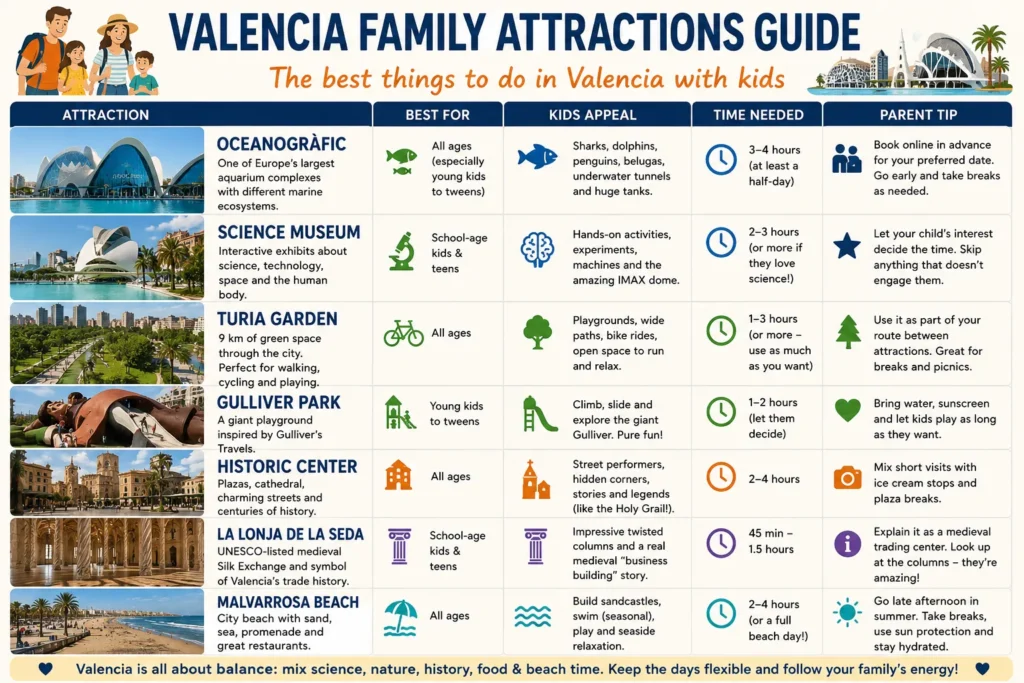
2. Oceanogràfic — The Big Family Attraction
Oceanogràfic is one of Valencia’s headline family attractions and one of the largest aquarium complexes in Europe.
Its different environments allow families to move through marine habitats rather than simply looking at one enormous tank.
Depending on current exhibits and access, visitors may encounter areas representing different marine ecosystems and a wide variety of species.
For children, the advantage is obvious:
the experience keeps changing.
Why It Works Across Different Ages
Younger children may simply be fascinated by:
fish,
sharks,
jellyfish,
penguins,
and underwater environments.
Older children can engage with:
marine ecosystems,
adaptation,
biodiversity,
conservation,
and human impact on oceans.
Parents do not have to force the educational element.
The animals usually create the questions.
How Long Should Families Allow?
I would avoid declaring:
“Oceanogràfic takes exactly three hours.”
Families are too different.
Some children will move quickly.
Others will want to watch one habitat for twenty minutes.
Think of Oceanogràfic as a major half-day-level attraction, then allow the family’s interest to determine the actual visit.
Should You Combine Oceanogràfic and the Science Museum?
Yes, potentially.
But do not assume that means both need to be explored completely.
A good family strategy might be:
Oceanogràfic as the main experience
plus
a shorter Science Museum visit
or the reverse if your children are particularly interested in science.
With three nights in Valencia, separating them can create a much more relaxed trip.
Booking Strategy
Before visiting, check current official information for:
opening times,
ticket combinations,
family/child conditions,
temporary exhibitions,
and any scheduled experiences that matter to your family.
If Oceanogràfic is a trip priority, secure the appropriate ticket rather than assuming the preferred date and time will always be available.
Family rating: ★★★★★
Best for: Almost all ages
Planning level: Medium to high
Allow: A substantial part of the day
Families who love marine life can also explore our Largest Aquariums in the World guide to see how Oceanogràfic compares with other major aquarium destinations.
3. Science Museum — Let Children Touch Something
The Museu de les Ciències gives families the opposite experience from many historic attractions.
Instead of:
Don’t touch.
the philosophy of interactive science spaces is much closer to:
Try it.
That difference can be enormously refreshing during a European sightseeing trip.
Who Will Enjoy It Most?
School-age children are an obvious audience.
But the usefulness depends more on interest than age.
A child fascinated by:
space,
technology,
physics,
biology,
or experiments
may want far more time than you planned.
That is exactly when I would change the itinerary.
Don’t Rush a Child Who Is Actually Learning
This is one of those moments where parents can accidentally make travel worse by following the plan too well.
You paid to enter an interactive science museum.
Your child becomes fascinated by an exhibit.
Then everyone hears:
“Come on, we have to go. The next attraction starts in twenty minutes.”
Why?
If a child is genuinely absorbed in something educational while traveling, I would protect that moment before protecting another item on the checklist.
The next building will survive without you.
4. Turia Garden — Valencia’s Family Superpower
If I had to choose one feature that makes Valencia unusually family-friendly, it might not be Oceanogràfic.
It might be Jardín del Turia.
The park occupies the former riverbed of the Turia and stretches for several kilometers through the city.
That means it functions as more than somewhere families deliberately visit.
It can become part of how they move through Valencia.
Why This Changes Family Travel
Imagine two routes.
Route A
Sidewalk.
Traffic lights.
Cars.
Crowded streets.
Repeatedly telling children:
Stay close.
Route B
Green space.
Paths.
Trees.
Playgrounds.
Cyclists.
Room.
That difference matters.
Obviously, the Turia is still an urban public space and families need normal awareness around bikes and busy areas.
But the overall environment can make moving through Valencia feel very different from moving through a dense historic center.
Walk, Cycle or Stop
You do not need to “visit” the entire Turia Garden.
Use pieces of it.
Walk through it on the way somewhere.
Rent bikes if that works for the family.
Stop at a playground.
Sit under trees.
Have a snack.
Let children run.
The park becomes infrastructure for the vacation.
5. Gulliver Park — The Playground That Explains Valencia With Kids
This is one attraction that absolutely belongs in a Valencia family guide.
Parque Gulliver transforms the giant figure of Gulliver from Gulliver’s Travels into a large-scale play structure.
Children climb over him.
Slide down parts of the figure.
Explore ramps and different surfaces.
From ground level, the children effectively become the tiny Lilliputians from the story.
That is a wonderfully strange idea for a playground.
Why I Would Protect Time for It
Because this is not:
another thing parents want children to appreciate.
It is for them.
After:
museum,
aquarium,
historic building,
or restaurant,
children get a place where the objective is simply:
play.
That matters more than it looks on an itinerary.
How Long?
Do not schedule:
Gulliver Park — 30 minutes.
That is how parents end up negotiating with children who have just discovered their favorite place in Valencia.
Give it flexible time.
If everyone is finished quickly:
move on.
If the children love it:
stay.
Family rating: ★★★★★ for younger and school-age children
Cost: Check current access conditions
Best feature: Pure play in the middle of a sightseeing trip
Combine with: Turia Garden / City of Arts and Sciences
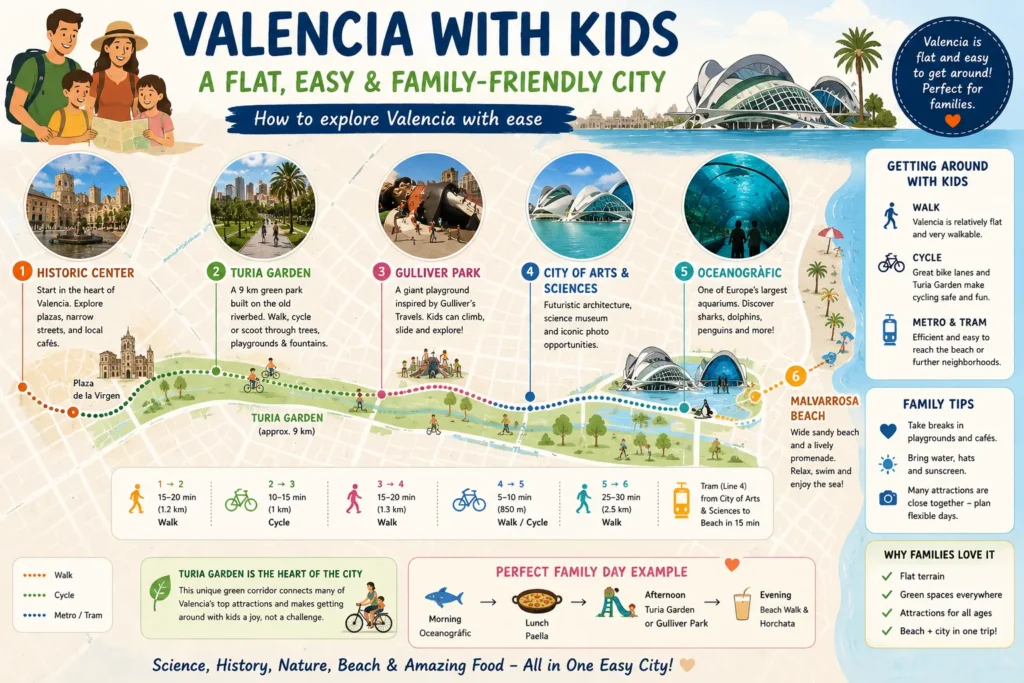
A Natural Family Route Through Modern Valencia
This is where the geography becomes useful.
Families can combine parts of:
Turia Garden
↓
Gulliver Park
↓
City of Arts and Sciences
↓
Oceanogràfic
without repeatedly crossing the entire city.
But do not interpret that as permission to do everything in one marathon day.
The route is valuable because it makes different combinations easy.
Example With Younger Children
Morning:
Gulliver Park.
Then:
Turia.
Lunch.
Oceanogràfic.
Done.
Example With Science-Loving Older Kids
Morning:
Science Museum.
Lunch.
Oceanogràfic.
Short Turia walk afterward.
Done.
Example When Everyone Needs a Slower Day
Turia.
Gulliver.
Long lunch.
Beach.
No museum required.
That flexibility is one of Valencia’s biggest strengths.
6. Valencia Historic Center — Don’t Skip the Old City
Valencia’s futuristic architecture is so distinctive that families can accidentally treat the historic center as secondary.
Don’t.
The contrast is part of the city’s identity.
Modern Valencia around the City of Arts and Sciences feels dramatically different from:
historic streets,
churches,
plazas,
markets,
and medieval architecture
in the old center.
Children can experience both versions of the city without changing hotels.
Plaza de la Virgen and Central Valencia
The area around Plaza de la Virgen provides an easy place to begin exploring historic Valencia.
Instead of constructing a complicated monument route, allow time for:
plazas,
streets,
food,
architecture,
and ordinary city life.
After a full morning at Oceanogràfic, the family does not necessarily need another three-hour structured visit.
Sometimes a historic center works best as:
walk + look + eat.
7. Valencia Cathedral — History, Legend and the Holy Grail
Valencia Cathedral contains layers of architectural and religious history.
But there is one story children may remember much more easily:
the Holy Grail.
A chalice preserved in the cathedral has traditionally been associated with the cup used by Jesus at the Last Supper.
The historical claims surrounding such relics are complex and should not be presented to children as unquestioned fact.
That actually makes the story more interesting.
Ask:
Why do people believe objects are important?
How do historians investigate something this old?
How can tradition and historical evidence be different?
Now a religious relic becomes a lesson in how history itself is interpreted.
Should Every Family Enter?
No.
If children are already experiencing cathedral fatigue after traveling elsewhere in Spain, Valencia Cathedral does not become mandatory simply because it is important.
If the family is interested in:
religious history,
architecture,
or the Holy Grail tradition,
go inside.
Otherwise, the surrounding historic center still works.
8. El Miguelete — Decide Based on the Legs
The cathedral’s bell tower, El Miguelete / Micalet, offers views across Valencia.
It also requires climbing.
By this point in our Spain family guides, the rule should be familiar:
do not climb towers because a checklist says you should.
Ask:
Are the children interested?
Is the weather comfortable?
Has everyone already walked all morning?
Do we actually want the view?
If yes:
go.
If no:
Valencia remains fully visited.
9. La Lonja de la Seda — Valencia’s UNESCO Story
La Lonja de la Seda — the Silk Exchange — is one of Valencia’s most important historic buildings and a UNESCO World Heritage Site.
For children, the name provides the easiest entry point:
Silk Exchange.
What was being exchanged?
Why silk?
Why was Valencia important enough to need a building like this?
Explain It as a Medieval Business Center
Children sometimes assume important historic buildings were:
palaces,
castles,
or churches.
La Lonja provides another story.
Commerce.
Merchants.
Contracts.
Trade.
Money.
Mediterranean connections.
Valencia’s prosperity was tied to its role as an important commercial city.
That makes La Lonja useful because it expands children’s understanding of what made cities powerful.
Not only kings.
Not only armies.
Trade.
Look at the Columns
Inside the main trading hall, the twisting columns create one of the building’s most memorable visual features.
Children do not need to know every architectural term.
Ask:
What do they look like?
Trees?
Ropes?
Something else?
Architecture becomes easier when children describe it before adults explain it.
UNESCO Without the Lecture
La Lonja was recognized by UNESCO because of its exceptional importance as a late Gothic secular building associated with Mediterranean mercantile history.
For a family visit, the simpler version works:
“This building survives from a time when Valencia was one of the Mediterranean’s important trading cities.”
Then walk inside.
That is enough to begin.
Family rating: ★★★★
Best for: School-age children and teenagers
Biggest advantage: A different historical story from another palace or cathedral
Don’t Turn Historic Valencia Into Another Museum Day
This is important.
A family could visit:
Cathedral,
tower,
La Lonja,
another church,
another museum,
another historic building.
I would not.
Valencia’s advantage is variety.
Use it.
One or two historic interiors are enough before moving back toward:
food,
park,
science,
or beach.
What I Would Prioritize With Kids
For a first Valencia family trip, my priorities would be:
1. Oceanogràfic
↓
2. Turia Garden + Gulliver Park
↓
3. City of Arts and Sciences / Science Museum
↓
4. Historic Valencia + La Lonja
↓
5. Beach
And then:
paella.
Not as something squeezed between attractions.
As one of the experiences.
The Valencia Family Rhythm I Would Use
Valencia does not require the same defensive heat strategy as Seville on every summer day, and it does not have Granada’s constant hills.
That allows a more relaxed structure.
I would think:
one major attraction
↓
food
↓
park / rest
↓
second lighter experience
↓
beach or evening walk
The important thing is preserving the contrast.
Do not turn Valencia into:
aquarium → museum → cathedral → UNESCO building → tower.
The city gives families too many different kinds of experiences to travel that way.
Use them.
Mercado Central and Valencia’s Food Story
Valencia is one of those destinations where food should not be treated as something that happens between attractions.
Food is part of the reason to come.
This is the birthplace of paella.
It has one of Spain’s great food markets.
It has its own famous drink made from tiger nuts.
And because Valencia combines city life with nearby agricultural landscapes and the Mediterranean, its food tells another part of the region’s story.
For families, Mercado Central — the Central Market — is an easy place to begin.
10. Mercado Central — Let Children See the Ingredients First
Valencia’s Central Market is worth visiting even if the family has no intention of cooking.
Fruit.
Vegetables.
Seafood.
Meat.
Cheese.
Olives.
Spices.
Local products.
Instead of explaining Spanish food through a restaurant menu, children can see the ingredients before they become dishes.
That makes a market particularly useful with curious eaters.
Turn the Market Into a Family Challenge
Give each child something to find.
The strangest seafood.
A fruit they have never eaten.
The biggest ham.
Something they want to taste.
Something they definitely do not want to taste.
Now the market becomes more than adults slowly examining food stalls while children ask when they can leave.
Don’t Expect It to Be a Theme Park
This is a working food market and an important architectural landmark.
Families should behave accordingly.
Do not block vendors.
Do not let children handle products without permission.
And do not assume every stall exists primarily to provide tourists with samples.
The fun comes from observing how a real market works.
Paella Valenciana — Eat It Where It Began
Many children already know the word paella before arriving in Spain.
But what they imagine may not be traditional Paella Valenciana.
This is worth explaining because Valencia gives families the opportunity to see how famous foods change as they travel around the world.
Traditional Paella Valenciana Is Not Simply Seafood Paella
Seafood paella is extremely popular and widely associated with Spain.
But traditional Paella Valenciana is historically associated with ingredients such as:
rice,
chicken,
rabbit,
green beans,
garrofó beans,
and seasonings including saffron.
Exact preparations vary, and restaurants may offer numerous types of paella.
The important point for children is simple:
the famous seafood version is not the only paella, and it is not the traditional Valencian version that gave the dish its identity.
Rabbit?
Yes.
That may become the entire lunch conversation.
Some children will be curious.
Others will immediately reject the idea.
Do not force it.
One of the advantages of family travel is giving children the opportunity to try something, not requiring them to like it.
If traditional Paella Valenciana is too adventurous for everyone, choose another rice dish the family will enjoy.
Paella Is Traditionally a Lunch Experience
This is useful itinerary information.
Rather than saving Valencia’s signature dish for a late dinner, consider making paella the centerpiece of a proper lunch.
That fits perfectly into a family travel day.
Morning attraction.
Long lunch.
Rest.
Then another lighter experience later.
Beach + Paella Is a Natural Combination
Valencia’s coastal neighborhoods provide one of the most appealing ways to structure the experience.
Beach.
Lunch.
Paella.
Walk.
No museum reservation immediately afterward.
That can become one of the most relaxed days of the entire Spain trip.
Horchata and Fartons — The Easy Family Food Experience
If rabbit in paella created resistance, this next Valencia specialty may be an easier sell.
Valencian horchata — or orxata in Valencian — is traditionally made from chufa, or tiger nuts.
It is served cold and is particularly refreshing in warm weather.
And then there are:
fartons.
Long, soft, sweet pastries traditionally paired with horchata.
Dip.
Eat.
Repeat.
Children usually understand the concept very quickly.
Why I Like Food Experiences Like This
Nobody needs a reservation.
Nobody needs an audio guide.
Nobody needs to understand medieval history.
The family simply tries something that belongs to the place.
Some of the easiest travel memories to recreate years later are food memories.
You may not be able to rebuild the City of Arts and Sciences at home.
You can find horchata or try making something inspired by the trip.
That keeps destinations alive after the vacation ends.
Valencia’s Beaches — Give the City Trip a Vacation Day
Valencia’s Mediterranean location changes the entire family experience.
You can spend the morning sightseeing and then go to the beach.
Or you can deliberately make the beach the main activity.
That flexibility is one of the strongest arguments for Valencia with children.
Playa de la Malvarrosa
Malvarrosa is one of Valencia’s best-known urban beaches.
Wide sand.
Mediterranean water.
Promenade.
Restaurants.
Space.
For families who have spent several days moving through Spanish cities, the change can be extremely welcome.
Don’t Treat the Beach Like Another Attraction
This sounds obvious, but itinerary planning encourages strange behavior.
14:00–16:00 Beach.
Then leave because the spreadsheet says the next thing begins at 16:30.
If the family is having a wonderful afternoon:
stay.
Valencia gives you that option.
Use it.
Beach Safety
As with any beach:
check current sea conditions,
follow lifeguard instructions,
use sun protection,
keep children appropriately supervised,
and remember that conditions can change.
Do not assume an urban Mediterranean beach is automatically calm every day.
Should You Stay Near the Beach?
Potentially.
Families who want a more relaxed vacation may enjoy staying closer to the coast.
But this creates a trade-off.
You gain:
beach access,
promenade,
sea atmosphere.
You lose some convenience for:
historic Valencia,
Central Market,
and certain city attractions.
For a first three-night trip, I would choose accommodation according to which half of Valencia matters most to the family.
Albufera — Where Paella’s Landscape Starts to Make Sense
Families staying longer may consider leaving central Valencia for Albufera Natural Park, south of the city.
This is where the Valencia story expands beyond:
city + beach.
Wetlands.
Lagoon.
Rice-growing landscapes.
Birdlife.
Sunset.
And the agricultural environment connected with Valencia’s rice culture.
Why Albufera Matters to the Paella Story
Paella makes more sense when children understand that rice did not simply appear in a restaurant kitchen.
The surrounding landscape helped shape the cuisine.
Food becomes geography.
That is a powerful travel lesson.
Should Every Family Go?
No.
For two days in Valencia:
stay focused on the city.
For three days:
Albufera becomes possible depending on priorities.
For four or more:
it becomes much easier to include without sacrificing Valencia itself.
Families particularly interested in:
nature,
birds,
boat experiences,
food,
or sunset landscapes
may value it more highly.
Check current transport, boat and visitor conditions when planning.
Where to Stay in Valencia With Kids
Valencia gives families several genuinely different accommodation strategies.
There is no single correct neighborhood.
Choose according to the trip you want.
Ciutat Vella — Best for Historic Valencia
Stay in or around the historic center if your priorities include:
Central Market,
La Lonja,
Cathedral,
historic streets,
restaurants,
and walking.
Best for
First-time families who want the traditional city experience.
Trade-off
The City of Arts and Sciences and beach require transportation.
Ruzafa / Russafa — Best for Neighborhood Life and Food
Ruzafa provides:
restaurants,
cafés,
shops,
and a more residential city atmosphere while remaining relatively central.
Best for
Families who enjoy neighborhood dining and want something outside the most tourist-heavy historic core.
Check
Exact street noise.
A lively neighborhood is only useful if the children can sleep.
City of Arts and Sciences Area — Best for Modern Family Attractions
For families whose children are primarily excited about:
Oceanogràfic,
Science Museum,
Turia,
and Gulliver Park,
staying around the modern eastern side of the city can be extremely practical.
Best for
Families prioritizing science and younger-child attractions.
Trade-off
Historic Valencia feels less immediate.
Beach Area — Best for a City + Sea Vacation
Stay near Malvarrosa or surrounding coastal areas if the beach is a major part of the trip.
This works especially well for:
summer stays,
longer visits,
and families who want a slower rhythm.
Trade-off
More transportation into central Valencia.
Hotel or Apartment?
The usual family decision applies.
Hotel
Better if you value:
reception,
luggage storage,
housekeeping,
breakfast,
and simpler short stays.
Apartment
Better if you value:
separate bedrooms,
kitchen,
laundry,
more space,
and flexible meals.
Because Valencia often works well for three or more nights, apartments can be particularly useful.
Getting Around Valencia With Kids
This is one of Valencia’s strengths.
The city offers a combination of:
walking,
public transportation,
cycling,
and green-space routes.
For most families:
no rental car is necessary.
Metro and Tram
Valencia’s Metro and tram network can be useful for:
airport connections,
beach areas,
and longer journeys.
The exact best route depends heavily on accommodation location.
Use current journey-planning information rather than memorizing routes from an old guide.
Bus
Buses can fill gaps where rail transport is less convenient.
Again, Valencia is not a city where families need to prove they can walk everywhere.
Cycling in Valencia
This deserves special attention.
Valencia’s relatively flat terrain and extensive cycling infrastructure can make bicycles a genuine family transportation option.
The Turia Garden is particularly attractive for cycling.
But:
family cycling suitability depends on the children’s ages and confidence.
Do not rent bicycles because Valencia is famous for cycling if a child is uncomfortable riding in an unfamiliar city.
What About Bike Seats or Trailers?
Rental options vary by provider.
Families with younger children should check:
child-seat availability,
trailers,
helmet availability,
age/weight restrictions,
and current safety requirements
before assuming the exact setup they need will be available.
Valencia With a Stroller
Compared with hillier destinations such as Granada and Toledo, Valencia can feel refreshingly straightforward.
The flatter terrain is a major advantage.
Turia Garden also gives families long stretches away from normal street traffic.
Historic surfaces and individual buildings can still create accessibility issues, but overall this is one of the easier major Spanish destinations to navigate with younger children.
Valencia in Summer With Kids
Summer brings:
heat,
strong sun,
beach weather,
and high demand.
Valencia’s coastal location changes the experience compared with inland Madrid or Seville, but families still need to respect the midday heat.
A Good Summer Rhythm
Morning
Major attraction.
Oceanogràfic.
Science Museum.
Historic center.
Lunch
Sit down.
Paella works beautifully here.
Early Afternoon
Hotel.
Pool.
Indoor attraction.
Rest.
Late Afternoon
Turia.
Gulliver.
Beach.
Evening
Walk.
Food.
Horchata.
The basic family rule remains:
do not spend the hottest hours proving how much sightseeing you can survive.
Spring and Autumn
These can be excellent periods for:
cycling,
walking,
Turia Garden,
historic sightseeing,
and Albufera.
Beach swimming becomes more weather-dependent, but Valencia does not stop working as a family destination when nobody enters the sea.
Winter
Valencia remains a city destination.
The beach becomes more about:
walking,
space,
and Mediterranean atmosphere
than swimming.
Museums, Oceanogràfic, food and historic sights remain relevant.
Always check current attraction schedules and weather for the actual dates.
A Realistic 3-Day Valencia Family Itinerary
This itinerary uses Valencia’s greatest advantage:
variety.
Each day feels different.
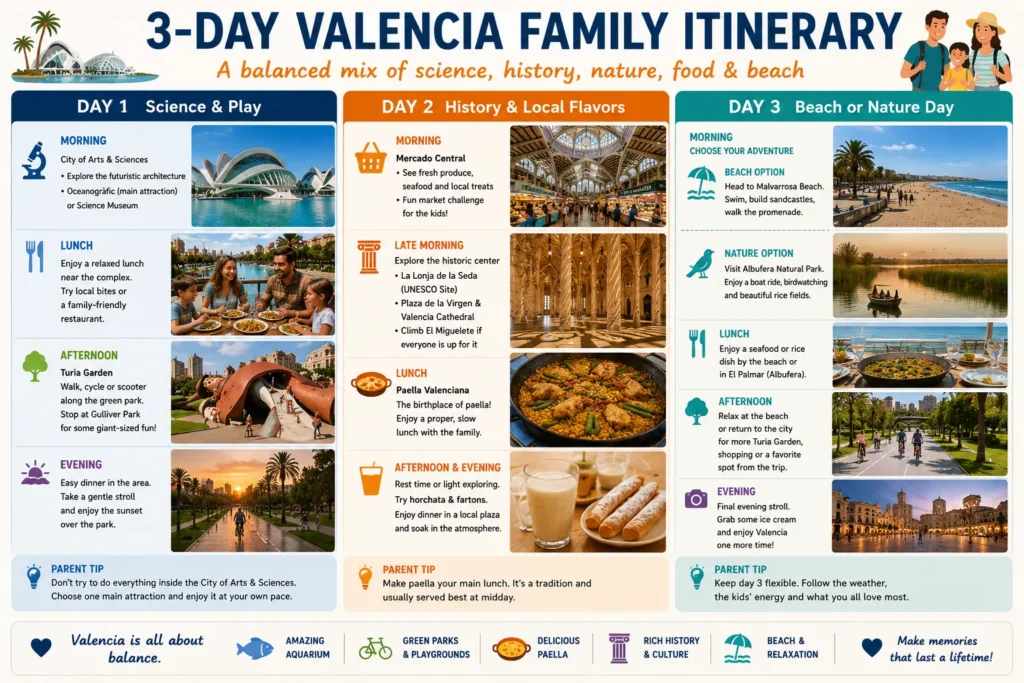
Day 1 — Science + Turia + Gulliver
Morning — City of Arts and Sciences
Explore the architecture.
Then choose the family’s main attraction.
Oceanogràfic-focused family
Make Oceanogràfic the major experience.
Do not worry about completing the entire Science Museum afterward.
Science-focused family
Prioritize the museum and add Oceanogràfic according to time and interest.
Lunch
Eat.
Sit.
No sprint.
Afternoon — Turia Garden + Gulliver Park
Now change the type of activity completely.
Outside.
Move.
Play.
Let children decide how long Gulliver deserves.
Evening
Easy dinner.
No cathedral.
No tower.
Day 1 already worked.
Day 2 — Historic Valencia + Food
Morning — Mercado Central
Start with food and city life.
Then walk toward:
La Lonja de la Seda.
Explore the UNESCO-listed trading hall.
Late Morning — Historic Center
Plaza de la Virgen.
Cathedral exterior or interior according to interest.
Miguelete if everyone genuinely wants the climb.
Lunch — Paella
Make this the day’s major meal.
Do not squeeze it into forty minutes.
Afternoon — Rest
Especially in warm weather.
Late Afternoon — Family Choice
Shopping.
More historic streets.
Turia.
Horchata and fartons.
Nothing ambitious.
Day 3 — Beach + Choose Your Valencia
Day 3 should not automatically become another full sightseeing day.
Morning Option A — Beach
Head toward Malvarrosa.
Walk.
Swim if conditions and season are appropriate.
Relax.
Morning Option B — Albufera
For nature-focused families, use part of the day for Albufera instead.
Do not try to do a major Albufera excursion and a full beach day simply because both sit outside the historic center.
Choose according to family interest.
Lunch
If you are near the coast, this can be another excellent opportunity for a rice-based meal.
Afternoon
Beach.
Rest.
Turia.
Return to something the children loved.
Final Evening
Do not schedule a mandatory finale.
Walk.
Eat.
Get horchata.
Let Valencia end easily.
Valencia With Younger Children
Valencia may be one of the strongest Spanish city choices for families with younger children.
I would emphasize:
Oceanogràfic,
Gulliver Park,
Turia Garden,
beach,
short historic-center walks,
and Science Museum according to age and interest.
Reduce:
long cathedral visits,
tower climbs,
and unnecessary historic interiors.
A four-year-old does not need to understand medieval Mediterranean commerce for the family to enjoy Valencia.
Valencia With Teenagers
Teenagers can get a different city.
Science and technology.
Marine conservation.
Cycling.
Beach.
Food.
Architecture.
Photography.
Medieval trade.
Shopping.
And the opportunity to compare a futuristic architectural complex with a UNESCO-listed Gothic commercial building in the same city.
That contrast can make Valencia surprisingly rewarding.
Valencia or Barcelona With Kids?
This is one of the most useful family comparisons on Spain’s Mediterranean coast.
| Valencia | Barcelona | |
|---|---|---|
| Biggest family strength | Balance + easy pace | Iconic attractions + variety |
| Signature architecture | City of Arts and Sciences | Gaudí |
| Aquarium | Oceanogràfic | Aquarium available |
| Major park advantage | Turia Garden | Park Güell / Montjuïc |
| Playground advantage | Gulliver Park | Many local parks |
| Beach | Yes | Yes |
| Historic center | Strong | Exceptional |
| Famous food identity | Paella | Catalan cuisine |
| Terrain | Relatively flat | More varied |
| Cycling | Excellent | Good |
| First-trip international fame | Lower | Much higher |
| Best for slower family trip | Excellent | Very good |
Choose Valencia If Your Family Wants:
more space,
easier cycling,
a major aquarium,
science,
playgrounds,
beach,
and a less intense city rhythm.
Choose Barcelona If Your Family Wants:
Gaudí,
world-famous architecture,
more headline attractions,
a larger-city experience,
and iconic first-trip sightseeing.
Should Valencia Replace Barcelona?
Not automatically.
They are different enough that this is not simply:
Barcelona, but quieter.
Valencia has its own identity.
If this is a first Spain trip and the family has never seen Barcelona, Barcelona may still be the obvious Mediterranean anchor.
If you have already visited Barcelona — or your children strongly prioritize:
aquarium,
science,
cycling,
parks,
and beach time —
Valencia can be a fantastic alternative.
How Valencia Fits Into a Mediterranean Spain Family Trip
Valencia works particularly well as a bridge between destinations rather than an isolated detour.
A Mediterranean route can connect:
Barcelona → Valencia
and then continue according to the wider trip.
Because the cities are linked by rail and offer different family experiences, the combination can work much better than visiting two destinations that feel nearly identical.
Families building a coastal route can use our Mediterranean Spain family itinerary to connect Barcelona, Valencia and other Mediterranean destinations at a realistic pace.
For a broader comparison of Spanish destinations, our 15 Best Places to Visit in Spain with Kids guide can help determine whether Valencia belongs in your first family trip.
And families comparing the two Mediterranean cities directly can use our Barcelona with Kids family travel guide for Barcelona’s attractions, neighborhoods, beach strategy and realistic family itinerary.
Common Mistakes Families Make in Valencia
Trying to Complete the Entire City of Arts and Sciences
Let children’s interests determine the visit.
Skipping Gulliver Park
Family travel needs attractions designed primarily for children too.
Treating Turia Garden as Just Another Park
Use it as part of the family’s movement through Valencia.
Eating Generic Paella Without Understanding the Valencia Connection
Try the local food story, not simply the word on a menu.
Scheduling Paella Like Fast Food
Give lunch time.
Visiting Only Modern Valencia
The historic center and La Lonja tell an entirely different story.
Visiting Only Historic Valencia
Then you have missed what makes Valencia unusual.
Renting a Car for a Normal City Stay
Usually unnecessary.
Planning Every Hour
Valencia’s strength is that the family can change direction easily.
Use that flexibility.
What I Would Protect in a Valencia Family Itinerary
If I had to protect three things, they would be:
one genuinely child-centered experience
one proper Valencian meal
and
one block of time with nowhere urgent to be.
The first might be Oceanogràfic.
Or Gulliver Park.
The second should probably involve rice.
The third could happen:
in Turia Garden,
at the beach,
over horchata,
or simply while wandering.
The more family trips I think about, the less convinced I am that every memorable hour needs to contain a famous attraction.
Valencia makes that especially obvious.
A child may remember sliding down Gulliver longer than entering a UNESCO building.
That does not reduce the value of La Lonja.
It simply means the family experienced the city differently.
Why Valencia Can Be Easier Than Families Expect
Some cities require a lot of strategy.
Timed tickets.
Steep hills.
Long transfers between attractions.
A constant calculation about whether the children can manage one more thing.
Valencia can feel different.
Not effortless.
No family trip is effortless.
But the combination of relatively flat terrain, green space, public transportation, cycling infrastructure and very different types of attractions gives parents options.
If the museum is not working:
go outside.
If everyone is tired of historic buildings:
go to the aquarium.
If the children need to move:
Gulliver Park.
If nobody wants another ticket:
Turia Garden.
If the family needs to stop sightseeing altogether:
beach.
Having alternatives close enough to use them is one of the most underrated advantages a family destination can offer.
Don’t Make Valencia Compete With Barcelona
I think this is particularly important when planning Spain.
Valencia is often evaluated by asking:
Is it better than Barcelona?
That is not how I would choose.
Barcelona is one of Europe’s great first-time destinations.
Sagrada Família alone creates an architectural experience Valencia does not attempt to replicate.
But Valencia can provide something Barcelona sometimes struggles to provide during a busy family trip:
breathing room.
The question is not necessarily:
Which city is better?
It is:
Which city fits this particular trip better?
A family visiting Spain for the first time and wanting iconic architecture may choose Barcelona.
A family returning to Spain may choose Valencia immediately.
A family with young children who love aquariums, parks and playgrounds may prefer Valencia.
A family with teenagers fascinated by Gaudí may prefer Barcelona.
Neither decision needs defending.
Let Children Have Their Own Valencia
Parents naturally arrive with priorities.
We want the children to see:
La Lonja.
The cathedral.
Historic Valencia.
We want them to understand:
Mediterranean trade,
Gothic architecture,
the origins of paella.
All worthwhile.
Children may create a completely different hierarchy.
1. Gulliver Park
2. Sharks
3. Beach
4. Fartons
5. Everything the parents considered historically essential
That is fine.
I do not think a family trip succeeds when children learn to rank attractions the same way adults do.
It succeeds when everyone finds a reason to care about the destination.
Explain why La Lonja matters.
Then let Gulliver win.
One Valencia Afternoon I Would Leave Completely Open
If the family has three days, I would protect at least one afternoon from reservations.
Maybe everyone returns to the beach.
Maybe the children demand Gulliver again.
Maybe you rent bikes.
Maybe lunch lasts much longer than expected.
Maybe the family discovers a plaza or café nobody researched beforehand.
Maybe everyone simply needs the hotel.
Leave room for that.
A flexible afternoon is particularly valuable in Valencia because there are so many easy alternatives.
You do not need to know what the family will want before the trip begins.
You only need enough space in the itinerary to respond when you find out.
Before You Book Valencia: My Family Checklist
1. Decide Which Valencia You Want
Is this primarily:
science + aquarium
historic city
beach vacation
or
a combination?
Your accommodation choice should follow that answer.
2. Decide Whether Oceanogràfic Is Essential
If it is, check current ticket availability and opening information before building that day.
3. Protect Gulliver Time
Especially with younger children.
Do not place it fifteen minutes before another reservation.
4. Plan One Proper Paella Lunch
Not because every family must become a food expert.
Because food is one of Valencia’s defining cultural experiences.
5. Check Beach Conditions
Season and weather matter.
A Mediterranean city does not guarantee swimming conditions every day.
6. Decide Whether Cycling Actually Fits Your Family
Valencia is cycling-friendly.
That does not automatically make every family a cycling family.
7. Leave Something Unplanned
Valencia rewards flexibility.
Is Valencia Worth Visiting With Kids?
Yes.
And I think Valencia becomes more compelling, not less, when you evaluate it specifically as a family destination.
It may not have Spain’s most famous palace.
It may not have Gaudí.
It may not have the Alhambra.
But it has something many families need more:
variety without constant difficulty.
Children can learn about marine life in the morning.
Play inside a giant Gulliver in the afternoon.
Cycle through a former riverbed.
Stand inside a medieval silk exchange.
Eat paella where the dish originated.
Drink horchata.
And finish the day beside the Mediterranean.
Those experiences belong to the same city.
That is Valencia’s strength.
Final Thoughts: Valencia Gives Families Room to Enjoy Spain
Valencia does not need to shout as loudly as some of Spain’s more famous destinations.
Its appeal becomes obvious through the way the days work.
There is enough history for parents who want culture.
Enough science for children who want to interact with something.
Enough outdoor space to recover from sightseeing.
Enough food identity to make meals part of the trip.
And a beach when nobody wants to look at another building.
For family travel, that balance can be more valuable than having the longest list of famous attractions.
I would visit Oceanogràfic.
Spend time in Turia Garden.
Let the children play at Gulliver.
Walk through historic Valencia.
Explain what happened inside La Lonja.
Make paella a real lunch rather than a rushed dinner item.
Try horchata and fartons.
Then leave enough time for the family to choose something themselves.
Maybe they choose another museum.
Maybe another beach afternoon.
Maybe another hour at the playground.
That choice is part of the trip.
Because years later, the family may not remember whether Valencia was the third or fourth most historically important city on the itinerary.
They may remember something much simpler:
the shark swimming overhead,
the enormous Gulliver,
cycling beneath the trees,
rice arriving in a huge pan,
or running toward the Mediterranean at the end of a long day.
And if that is what they remember,
Valencia did exactly what a great family destination should do.