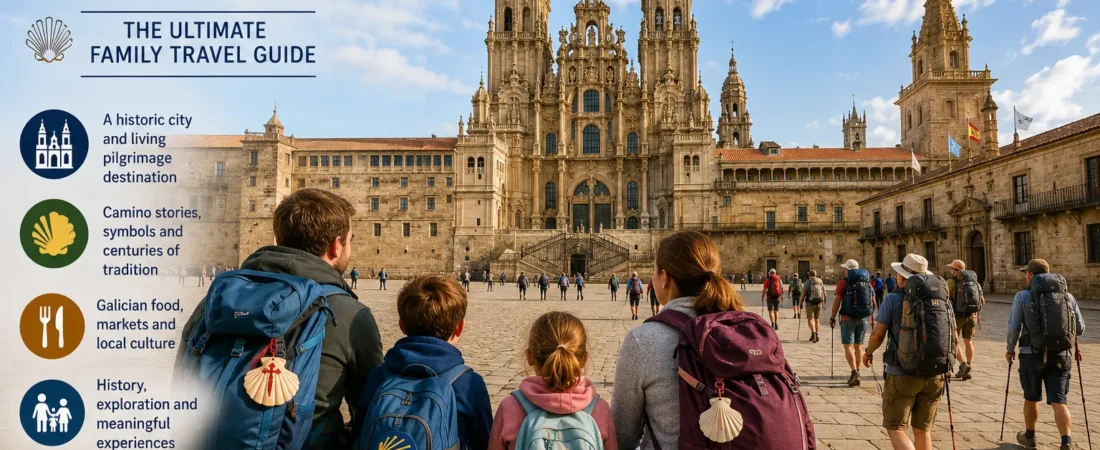
Santiago de Compostela is a city built around an ending.
Walk through the historic center and you will see people carrying backpacks.
Some have walking poles.
Many have scallop shells attached to their bags.
Yellow arrows appear along streets.
Then, eventually, everyone seems to be moving toward the same place:
Praza do Obradoiro.
Some pilgrims arrive smiling.
Some take photographs.
Some sit quietly.
Some hug the people they walked with.
Others simply drop their backpacks and stare at the Cathedral.
Children notice this.
And that is what makes Santiago de Compostela with kids different from visiting another beautiful European cathedral city.
Before explaining:
Romanesque architecture,
Baroque façades,
medieval pilgrimage,
or religious history,
ask one simple question:
“Why are all these people arriving here?”
That question can unlock the entire city.
Santiago de Compostela with Kids: Quick Family Guide
| Question | Recommendation |
|---|---|
| Ideal first stay | 2 nights |
| Minimum worthwhile visit | 1 full day |
| Best for | History, Camino culture, food, architecture |
| Best ages | School-age children and teens especially strong |
| Toddlers | Good with slower pacing |
| Essential experience | Praza do Obradoiro + Cathedral |
| Best family story | The end of the Camino |
| Best child activity | Camino symbol hunt |
| Major UNESCO experience | Historic Old Town |
| Famous Cathedral feature | Botafumeiro |
| Guaranteed to see Botafumeiro swing? | No |
| Car needed? | No for the historic center |
| Biggest weather consideration | Rain |
| Stroller | Manageable in parts; historic paving requires patience |
| Best family strategy | Understand the Camino before collecting attractions |
For a first visit, I would prioritize:
Camino symbols
↓
Praza do Obradoiro
↓
Cathedral
↓
Old Town
↓
Galician food
Then add museums and other attractions according to:
weather,
children’s ages,
and interest.
Why Santiago Works With Kids
Santiago does not have the obvious family attractions of:
Barcelona,
Málaga,
or Mallorca.
There is no major city beach.
No giant amusement park defines the destination.
And children who have already traveled through Spain may initially see:
another historic center,
another cathedral,
another plaza.
That is why the Camino story needs to come first.
Turn the City Into the Finish Line
Tell children before exploring:
People have walked here from places across Spain and Europe for centuries.
Today, pilgrims still arrive in Santiago using different Camino routes and for different reasons.
Some walk for religious reasons.
Some for:
culture,
personal challenge,
history,
nature,
reflection,
or simply the experience of making a long journey on foot.
Now every backpack becomes interesting.
Every shell means something.
Every arrow points somewhere.
And the Cathedral becomes:
the destination
rather than simply:
the next old building.
What Is the Camino de Santiago?
The Camino de Santiago — Way of St. James — is not one single trail.
It is a network of pilgrimage routes that lead toward Santiago de Compostela.
Different pilgrims may arrive from:
France,
Portugal,
other parts of Spain,
and beyond.
Routes have different:
distances,
landscapes,
histories,
and levels of popularity.
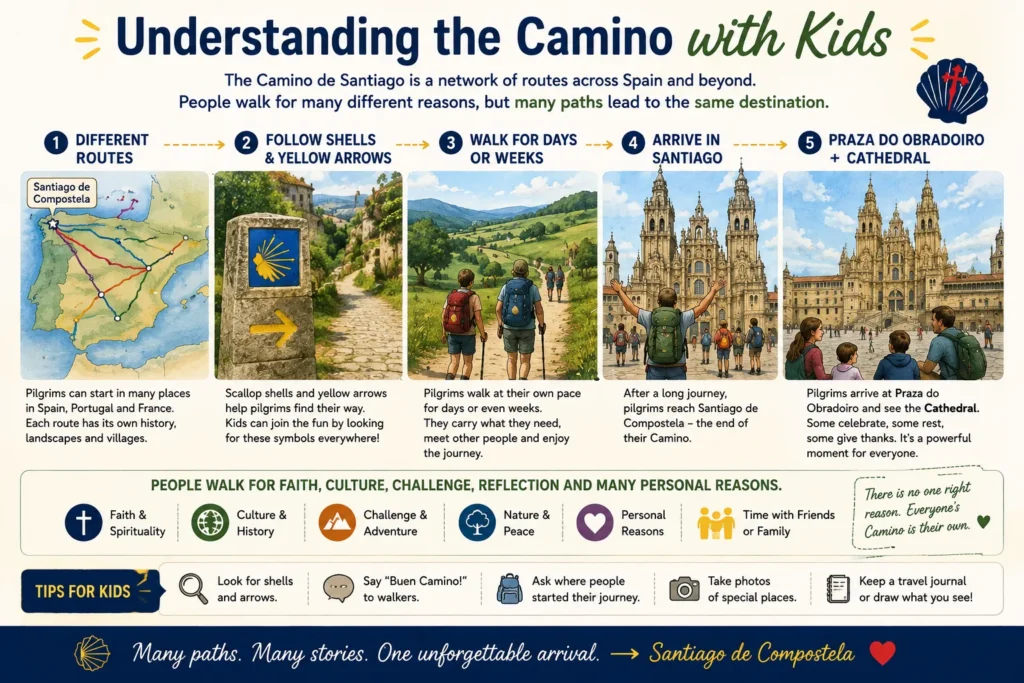
Explain It to Children Like This
“Imagine choosing somewhere hundreds of kilometers away and walking toward this city for days or weeks, following signs along the way.”
Then show them a shell.
Or a yellow arrow.
Now the concept is physical.
Why Do Pilgrims Come to Santiago?
This needs a little historical precision.
According to Christian tradition, the remains of St. James the Apostle — Santiago — came to be associated with this place.
The discovery traditionally attributed to his tomb helped Santiago develop into one of medieval Christianity’s major pilgrimage destinations.
For a family travel guide, the important distinction is:
this is a religious and historical tradition, not something we need to present as an archaeologically proven fact.
That distinction does not make the story less interesting.
It makes the explanation more accurate.
Santiago Became One of Europe’s Great Pilgrimage Destinations
During the Middle Ages, pilgrims traveled toward Santiago from across Europe.
The routes encouraged movement not only of people, but also:
ideas,
artistic styles,
religious traditions,
commerce,
and culture.
For older children, this creates a useful way to understand medieval Europe.
There were no:
airports,
high-speed trains,
Google Maps,
or family WhatsApp groups.
Yet people still traveled enormous distances.
Ask Children Why
Why would someone do that?
Religion?
Adventure?
Hope?
Community?
A promise?
Today, pilgrims may have completely different motivations.
Ask the same question while watching modern walkers arrive.
Why do you think that person walked the Camino?
There may be no way to know.
That is what makes the question interesting.
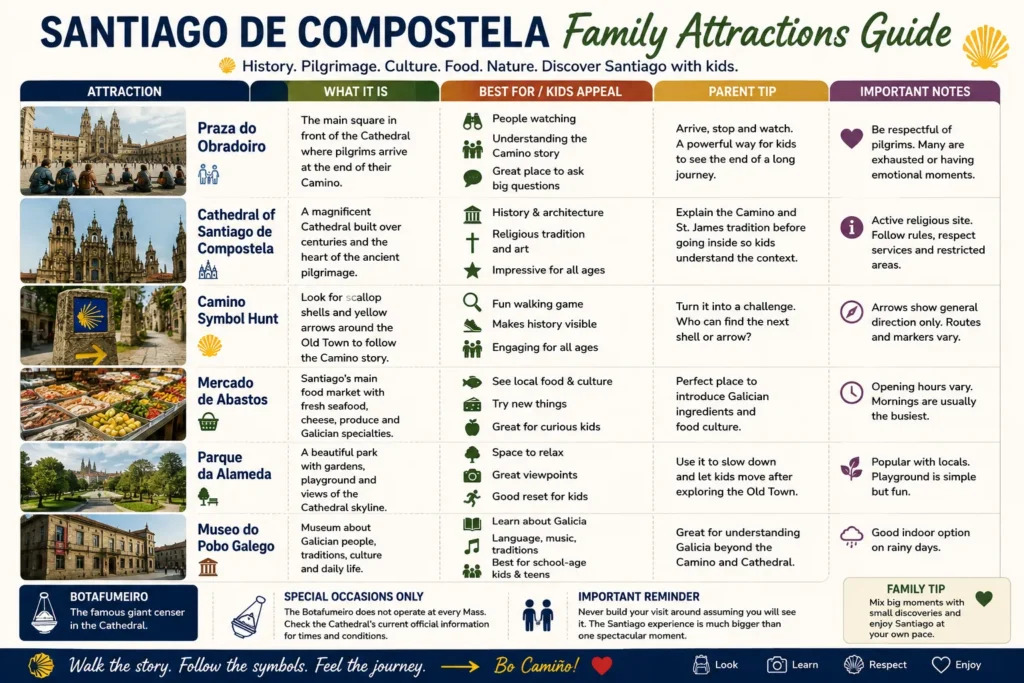
1. Praza do Obradoiro — Start Here, Then Stop
Many city guides treat the plaza as the space outside the Cathedral.
For families, I would treat it as an attraction in its own right.
Do not immediately walk through it.
Stop.
Watch People Arrive
This may be one of the most memorable Santiago experiences.
You might see pilgrims:
take off backpacks,
photograph the Cathedral,
sit on the ground,
celebrate,
hug,
or simply stand still.
Children can understand achievement without understanding medieval theology.
Someone has reached the end of a long journey.
Ask One Question
“How far do you think they walked?”
Then:
one day?
one week?
a month?
Where did they sleep?
What did they carry?
Would you do it?
Suddenly a plaza becomes a conversation.
Don’t Treat Pilgrims as Entertainment
There is an important family lesson here too.
People arriving may be:
exhausted,
emotional,
praying,
celebrating something personal,
or simply trying to recover.
Observe respectfully.
Do not:
interrupt someone for a photograph,
photograph emotional strangers intrusively,
or treat arriving pilgrims like performers.
Children can learn that travel destinations are still real places filled with real people.
2. Cathedral of Santiago de Compostela — Now Go Inside
After children understand why people are arriving, the Cathedral makes much more sense.
The Cathedral of Santiago de Compostela developed over centuries and contains layers of:
religious history,
architecture,
art,
and pilgrimage tradition.
Its importance cannot be reduced to:
“big old church.”
Start Outside
Stand in Praza do Obradoiro.
Look at the façade.
Ask:
Does this look medieval?
The answer is complicated.
The Cathedral has older Romanesque origins, while the famous Obradoiro façade that visitors see today reflects later Baroque transformation.
That is a useful concept for children.
Historic buildings do not necessarily belong to one moment.
They change.
Buildings Can Have Layers
Think of the Cathedral as a structure that generations kept:
building,
changing,
decorating,
repairing,
and interpreting.
That is much closer to reality than giving children one architectural label and moving on.
Should Families Go Inside?
Yes, I think the interior is important here.
Not because every family must inspect every chapel.
But because this is where the pilgrimage story leads.
Keep the visit appropriate to:
children’s ages,
current access arrangements,
religious services,
and family interest.
Remember: This Is an Active Religious Site
The Cathedral is not simply a tourist attraction.
Families should respect:
services,
prayer,
restricted areas,
photography rules,
and current visitor procedures.
If a service is underway, sightseeing behavior may need to change.
That itself is useful for children to understand.
Some famous monuments are still being used for the purpose they were built for.
The Tomb of St. James and the Difference Between Faith and Historical Evidence
This is another place where parents may need careful language.
Christian tradition identifies the tomb at Santiago with St. James the Apostle.
For believers, the religious significance can be profound.
From a historical perspective, the attribution belongs to a long religious tradition whose claims should not simply be presented to children as undisputed archaeological fact.
You can say:
“For centuries, Christians have believed and taught that the tomb here is connected with St. James.”
That is both respectful and accurate.
3. Botafumeiro — The Cathedral Experience Kids May Remember
Even children who are not particularly interested in cathedrals may become interested when they hear about the Botafumeiro.
It is a very large ceremonial censer associated with Santiago Cathedral.
When used, it swings dramatically through the transept.
That is visually extraordinary.
But Will You See It?
Do not assume so.
This is important.
The Botafumeiro does not operate for every visitor or every Mass simply because tourists are present.
Its use depends on specific liturgical occasions and other arrangements.
If seeing it matters to the family, check the Cathedral’s current official information close to the visit.
Do not build a child’s entire Santiago expectation around:
“At 12:00 the giant incense thing will definitely swing.”
It may not.
Explain What a Censer Is First
Children may have no idea what they are looking at.
Explain simply:
A censer holds incense.
Incense is burned during certain religious ceremonies.
Then show them the scale of the Botafumeiro.
Now the interesting question becomes:
Why is this one so enormous?
Don’t Repeat the “It Was Made to Cover Pilgrim Smell” Story as Fact
This is one of those travel stories that gets repeated because it is memorable.
You may hear claims that the Botafumeiro existed primarily to deal with the smell of medieval pilgrims.
Treat simplistic explanations like that cautiously.
Its function belongs within the Cathedral’s liturgical use of incense and ceremonial tradition.
A funny story is not automatically the best history.
4. Santiago’s UNESCO Old Town — The City Is More Than the Cathedral
Santiago de Compostela’s historic city is recognized as a UNESCO World Heritage Site.
But again:
UNESCO status should not become a badge we mention and immediately forget.
Ask:
Why does this city matter internationally?
The Answer Is the Relationship Between City and Pilgrimage
Santiago developed around its religious importance and role as a pilgrimage destination.
Its historic urban fabric contains architectural layers associated with centuries of development.
Churches.
Monasteries.
Plazas.
Historic streets.
Civic buildings.
The Cathedral dominates the story, but it is not the entire story.
The Camino and UNESCO Can Become Confusing
There are related but distinct UNESCO designations associated with Santiago and Camino heritage.
For families, we do not need to turn this into a classification exercise.
Just keep one distinction clear:
Santiago’s Old Town is itself a UNESCO World Heritage Site.
The broader pilgrimage routes also have important World Heritage recognition in their own right.
The city and the routes are connected, but they are not the same UNESCO property.
5. Camino Symbol Hunt — One of the Easiest Activities in Santiago
Now give children something to do.
Look for:
scallop shells
and
yellow arrows.
These are among the most recognizable symbols associated with Camino wayfinding.
Why the Scallop Shell?
The scallop shell became strongly associated with the pilgrimage to Santiago.
Today you will see it:
on pilgrim backpacks,
signs,
pavements,
souvenirs,
and route markers.
You do not need to explain every legend connected with the shell.
Start with what children can see:
“When you see this symbol, think Camino.”
Make It a Game
Who finds the first shell?
How many can you spot before lunch?
Can you find an arrow?
Which direction are the pilgrims going?
Now children are navigating the historic city instead of merely following their parents through it.
Follow the Symbols Backward
This can be especially fun.
Instead of following pilgrims toward the Cathedral, walk away from the Cathedral and notice where Camino symbols appear.
Ask:
Where did these people come from before reaching this street?
The city starts extending beyond the plaza.
Don’t Turn It Into a Competition
There is no need to count 147 shells.
The point is to make children notice the visual language of the Camino.
Once they understand it, they may start spotting Camino symbols elsewhere in Spain and Europe.
That is one of the joys of travel:
one destination teaches you how to notice the next one.
6. Walk the Historic Streets Without Trying to Complete Them
After the Cathedral and Obradoiro, I would deliberately avoid immediately marching toward another major attraction.
Walk.
Santiago’s historic center rewards:
looking up,
turning into side streets,
finding plazas,
watching pilgrims,
and stopping for food.
Rain Changes the Appearance of Santiago
Stone streets.
Arcades.
Grey skies.
Wet façades.
Santiago can look dramatically different from the sun-baked Andalusian cities families may have visited earlier.
That contrast is part of northern Spain.
But I am not going to tell you:
“Santiago is better in the rain.”
If everyone is wet and cold, it may simply be unpleasant.
We will build a practical rain strategy later in the guide.
The Arcades Suddenly Make Sense
As families walk through the historic center, notice covered passages and arcaded streets.
Architecture responds to:
climate,
movement,
commerce,
and everyday life.
Ask children:
Why would covered walkways be useful here?
Look at the weather.
They may solve that one themselves.
7. Pilgrims Are Part of the City — But So Are Residents
This is worth remembering.
Santiago is internationally famous because of pilgrimage.
But it is also:
a university city,
a regional capital,
a place where people work,
study,
shop,
eat,
and live.
Do not reduce Santiago to a medieval religious theme park.
Look for the Ordinary City
Students.
Local cafés.
Markets.
Buses.
Shops.
People walking home.
A destination becomes more interesting when children realize that famous places continue functioning after tourists leave.
What I Would Prioritize on the First Santiago Day
If the family has just one day, my priorities would currently be:
Camino symbol hunt
↓
Praza do Obradoiro
↓
Cathedral
↓
Old Town
↓
Galician food
That is already enough to understand why Santiago matters.
If the Botafumeiro operates during the visit:
extraordinary.
If it does not:
the Santiago experience has not failed.
That is exactly the expectation I would set with children before entering the Cathedral.
The Santiago Family Rhythm I Would Use
Santiago works better when families do not treat every historic building as another compulsory interior.
Think:
walk + discover Camino symbols
↓
Obradoiro
↓
Cathedral
↓
food
↓
unstructured Old Town
↓
one additional experience
That final experience can depend on:
weather,
children’s ages,
and how much cathedral-and-history attention remains.
The city already has a strong narrative.
You do not need to manufacture one by adding more attractions.
8. Mercado de Abastos — See Galicia Through Food
After the Cathedral, Camino symbols and historic streets, I would deliberately change the subject.
Food.
Mercado de Abastos de Santiago gives families a completely different way to understand Galicia.
Fish.
Shellfish.
Cheese.
Meat.
Vegetables.
Fruit.
Local products.
And ingredients children may never have seen before.
For a family, this can be more engaging than immediately entering another historic building.
Give Children a Galician Market Challenge
Ask them to find:
one seafood they recognize
one seafood they have never seen
one cheese
one thing they want to taste
and
the strangest-looking ingredient in the market.
There are no wrong answers.
The goal is observation.
Galicia’s Relationship With the Sea Is Everywhere
Santiago itself is inland.
But Galicia’s Atlantic coastline strongly shapes the region’s food culture.
That is why seafood appears so prominently.
For older children, this creates another geographical connection.
Look at a map.
Where is Santiago?
Where is the coast?
How did seafood reach inland markets historically?
Food starts explaining geography.
Don’t Assume Every Stall Operates All Day
Markets have their own rhythms.
If seeing the market at its liveliest or eating there matters to the family, check current opening information and individual business schedules.
Do not treat it like a shopping mall that operates identically from morning until evening.
9. What to Eat in Santiago de Compostela With Kids
Galician food gives families several excellent opportunities to try something genuinely regional without requiring every child to become an adventurous seafood eater overnight.
My strategy would be:
one easy local food
one unfamiliar regional food
one thing everybody reliably eats.
Then share.
Empanada Gallega — An Easy Place to Begin
Empanada gallega can be one of the easiest introductions.
Galician empanadas come with different fillings, which may include:
meat,
fish,
seafood,
or vegetables.
That means the family can choose according to actual preferences.
Why It Works
Children understand the basic concept.
Pastry or bread-like dough.
Filling.
Slice.
Eat.
The regional experience comes through the preparation and filling rather than requiring them to confront an entirely unfamiliar format.
Pulpo a Feira — The Octopus Question
One of Galicia’s best-known dishes is pulpo a feira, traditionally associated with octopus seasoned with ingredients such as olive oil, salt and paprika.
For some children:
fantastic.
For others:
the word octopus ends negotiations immediately.
Don’t Hide What It Is
I would never tell a child:
“Just try it first and I’ll tell you afterward.”
Say:
“It’s octopus. Want to try one piece?”
If yes:
great.
If no:
someone else eats it.
Food curiosity works better when children trust the adults offering the food.
Pimientos de Padrón — The Famous Pepper Surprise
Pimientos de Padrón are small green peppers strongly associated with Galicia.
They are famous for the saying that roughly translates to:
some are hot and some are not.
The reality can vary according to the peppers and growing conditions, so do not promise children that a particular plate will be mild.
Should This Become a Family Game?
With older children who already tolerate peppers and spice?
It can be fun.
With a young child who dislikes spicy food?
No.
Do not turn:
“Which one is hot?”
into a practical joke.
Let children choose whether they want to participate.
Galician Seafood
Families who enjoy seafood have an enormous amount to explore in Galicia.
Depending on season and restaurant, they may encounter different:
shellfish,
fish,
octopus,
and other Atlantic products.
This is where I would avoid creating a rigid:
“You must eat these seven things”
list.
Ask what is:
local,
seasonal,
and recommended
where you are actually eating.
Tarta de Santiago — The Dessert With a Camino Connection
This is one of the easiest foods to connect directly with the destination.
Tarta de Santiago is an almond cake traditionally associated with Galicia and recognizable by the Cross of Santiago often marked across the top.
Children have already been looking for:
shells,
arrows,
and Camino symbols.
Now the pilgrimage imagery appears on dessert.
Excellent.
Important Allergy Note
Traditional Tarta de Santiago is almond-based.
Families dealing with nut allergies should not treat this as an ordinary cake.
Check ingredients and cross-contact directly with the establishment.
This is not a food where appearance tells you enough.
Let Children Find the Cross
Before eating:
ask what symbol is on top.
Have they seen it anywhere else in Santiago?
Now dessert becomes part of the symbol hunt.
This is the kind of educational activity I strongly support.
It ends in cake.
My First Santiago Family Meal
I might order something like:
empanada to share
↓
one Galician seafood or octopus dish
↓
something familiar
↓
Tarta de Santiago
That gives children:
familiarity,
one challenge,
and a very clear incentive structure.
10. Parque da Alameda — The Family Reset With a Cathedral View
Historic centers can become tiring because every street seems to contain something parents think children should appreciate.
Santiago needs a reset.
Parque da Alameda provides one.
Green space.
Walking.
Benches.
Views.
Room to slow down.
Why I Would Put It in a Two-Day Itinerary
After:
Cathedral,
historic streets,
market,
and food,
children may not need another museum.
They may need:
space.
That is enough reason to go.
Look Back Toward Santiago
The park also provides opportunities to see the historic city and Cathedral from a different perspective.
This is useful.
Children have already stood beneath the Cathedral.
Now they can see how it sits within the city.
Close view.
Far view.
Different understanding.
Family Rating
★★★★½
Best for: All ages
Best use: Reset + walking + views
Time: As long as the family needs
Do not schedule the park to the minute.
11. Museo do Pobo Galego — When Children Want to Understand Galicia
Families with older children or teenagers may want something beyond the Camino story.
The Museo do Pobo Galego — Museum of the Galician People can help introduce Galicia’s:
culture,
traditions,
society,
and regional identity.
This matters because Santiago is not simply:
the place where the Camino ends.
It is in Galicia.
And Galicia has its own:
language,
history,
music,
food,
traditions,
and identity.
Galicia Is Not Just “Northern Spain”
Children may notice signs containing words that look different from standard Spanish.
That may be Galician — galego.
This gives families another opportunity similar to what we encountered with Euskara in the Basque Country.
Spain contains multiple languages and strong regional cultures.
Ask Children to Find Galician
Look at signs.
Menus.
Place names.
Which words resemble Spanish?
Which look different?
For older children who have studied Spanish, this can become particularly interesting.
Do All Families Need This Museum?
No.
I would prioritize it for:
school-age children interested in culture,
teenagers,
families spending two or more days,
and rainy weather.
For a one-day Santiago visit:
Camino + Cathedral + Old Town come first.
Rainy-Day Santiago With Kids
Rain deserves its own strategy here.
Santiago is in Galicia.
Families should arrive prepared for variable weather rather than mentally importing an Andalusian forecast into northern Spain.
Do Not Romanticize Rain With Children
Travel writing loves sentences like:
“Santiago’s ancient stones are most magical in the rain.”
Maybe.
They are also slippery.
Shoes get wet.
Children get cold.
Strollers get damp.
Nobody cares how atmospheric medieval stone looks when their socks are soaked.
Use Santiago’s Covered Spaces
Remember the arcades from Part 1?
Now they become practical.
Use:
covered walkways,
Cathedral time,
market,
museums,
cafés,
and longer meals
to break outdoor walking into manageable sections.
My Rain Strategy
Do not create one completely separate itinerary.
Keep movable pieces.
For example:
Cathedral
market
museum
lunch
Old Town
park
Then reorder them according to actual conditions.
If the rain stops:
walk.
If it starts heavily:
go inside.
Waterproofing Matters More Than Optimism
For wet-weather Santiago, I would care about:
water-resistant outer layers,
appropriate footwear,
a stroller rain cover if relevant,
and somewhere to keep essential items dry.
An umbrella may help, but families carrying:
bags,
strollers,
and children’s hands
may find wearable rain protection more practical.
Where Should Families Stay in Santiago?
This decision is considerably easier than choosing a Mallorca or Ibiza base.
For a first two-night visit, I would stay in or near the historic center unless there is a strong reason not to.
1. Historic Center — Best for Atmosphere
Staying within the old city places families close to:
Cathedral,
Obradoiro,
restaurants,
historic streets,
and the Camino atmosphere.
That can be wonderful.
The Trade-Off
Historic buildings may involve:
stairs,
limited elevators,
difficult vehicle access,
old paving,
and rooms that are charming but not necessarily designed around a family of five with luggage.
Check the actual property.
2. Just Outside the Historic Core — My Practical Family Choice
For many families, this may be the sweet spot.
Close enough to walk into the historic center.
But potentially easier for:
taxis,
luggage,
modern accommodation,
and transportation.
Why I Like This Compromise
You do not need to sleep directly beside the Cathedral to experience Santiago.
If moving five suitcases becomes substantially easier by staying a ten-minute walk away:
that is a good trade.
3. Near the Station — Useful for Rail-Based Trips
Families arriving and leaving by train may prioritize easy station access.
This can make particular sense for:
short stays,
heavy luggage,
or Santiago as one stop in a longer northern Spain journey.
But check the actual walking relationship with the historic center before booking solely because a hotel says:
“near station.”
My Santiago Accommodation Rule
For two nights, prioritize:
walkability
quiet sleep
easy luggage logistics
and
room configuration
over having the most historic address.
Getting Around Santiago With Kids
Once the family is in central Santiago:
walking is the main strategy.
The historic core is compact enough that most of the essential experience does not require constant transportation.
Do You Need a Rental Car?
For Santiago itself:
No.
For a wider Galicia road trip:
possibly.
That distinction matters.
If the car spends two days parked while the family explores the Old Town on foot, it may be solving a problem you do not have.
Train
Santiago has rail connections that can make it practical within a wider Galicia or Spain itinerary.
For actual trip planning, check current schedules for your travel dates rather than relying on times embedded in an evergreen guide.
Airport
Families flying into or out of Santiago should check current ground-transport options and journey times when planning.
Again, these operational details can change.
I would rather tell families where to verify them than publish a bus timetable that becomes wrong.
Taxi
Useful for:
luggage,
airport/station transfers,
heavy rain,
and the moment when everyone has walked enough.
Santiago With a Stroller
Central Santiago is manageable enough that stroller-age families can absolutely visit.
But this is a historic city.
Expect:
stone paving,
uneven surfaces,
slopes,
crowds,
and occasional steps.
Lightweight Helps
A lighter stroller can be easier to manage through:
historic streets,
accommodation entrances,
and uneven paving.
But individual family needs vary.
Rain + Historic Stone + Stroller
This combination deserves extra patience.
Wet paving can become slippery.
Do not rush simply because the next attraction is only seven minutes away.
The Camino has existed for centuries.
Your museum reservation is unlikely to justify a stroller sprint over wet stone.
Best Time to Visit Santiago With Kids
Santiago’s seasonality is very different from Mediterranean Spain.
There is no single best period independent of what the family wants.
Summer
Advantages can include:
longer daylight,
more Camino activity,
and easier outdoor exploration when conditions cooperate.
It can also mean:
more visitors,
more pilgrims,
higher demand,
and busy central areas.
Spring
Potentially excellent for:
walking,
culture,
and Camino atmosphere.
But rain remains part of the planning equation.
Autumn
Another strong period for:
food,
historic-city exploration,
and families who do not need peak summer conditions.
Weather becomes increasingly important as the season progresses.
Winter
Santiago can become quieter and more atmospheric, but families should expect:
cooler conditions,
shorter days,
and the possibility of wet weather.
This becomes much more of a:
culture,
food,
history,
and city-break trip.
Don’t Choose the Season Only by Rain Statistics
The wider Spain itinerary matters.
If Santiago is part of a longer northern Spain journey, optimize the whole trip rather than trying to locate a theoretically perfect dry week for one city.
Then pack properly.
City Only or a Mini Camino Experience?
This is one of the most interesting family decisions in Santiago.
You can visit the city without walking any meaningful portion of the Camino.
That is completely legitimate.
But some families may want children to experience a little of the route itself.
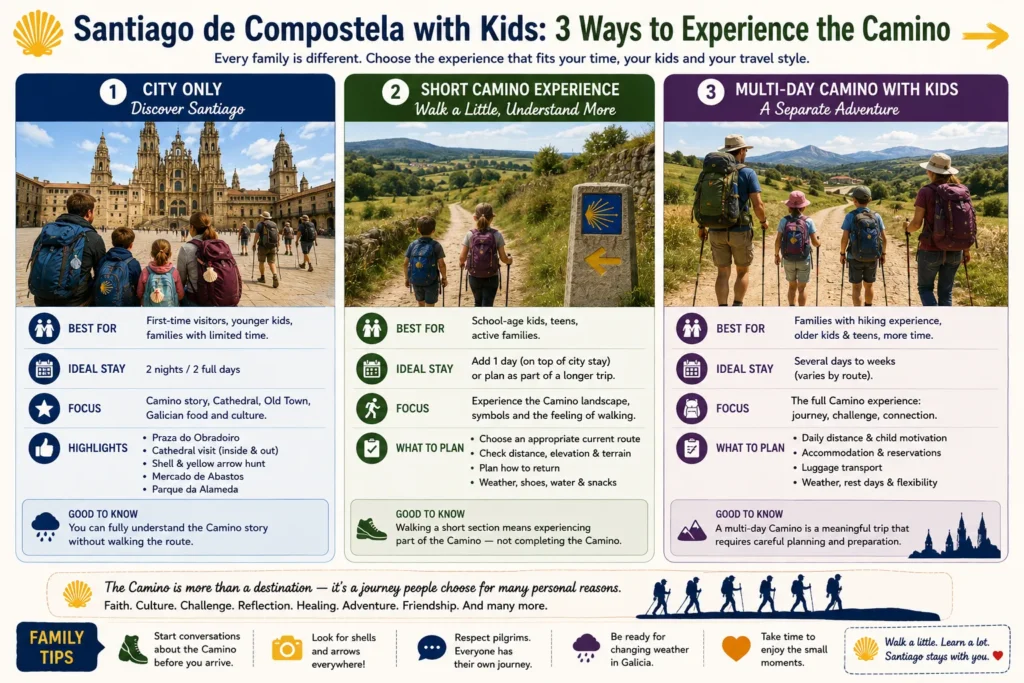
Option 1 — Santiago City Only
Best for:
younger children,
short stays,
families already moving frequently,
or anyone primarily interested in:
Cathedral,
Old Town,
food,
and Camino culture.
Children can still:
follow arrows,
find shells,
watch pilgrims arrive,
and understand the pilgrimage story.
They do not need to walk 100 kilometers to participate intellectually.
Option 2 — A Short Camino Walk
Families with:
school-age children,
teenagers,
comfortable walking ability,
and extra time
may consider walking a short section associated with the Camino.
The goal is not:
certificate,
distance record,
or pretending the family completed a pilgrimage it did not complete.
The goal is:
experience the route.
What Changes When You Walk Even a Little?
Children start noticing:
waymarkers,
terrain,
other walkers,
distance,
weather,
and what carrying a backpack feels like.
Then returning to Santiago has more context.
Even a short walk can make the phrase:
“the Camino”
less abstract.
But Do Not Invent a Random “Mini Camino” Route
This is important.
The correct route depends on:
where the family starts,
transportation,
children’s walking ability,
weather,
current route conditions,
and how they plan to return.
For an actual short Camino experience, use current official Camino information and plan the specific section deliberately.
Option 3 — Multi-Day Camino With Kids
This is no longer a Santiago sightseeing decision.
It is a different trip.
A multi-day Camino with children requires planning around:
daily distance,
accommodation,
luggage,
weather,
footwear,
food,
rest,
children’s motivation,
and the specific route.
I would not squeeze that subject into a few paragraphs here.
It deserves its own dedicated family guide.
Which Would I Choose?
For a first two-night Santiago visit:
City Only.
Let the family understand the Camino first.
For a longer Galicia trip with active school-age children or teenagers:
a short Camino experience can add real value.
For families seriously considering several walking days:
plan it as its own journey.
The Most Important Thing Is Not Pretending
Do not tell children:
“We did the Camino!”
because the family walked two kilometers outside Santiago.
Say:
“We walked part of the Camino to understand what the route feels like.”
That is more accurate.
And frankly, more interesting.
The point is not collecting an achievement that belongs to someone else’s journey.
It is helping children understand why people have been walking toward Santiago for centuries.
A Realistic 2-Day Santiago de Compostela Family Itinerary
Two days is enough for a family to understand Santiago without turning the historic center into a checklist.
The key is giving the days different purposes.
Day 1 — Understand why people come here
Day 2 — Understand the city and Galicia around the Camino
That distinction matters.
If both days become:
church → museum → old building → plaza,
children may remember very little beyond wet stone.
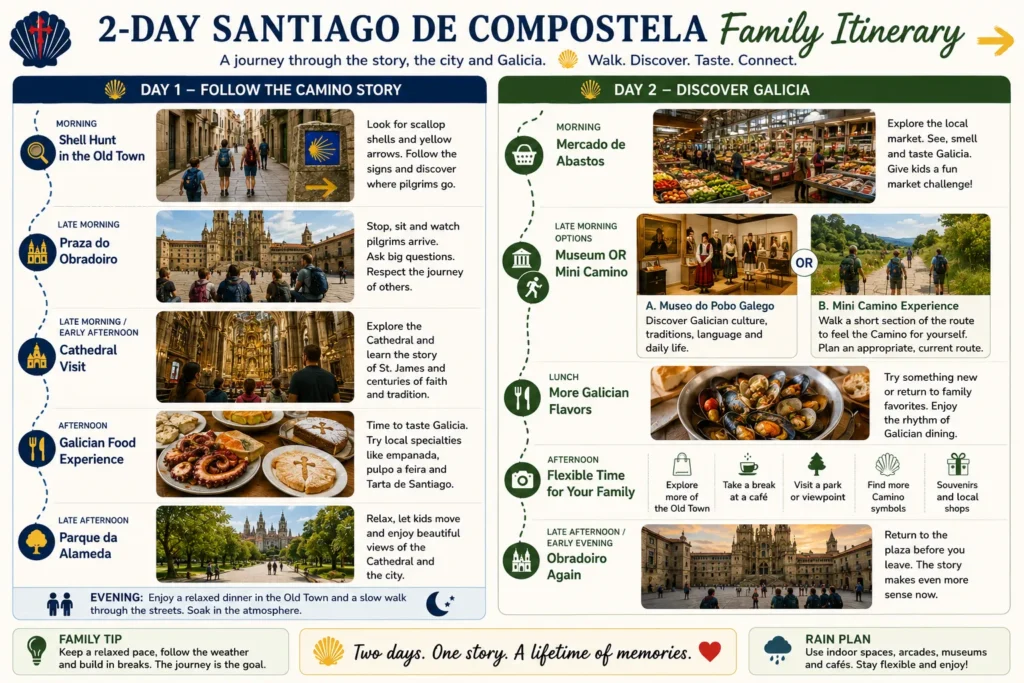
Day 1 — Follow the Camino to Its Ending
Start the first day with the story rather than the attractions.
Morning — Camino Symbol Hunt
Before heading directly to the Cathedral, walk through the historic streets.
Tell children to look for:
scallop shells
yellow arrows
pilgrims carrying backpacks
and
walking poles.
Let them lead occasionally.
Which direction does the arrow point?
Where are the pilgrims going?
The answer eventually becomes obvious.
Arrive at Praza do Obradoiro
Do not rush inside.
Stop.
Sit if appropriate.
Watch.
This is where the morning story reaches its conclusion.
Children have followed symbols through the city.
Now they see where many pilgrims are trying to arrive.
Watch Respectfully
Some arriving pilgrims may be celebrating.
Others may be exhausted or emotional.
Give them space.
Ask children quietly:
How long do you think that person has been walking?
Then let the plaza work.
Late Morning — Cathedral
Now enter the Cathedral according to current visitor arrangements.
The children already know:
why it matters,
why pilgrims come,
and why this building became the center of Santiago’s story.
That makes the interior much easier to understand.
Botafumeiro?
If it happens during the family’s visit:
wonderful.
If not:
move on.
Do not spend the entire day trying to engineer an encounter with it unless current official information gives the family a specific reason to do so.
The Botafumeiro is an extraordinary addition to Santiago, not the definition of a successful visit.
Lunch — First Galician Food Experience
After the Cathedral, stop properly.
This is a good time for:
empanada gallega,
something from the sea,
a familiar dish for cautious children,
and perhaps Tarta de Santiago afterward.
Do not immediately begin another museum.
Afternoon — Historic Santiago Without a Checklist
Walk.
Find another shell.
Notice the arcades.
Find a plaza.
Look for Galician words.
Watch the city operate around the pilgrims.
If the weather deteriorates:
move something indoors.
Optional — Museo do Pobo Galego
Add it if:
children are old enough to engage with Galicia’s regional identity,
the weather makes an indoor experience attractive,
or the family genuinely wants more cultural depth.
Otherwise:
skip it.
Late Afternoon — Parque da Alameda
Finish the more structured part of the day somewhere children can move.
Walk through the park.
Look back toward the Cathedral.
Now compare:
the enormous façade seen from Obradoiro
with
the Cathedral sitting within the wider city.
Evening — Return to the Old Town
Eat.
Walk.
Do not add another mandatory attraction.
The historic center feels different after the major day visitors begin dispersing.
Let the evening remain easy.
Day 2 — Market + Galicia + Family Choice
The second day should not simply repeat the Cathedral.
Start somewhere completely different.
Morning — Mercado de Abastos
Explore the market.
Give children the food challenge:
find something familiar,
something unfamiliar,
something from the sea,
and something they would actually like to eat.
Late Morning — Choose According to the Family
This is where the itinerary branches.
Option A — Galicia Culture
Visit Museo do Pobo Galego if you skipped it yesterday.
Best for:
school-age children,
teenagers,
and families wanting to understand Galicia beyond Santiago.
Option B — More Santiago
Return to part of the historic center everyone liked.
There is nothing wrong with repetition.
Option C — Short Camino Experience
If the family deliberately planned an appropriate section using current route information, this is the day to experience a little of the Camino itself.
Option D — Rain Plan
Cathedral-related interior visit, museum, market, café and food according to current conditions.
Lunch
Let Day 2 become more adventurous if children are interested.
Maybe:
pulpo a feira.
Pimientos de Padrón.
More seafood.
Or maybe they want the empanada again.
Repeating something children genuinely liked is not a culinary failure.
Afternoon — Leave Space
I would deliberately avoid booking the entire final afternoon.
Maybe the family wants:
another park walk,
souvenir shopping,
more Camino symbols,
a café,
another Cathedral look,
or absolutely nothing.
That flexibility is particularly useful if the weather has already forced changes elsewhere.
Final Stop — Obradoiro Again
Before leaving Santiago, I would return to Praza do Obradoiro.
Not because families need another Cathedral photograph.
Because the plaza means something different now.
On the first morning, children were learning:
why are these people here?
By the end of Day 2, they know.
That makes returning worthwhile.
One Day or Two Days in Santiago?
One Day
Enough for:
Camino symbols,
Obradoiro,
Cathedral,
Old Town,
and Galician food.
A strong visit is absolutely possible.
Two Days
My preferred first family stay.
It gives room for:
market,
park,
Galician culture,
weather flexibility,
and possibly a short Camino experience.
Most importantly, Santiago stops feeling like:
a Cathedral surrounded by streets.
Three Days?
Useful if the family wants:
a short Camino experience,
deeper cultural exploration,
a nearby excursion,
or a particularly slow pace.
But I would not add a third day merely to collect more Santiago attractions.
Santiago With Toddlers
With toddlers, keep the story extremely simple.
People walked a long way.
They followed signs.
They arrived here.
There is the Cathedral.
That is enough.
What I Would Prioritize
Shell hunt.
Obradoiro.
Short Cathedral visit.
Market.
Park.
Cake.
That is a surprisingly solid toddler itinerary.
What I Would Reduce
Long museums.
Detailed pilgrimage history.
Repeated church interiors.
Extended periods standing quietly.
And an ambitious “mini Camino” simply because the parents want the photograph.
Santiago With School-Age Children
This may be Santiago’s strongest family age.
Children can understand:
routes,
distance,
symbols,
pilgrimage,
medieval travel,
religious tradition,
and the idea of completing a long journey.
Give Them a Distance Challenge
Before arriving, show them where one Camino route begins relative to Santiago.
Then compare that with distances they understand.
How many school trips would that be?
How many days might someone walk?
What would they carry?
What would they leave at home?
Now the arriving pilgrims become much easier to appreciate.
Santiago With Teenagers
Teenagers can go much deeper.
Why do people voluntarily walk hundreds of kilometers today?
Religion?
Mental reset?
Challenge?
Grief?
Adventure?
Community?
Social media?
Tourism?
Tradition?
There is no single answer.
Pilgrimage Is Not Only a Medieval Concept
That may be Santiago’s most interesting lesson for teenagers.
The Camino is historically ancient.
But the people walking into Obradoiro are contemporary.
Old tradition.
Modern motivations.
Same destination.
That tension makes Santiago much more interesting than simply studying a medieval pilgrimage route.
Should You Walk the Camino With Kids?
Possibly.
But this question needs to be separated from:
Should you visit Santiago with kids?
They are not the same trip.
A Multi-Day Family Camino Requires Its Own Plan
Parents need to think about:
children’s ages,
walking experience,
daily distance,
route choice,
elevation,
weather,
footwear,
blisters,
food,
accommodation,
luggage,
rest days,
motivation,
and what happens when somebody simply does not want to walk another 15 kilometers.
That is substantially more complicated than a normal city break.
Don’t Choose the Camino for the Certificate
Families may hear about distance requirements connected with pilgrim credentials or the Compostela certificate.
If completing the formal pilgrimage requirements matters, check the current official Pilgrim’s Office rules before planning.
Those rules and documentation requirements should not be copied from an old travel article and assumed permanent.
More importantly:
do not design a child’s walking vacation entirely around earning a piece of paper.
The walking experience should make sense for the child first.
Could a Family Walk Only Part of It?
Absolutely.
A family can experience Camino walking without claiming to have completed the Camino.
That may actually be the best introduction.
Walk an appropriate section.
Notice the markers.
Meet walkers.
Understand the terrain.
Then decide whether a longer Camino is something the family would genuinely enjoy in the future.
Santiago or Bilbao With Kids?
These are two excellent northern Spain cities that provide almost opposite experiences.
| Santiago de Compostela | Bilbao | |
|---|---|---|
| Central story | Pilgrimage + medieval history | Urban transformation + architecture |
| Signature landmark | Cathedral | Guggenheim |
| Best child activity | Camino symbol hunt | Architecture/public-art exploration |
| Food | Galician | Basque |
| Outdoor reset | Alameda | Artxanda / river |
| Major cultural identity | Galicia | Basque Country |
| Rain strategy | Good | Excellent |
| Younger kids | Good | Good |
| School-age children | Excellent | Excellent |
| Teens | Excellent | Excellent |
| Ideal first stay | 2 nights | 2–3 nights |
Which Would I Choose?
For children interested in:
journeys,
medieval history,
religion,
symbols,
and human stories,
Santiago.
For children interested in:
architecture,
art,
engineering,
and modern cities,
Bilbao.
With enough time?
Both.
They explain completely different parts of northern Spain.
Families considering the Basque Country can use our Bilbao with Kids family travel guide to explore the Guggenheim, Artxanda, Casco Viejo, Basque food and a realistic three-day itinerary.
Santiago or San Sebastián With Kids?
This comparison is even easier.
San Sebastián offers:
beach,
Monte Igueldo,
pintxos,
and an easier outdoor family rhythm.
Santiago offers:
Camino,
Cathedral,
pilgrimage culture,
Galician identity,
and a much stronger historical narrative.
Younger Children?
San Sebastián may be easier because:
beach.
Funicular.
Play.
School-Age Children and Teens?
Santiago becomes much more competitive once children can understand what the Camino represents.
Again:
the better destination depends on the children.
How Santiago Fits Into a Northern Spain Family Trip
Santiago can work beautifully as the western conclusion of a longer northern journey.
A broad route might move through:
Basque Country
↓
Cantabria / Asturias
↓
Galicia
↓
Santiago de Compostela
depending on:
available time,
transportation,
and the family’s priorities.
But northern Spain is large.
Do not look at the map and turn every interesting city into:
one night.
Santiago Works Particularly Well as an Ending
This is partly symbolic.
A trip that ends in Santiago naturally gains a sense of arrival.
Even if the family did not walk the Camino, they have traveled across northern Spain and eventually reached the city that has represented arrival for pilgrims for centuries.
You do not need to overstate that connection.
Let children notice it.
Families building the wider route can use our Northern Spain family itinerary to connect Santiago with other northern destinations without turning the vacation into constant hotel changes.
Families comparing Santiago with destinations across the country can also use our 15 Best Places to Visit in Spain with Kids guide.
Common Mistakes Families Make in Santiago
Treating It as Just Another Cathedral City
Explain the Camino first.
Promising the Botafumeiro
Never assume it will operate.
Presenting the Tomb Tradition as Undisputed Archaeological Fact
Distinguish religious tradition from historical evidence.
Photographing Pilgrims Intrusively
Respect people’s personal moments.
Turning Every Historic Building Into a Mandatory Interior
The streets tell much of the story.
Ignoring Galicia
Santiago is more than pilgrimage.
Assuming Spain Means Dry Weather
Pack for Galicia.
Trying to Walk a Random “Mini Camino”
Plan an actual appropriate section.
Saying “We Did the Camino” After a Short Walk
Say what you actually did.
Designing a Multi-Day Camino Around a Certificate
Design it around the children.
What I Would Protect in a Santiago Family Trip
If I could protect only four things:
understanding the Camino
watching Obradoiro
entering the Cathedral with context
and
experiencing something distinctly Galician.
Everything else can move.
Museum?
Interest.
Botafumeiro?
Schedule.
Market?
Time.
Short Camino?
Family.
Rain?
Rearrange.
One Santiago Hour I Would Leave Completely Empty
Sit somewhere.
Maybe Obradoiro.
Maybe a café.
Maybe Alameda.
Maybe under an arcade while rain passes.
Watch the city.
Santiago is unusually good at rewarding observation because so many people around you are:
arriving,
departing,
studying,
working,
worshipping,
or continuing their own journeys.
Not every hour needs an attraction attached to it.
Is Santiago de Compostela Worth Visiting With Kids?
Yes.
But its strongest family appeal is not conventional entertainment.
It is story.
A child can arrive knowing almost nothing about Santiago and leave understanding:
people have walked here for centuries.
They followed routes from far away.
They carried symbols.
They came for different reasons.
A city grew around that movement.
And people are still doing it today.
That is a remarkable amount for one destination to communicate.
How Many Nights Would I Book?
For most first-time families:
2 nights.
One day works.
Two is better.
Three becomes useful when the family wants:
a short Camino experience,
deeper Galicia exploration,
or a slower trip.
Final Thoughts: Santiago Makes the Journey Visible
Many travel destinations are about what happened there.
A king lived here.
A battle happened there.
Someone built this.
An empire controlled that.
Santiago is different.
Its story is also about people moving toward it.
That movement is still visible.
You can stand in Praza do Obradoiro today and watch someone finish a journey.
Maybe they walked for five days.
Maybe five weeks.
Maybe they came for faith.
Maybe grief.
Maybe challenge.
Maybe friendship.
You probably will not know.
Children do not need to know either.
They only need to understand that the backpack in front of them may have traveled much farther than theirs did.
Then the Cathedral changes.
The shell changes.
The yellow arrow changes.
Even the streets change.
They are no longer simply decorative details in another historic Spanish city.
They belong to a route.
That is why I would introduce Santiago to children through the Camino rather than through the Cathedral.
Start with the journey.
Then show them the destination.
Eat Galician food.
Look for another shell.
Learn that Galicia has its own language and identity.
Accept that it may rain.
And if the Botafumeiro swings?
Wonderful.
If it doesn’t?
Nothing essential has been lost.
Because the most important thing happening in Santiago was never a giant censer moving through a Cathedral.
It was the idea that, for centuries, people looked toward one distant city and decided:
I am going to walk there.
And some of them are still arriving when your family does.