Finding the best castles in Spain for families is not really about choosing the castle with the tallest tower or the most dramatic photograph.
Spain’s castles and fortified palaces tell very different stories.
At the Alcázar of Segovia, children can cross a drawbridge into a medieval royal residence perched dramatically between two rivers. At the Alhambra, the story is not simply “a castle” at all—it was a Nasrid palatine city, citadel, royal residence, and fortress. The Real Alcázar of Seville adds yet another layer: a palace complex shaped by centuries of Islamic and Christian rule that remains a royal residence today.
That is why I would not rank Spanish castles from #1 to #15 and pretend every family should reach the same conclusion.
Instead, ask:
What kind of castle story will make our kids want to keep exploring?
A child who wants towers and drawbridges may love Segovia.
A child fascinated by knights may respond to a medieval fortress.
Another may become more interested in the Alhambra once they understand that families, soldiers, officials, and rulers once lived inside an entire fortified city.
The best castle is the one that fits your children’s imagination, your family’s interests, and the Spain itinerary you are already taking.
This guide helps you choose that castle.
Opening hours, ticket systems, access to individual towers or rooms, restoration work, and visitor routes can change, so always check current official information before building a family day around a particular site.
Quick Answer: Which Castle in Spain Should Your Family Choose?
Start with the experience rather than the ranking.
| Castle / Palace | Destination | Why Families May Consider It |
|---|---|---|
| Alcázar of Segovia | Segovia | Towers, moat, royal history, classic castle atmosphere |
| Alhambra | Granada | Palaces + fortress + Islamic Spain + gardens |
| Real Alcázar of Seville | Seville | Centuries of architecture + gardens + living royal palace |
| Castle of Loarre | Aragón | Medieval fortress experience |
| Royal Palace of Olite | Navarra | Towers, galleries and medieval royal-court atmosphere |
| Bellver Castle | Mallorca | Unusual circular castle + Palma setting |
| Santa Bárbara Castle | Alicante | Hilltop fortress + Mediterranean city |
| Gibralfaro Castle | Málaga | Fortifications + Málaga views |
| Coca Castle | Castilla y León | Distinctive brick fortress architecture |
| Ponferrada Castle | León | Medieval fortress + Templar associations |
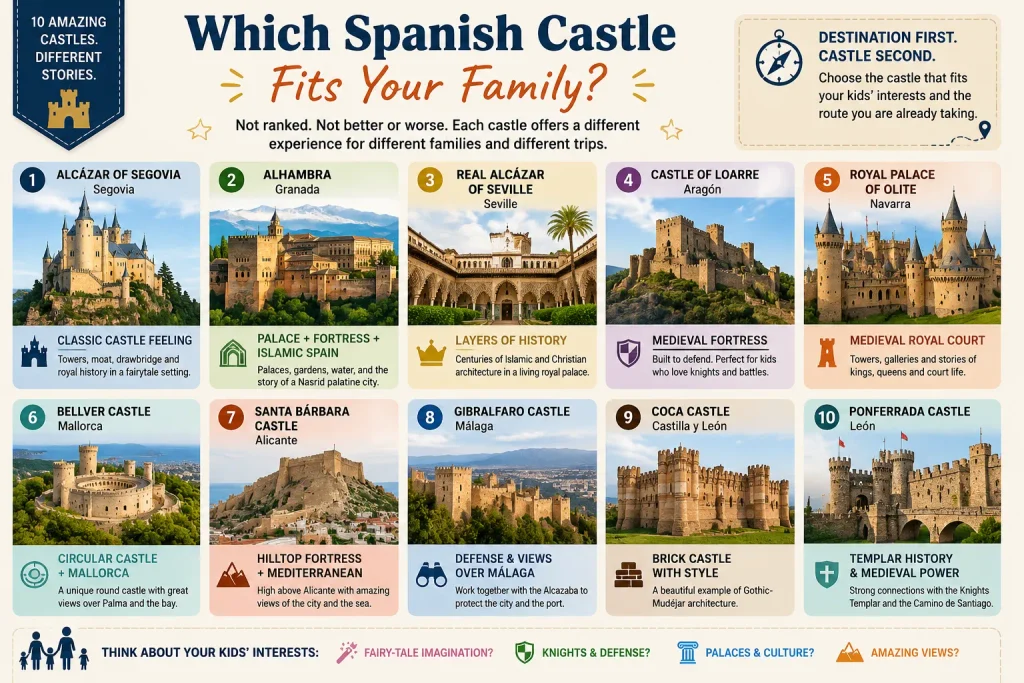
These are not ranked from best to worst.
And they are not interchangeable.
If your family is already visiting Granada, the Alhambra can be one of the defining experiences of the entire trip.
If Madrid is your base and you want a manageable castle-focused day trip, Segovia creates a completely different experience.
If Mallorca is primarily an island vacation, Bellver Castle lets you add history without turning the trip into a cross-country castle hunt.
Destination first. Castle second.
Before Choosing a Castle, Ask What Your Kids Think a Castle Is
Ask a young child to draw a castle and you will probably get some combination of:
towers + walls + flags + princesses + knights + maybe a dragon
Real castles are more complicated.
Some were primarily fortresses.
Some became royal residences.
Some combine palace and military functions.
Some were transformed repeatedly over centuries.
And some places commonly included in “Spain’s best castles” lists are not accurately understood if we reduce them to a fairy-tale castle.
That difference can become part of the fun.
Before the trip, ask:
“What do you think we will find inside?”
Then compare their imaginary castle with the real one.
Castle, Fortress, Palace or Alcázar?
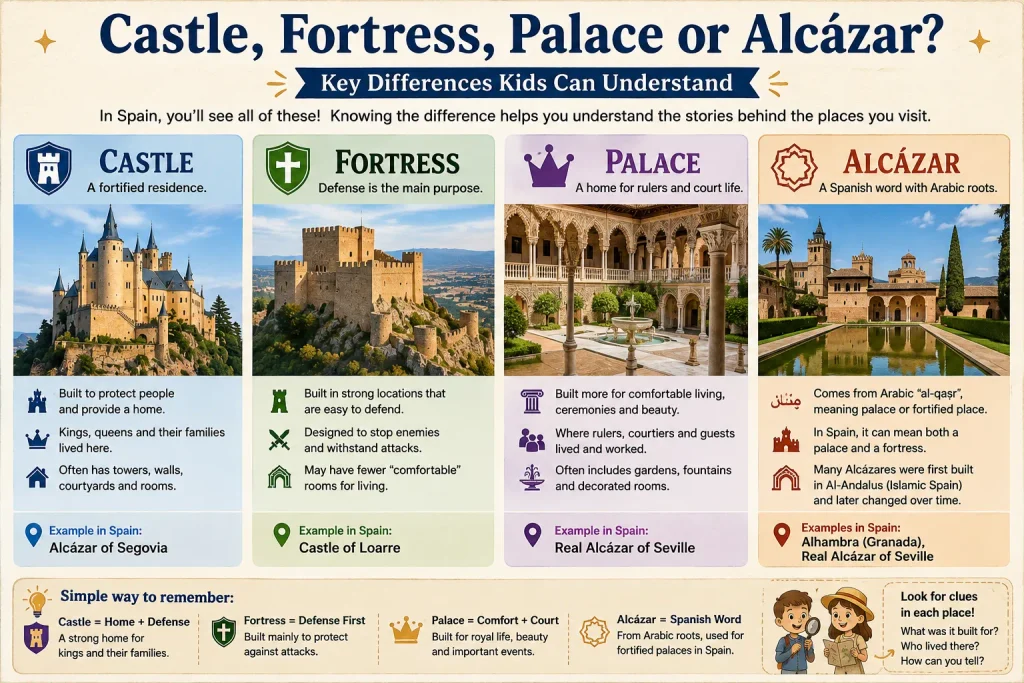
These words can become confusing during a Spain trip.
You do not need to give children an architectural-history lecture, but a simple distinction helps.
Castle
A broad term that can describe a fortified residence or defensive structure.
Fortress
Defense is the central idea.
Think:
walls + strategic location + protection + soldiers
Palace
A residence designed primarily for rulers, courts, or elite life rather than simply defense.
Alcázar
The Spanish word comes from the Arabic al-qaṣr, associated with a palace, castle, or fortified residence.
That is why Spain has places called:
- Alcázar of Segovia
- Real Alcázar of Seville
- Alcázar in other historic cities
But the buildings do not all look the same.
Spain’s history made the word part of its architectural vocabulary.
For kids, the simplest version is:
“Some castles were built mainly to defend people. Others were also homes for kings and rulers.”
Then let the building show them the difference.
1. Alcázar of Segovia — Best for the Classic Castle Feeling
Segovia
If your child wants something that immediately looks like a castle, the Alcázar of Segovia is one of the strongest choices in Spain.
The official Segovia tourism site describes it as a medieval castle that served at different times as a royal residence, fortress, and prison. It stands on a rocky promontory between the Eresma and Clamores rivers, approached across a deep moat and drawbridge. Its Gothic appearance developed particularly during the reigns of John II and Henry IV.
That is already enough material for a child.
Moat?
Check.
Drawbridge?
Check.
Towers?
Definitely.
Kings and queens?
Yes.
Why It Works So Well with Kids
The architecture does much of the storytelling for you.
You do not have to spend ten minutes convincing a child:
“Imagine this was once a castle.”
They can see it.
That makes it particularly useful for younger children whose idea of medieval history is still mostly visual.
Give Them a Castle Mission
Before entering, ask them to find:
- the moat
- the drawbridge
- the tallest-looking tower
- a coat of arms
- a room that looks suitable for a king or queen
- the best place they would choose to defend the castle
Now the visit becomes an investigation.
Did the Alcázar Inspire Disney?
You will often encounter claims online connecting the Alcázar of Segovia with Disney castle designs.
I would not present that to children as an established historical fact unless you have a reliable primary source establishing the specific design connection being claimed.
The Alcázar does not need Disney to make it interesting.
Its real history is already good enough.
Combine It with the Aqueduct Story
Segovia is especially valuable for families because one day can contain two completely different kinds of storytelling.
At the Roman aqueduct:
engineering + Romans + the Devil legend
At the Alcázar:
medieval rulers + fortification + royal life
Our The Legend of Segovia’s Aqueduct: A Story to Tell Your Kids in Spain gives you a ready-made story to use before walking through the Old Town toward the castle.
And our Segovia with Kids: A Family Travel Guide can help you turn both monuments into a realistic family day rather than treating Segovia as a checklist of historic buildings.
2. The Alhambra — Best for Showing Kids That a “Castle” Can Be an Entire World
Granada
The Alhambra is where the word castle becomes inadequate.
The official Patronato describes the Alhambra as a palatine city, citadel and fortress, and the residence of Nasrid sultans, officials, court servants, and elite soldiers. The complex developed over centuries rather than being constructed as one single building at one moment.
That is the idea I would give children first:
“We’re not just going inside a castle. We’re going inside a fortified city where rulers once lived.”
Now the Alhambra makes much more sense.
What Should Kids Look For at the Alhambra?
Instead of trying to make children understand every dynasty and architectural term, give them things to notice.
Water
Look for:
- fountains
- channels
- pools
- reflections
Ask:
“Why would water be so important here?”
Patterns
Look at walls, ceilings, tiles, and carved decoration.
Ask:
“How many repeating shapes can you find?”
Arabic Writing
Children may initially assume the decoration is only geometric.
Then show them that writing itself forms part of the visual world around them.
Gardens
The Alhambra is not just walls and rooms.
Let children notice how buildings, gardens, shade, views, and water work together.
The Alcazaba
This is where the defensive side becomes much easier to understand.
The official Alhambra documentation describes the Alcazaba as the military area that housed the elite guard protecting the ruler, family, and government institutions.
Now ask:
“If you were guarding Granada, where would you stand?”
The Alhambra Was Not Frozen in 1492
This is important.
Families sometimes receive an oversimplified version:
Muslims built Alhambra → Christians conquered Granada → story ends.
It didn’t.
After 1492 the Alhambra became a Christian Royal House. Later, Charles V commissioned a Renaissance palace within the complex, and the site continued to change, suffer damage, receive repairs, and evolve through subsequent centuries.
That makes the Alhambra particularly useful with older children.
One place can contain layers of:
Islamic Spain → Nasrid royal life → Christian monarchy → Renaissance architecture → preservation and modern heritage
History did not erase one layer before beginning the next.
The layers remain beside one another.
Don’t Rush the Alhambra with Kids
This is not the attraction where I would try to maximize the number of rooms seen per hour.
Children can become visually overloaded.
Palace.
Ceiling.
Courtyard.
Tiles.
Another courtyard.
Another palace.
Another explanation.
Eventually everything becomes:
“Another old room.”
Pick a few ideas before entering.
Maybe:
water + patterns + fortress + how rulers lived
Then let those themes carry the visit.
Our Granada with Kids: A Family Travel Guide can help you decide how much of the family day should belong to the Alhambra and how to balance it with the rest of Granada.
3. Real Alcázar of Seville — Best for Seeing History Layered Together
Seville
The Real Alcázar creates another challenge for children:
“Who built this?”
The answer is not one person or even one period.
The official history traces the palace complex through Islamic rule and subsequent Christian monarchs. The site’s origins include a 10th-century Umayyad government enclosure; later Almohad construction survives within the complex, while after the Castilian conquest new royal buildings were added, including the Gothic Palace and Pedro I’s 14th-century Mudéjar palace.
And unlike many historic palaces, the Real Alcázar remains a royal residence. Its official site describes it as Europe’s oldest royal palace still in use.
For children, I would simplify all of that into one idea:
“Different rulers kept changing this place instead of starting over somewhere else.”
Now ask them to look for the changes.
Turn the Alcázar into a Pattern Hunt
The Real Alcázar is perfect for children who like visual puzzles.
Look for:
- geometric patterns
- arches
- tiles
- carved decoration
- courtyards
- water
- gardens
Instead of explaining every artistic term first, ask:
“Can you find two walls that look completely different?”
Then explain why.
The building itself becomes evidence that Seville’s history contains multiple cultural and political layers.
Don’t Forget the Gardens
With children, the gardens are not an optional extra after the “important” rooms.
They may be what keeps the visit enjoyable.
Historic interiors require:
- quiet
- attention
- controlled movement
Gardens allow the family rhythm to change.
That matters.
A good family visit is not measured by how long children can behave like miniature art historians.
For the wider city, our Seville with Kids: A Family Travel Guide can help you decide how the Real Alcázar fits alongside the cathedral, plazas, parks, food, and other family experiences.
4. Royal Palace of Olite — Best for Towers and Medieval Imagination
Navarra
If Segovia gives children the classic castle silhouette, Olite gives them the chance to imagine a medieval royal court.
The Royal Palace of Olite was associated with the Kings of Navarre and developed into an elaborate Gothic royal complex with towers, rooms, galleries, patios, and gardens. Navarra’s official tourism site explains that Charles III “the Noble” oversaw major 15th-century development and that the palace incorporated French architectural influence and Mudéjar decoration.
This is exactly the sort of place where children can imagine:
Who lived in that tower?
What happened in that courtyard?
Where would guards stand?
Which room would you choose?
Look for the Ice Well
Here is a detail children may remember better than another royal name.
The official Navarra tourism guide highlights an ice well used to store snow in layers and help preserve food.
Ask:
“How would you keep food cold if refrigerators didn’t exist?”
Suddenly medieval life becomes practical.
And practical questions are often the easiest way into history.
A Castle Where Storytelling Already Fits
Olite currently offers dramatized visits in which figures representing Queen Eleanor of Navarre and Charles III introduce visitors to court life and the palace’s history. The official Navarra tourism listing shows these tours running during 2026, though families should check current language, schedule, availability, and booking details before relying on them.
That kind of experience can work particularly well for children who respond more strongly to people and stories than architectural explanations.
5. Castle of Loarre — Best for Asking “How Would You Defend This?”
Aragón
Some castles are easiest to understand through royal life.
Others make more sense when children think like defenders.
Loarre belongs in the second category.
Before explaining architectural terminology, ask:
“Why would someone build a fortress up here?”
Let the children look at the landscape.
Then ask:
“If an enemy were approaching, how early could you see them?”
Now walls, towers, elevation, and access routes have a purpose.
That is much more interesting than saying:
“This is an important example of Romanesque military architecture.”
You can give them the terminology later.
First let them solve the problem.
Fortress Thinking: Five Questions for Kids
At Loarre—or almost any defensive castle—ask:
1. Where is the hardest place to attack?
Look at the terrain.
2. Where would you put the guards?
Find towers and viewpoints.
3. How would people get water?
A fortress still needs everyday resources.
4. Where is the weakest entrance?
Look at gates and approaches.
5. What happens if attackers simply wait outside?
Now children begin thinking about:
- food
- water
- storage
- communication
- endurance
A castle stops being a pile of old stone.
It becomes a survival machine.
Which of These First Five Fits Your Family?
If we stop here for a moment, the differences are already obvious.
Choose the Alcázar of Segovia if…
Your children want the most immediately recognizable castle experience.
Choose the Alhambra if…
You want palaces + fortress + gardens + Islamic Spain + layers of history in one major experience.
Choose the Real Alcázar of Seville if…
You want children to see how different cultures and rulers changed the same palace complex over centuries.
Choose Olite if…
Your children love towers, royal courts, and medieval imagination.
Choose Loarre if…
They are fascinated by fortresses, defense, knights, and how castles actually worked.
None needs a five-star rating.
They are good for completely different reasons.
And that is exactly why a family should choose the story and experience first, not the castle’s position on somebody else’s list.
6. Bellver Castle — Best for a Castle That Doesn’t Look Like the Others
Palma, Mallorca
By the time children have seen several Spanish castles, they may begin expecting the same basic shape.
Walls.
Square towers.
Courtyard.
More walls.
Then Bellver Castle gives you an easy question:
“What’s different about this castle?”
The answer becomes obvious when children understand its layout.
Bellver is circular.
The 14th-century Gothic castle was built for King James II of Mallorca and is notable for its unusual circular plan, with a round central courtyard and towers arranged around the structure.
That alone makes it memorable.
Why Families May Choose Bellver
Bellver works especially well because most families do not travel to Mallorca primarily to visit castles.
You may already be there for:
- beaches
- Palma
- villages
- coastal scenery
- island time
Bellver allows you to add a substantial piece of Mallorcan history without turning the vacation into a castle itinerary.
Ask Kids Why It Is Round
Do not give them the answer immediately.
Ask:
“Why would someone design a castle like a circle?”
Let them walk around.
Look toward the courtyard.
Look at the towers.
Look at the landscape around Palma.
Whether or not they solve the architectural reasoning, they have started examining the building instead of merely walking through it.
For the rest of the island, our Mallorca with Kids: A Family Travel Guide can help you decide where Bellver fits among Palma, beaches, villages, and family attractions.
7. Santa Bárbara Castle — Best for Combining a Fortress with Alicante
Alicante
Santa Bárbara Castle demonstrates why location matters so much in defensive architecture.
The fortress occupies Mount Benacantil, high above Alicante and the Mediterranean.
Before telling children anything about who controlled it, ask:
“Why would you build a fortress up there?”
They will probably work out part of the answer themselves.
From a commanding position, defenders could observe the surrounding landscape and coast.
The Mountain Has Its Own Visual Story
From parts of Alicante, Mount Benacantil is associated with the profile known as La Cara del Moro — the Face of the Moor.
That gives children another observational challenge.
Can they see the face?
Whether they immediately recognize it or not, they are now looking at the landscape as part of the city’s story.
Castle + Mediterranean City
Santa Bárbara also works because you do not need a separate castle-focused journey.
Alicante families can combine history with:
- city exploration
- waterfront
- beaches
- food
- Mediterranean views
That makes the castle particularly useful on a Mediterranean Spain itinerary.
Our Mediterranean Spain Family Itinerary: 4 Days, 7 Days & 2 Weeks with Kids can help you decide whether Alicante belongs in the wider route before adding individual attractions.
8. Gibralfaro Castle — Best for Understanding Why Málaga Needed Defenses
Málaga
Gibralfaro Castle rises above Málaga.
And once again, I would begin with the view.
Ask:
“What can you see from up here?”
Then:
“Why would that have mattered hundreds of years ago?”
Children can begin connecting elevation with defense without memorizing a military-history lecture.
The fortress has deep connections with the defensive history of Málaga and with the Alcazaba below.
Gibralfaro and the Alcazaba Are Not the Same Thing
This is worth explaining before the family arrives.
Visitors sometimes mentally combine the two because they occupy the same broader historic landscape.
But they are distinct monuments with different functions and histories.
A useful child-friendly explanation is:
“The Alcazaba was a fortified palace. Gibralfaro was a fortress protecting the strategic hill above it.”
Now children have two different architectural jobs to compare.
Do You Need Both with Kids?
Not automatically.
Consider:
- children’s ages
- heat
- walking
- how interested they are in fortifications
- how much time you have in Málaga
If everyone is exhausted after one major historic site, seeing a second because the itinerary says so may add very little.
Our Málaga with Kids: A Family Travel Guide can help you balance Gibralfaro and the Alcazaba with beaches, parks, food, and the rest of the city.
9. Coca Castle — Best for Kids Who Think Every Castle Must Be Made of Gray Stone
Coca, Castilla y León
Coca Castle is useful because it breaks another visual assumption.
Children may imagine medieval castles as enormous piles of gray stone.
Then Coca gives them brick.
The castle is one of Spain’s striking examples of late medieval brick fortification, commonly associated with Gothic-Mudéjar architecture.
Its towers, defensive forms, and extensive use of brick give it a completely different appearance from Segovia or Loarre.
Why Does the Material Matter?
Ask:
“Why didn’t they build every castle from the same thing?”
Now you can talk about:
- locally available materials
- building traditions
- technology
- architectural influence
- money
- geography
Buildings are shaped by the places that create them.
That is a much more useful lesson than teaching children that all medieval castles belong to one visual template.
Should You Make a Special Trip?
This depends on the route.
Coca is much easier to justify when your family is already exploring Castilla y León or building a road trip around central Spain.
It may make much less sense on a short first-time Madrid–Barcelona vacation.
Again:
The castle needs to fit the itinerary.
10. Ponferrada Castle — Best for Starting a Templar Conversation
Ponferrada, León
Mention the Knights Templar and some older children immediately become interested.
Swords.
Crusades.
Secret orders.
Treasure.
Mysteries.
Popular culture has added plenty of mythology around them.
Ponferrada gives parents an opportunity to separate that mythology from history.
The castle is strongly associated with the Templars, who had a presence in Ponferrada in the Middle Ages.
Start with the Question Kids Actually Ask
“Who were the Templars?”
The simple version:
They were a medieval Christian military order founded in the context of the Crusades.
Over time they became powerful and wealthy, and their history later accumulated an enormous amount of legend.
That means Ponferrada fits perfectly into the same Travel With Kids World approach we used with Segovia’s aqueduct:
Tell the exciting story. Then separate legend from evidence.
Don’t Turn Templar Legends into Facts
If children encounter stories about:
- secret treasure
- hidden knowledge
- mysterious rituals
- extraordinary conspiracies
you do not need to ruin the fun.
Just say:
“That’s one of the stories people tell. Now let’s see what historians actually know.”
Children can enjoy mysteries without being taught that every mystery is historical fact.
Which Castle Is Best by Age?
Age is useful, but interest still matters more.
A castle-loving six-year-old may engage much more deeply than a bored thirteen-year-old.
Still, there are some useful patterns.
Toddlers and Preschoolers
At this age, I would focus on:
- visually obvious castles
- manageable visit length
- outdoor spaces
- easy storytelling
- avoiding excessive explanations
The Alcázar of Segovia can work well because it immediately looks like the thing children expect a castle to be.
Bellver can be memorable because of its unusual shape.
But logistics matter enormously.
Stairs, uneven surfaces, towers, heat, and long historic interiors can turn an ambitious castle visit into a very long afternoon.
Elementary-School Children
This may be the best age for castle storytelling.
Children can begin understanding:
- defense
- kings and queens
- medieval daily life
- sieges
- water and food storage
- religious and cultural change
- architecture
This is where places such as:
Segovia → royal castle
Loarre → fortress
Olite → medieval court
Alhambra → palatine city
can produce very different conversations.
Tweens and Teenagers
Older children can move beyond:
“Kings lived here.”
Ask harder questions.
Why was the fortress built in this location?
Who paid for it?
Who actually did the construction?
What happened to ordinary people during a siege?
Why did one ruler preserve a previous ruler’s architecture?
Why do modern countries spend money restoring old castles?
Why are some legends more famous than the historical evidence?
This is where the Alhambra and Real Alcázar become particularly rich because the buildings reveal complicated layers of Spanish history.
Best Castle for Families with a Big Age Gap
Imagine:
5-year-old + 10-year-old + 16-year-old
The five-year-old wants towers.
The ten-year-old wants knights.
The sixteen-year-old wants something that does not feel designed for five-year-olds.
For this family, I would prioritize places with several levels of interpretation.
The Alcázar of Segovia can work because the youngest child gets the visual castle while older children can engage with royal and military history.
The Alhambra offers even greater historical depth, although its scale and visit logistics require more planning.
The key is not forcing every child to learn the same thing.
Let one child hunt for towers.
Let another study patterns.
Let another read about political history.
They can visit the same castle without having the same visit.
Castle or Palace?
This question becomes especially useful in Granada and Seville.
If children think a castle exists only for defense, ask them to look at:
- decorated rooms
- courtyards
- gardens
- fountains
- ceremonial spaces
Then ask:
“Does this look like a place designed only for soldiers?”
Now the distinction between fortress and palace begins to make sense.
At the Alhambra, both functions coexist within a larger fortified complex.
At the Real Alcázar, royal residence and palace life become much more central.
Architecture tells you what people wanted a building to do.
Castle or Cathedral?
This sounds like an odd comparison.
With children, it is practical.
Historic Spanish cities can contain:
castle + cathedral + old town + museum + another church + another palace
all in the same day.
Adults may see six completely different monuments.
A tired child may see:
six old buildings.
So choose priorities.
If the children are excited about the castle, let the castle be the major historic interior that day.
You can still see the cathedral.
You do not necessarily need to inspect every chapel.
Family travel improves when not every important monument becomes compulsory.
How Many Castles Should a Spain Family Trip Include?
Probably fewer than a castle enthusiast initially wants.
On a two-week trip, you might encounter many.
That does not mean you need tickets to all of them.
Try giving castles different roles.
One could be:
the royal castle
another:
the military fortress
another:
the Islamic palace-fortress
another:
the ruined castle viewed from outside
Now each adds something.
If Castle #5 teaches exactly the same lesson as Castle #2, the children may be ready for a beach.
What Should Kids Look for Inside a Castle?
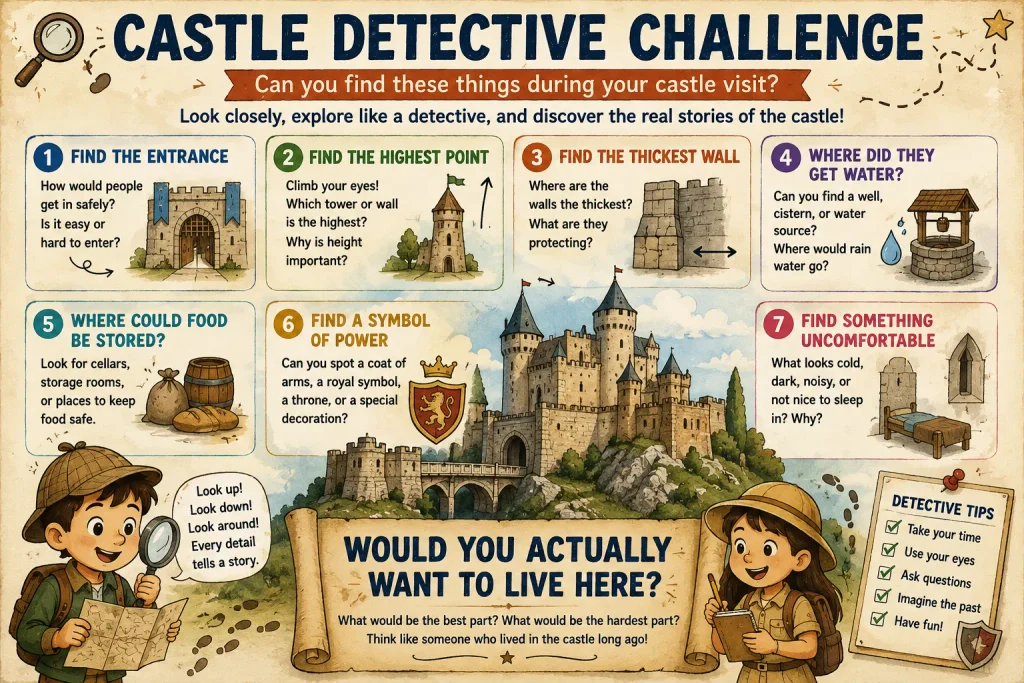
Give them a Castle Detective Mission.
Find:
1. The Entrance
How would defenders stop someone getting inside?
2. The Highest Point
Why would height matter?
3. The Thickest Wall
What is it protecting?
4. Water
Where did people get it?
5. Food Storage
What happens during a siege?
6. A Symbol of Power
Find:
- a coat of arms
- throne
- royal symbol
- decorated room
7. Something That Looks Uncomfortable
Ask:
“Would you actually want to live here?”
This may produce the most honest historical discussion of the day.
Castles Were Not Theme Parks
Children often receive a romantic version of castles.
Princesses.
Feasts.
Knights.
Flags.
But real fortified life could also involve:
- cold
- smoke
- darkness
- disease
- limited sanitation
- political violence
- warfare
- uncomfortable travel
- enormous inequality
You do not need to make a six-year-old miserable with medieval mortality statistics.
But you can gently challenge the fantasy.
Ask:
“What would you miss most from home if you had to live here?”
Wi-Fi will probably win.
Then:
“What about heating?”
“A refrigerator?”
“A toilet like ours?”
Suddenly history becomes everyday life.
Don’t Promise Every Tower Is Open
Historic monuments change.
A tower may close.
A restoration project may alter the visitor route.
Access may be limited by:
- maintenance
- capacity
- weather
- safety
- special events
Some towers also involve significant stairs and may not suit every visitor.
If climbing a particular tower is the main reason your child wants to visit, check the current official visitor information before promising it.
The castle will still be historic if the tower is closed.
The child may be less philosophical.
Accessibility Matters More Than Castle Rankings
Historic castles were not designed for modern strollers, wheelchairs, elevators, or family tourism.
Expect possible:
- stairs
- uneven stone
- narrow passages
- steep approaches
- towers
- cobbled surfaces
But accessibility varies dramatically between sites and can change as visitor infrastructure improves.
If someone in your family has specific mobility requirements, check the individual monument’s current accessibility information rather than relying on a general statement that a castle is “easy” or “difficult.”
This is another reason I would never give:
Toddler Friendly ⭐⭐⭐⭐⭐
to an ancient fortress.
One toddler walks everywhere.
Another needs a stroller.
Those families are not having the same visit.
How Much Do Spanish Castles Cost to Visit?
There is no useful permanent national price table.
Admission can vary according to:
- monument
- age
- temporary exhibitions
- tower access
- guided tours
- combined tickets
- free-entry periods
- resident or eligibility discounts
- booking method
Some historic sites may be inexpensive.
Major attractions such as the Alhambra require a different level of planning.
Instead of comparing castles by adult admission alone, compare:
How important is this experience to our family?
A €15 attraction everyone remembers can be better value than a €5 monument nobody wanted to enter.
For the wider vacation, our Spain Family Travel Budget: How Much Does a Trip to Spain Cost with Kids? (2026) can help you decide how many paid historic attractions belong in the complete family budget.
Do Families Need Guided Tours?
Not always.
A guide can be excellent when:
- the site’s history is difficult to understand independently
- children respond well to storytelling
- the tour is genuinely designed for families
- you want historical context rather than simply looking at rooms
A guide can be less useful when:
- the children are too young for the format
- the tour is long
- everyone needs flexibility
- the children prefer exploring visually
Audio guides can provide a middle ground where available.
But the best family tour is not necessarily the one containing the most information.
It is the one the children are still listening to twenty minutes later.
Turn One Castle into a Story
This is where our newer Travel With Kids World approach becomes useful.
Instead of telling children:
“This castle was built in X century by X ruler.”
begin with:
“Someone is attacking this castle. Where would you hide?”
or:
“You’re the king. Which tower is yours?”
or:
“The castle has been surrounded for a month. What’s the first thing we’re going to run out of?”
Then introduce the history.
Story creates the question.
History provides the answer.
That is much more memorable than asking children to memorize a date.
Common Mistakes Families Make at Castles in Spain
1. Choosing from a National Ranking
Start with your itinerary.
2. Calling Every Historic Palace a Castle
The distinction can make the visit more interesting.
3. Repeating Legends as Historical Facts
Tell the story—and label it as a story.
4. Assuming Every Tower Is Accessible
Check current information.
5. Scheduling Too Many Castles
Historic-building fatigue is real.
6. Ignoring Heat
Hilltop fortresses and exposed walls can become uncomfortable during hot weather.
7. Ignoring Walking and Stairs
The photograph does not show the entire route.
8. Explaining Everything Before Children Become Curious
Let them look first.
9. Trying to Complete Every Room
Stop when attention disappears.
10. Forgetting That Castles Were Real Places
People lived, worked, fought, ate, slept, ruled, and sometimes died there.
That is more interesting than the star rating.
FAQ: Best Castles in Spain for Families
What is the best castle in Spain for kids?
There is no universal best castle.
The Alcázar of Segovia is particularly easy for children to recognize as a classic castle, while the Alhambra offers much deeper palace, fortress, garden, and cultural history.
The right choice depends on the child’s age, interests, and your route.
Is the Alcázar of Segovia good for children?
It can be an excellent family historic attraction because its towers, moat, drawbridge, rooms, and dramatic setting make many castle concepts visually easy to understand.
Check current access information if climbing towers is important to your visit.
Is the Alhambra a castle?
Calling it simply a castle understates the site.
The Alhambra developed as a fortified palatine city containing royal palaces, defensive structures, residences, gardens, and other spaces.
Is the Real Alcázar of Seville a castle?
It is better understood as a historic royal palace complex with layers of Islamic and Christian architecture and history.
It remains associated with the Spanish monarchy.
Which Spanish castle looks most like a fairy-tale castle?
The Alcázar of Segovia is one of the Spanish castles most likely to match a child’s visual expectation of towers, a moat, and a dramatic royal castle.
That does not require making unverified claims about Disney inspiration.
How many castles should families visit in Spain?
There is no ideal number.
For most families, choosing a few castles that provide clearly different experiences is more useful than visiting every fortress on the route.
Are Spanish castles stroller-friendly?
Do not assume so.
Historic castles can include stairs, cobblestones, steep approaches, narrow passages, and towers. Check current accessibility information for the specific monument.
Final Thoughts: Give Every Castle a Different Story
Spain has thousands of castles, fortifications, palaces, and defensive remains.
A family does not need to rank them all.
Choose a few that tell different stories.
Segovia can be the castle of kings, towers, and childhood imagination.
The Alhambra can reveal Islamic Spain, palace life, gardens, water, and a fortified city.
Seville’s Real Alcázar can show children how one place can change under different rulers while preserving layers from different periods.
Loarre can become the fortress where children think like defenders.
Olite can open the door to medieval royal life.
Bellver can challenge the idea that every castle has to look the same.
Santa Bárbara and Gibralfaro can show why hills, coastlines, and visibility mattered when choosing where to build defenses.
Coca can prove that castles do not even need to be made from the gray stone children expect.
And Ponferrada can begin a conversation about the Knights Templar—and about where history ends and legend begins.
That is the better way to explore Spain’s castles with kids.
Do not ask:
“Which castle is ranked #1?”
Ask:
“What new story will this castle help our children understand?”
Then let them look.
Let them climb where access is permitted.
Let them search for defenses.
Let them imagine where the water came from.
Let them decide which room they would choose.
Let them ask whether the legend really happened.
And when they become curious, give them the history.
Because children do not need fifteen castles that blur together into one long collection of stone walls.
They need a few castles they can still tell you about when the trip is over.
Continue Exploring Spain with Kids
Segovia with Kids
Our Segovia with Kids: A Family Travel Guide can help you combine the Alcázar with the Roman aqueduct, cathedral, Old Town, food, and a realistic family day.
The Legend of Segovia’s Aqueduct
Before or during your Segovia visit, read The Legend of Segovia’s Aqueduct: A Story to Tell Your Kids in Spain and turn one of Spain’s greatest Roman monuments into a story of a girl, the Devil, a rooster, and one missing stone—before discovering the real engineering behind it.
Best Places to Visit in Spain with Kids
Our Best Places to Visit in Spain with Kids can help you decide which castle cities actually belong in your family itinerary instead of planning the entire route around individual monuments.