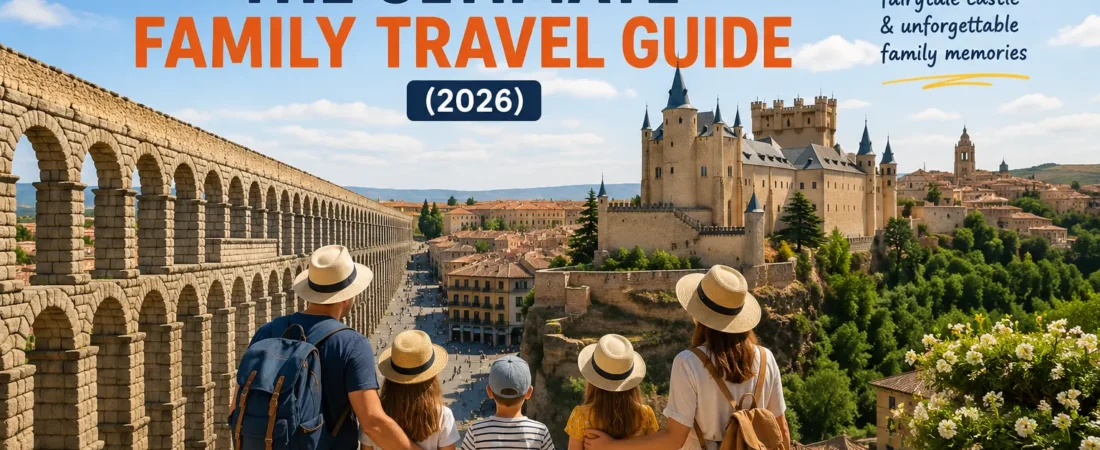
Some historic cities require children to understand the history before they become interesting.
Segovia works the other way around.
First, children see an enormous Roman aqueduct standing above the city without mortar.
Then they walk through medieval streets toward a castle perched dramatically above two river valleys.
Along the way there is a Gothic cathedral, a large Plaza Mayor, traditional bakeries and one of Spain’s most famous regional dishes.
Only afterward do you need to explain the history.
That makes Segovia with kids particularly effective.
The city gives children something visual first.
Romans built that.
Kings lived there.
That castle protected the city.
History becomes much easier when children can actually see the story.
And for families staying in Madrid, Segovia offers another major advantage:
you can experience all of this without changing hotels.
Take a fast train from Madrid.
Spend the day in a completely different Spanish city.
Return to the same room that evening.
For a family carrying several suitcases through Europe, that simplicity matters.
Segovia with Kids: Quick Family Guide
| Question | Recommendation |
|---|---|
| Ideal stay | Day trip or 1 night |
| Best base | Madrid |
| Best for | Roman history, castles, architecture, food |
| Best ages | Excellent for school-age children |
| Getting around | Walking + bus/taxi from station |
| Car needed? | No for a Madrid day trip |
| Biggest planning issue | Train station is outside historic center |
| Best first sight | Roman Aqueduct |
| Best attraction for many kids | Alcázar of Segovia |
| Best outdoor break | Plaza Mayor / San Marcos area |
| Signature food | Cochinillo asado |
| Day trip possible? | Absolutely |
Segovia is smaller than Madrid and much easier to understand geographically.
But there is one important planning detail:
the high-speed railway station is not in the historic center.
That matters much more to families than the headline train time.
We’ll deal with that properly later in this guide.
Segovia Is a UNESCO World Heritage City
Segovia’s Old Town and Roman Aqueduct have been recognized as a UNESCO World Heritage Site since 1985.
The designation is important because Segovia is not simply a city with one remarkable Roman monument.
The historic city preserves layers of history that developed around it over centuries — from the Roman aqueduct to medieval streets, religious architecture and the Alcázar rising above the surrounding valleys.
For families, however, the UNESCO label becomes much more interesting when children can actually see why the city was considered worth protecting.
Start beneath a Roman aqueduct.
Walk through the historic streets.
Reach the cathedral.
Continue to a medieval royal castle.
In Segovia, a UNESCO World Heritage Site does not feel like one monument you enter and leave. The family spends much of the day walking through it.
That is one of the reasons the city works so well as an introduction to Spanish history for children.
Why Segovia Works So Well With Children
Segovia has something many historic destinations struggle to provide:
variety without enormous distances.
A child can experience:
Roman engineering,
medieval streets,
a cathedral,
a castle,
a traditional Castilian lunch,
and open countryside views
within one day.
Compare that with a city where the family spends half the afternoon moving between attractions on public transportation.
Segovia feels much more contained.
The City Has an Almost Perfect Family Story
Start with the Romans.
Walk forward through history.
Reach medieval Segovia.
See the cathedral.
Finish at the castle.
You do not need to manufacture an educational narrative.
The city has already created one.
That is one reason I think Segovia can work particularly well for children who normally lose interest when parents say:
“Today we’re visiting another historic city.”
There is always another visual landmark ahead.
1. Roman Aqueduct — The Best Introduction to Segovia
The Roman Aqueduct is not an attraction hidden behind a ticket office.
You arrive in the city and there it is.
Huge granite blocks.
Arch after arch.
Standing directly above the urban landscape.
That immediacy makes it an excellent first stop with children.
The Question Kids Usually Understand Immediately
Instead of starting with dates, ask:
How is that still standing?
The visible monumental section of the aqueduct was constructed from granite blocks fitted together without mortar.
That alone can turn the monument into an engineering puzzle.
How did the Romans lift the stones?
How did they make the arches?
Where did the water come from?
Why didn’t everything collapse?
Now Roman history has become a series of questions.
Don’t Rush Away
One mistake is treating the aqueduct as something to photograph before moving immediately into the Old Town.
Give children time to stand underneath it.
Walk around Plaza del Azoguejo.
Look at the difference in height from one end to another.
The aqueduct becomes more impressive when you stop seeing it as a background for photographs and start looking at it as infrastructure.
This thing had a job.
It moved water.
How Long Do Families Need?
You do not need a formal 90-minute visit.
For many families:
30–45 minutes
around the aqueduct and surrounding area is plenty before continuing toward the Old Town.
And because the exterior experience is free, there is no pressure to remain simply because you bought an expensive ticket.
Family rating: ★★★★★
Best for: All ages
Cost: Free to view
Best feature: Immediate visual impact
2. Walk From the Aqueduct to Plaza Mayor — Let Segovia Be the Attraction
After the aqueduct, resist the temptation to rush straight to the next major monument.
Walk.
The route through Segovia’s historic center is part of the experience.
Shops.
Stone buildings.
Small plazas.
Historic façades.
Views opening unexpectedly between streets.
This is where Segovia differs from a museum-heavy city.
You are moving toward the next attraction while still sightseeing.
A Useful Family Rule
If children stop to look at something that was not on your itinerary, sometimes let them.
Travel guides naturally prioritize famous landmarks.
Children do not.
They may remember:
a strange shop,
a pastry,
a street musician,
a dog in a plaza,
or an old doorway
more clearly than the cathedral you spent €30 taking the family into.
Segovia is compact enough to allow those interruptions.
Use that advantage.
3. Plaza Mayor — The Place to Stop Doing Things
Eventually the family reaches Plaza Mayor.
This is where I would deliberately slow down.
Segovia Cathedral dominates one side of the square, but the plaza itself has value.
Sit.
Get a drink.
Have something small to eat.
Let children stop walking.
Look around.
Why This Matters
Parents often underestimate how much standing children do during sightseeing.
Even when the walking distance is modest, they are:
standing in queues,
standing in churches,
standing while adults read information panels,
standing while someone takes photographs.
A café stop is not wasted sightseeing time.
It may be what makes the next attraction enjoyable.
Family rating: ★★★★
Best for: Everyone
Best use: Rest between major attractions
4. Segovia Cathedral — Beautiful, but Know Your Family
Segovia Cathedral rises prominently above Plaza Mayor.
Its late Gothic architecture makes it one of the defining buildings of the city.
But from a family itinerary perspective, there is a more important question:
Does your family need another cathedral today?
If Segovia is part of a longer Spain trip, children may already have visited major churches in Madrid, Toledo, Barcelona or elsewhere.
Historical importance alone does not mean every family should enter every religious building.
When I Would Go Inside
Visit if:
children enjoy architecture,
the family is interested in religious history,
you have enough time,
or this is one of the trip’s few major cathedral visits.
Consider enjoying the exterior and Plaza Mayor instead if:
children are already tired,
you plan to spend substantial time at the Alcázar,
or everyone has reached cathedral saturation.
Skipping an interior does not mean you failed to visit Segovia.
If You Do Enter
Keep the visit focused.
Look at:
the scale,
the Gothic structure,
chapels,
stained glass,
and how the building dominates the surrounding city.
For many families, 30–60 minutes will be enough.
Family rating: ★★★★
Best for: School-age children and teenagers interested in architecture
Main decision: Cathedral interior vs saving energy for the Alcázar
5. Alcázar of Segovia — The Attraction Most Children Will Remember
If the aqueduct provides Segovia’s Roman moment, the Alcázar provides its fairytale moment.
The castle stands on a rocky promontory where the Eresma and Clamores valleys meet.
Towers.
Pointed roofs.
Stone walls.
Royal rooms.
Armor.
Views across the Castilian landscape.
For many children, this is exactly what they hoped a European castle would look like.
About the Disney Story
You will often see claims online that the Alcázar inspired Disney’s Cinderella Castle.
I would not build the family visit around that claim.
The resemblance is fun to discuss, and the Alcázar certainly has a storybook appearance, but the popular Disney-inspiration claim is repeated far more confidently online than the historical evidence warrants.
The castle does not need Disney to make it interesting.
It has enough history of its own.
Inside the Alcázar
The experience can include royal rooms, historic decoration, armor and exhibits connected with the castle’s long history.
This gives families something very different from the cathedral.
Children can imagine:
who lived here,
how the fortress was defended,
what royal life might have looked like,
and why this location was chosen.
Should You Climb the Tower?
The Tower of Juan II can provide spectacular views.
But this is one of those moments where parents should evaluate the family rather than automatically following a “must-do” list.
A tower climb means stairs.
Potentially lots of them.
If everyone is energetic, the view can be a memorable finale.
If children are already exhausted, the castle itself is still worth visiting without turning the tower into a family endurance test.
Check current access conditions and ticket options before visiting.
How Long Should Families Allow?
Approximately:
1.5–2 hours
works for many families who want to explore the castle without rushing.
Allow additional time if you plan to climb the tower and everyone is enjoying the visit.
Family rating: ★★★★★
Best for: School-age children and teenagers
Allow: Around 1.5–2 hours
Biggest advantage: History children can visualize immediately
6. Mirador de la Pradera de San Marcos — The View That Makes the Castle Look Impossible
After visiting the Alcázar, there is another way to understand it.
Go below.
From the Pradera de San Marcos area, families can look back toward the castle perched dramatically above the landscape.
The perspective is completely different from standing inside it.
Now children can see why the location worked as a fortress.
Why Families May Like This More Than Another Interior
There is grass.
Space.
Fresh air.
A dramatic view.
No requirement to study anything.
After several hours inside the historic center, that combination can be extremely welcome.
It is also one of Segovia’s strongest family-photo locations.
But Think About the Return
This is the Segovia version of the lesson we learned in Toledo:
distance on a map is not the whole story.
Going down from the historic center changes elevation.
If you need to return uphill afterward, factor that into the family’s energy.
A viewpoint is less magical when everyone is angry about the climb back.
Family rating: ★★★★★
Best for: All ages
Best feature: Alcázar panorama + outdoor break
Planning issue: Elevation and onward route
Segovia’s Biggest Advantage Over Toledo for Younger Children
Madrid families often compare Toledo and Segovia.
For younger children, Segovia has one particular advantage:
its major historical stories are extremely visual.
You do not need to explain centuries of religious and political history before the attractions make sense.
Aqueduct:
Romans built it to move water.
Castle:
Kings lived and defended this place.
Cathedral:
Look how enormous they built it.
That does not make Segovia historically simpler.
It makes the first layer of the story easier for children to access.
Toledo may offer greater complexity for older children interested in cultural history.
Segovia offers extraordinary visual hooks.
What I Would Prioritize With Kids
If you have one day, you do not need every attraction.
My priorities would be:
1. Roman Aqueduct
↓
2. Walk through the Old Town
↓
3. Plaza Mayor
↓
4. Cathedral — interior optional
↓
5. Alcázar
↓
6. Pradera de San Marcos — if family energy and logistics allow
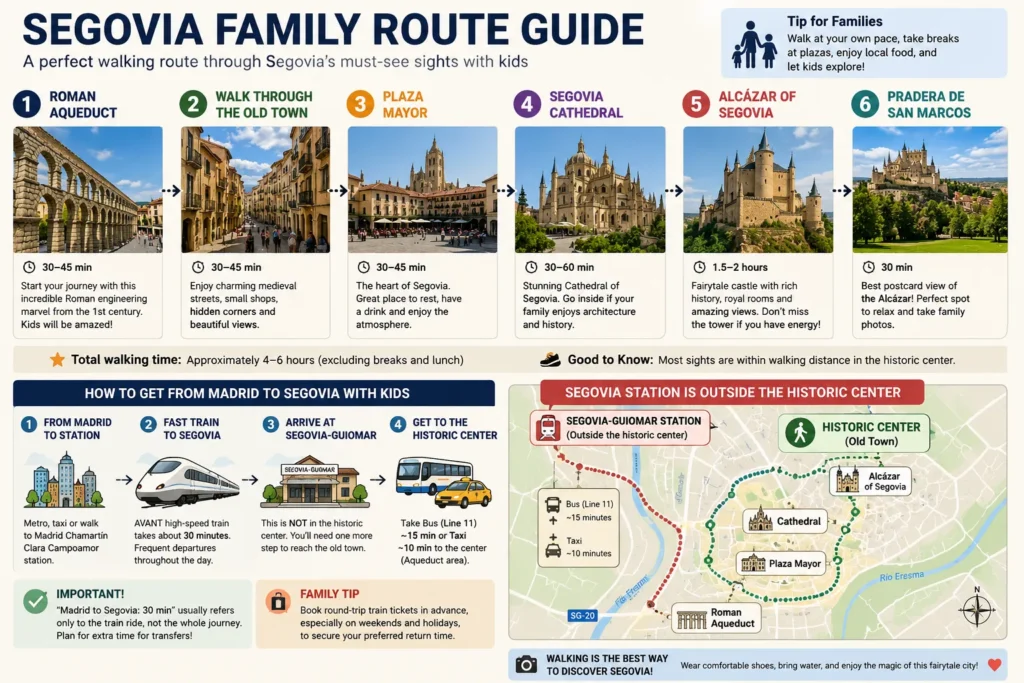
That creates a natural journey through the city instead of repeatedly crossing the same streets.
One Important Thing Before Planning the Day Trip
There is a detail that gets hidden by the phrase:
“Segovia is only around half an hour from Madrid by fast train.”
The fast train arrives at Segovia-Guiomar station.
That station is outside Segovia’s historic center.
So when a travel guide says:
Madrid to Segovia: approximately 30 minutes
that is not your family’s total travel time.
You still need to reach the Madrid departure station, take the train, then travel from Segovia-Guiomar into the city.
That doesn’t make the day trip difficult.
It just means we need to plan it properly.
How to Get From Madrid to Segovia With Kids
Segovia is one of Madrid’s easiest high-impact family day trips.
But there is an important difference between:
a short train ride
and
a short journey.
The high-speed rail portion can be remarkably quick.
Your actual family journey includes:
hotel → Madrid station → train → Segovia-Guiomar → historic center.
Plan for the entire chain and Segovia becomes easy.
Ignore everything except the train time and the morning can feel unexpectedly complicated.
Madrid to Segovia by Fast Train
Fast trains connect Madrid with Segovia-Guiomar, with many services completing the rail portion in roughly half an hour.
For most families already staying in Madrid, this is the option I would consider first.
You avoid:
driving,
parking,
and navigating an unfamiliar city by car.
Children also get another small travel experience:
a fast Spanish train.
That can be part of the day rather than simply transportation.
Book the Return Journey Too
The same advice applies here as Toledo.
Do not assume that whenever the family finishes sightseeing, the perfect return train will be waiting.
Check current schedules and fares before traveling and consider booking both directions, particularly during:
weekends,
holidays,
and busy travel periods.
A return reservation also gives parents a useful deadline for deciding when the family needs to leave the historic center.
Segovia-Guiomar Is Not Segovia’s Old Town
This is the most important transportation detail.
Segovia-Guiomar station sits outside the historic center.
When the train doors open, you will not see the Roman Aqueduct waiting outside.
Families need another transportation step.
Depending on current services and your preferences, this can involve:
bus
or
taxi.
Check current local transport information shortly before traveling because routes and schedules can change.
Where Should You Go First?
For a first visit, I would make the Roman Aqueduct the starting point.
That creates a beautifully simple family route:
Segovia-Guiomar
↓
Aqueduct
↓
Old Town
↓
Plaza Mayor
↓
Cathedral
↓
Alcázar
Instead of jumping randomly between attractions, the family naturally moves through the historic city.
Do You Need a Car?
For a normal Madrid day trip:
No.
Fast train + local transportation + walking works well.
A car becomes more useful if Segovia is part of a broader Castilla y León road trip or you plan to explore destinations outside the city.
But even with a car, there is little reason to spend the day trying to drive between Segovia’s major historic attractions.
Once you reach the center:
walk.
What to Eat in Segovia With Kids
Segovia has one of Spain’s most recognizable regional food identities.
This is not a city where food should be reduced to whatever sandwich is closest to the castle.
The challenge is that its most famous dish is also a substantial one.
Cochinillo Asado — Segovia’s Famous Roast Suckling Pig
Cochinillo asado is closely associated with Segovia.
Traditionally roasted until the skin becomes crisp while the meat remains tender, it is served by restaurants throughout the city.
For food-focused adults, this may be one of the reasons to visit.
For children, reactions can vary considerably.
Some will love it.
Some will be fascinated by the presentation.
Others may suddenly decide they have become vegetarian for lunch.
All are possible.
Do You Need to Eat at the Most Famous Restaurant?
No.
Several established restaurants specialize in traditional Segovian cooking.
A famous name can be part of the experience, but it is not the only way to eat well.
With children, I would prioritize:
a sensible reservation time,
comfortable seating,
a menu that works for everyone,
and location within the day’s route
over choosing a restaurant solely because every guidebook mentions it.
Use Lunch as the Midday Reset
A traditional Segovian lunch can be substantial.
That is actually useful.
Structure the day around it.
Aqueduct + Old Town in the morning
↓
proper lunch
↓
Alcázar in the afternoon
Now lunch becomes the break between two distinct halves of the day.
Children sit down.
Parents sit down.
Everyone drinks.
Nobody has to look at a monument for an hour.
That is good family travel.
Judiones de La Granja
Another regional specialty is judiones, large white beans traditionally associated with nearby La Granja.
The dish is rich, filling and particularly appealing in cooler weather.
It also provides an alternative local experience for families who do not want roast suckling pig.
Ponche Segoviano — Save Room for This
Dessert may be an easier regional introduction for children.
Ponche Segoviano is a traditional Segovian cake typically made with layers of sponge, cream and marzipan-like almond elements.
This is the kind of local specialty I like on family trips.
You do not need children to understand culinary history.
Just buy a portion.
Share it.
See what everyone thinks.
Food becomes another way of remembering the city.
Where to Stay in Segovia With Kids
Most Madrid-based families do not need to stay overnight.
But Segovia deserves more than a day trip if your family likes:
castles,
historic towns,
photography,
slow travel,
or exploring beyond the most famous landmarks.
Historic Center — Best for a One-Night Stay
If you stay overnight, I would strongly consider remaining within or immediately around the historic center.
The advantage is simple:
Segovia after many day-trippers leave.
You can walk through the city in the evening without thinking about the return train.
The following morning becomes slower.
And the major landmarks remain nearby.
Aqueduct Area — Practical for Families
Staying closer to the aqueduct can provide:
restaurants,
easy orientation,
and convenient access to the main walking route through the city.
Families carrying luggage may also find this more practical than choosing accommodation solely because it sits in the most atmospheric medieval lane.
As always, check the exact property for:
stairs,
elevator,
parking,
family room configuration,
and noise.
Is One Night Worth It?
Stay Overnight If:
your family enjoys historic towns,
you want Segovia after the day-trip crowds,
you plan to explore nearby destinations,
or you dislike fitting everything around a return train.
Stay in Madrid If:
you want to minimize hotel changes,
Segovia is one of several Madrid day trips,
or one strong day is enough for the family.
For most first-time family trips to Spain:
Madrid base + Segovia day trip
is extremely efficient.
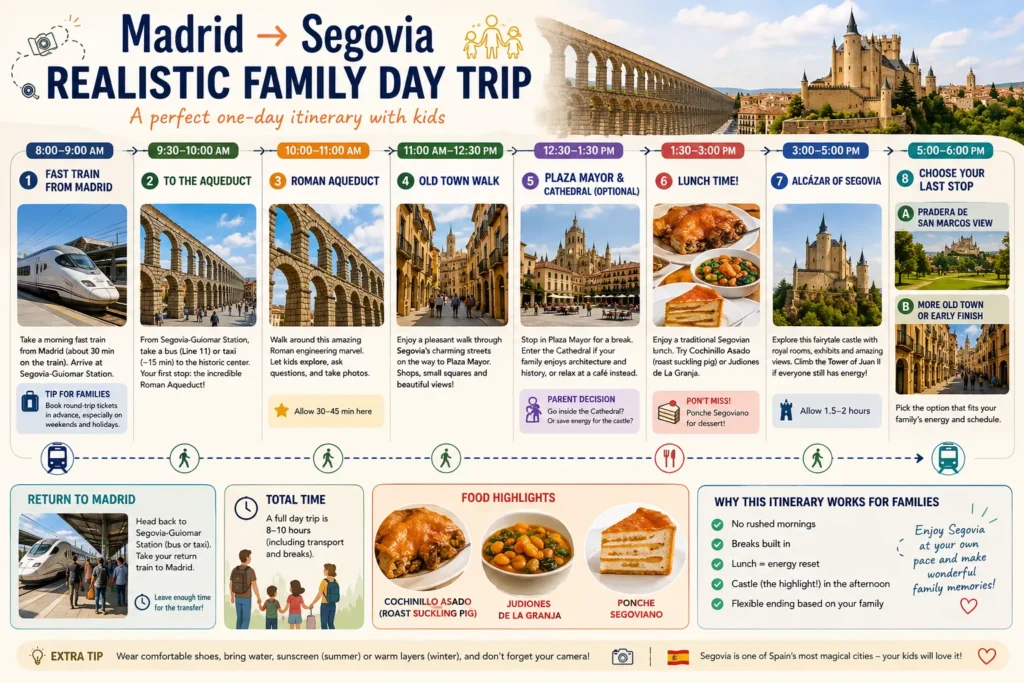
A Realistic Segovia Day Trip From Madrid
The goal is not to see everything in Segovia.
The goal is to create a day where the city’s story unfolds naturally.
Morning — Madrid to Segovia
Take a morning fast train to Segovia-Guiomar.
Leave enough time at the Madrid station that nobody begins the day by sprinting with breakfast in one hand.
On arrival, use local transport or a taxi toward the historic center.
Start around the Roman Aqueduct.
Morning — Roman Aqueduct
This is your introduction to Segovia.
Walk underneath it.
Look at the granite blocks.
Let children ask questions.
Take photographs.
Do not immediately rush away because the aqueduct does not require a ticket.
Allow approximately 30–45 minutes around the monument and surrounding area.
Late Morning — Walk Through the Old Town
Begin moving toward Plaza Mayor.
Let the walk itself become part of the sightseeing.
There is no need to create a formal stop every fifteen minutes.
Midday — Plaza Mayor + Cathedral Decision
Reach Plaza Mayor.
Stop.
Then decide:
Do we want to enter the cathedral?
If yes, make a focused visit.
If no, enjoy the exterior and preserve everyone’s energy for the Alcázar.
This decision should depend on the family, not on whether a travel guide labels the cathedral “must-see.”
Lunch — Make It a Real Break
This is a good time for the traditional Segovia meal.
Try:
cochinillo
or
judiones
if the family is interested.
Then find some Ponche Segoviano.
Do not rush lunch to gain another 30 minutes of sightseeing.
The afternoon still contains the attraction many children will be waiting for.
Afternoon — Alcázar of Segovia
Give the castle enough time.
Explore the rooms.
Talk about how the location worked defensively.
Look across the surrounding landscape.
If the tower is open, your ticket permits access and everyone has enough energy, decide whether the climb makes sense.
If not:
skip it.
You still visited the Alcázar.
Late Afternoon — Choose Based on Energy
This is where rigid itineraries usually go wrong.
You have options.
Option A — Pradera de San Marcos
Best if everyone still has energy and wants the classic exterior view of the Alcázar.
Option B — More Old Town
Walk slowly back through Segovia.
Stop for food, shopping or photographs.
Option C — Finish Early
If the children are done:
they are done.
Go toward the station.
A successful family day trip does not require using every minute until the last possible train.
Return to Madrid
Leave enough buffer to reach Segovia-Guiomar.
Remember that you are not simply walking from the Alcázar onto a Madrid train.
There is still a transfer between the historic center and the railway station.
Then return to Madrid.
Same hotel.
Same luggage.
No check-in.
That logistical simplicity is one of the biggest reasons Segovia belongs in a Madrid family itinerary.
A One-Night Segovia Family Itinerary
If you decide not to return immediately to Madrid, slow everything down.
Day 1
Madrid → Segovia
Roman Aqueduct
Old Town
Plaza Mayor
Cathedral if interested
long lunch
Alcázar
evening walk
traditional dinner
Day 2
Slow breakfast
Pradera de San Marcos
another neighborhood or attraction
Ponche Segoviano
continue the Spain trip or return to Madrid
The major difference is not how many more attractions you can add.
It is that the clock stops controlling the city.
Segovia in Summer With Kids
Segovia’s elevation means its climate differs from Madrid’s, but summer days can still become hot and sunny.
Families should carry:
water,
sun protection,
and hats.
Use indoor attractions and lunch strategically during the strongest part of the day.
The walk through the historic center also contains exposed sections, so do not assume a relatively short route means heat is irrelevant.
Segovia in Winter
Segovia can become genuinely cold.
That medieval-castle atmosphere may become even stronger, but family packing needs to match the conditions.
Cold wind and children who cannot feel their fingers are not automatically magical.
Check the forecast.
Bring appropriate layers.
And remember that daylight hours are shorter.
Spring and Autumn
For walking-focused family sightseeing, these can be particularly comfortable periods.
But weather can vary substantially.
Always check conditions shortly before the trip rather than planning entirely around seasonal averages.
Segovia With a Stroller
Compared with Toledo, Segovia may feel somewhat more straightforward in parts of the main sightseeing route.
But this is still a historic city.
Expect:
cobblestones,
slopes,
uneven surfaces,
and some stairs.
A lightweight stroller can be useful for younger children.
Large travel systems can become cumbersome.
And accessibility inside historic monuments should be checked individually.
Toledo or Segovia With Kids?
Now we can make the comparison more practical.
| Segovia | Toledo | |
|---|---|---|
| Best visual hook | Roman Aqueduct + Alcázar | Medieval hilltop city |
| Castle experience | Excellent | Alcázar / military history |
| Roman history | Excellent | Present but less visually dominant |
| Three Cultures story | Limited | Excellent |
| Religious/cultural history | Strong | Exceptional |
| Food | Cochinillo, judiones, ponche | Marzipan, carcamusas |
| Easy for younger kids to understand | Excellent | Good |
| Best for teenagers interested in complex history | Very good | Excellent |
| Madrid day trip | Excellent | Excellent |
| Train-station complication | Station outside center | Station below Old Town |
| Walking challenge | Moderate | Generally more demanding |
Choose Segovia If Your Children Like:
castles,
Romans,
engineering,
fairytale-looking architecture,
and history they can understand visually.
Choose Toledo If Your Children Like:
medieval cities,
swords,
religious history,
different cultures,
and more complicated historical stories.
If You Have Four or Five Nights in Madrid
My answer changes.
Do not necessarily choose.
Visit both on separate days.
That gives the family:
Madrid — royal capital + museums + parks + football
Toledo — medieval Spain + Three Cultures
Segovia — Romans + castle
Three very different experiences.
One Madrid hotel.
Common Mistakes Families Make in Segovia
Thinking the Train Station Is Beside the Aqueduct
It isn’t.
Plan the final transport into town.
Planning Around Train Time Instead of Door-to-Door Time
Thirty minutes on the train does not mean thirty minutes from your Madrid hotel to Segovia’s historic center.
Entering Every Monument
Cathedral fatigue exists.
Save energy for the places your family actually wants to see.
Skipping Lunch to Save Time
Segovia’s food is part of the destination.
And children need a break.
Automatically Climbing the Alcázar Tower
Look at your children first.
Then look at the stairs.
Make the decision in that order.
Forgetting the Return Transfer
Build enough time to get from the historic center back to Segovia-Guiomar.
Treating Segovia as a Half-Day Because It Looks Small
You can technically rush through the major sights.
You probably should not.
How Segovia Fits Into a Spain Family Trip
For many families, Segovia fits naturally into a Madrid stay.
A practical structure might be:
Madrid — 4 or 5 nights
with:
Toledo — one day trip
and
Segovia — one day trip
Families planning Madrid as their Central Spain base can use our Madrid with Kids family travel guide to build the city portion of the trip.
If you are deciding between the two most popular historic day trips, our Toledo with Kids family travel guide explains how Toledo differs in walking difficulty, history and family experience.
For the wider journey, our 15 Best Places to Visit in Spain with Kids guide can help you decide whether Madrid and Central Spain should be combined with Barcelona, Andalusia, the Mediterranean coast or northern Spain.
Is Segovia Worth Visiting With Kids?
Yes.
In fact, for some families it may be one of the easiest historic cities in Spain to make children genuinely interested in.
Not because it has amusement parks.
Not because everything has been redesigned for children.
But because the major sights already tell understandable stories.
The Romans built an aqueduct.
A medieval city grew around it.
Kings used a castle above the valleys.
People still cook food associated with the region.
Children can see those stories rather than simply being told that something is historically important.
Final Thoughts: Segovia Makes History Easy to See
Segovia does not require families to work very hard to find its identity.
The aqueduct announces it immediately.
The Old Town leads naturally toward Plaza Mayor.
The cathedral rises above the square.
And the route eventually reaches a castle positioned so dramatically that even children who claim not to care about history usually understand why it matters.
That is the strength of Segovia with kids.
Do not try to make the day educational every minute.
Let the aqueduct create the questions.
Let the castle create the imagination.
Let lunch introduce the region.
And let the streets between them do some of the work.
If the family returns to Madrid remembering:
the giant Roman arches, the castle on the cliff and the dessert they ate after lunch,
that is already a very successful day in Segovia.