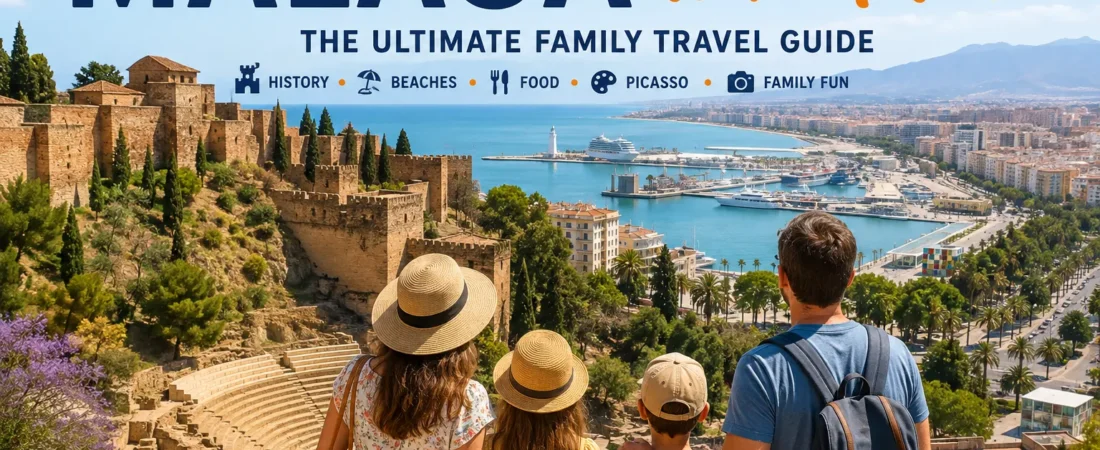
Málaga is easy to misunderstand.
Some travelers see it primarily as:
the airport for the Costa del Sol.
Fly in.
Rent a car.
Drive toward a beach resort.
But families who leave immediately miss one of southern Spain’s easiest cities to combine:
history,
beach,
food,
art,
and outdoor time.
A Moorish fortress rises above a Roman theatre.
A castle overlooks the Mediterranean.
Picasso was born here.
A pedestrian-friendly historic center sits within walking distance of the waterfront.
Muelle Uno gives families an easy harbor promenade.
And when everyone has had enough sightseeing, the beach is right there.
For families searching for Malaga with kids, that combination is the real attraction.
Málaga does not require parents to choose between a cultural city break and a Mediterranean family vacation.
You can do both.
And compared with hillier destinations such as Granada, much of the central family experience is relatively straightforward to navigate.
There is one exception.
Gibralfaro.
We will deal with that hill strategically rather than pretending every family should enthusiastically climb it in the Andalusian sun.
Málaga with Kids: Quick Family Guide
| Question | Recommendation |
|---|---|
| Ideal stay | 3 nights |
| Minimum worthwhile stay | 2 full days |
| Best for | History, beach, food, art, waterfront |
| Best ages | Excellent across a wide age range |
| Getting around | Mostly walking + bus/taxi when useful |
| Car needed? | No for a normal city stay |
| Central walking difficulty | Relatively easy |
| Main hill challenge | Gibralfaro |
| Essential historic attraction | Alcazaba |
| Best easy family combination | Alcazaba + Roman Theatre |
| Best city beach | Malagueta |
| Best food + beach experience | Pedregalejo |
| Best evening walk | Muelle Uno |
| Best for art-loving older kids | Museo Picasso Málaga |
| Biggest summer issue | Heat + strong sun |
| Good Costa del Sol base? | Yes |
Málaga does not need a twenty-attraction itinerary.
For a first family visit, I would build the trip around:
Alcazaba
↓
Roman Theatre
↓
Gibralfaro if the family wants the view
↓
historic center
↓
Muelle Uno
↓
beach
↓
one proper Málaga food experience
That already creates a trip where every part of the day feels different.
Why Málaga Works So Well With Kids
Málaga’s strongest family advantage is contrast without complicated transportation.
Imagine one day containing:
a fortress,
Roman ruins,
lunch,
a harbor walk,
and the beach.
That sounds like several different destinations.
In Málaga, those experiences can fit together surprisingly naturally.
History Does Not Require an Entire Museum Day
This matters with children.
The Roman Theatre is outside.
The Alcazaba contains:
walls,
courtyards,
gardens,
views,
and changing spaces.
Gibralfaro feels like a castle and viewpoint.
Children are not required to spend the entire historical experience moving between glass cases.
Then the City Gives Them an Exit
Had enough history?
Beach.
Had enough beach?
Food.
Need an easy evening?
Muelle Uno.
Interested in art?
Picasso.
A city becomes much easier with children when parents have several genuinely different Plan Bs.
Málaga has them.
Málaga’s History Is Visible in Layers
Málaga has been shaped by different civilizations over a very long period.
Phoenician origins.
Roman Malaca.
Islamic Málaga.
Christian Málaga.
Modern Mediterranean city.
You do not need to explain all of that before breakfast.
Instead, let children see the layers.
The easiest place to begin is one of the city’s best historical combinations.
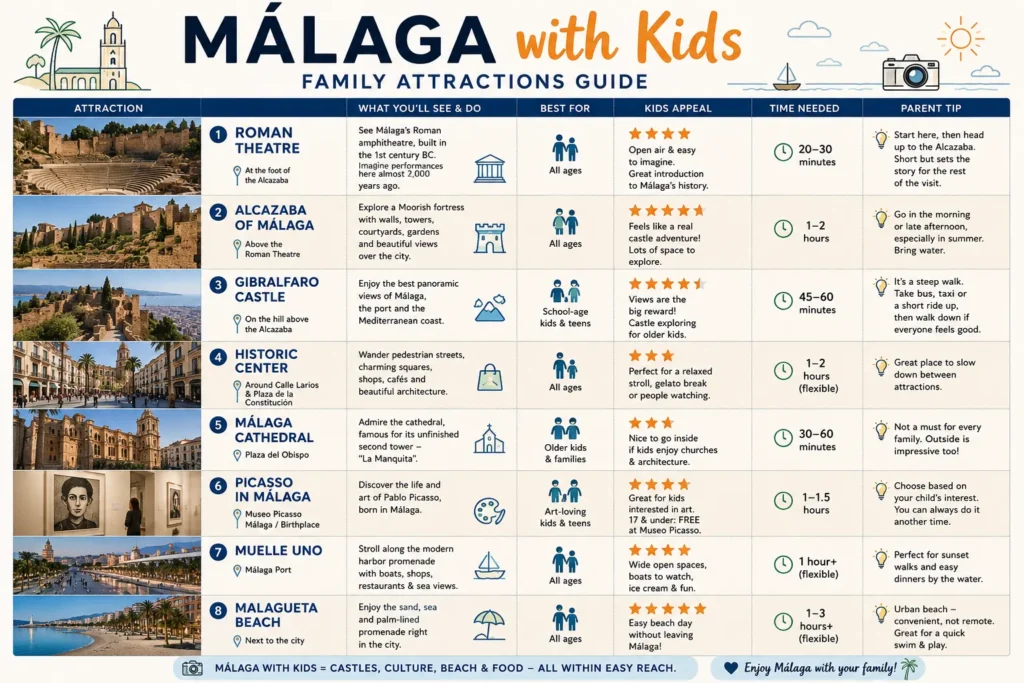
1. Roman Theatre — Start at the Bottom
At the foot of the Alcazaba sits Málaga’s Roman Theatre.
That location is perfect for families.
You can stand in one place and begin connecting completely different historical periods.
Roman theatre below.
Islamic fortress above.
Children can physically see that the city changed.
Explain It Simply
For younger children:
“People were coming here to watch performances almost two thousand years ago.”
That is enough.
Ask:
Where did people sit?
Where did performers stand?
How many people could watch?
What would it have sounded like?
Suddenly ruins become a place where actual people did something understandable.
Don’t Overschedule the Roman Theatre
This does not need to become a major half-day attraction.
That is one of its advantages.
Stop.
Look.
Give children context.
Then continue upward toward the Alcazaba.
Family rating: ★★★★
Best for: All ages as a short historical stop
Biggest advantage: Easy to combine with the Alcazaba
2. Alcazaba of Málaga — My Historical Priority With Kids
If the family chooses only one major historic attraction in Málaga, I would choose the Alcazaba.
The fortress-palace complex rises above the Roman Theatre and gives children a completely different historical environment.
Walls.
Arches.
Courtyards.
Gardens.
Water.
Views.
Passageways.
The surroundings change enough to keep the visit moving.
What Was the Alcazaba?
Keep the first explanation simple.
The Alcazaba was a fortified palace complex developed during Málaga’s Islamic period.
Its location was strategic.
Look toward:
the sea,
the port,
and the city.
Now ask:
Why build a fortress here?
Children can answer part of the historical question just by looking.
Let Children Find the Defenses
Instead of explaining every ruler and architectural phase, give younger children a mission.
Find:
a defensive wall,
a tower,
a narrow entrance,
somewhere a guard might watch from,
water,
a courtyard,
and the best view.
Now the fortress becomes something to investigate.
Don’t Call It a Mini Alhambra
This comparison appears constantly because families often visit Málaga and Granada on the same Andalusia trip.
I would avoid it.
The Alcazaba is not:
“the Alhambra, but smaller.”
It has its own history, geography and relationship with Málaga.
If children have already visited the Alhambra, ask instead:
What looks similar?
What feels different?
Comparison becomes useful without making one monument a lesser version of another.
How Long Should Families Allow?
For many families:
around 1–2 hours
can work well.
History-focused families may stay longer.
Families with younger children may move faster.
Do not force the visit to last a predetermined time because somebody online said it takes exactly 90 minutes.
Summer Strategy
Go earlier.
Shade exists, but this remains southern Spain.
Walls that look romantic in photographs can feel very different when the family is walking in intense afternoon sun.
Family rating: ★★★★★
Best for: School-age children and teenagers, but adaptable for younger kids
Planning priority: High
Combine with: Roman Theatre + historic center
3. Gibralfaro Castle — Get the View Without Proving Anything
Above the Alcazaba sits Castillo de Gibralfaro.
The castle’s elevated position provides some of Málaga’s most impressive views.
Port.
Bullring.
City.
Mediterranean.
Coast.
This is exactly the kind of place travel guides describe with:
“Enjoy the scenic walk uphill.”
With children in August, I would add:
or don’t.
You Do Not Have to Walk Up Gibralfaro
This is one of the most useful Málaga family tips.
The fact that a walking route exists does not mean every family should use it in both directions.
The climb can become:
steep,
hot,
and tiring.
Particularly after the family has already explored the Alcazaba.
My Preferred Family Strategy
Depending on current transport arrangements and where the family starts:
bus or taxi up
↓
explore Gibralfaro
↓
walk down if weather and family energy make sense
can be far more enjoyable.
You preserve children’s energy for the actual castle and view instead of spending it all reaching them.
Is Gibralfaro Essential?
No.
This is important.
If you have:
young children,
extreme heat,
limited time,
or a family already satisfied after the Alcazaba,
skip it.
Málaga remains Málaga.
When I Would Definitely Go
Older children.
Teenagers.
Comfortable weather.
Families who love castles.
Anyone particularly interested in panoramic photography.
Then Gibralfaro becomes much easier to justify.
Family rating: ★★★★½
Best for: School-age children and teens
Biggest challenge: The hill
Best strategy: Consider transport uphill
Alcazaba + Gibralfaro on the Same Day?
Yes.
But I would not automatically do them back-to-back on foot.
The danger is:
Roman Theatre
↓
Alcazaba
↓
climb
↓
Gibralfaro
↓
everyone exhausted before lunch.
If castles are a major family interest:
go for it strategically.
If not:
the Alcazaba alone may be enough historical fortification for one morning.
4. Málaga Historic Center — Let the City Become the Attraction
After the Alcazaba, I would not immediately send the family into another museum.
Walk.
Central Málaga gives families:
pedestrian streets,
plazas,
shops,
cafés,
restaurants,
historic architecture,
and places to stop.
This is where the trip can breathe.
Calle Larios
Calle Marqués de Larios is one of central Málaga’s best-known pedestrian streets.
For families, the practical value is straightforward:
space to walk without navigating normal vehicle traffic.
Use it as part of the journey rather than treating it as an attraction requiring a fixed time slot.
Plaza de la Constitución
Another useful central reference point.
Stop.
Get something cold.
Look around.
Decide what everyone wants next.
Not every important travel moment needs an admission ticket.
5. Málaga Cathedral — Do You Need to Go Inside?
Málaga Cathedral is one of the city’s major landmarks.
Its distinctive unfinished second tower helped produce the nickname:
La Manquita — “the one-armed lady.”
That is exactly the kind of detail children may remember better than an architectural lecture.
Should Every Family Enter?
No.
If the family:
loves churches,
architecture,
religious history,
or wants a quieter interior experience,
go inside.
If you have already visited several Spanish cathedrals and the children are clearly experiencing:
cathedral number nine syndrome,
admire the exterior and keep walking.
The Family Question I Would Ask
Does entering the cathedral add something genuinely different to today’s itinerary?
If yes:
go.
If not:
save the energy for something else.
Málaga gives you plenty of alternatives.
6. Picasso in Málaga — Important, but Not Mandatory for Every Child
Pablo Picasso was born in Málaga.
That makes art an important part of the city’s modern cultural identity.
But the phrase:
“Picasso was born here”
does not automatically mean every family should spend several hours inside an art museum.
Age and interest matter.
Museo Picasso Málaga
For:
art-interested school-age children,
teenagers,
and families already familiar with Picasso,
the museum can add a completely different dimension to Málaga.
Instead of another:
castle,
church,
or archaeological site,
the family encounters modern art.
That contrast can be valuable during a longer Spain trip.
With Younger Children?
I would make the decision based on the child.
Some younger children genuinely enjoy art.
Others will spend the visit asking when the beach begins.
Both are normal.
Do not use Picasso’s international importance as evidence that your five-year-old must appreciate Cubism today.
A Better Way to Introduce Picasso to Kids
Instead of:
“Picasso was one of the most important artists of the twentieth century.”
start with something visual.
Why does that face look like that?
Can you find the eyes?
How many angles do you see?
Would you draw a person this way?
Do you think he was trying to make the picture realistic?
Children engage much more easily when art begins with a question.
Picasso Birthplace
Families particularly interested in Picasso may also encounter the house associated with his birthplace around Plaza de la Merced.
But I would not automatically schedule:
museum + birthplace
for every family.
Choose according to actual interest.
Family rating: ★★★★ for art-interested families
Teen potential: ★★★★★
For younger kids: Highly dependent on interest
Plaza de la Merced — Useful Even Without a Picasso Pilgrimage
The square around Picasso’s birthplace can still fit naturally into a central Málaga walk.
This is another example of why I like Málaga with children.
Parents do not need to classify every location as:
attraction
or
not attraction.
Some places simply become part of exploring the city.
7. Muelle Uno — The Easy Family Evening
After:
Roman history,
Islamic fortifications,
cathedral architecture,
or Picasso,
Muelle Uno requires very little explanation.
Waterfront.
Boats.
Restaurants.
Shops.
Open space.
Walking.
That makes it one of Málaga’s easiest family experiences.
Why I Like It Late in the Day
Children do not need another historical explanation.
Parents do not need another ticket.
Everyone can:
walk,
eat,
look at boats,
stop,
and decide when the day is finished.
This is exactly the kind of low-pressure experience family itineraries need.
Centre Pompidou Málaga
Families interested in modern and contemporary art may notice the colorful cube associated with Centre Pompidou Málaga around the Muelle Uno area.
This can provide another art option depending on:
current exhibitions,
children’s ages,
and family interest.
Again:
Málaga does not require every museum.
Choose.
8. Malagueta Beach — The Easiest Beach to Add to a City Day
Continue east from the central waterfront and the trip changes again.
Sand.
Sea.
Beach.
Playa de la Malagueta is not necessarily the beach I would choose for every Costa del Sol beach vacation.
That is not its main advantage.
Its advantage is:
location.
Why Malagueta Works for Families
Imagine:
morning Alcazaba,
lunch,
Muelle Uno,
then:
beach.
No long excursion.
No rental car.
No hotel change.
That makes Malagueta extremely useful.
Don’t Ask It to Be a Remote Paradise
This is an urban beach.
Families expecting an isolated Mediterranean cove are solving the wrong problem.
Malagueta gives you:
convenience,
city access,
promenade,
food nearby,
and easy beach time.
Those are substantial advantages with children.
How Long?
As long as the family wants.
This is exactly the kind of activity I would not schedule too tightly.
If everyone wants:
45 minutes?
Fine.
Three hours?
Also fine.
Beach Safety
Check:
current sea conditions,
lifeguard information,
flags,
weather,
and local guidance.
Supervise children appropriately.
Mediterranean does not mean automatically safe.
Family rating: ★★★★★ for convenience
Best for: All ages
Biggest advantage: Easy to combine with central sightseeing
Muelle Uno + Malagueta Is One of Málaga’s Best Family Combinations
This pairing deserves emphasis.
Families often think they need another major attraction after lunch.
They don’t.
A very good Málaga afternoon can simply be:
Muelle Uno
↓
ice cream / drink
↓
Malagueta
↓
beach
↓
dinner
That is not wasted sightseeing time.
It is part of why you chose a Mediterranean city.
What I Would Prioritize With Kids
For a first Málaga family trip, my priorities would be:
1. Alcazaba + Roman Theatre
↓
2. Muelle Uno
↓
3. Beach
↓
4. Gibralfaro according to age/weather
↓
5. Historic center
↓
6. Picasso according to interest
Then let:
food,
weather,
and family energy
decide the rest.
The Málaga Family Rhythm I Would Use
Málaga is one of those cities where families can accidentally plan too much simply because everything seems accessible.
I would structure the day more simply:
major morning experience
↓
proper lunch
↓
rest or beach
↓
late-afternoon waterfront / neighborhood
↓
dinner
That rhythm becomes even more valuable in summer.
And the next part of this guide is where Málaga becomes more than a city with a convenient beach.
Because east of Malagueta lies one of the family experiences I would specifically make room for:
Pedregalejo, a beachside table and espetos cooked beside the sea.
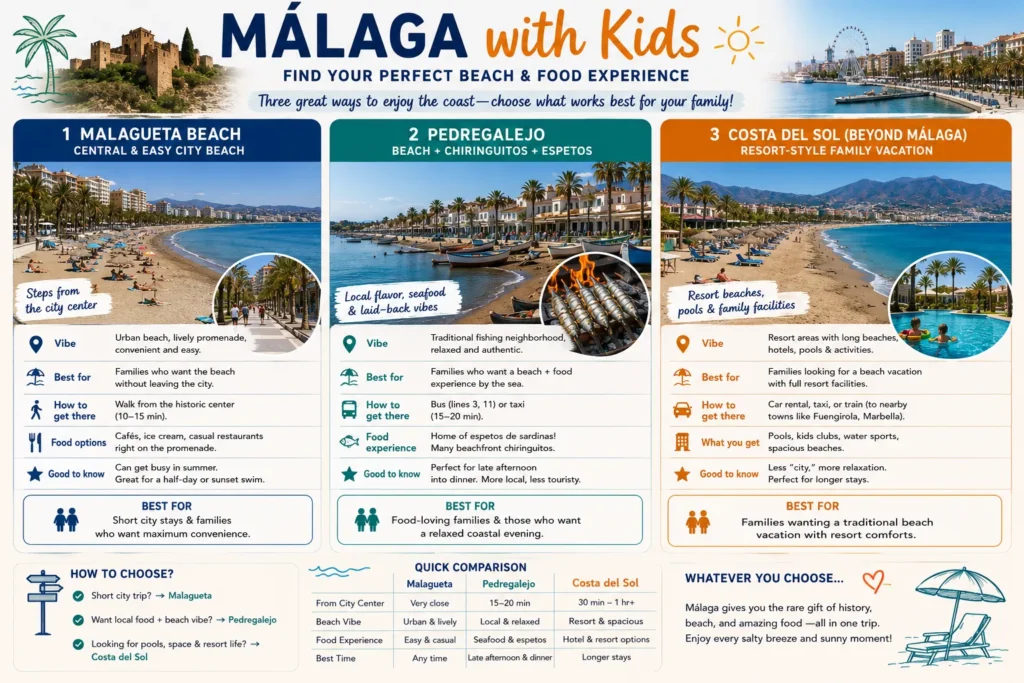
9. Pedregalejo — Where Málaga Becomes a Seaside Food City
Malagueta is convenient.
Pedregalejo is where I would go when the family wants the beach and the meal to become the experience.
East of central Málaga, this former fishing area has a very different rhythm.
Beach.
Promenade.
Small coves.
Restaurants.
Chiringuitos.
Families walking beside the sea.
And one of Málaga’s most recognizable food traditions:
espetos de sardinas.
For me, this is worth separating from a normal beach stop.
You are not simply going to Pedregalejo because you need more sand.
You are going because Málaga’s relationship with the Mediterranean becomes much easier to understand here.
Espetos — Sardines Cooked Beside the Sea
Espetos are strongly associated with Málaga’s coastal food culture.
Sardines are skewered and traditionally cooked over an open fire, often in the distinctive boat-shaped grills seen at chiringuitos along the coast.
For children, this is excellent food storytelling because they can often understand the cooking process before tasting anything.
Fish.
Skewer.
Fire.
Eat.
No complicated culinary explanation required.
Will Kids Like Sardines?
Some will.
Some absolutely will not.
Sardines have a distinctive flavor and contain bones, so I would not describe espetos as universally child-friendly.
Instead:
order some for the table.
Let everyone try.
If one child loves them:
great.
If another decides after half a bite that sardines are the worst invention in Spain:
also fine.
There will be other food.
Why I Would Choose Pedregalejo for an Evening
A family can spend the late afternoon at the beach.
Then:
change,
walk,
sit down,
order seafood,
watch the cooking,
and eat beside the Mediterranean.
No major attraction needs to follow.
That is a complete Málaga experience.
Family rating: ★★★★★
Best for: Beach + food combination
Best time: Late afternoon into dinner according to season and family schedule
Signature experience: Espetos
Malagueta or Pedregalejo With Kids?
They solve different problems.
| Malagueta | Pedregalejo | |
|---|---|---|
| Best advantage | Central convenience | Food + beach atmosphere |
| Combine with | Muelle Uno / city sightseeing | Espetos / seaside meal |
| Easy from historic center | Very easy | Requires a little more travel |
| Best for short visit | Yes | If food is a priority |
| Best for relaxed evening | Good | Excellent |
| Why families go | Easy beach time | Beach + local coastal culture |
I would not choose one beach and declare it the winner.
Use Malagueta when convenience matters.
Use Pedregalejo when the meal is part of the destination.
What to Eat in Málaga With Kids
Málaga’s food identity goes far beyond sardines.
And this is another city where sharing works extremely well.
Instead of ordering:
one unfamiliar dish per person,
order several things.
Put them in the middle.
Taste.
That reduces the risk and makes local food much easier with children.
Espetos de Sardinas
We already covered the experience.
If the family eats fish, try them at least once.
They make far more sense beside the sea than they do as a line on a list of Málaga foods.
Boquerones Fritos — An Easier Fish Introduction
Boquerones are anchovies, and fried boquerones are strongly associated with Málaga.
In fact, the connection between Málaga and boquerones is so strong that boquerón has long been used as a nickname associated with people from Málaga.
For children, fried preparation may make small fish more approachable than a stronger preserved anchovy experience.
Bones?
This is exactly the kind of practical question parents should ask rather than assuming.
Small fried fish may be served in ways unfamiliar to children.
Check what has been served and help younger children appropriately.
Do not simply hand over a plate because an adult travel guide called it kid-friendly.
Ajoblanco — The Soup That Doesn’t Look Like You Expect
Ajoblanco is a cold Andalusian soup traditionally associated with ingredients such as:
almonds,
bread,
garlic,
olive oil,
and water.
Children expecting tomato soup may be surprised.
There is no tomato.
That makes it a useful tasting dish.
Allergy Note
Because almonds are central to traditional ajoblanco, families dealing with nut allergies should treat this dish carefully and verify ingredients and preparation directly with the establishment.
Food traditions are interesting.
Allergy assumptions are not.
Gambas al Pil-Pil
Prawns cooked with ingredients such as:
garlic,
olive oil,
and chili
are another familiar Málaga-area dish.
For seafood-loving families, this may be an easy shared option.
For younger children sensitive to spice:
ask about the preparation.
The phrase “prawns with garlic” does not automatically tell you how spicy the dish will be.
What I Would Order for a First Málaga Family Meal
Something like:
one local fish dish
one easier familiar dish
one Málaga specialty
bread / vegetables / something everyone understands
Then share.
That is enough to begin.
Family food travel works better when the table contains both curiosity and insurance.
10. Atarazanas Market — Let Children See Málaga’s Food Before Eating It
Mercado Central de Atarazanas provides another way to explore Málaga’s food culture.
Fresh produce.
Fish.
Seafood.
Meat.
Olives.
Local ingredients.
Prepared foods depending on the stalls and current operations.
But the building itself also tells a story.
Look at the Entrance
The market’s name and surviving architectural elements connect the site with Málaga’s Islamic past and its historical use associated with shipbuilding.
That gives parents a surprisingly easy way to connect:
history,
food,
and the port city.
You do not need a separate history lecture.
You are buying food in a place whose story reflects Málaga’s relationship with the sea.
Market Challenge for Kids
Ask each child to find:
a fish they have never seen,
a fruit or vegetable they want to try,
the strangest-looking seafood,
something they recognize,
and something they would never voluntarily eat.
The final category usually produces the most enthusiasm.
Don’t Arrive Too Late Expecting the Same Experience
Food markets operate according to their own rhythms.
Check current opening hours and individual stall schedules before planning the visit.
Do not assume a market functions like a shopping mall from morning until late evening.
Where to Stay in Málaga With Kids
Málaga offers several very different family bases.
The right one depends on whether the trip is primarily:
city,
beach,
or a combination.
Centro Histórico — Best for a First City Trip
Staying around the historic center gives families convenient access to:
Alcazaba,
Roman Theatre,
Cathedral,
Picasso-related sights,
restaurants,
and pedestrian streets.
Muelle Uno and Malagueta remain accessible.
Best for
First-time families and shorter stays.
Main advantage
You can do a remarkable amount on foot.
Check
Street noise.
A central pedestrian location can still be lively late into the evening.
Soho — Best for Central Access Without Sleeping Deep in the Old Town
Soho can provide a useful compromise between:
historic center,
port,
transportation,
and a more contemporary neighborhood atmosphere.
Families interested in street art may also enjoy the area.
Best for
Families wanting central convenience with a slightly different feel from the historic core.
Malagueta — Best for City + Beach
If children wake up thinking about the beach rather than the cathedral, staying around Malagueta can make sense.
You gain:
easy sand access,
waterfront,
Muelle Uno nearby,
and reasonable access back toward central Málaga.
Best for
Summer families and travelers wanting the beach to be part of everyday life.
Pedregalejo — Best for a Slower Coastal Stay
Families staying longer may prefer Pedregalejo’s seaside rhythm.
Beach.
Restaurants.
Promenade.
Neighborhood atmosphere.
Trade-off
You are no longer stepping directly into Málaga’s main historic sights.
Transportation becomes more relevant.
Best for
Families prioritizing coast and food over immediate monument access.
Hotel or Apartment?
For two nights, a hotel can be extremely convenient.
For three or more, an apartment may become attractive because of:
space,
separate sleeping areas,
kitchen,
laundry,
and meal flexibility.
In summer, my filters would include:
air conditioning
and, if budget and location allow,
pool.
A pool is not necessary in Málaga.
It can still become one of the most useful things the family booked.
Getting Around Málaga With Kids
Central Málaga is one of the easier parts of the Costa del Sol to explore without a car.
Walking handles much of the historic-center experience.
Then use transportation strategically.
Bus
Useful for:
Gibralfaro,
Pedregalejo,
and journeys where walking adds effort without adding much experience.
Check current routes for the actual travel dates.
Taxi
I would use one without hesitation for:
Gibralfaro in intense heat,
luggage,
tired children,
or late returns when the alternative is an unnecessarily long walk.
Metro
Málaga’s Metro can be useful depending on where the family is staying or traveling, but most first-time historic-center sightseeing does not require parents to build the itinerary around it.
Do You Need a Car?
For Málaga itself:
No.
For a wider Costa del Sol or Andalusia road trip:
possibly.
That distinction matters.
Do not rent a car because the word Costa del Sol makes it sound mandatory.
Rent one when the actual itinerary benefits from it.
Málaga With a Stroller
Central Málaga is comparatively manageable.
Pedestrian areas.
Waterfront promenades.
Relatively flat central routes.
Those are all advantages.
Historic surfaces and individual monuments can still create:
steps,
uneven ground,
and accessibility limitations.
And the route toward Gibralfaro is a completely different proposition.
A stroller-friendly city does not make every hill stroller-friendly.
Check current accessibility information for specific attractions if that matters to your family.
Málaga in Summer With Kids
Málaga is a Mediterranean coastal city.
That helps.
It does not make the sun irrelevant.
Summer can bring:
heat,
strong UV exposure,
busy beaches,
and high visitor demand.
The Summer Rhythm I Would Use
Morning
Historic attraction.
Alcazaba.
Roman Theatre.
Market.
Picasso if that is the family’s priority.
Lunch
Stop.
Eat properly.
Early Afternoon
Hotel.
Pool.
Indoor attraction.
Or a carefully planned beach period depending on conditions, shade and the family’s sun strategy.
Late Afternoon
Beach.
Muelle Uno.
Pedregalejo.
Waterfront.
Evening
Food.
Walk.
No need to complete another monument.
Don’t Schedule Gibralfaro at the Worst Possible Time
This deserves repeating.
If the forecast is extremely hot, do not decide:
15:30 — family hike to Gibralfaro
because that is the empty slot on the itinerary.
Move it.
Take transportation.
Or skip it.
The viewpoint will not be offended.
Best Time to Visit Málaga With Kids
Spring
Excellent for:
walking,
history,
outdoor sightseeing,
and combining Málaga with wider Andalusia.
Beach conditions vary, but the city does not depend on swimming.
Summer
Best for families who actively want:
Mediterranean beach time,
long evenings,
and a city + coast trip.
But heat strategy becomes essential.
Autumn
Often an attractive balance between:
city sightseeing,
coastal atmosphere,
and more manageable walking conditions.
Winter
Málaga can be particularly appealing as a southern European city break.
Do not assume beach swimming.
Instead think:
waterfront,
food,
history,
art,
and generally milder conditions than many northern European destinations.
Always check actual weather rather than climate averages alone.
A Realistic 3-Day Málaga Family Itinerary
The goal is to make each day feel different.
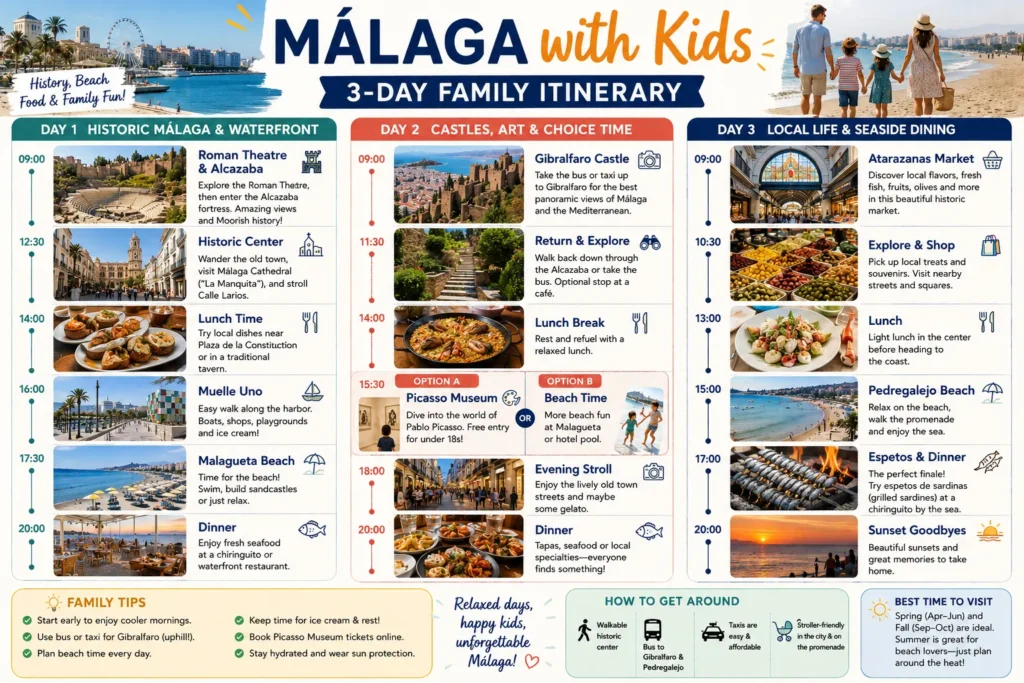
Day 1 — Málaga History + Waterfront
Morning — Roman Theatre + Alcazaba
Start at the bottom.
Roman history.
Then move into the Alcazaba.
Give the fortress enough time.
Late Morning — Historic Center
Walk.
Cathedral exterior or interior according to family interest.
Calle Larios.
Plaza de la Constitución.
Lunch
Try something local.
Then stop.
Afternoon
Rest according to weather.
Late Afternoon — Muelle Uno
Easy waterfront walking.
No historical explanation required.
Evening — Malagueta
Beach if conditions work.
Dinner nearby or return centrally.
Day 1 is complete.
Day 2 — Gibralfaro + Picasso + Flexible Beach Time
Morning — Gibralfaro
Use transportation uphill if that makes sense.
Enjoy the castle and view while everyone has energy.
Late Morning
Return toward the center.
Lunch
Long enough to actually enjoy it.
Afternoon — Choose According to the Family
Option A — Museo Picasso Málaga
For art-interested children and teenagers.
Option B — Malagueta
For children who have already seen enough culture today.
Option C — Hotel Pool
In summer, entirely legitimate.
Evening
Explore the historic center without a checklist.
Eat.
Walk.
Day 3 — Market + Pedregalejo
Morning — Atarazanas Market
Explore Málaga through food.
Then use the remaining morning for:
shopping,
historic streets,
or anything the family missed.
Lunch / Afternoon — Pedregalejo
Head east.
Beach.
Promenade.
Slow down.
Food Experience
This is the day I would deliberately look for:
espetos
and other Málaga seafood.
Let the meal take time.
Final Evening
Stay by the coast if everyone is happy.
There is no need to return downtown just because the itinerary began there.
Málaga With Younger Children
With toddlers and younger primary-school children, I would emphasize:
Roman Theatre,
Alcazaba as a castle-like experience,
Muelle Uno,
Malagueta,
Pedregalejo,
market exploration,
and plenty of beach/play time.
I would reduce:
long Picasso visits unless the child genuinely likes art,
Gibralfaro climbing,
multiple churches,
and excessive historic explanation.
Málaga With Teenagers
Teenagers can experience a much broader city.
Islamic history.
Roman archaeology.
Picasso.
Street art.
Photography.
Beach.
Shopping.
Food.
Mediterranean urban life.
And greater independence in central pedestrian areas.
Gibralfaro also becomes considerably more attractive when children are old enough to appreciate the view without needing to be carried toward it.
Málaga as a Costa del Sol Family Base
This is where Málaga becomes strategically important.
You do not necessarily need to choose between:
Málaga city
and
Costa del Sol.
Málaga can become the first base from which the family begins exploring the coast and surrounding Andalusia.
When Málaga Works Best as the Base
Choose Málaga if the family values:
city culture,
restaurants,
rail connections,
airport access,
historic sightseeing,
and beach access
in the same stay.
This can be much more interesting than choosing a resort if the family wants variety.
When I Would Choose a Resort Instead
If the primary objective is:
pool,
beach,
kids club,
resort facilities,
and minimal sightseeing,
then a dedicated Costa del Sol resort may fit the trip better.
Neither approach is superior.
They solve different family vacations.
Family Day Trips From Málaga
Málaga’s transportation position creates numerous possibilities.
But this is where parents can ruin a comfortable base by scheduling an excursion every day.
Choose carefully.
Nerja — Coast + Caves
Nerja can provide a different coastal experience from central Málaga and is particularly associated with its famous caves.
For families interested in:
natural landscapes,
caves,
and another coastal town,
this can make a strong day trip.
Ronda — Dramatic Landscape + Historic Town
Ronda offers something completely different.
Gorge.
Bridge.
Historic streets.
Mountain setting.
For school-age children and teenagers, the geography alone can make the trip worthwhile.
But travel time matters.
Do not add Ronda simply because it appears on every Andalusia list.
Other Costa del Sol Destinations
Families may also consider other coastal towns according to:
accommodation,
beach priorities,
transportation,
and the overall trip.
The mistake is trying to sample the entire Costa del Sol while still pretending Málaga is a relaxed base.
A base only feels like a base if you occasionally stay there.
How Málaga Fits Into a Southern Spain Family Trip
Málaga can work particularly well as:
an arrival city,
a departure city,
a short coastal base,
or the beginning/end of a wider Andalusian route.
A longer family journey can connect Málaga with destinations such as:
Granada
Córdoba
and
Seville
without requiring the family to treat every city as an isolated vacation.
Families planning the full region can use our Southern Spain family itinerary to decide how Málaga fits with the major Andalusian cities while keeping hotel changes manageable.
Families comparing Málaga with destinations across the country can also explore our 15 Best Places to Visit in Spain with Kids guide.
Common Mistakes Families Make in Málaga
Treating Málaga Only as an Airport
Give the city a chance before leaving the coast.
Walking to Gibralfaro Because the Guidebook Said It Was Scenic
Weather and children’s legs get a vote.
Scheduling Alcazaba + Gibralfaro + Picasso + Beach in One Continuous Day
Possible is not the same as enjoyable.
Assuming Malagueta Is the Only Beach Experience
Pedregalejo offers something different.
Eating Espetos Somewhere Random Just to Check Them Off
The seaside context is part of the experience.
Spending Every Day on a Day Trip
Then Málaga never becomes a base.
Renting a Car for Central Sightseeing
Usually unnecessary.
Assuming Every Child Needs Picasso
Interest matters more than cultural importance.
Ignoring the Midday Sun
Mediterranean coast does not mean unlimited summer walking.
What I Would Protect in a Málaga Family Itinerary
If I had to protect three things, they would be:
one morning for Málaga’s history
one genuinely relaxed beach period
and
one coastal meal that nobody needs to rush.
Those three experiences explain the city better than a twelve-attraction checklist.
The Alcazaba tells one Málaga story.
The beach tells another.
Espetos beside the sea tell another.
The city becomes interesting because those stories coexist within the same family trip.
Málaga Does Not Need to Compete With Granada or Seville
This matters on an Andalusia itinerary.
Málaga is sometimes treated as the weaker cultural stop because:
Granada has the Alhambra.
Seville has the Alcazaba, Cathedral and Plaza de España.
Córdoba has the Mosque-Cathedral.
Trying to make Málaga compete monument-for-monument misses the point.
Málaga gives the family something those cities cannot offer in exactly the same way:
a real Mediterranean city where history, art, beach and everyday coastal life sit unusually close together.
You can explore a Moorish fortress in the morning and have sand between your toes later that afternoon.
You can introduce a teenager to Picasso and then walk toward the harbor.
You can study Roman ruins and finish the day eating grilled sardines beside the Mediterranean.
That is not a lesser version of Andalusia.
It is a different one.
Málaga or Granada With Kids?
These two cities are often combined, but they provide very different family experiences.
| Málaga | Granada | |
|---|---|---|
| Essential historic attraction | Alcazaba | Alhambra |
| Beach | Yes | No |
| Terrain | Relatively flat centrally | Hills |
| Major planning challenge | Summer heat | Alhambra tickets |
| Art | Picasso | More history-focused |
| Science attraction | Limited | Parque de las Ciencias |
| Food identity | Seafood + espetos | Tapas culture |
| Best outdoor family time | Beach + waterfront | Generalife + viewpoints |
| Ideal first stay | 3 nights | 3 nights |
| Best role | City + coast base | Historic destination |
If the children are fascinated by castles and medieval history, Granada may be the stronger priority.
If the family wants:
history,
beach,
food,
and a less monument-heavy rhythm,
Málaga may work better.
With enough time, I would not choose.
They complement each other extremely well.
Families continuing inland can use our Granada with Kids family travel guide to plan the Alhambra, Albaicín, Science Park and a realistic three-day stay.
Málaga or Seville With Kids?
Again, they solve different travel problems.
Seville offers:
Royal Alcázar,
Cathedral,
Giralda,
Plaza de España,
flamenco,
and one of Spain’s strongest monumental city experiences.
Málaga offers:
beach,
harbor,
Picasso,
Alcazaba,
Roman history,
and easy access to the Costa del Sol.
For a first Andalusia trip, I would normally give Seville more nights if the family’s priority is cultural sightseeing.
But if the children are beginning to tire of:
palaces,
cathedrals,
and historical interiors,
Málaga can be exactly what the itinerary needs.
Changing the type of destination can be more refreshing than adding another supposedly essential monument.
Our Seville with Kids family travel guide covers the Alcázar, Plaza de España, flamenco and the summer strategy in detail.
Why I Like Málaga in the Middle of a Longer Spain Trip
This is where Málaga can become strategically valuable.
Imagine the family has already visited:
Madrid.
Toledo.
Córdoba.
Granada.
There has been a lot of:
history,
walking,
architecture,
and explanation.
Then Málaga appears.
Suddenly the afternoon can simply be:
beach.
That is not lowering the quality of the trip.
It may improve everything that follows.
Children need changes of pace just as much as adults do.
And honestly, adults often need them too.
Don’t Turn the Costa del Sol Into Another Checklist
Once families arrive in Málaga, another temptation appears.
Nerja.
Ronda.
Marbella.
Mijas.
Other beaches.
Other towns.
Suddenly the comfortable three-night Málaga stay contains three day trips.
You wake up early every morning and leave the city you deliberately chose as a base.
I would resist that.
Pick one excursion if there is something the family genuinely wants.
Then spend the rest of the time actually using Málaga.
Beach.
Market.
Food.
Waterfront.
Historic center.
Pool.
Nothing.
A base should reduce travel.
Not create more of it.
One Málaga Afternoon I Would Leave Completely Empty
On a three-day visit, I would protect at least one afternoon from reservations.
Maybe everyone wants Malagueta again.
Maybe the hotel pool wins.
Maybe the family stays far longer over lunch than expected.
Maybe you discover Pedregalejo deserves the entire evening.
Maybe a teenager wants Picasso after initially saying no.
Maybe nobody wants anything.
That is useful information too.
Free time is not a hole in a family itinerary that needs to be repaired.
It is what allows the itinerary to respond to the family.
Before You Book Málaga: My Family Checklist
1. Decide Whether Málaga Is a City Stay or Costa del Sol Base
This affects:
accommodation,
car rental,
number of nights,
and day trips.
Do not book first and decide later.
2. Decide How Important the Beach Is
If the beach is central to the trip, Malagueta or Pedregalejo may deserve more weight when choosing accommodation.
If history and restaurants matter more, Centro Histórico may be easier.
3. Check Gibralfaro Transport Before the Day
Do not wait until everyone is standing below the hill in midday heat to discover the options.
4. Protect One Coastal Meal
If the family eats fish, make room for espetos in an appropriate seaside setting.
Do not squeeze it between two timed attractions.
5. Decide Whether Picasso Actually Interests Your Children
If yes:
excellent.
If no:
Málaga contains enough other experiences.
6. Check the Summer Forecast
Use the actual weather to determine:
walking,
Gibralfaro,
beach time,
and midday rest.
7. Limit Day Trips
A three-night stay does not need three excursions.
8. Leave One Afternoon Flexible
You will almost certainly find a use for it.
Is Málaga Worth Visiting With Kids?
Yes.
And I think Málaga becomes more attractive when evaluated specifically as a family destination rather than as a competition between Andalusia’s most famous monuments.
The Alcazaba may not have the global fame of the Alhambra.
Málaga Cathedral may not dominate Spain travel lists like Seville Cathedral.
But families are not building a monument ranking.
They are building a vacation.
Málaga gives them:
history,
art,
food,
beach,
waterfront,
relatively easy central walking,
and enough variety to change plans when children have had enough of one type of experience.
That combination is extremely valuable.
Is Málaga Good With Younger Children?
Very.
I would build the trip around:
Alcazaba,
Roman Theatre,
Muelle Uno,
Malagueta,
Pedregalejo,
market,
pool,
and lots of unstructured time.
The historical explanations can remain simple.
Castle.
Romans.
Sea.
Fish.
Beach.
That is plenty.
Is Málaga Better With Teenagers?
It becomes different.
Teenagers can add:
Picasso,
street art,
photography,
Gibralfaro views,
independent historic-center exploration,
food,
shopping,
and deeper conversations about the different civilizations that shaped Málaga.
The beach remains useful.
Teenagers do not become immune to wanting an afternoon without a cathedral.
How Many Nights Does Málaga Need?
For most first family visits:
3 nights is excellent.
That gives enough time for:
historic Málaga,
beach,
Pedregalejo,
food,
Picasso if wanted,
and some flexibility.
Two Nights?
Still worthwhile.
Prioritize:
Alcazaba + Roman Theatre,
historic center,
Muelle Uno,
and one beach/coastal food experience.
Four or More Nights?
Now Málaga becomes a genuine base.
You can add:
one or two carefully chosen excursions,
slower beach days,
and more Costa del Sol time
without turning every morning into a departure.
Final Thoughts: Málaga Is More Than the Airport for the Costa del Sol
This may be the most important thing to understand about Málaga.
Do not arrive already mentally somewhere else.
Yes, the airport makes Málaga one of the major gateways to southern Spain.
Yes, many families land here because they are heading toward the Costa del Sol.
But the city itself deserves attention.
Walk past the Roman Theatre and look up at the Alcazaba.
Explore the fortress.
Take the easy way up Gibralfaro if the hill and weather make the heroic version unnecessary.
Walk through the historic center.
Visit Picasso if somebody genuinely wants to.
Then change the rhythm.
Head toward Muelle Uno.
Let the children see the boats.
Go to the beach.
And on another day, travel a little farther east and sit down near the sea while sardines cook over fire.
That combination is Málaga.
Not simply:
beach.
Not simply:
history.
Not simply:
Picasso.
And not simply:
the airport you use before driving somewhere else.
For family travel, Málaga’s greatest strength may be that nobody has to spend the entire trip wanting the same thing.
One child can care about the castle.
Another about the beach.
A teenager may choose Picasso.
A parent may be thinking about seafood.
Everyone can still have a good day together.
The more I think about family destinations, the more valuable that seems.
A city does not need to contain the greatest monument in Spain to deserve three nights.
Sometimes it needs to make the family want to stay outside after dinner.
Sometimes it needs a beach when the children have seen enough history.
Sometimes it needs a market, a harbor, a castle and grilled fish.
And sometimes the best thing a destination can do is make the itinerary feel easier.
Málaga does that unusually well.
If the family leaves remembering:
the Alcazaba walls,
the Mediterranean from Gibralfaro,
boats at Muelle Uno,
sand at Malagueta,
and the smell of espetos cooking beside the sea,
then Málaga was never just the gateway to the Costa del Sol.
It was one of the destinations.