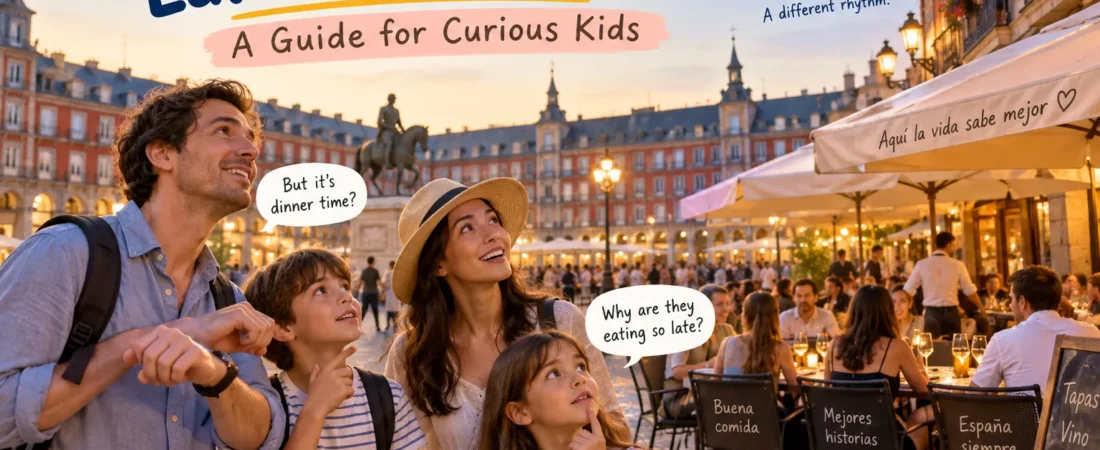
Why do Spanish people eat dinner so late? This is one of the first food-culture questions families may ask when traveling around Spain with kids. Dinner often begins much later than many visitors expect, but the reason involves more than simply preferring to eat late.
Your family spends the afternoon exploring Madrid, Barcelona, Seville or Valencia.
At 6:00 p.m., the kids are hungry.
At 6:30, everyone is ready for dinner.
You find a restaurant that looks perfect.
And then you discover something strange.
The kitchen may not be serving dinner yet.
Your child looks at you.
“But it is dinner time.”
Back home, perhaps it is.
In Spain, the clock around food often works differently.
Spain’s official tourism website says restaurants generally serve lunch from about 1:00 to 4:00 p.m. and dinner from about 8:00 to 11:30 p.m., with later service particularly common in large cities and during summer.
But the interesting question isn’t simply when Spanish people eat.
It is:
Why does the whole day seem to happen later?
The answer involves clocks, sunlight, work and school routines, social life—and a few myths about Spain that are worth correcting.
So the next time your kids ask why nobody seems ready for dinner at 6:30, you can give them a much better answer than:
“That’s just what Spanish people do.”
First: Is Dinner Really That Late?
Compared with many countries, yes.
Spain’s official tourism information describes meals as generally later than in many other countries. Dinner service commonly begins around 8:00 p.m., while eating at 9:00 or 10:00 p.m. does not seem unusual in many settings.
Lunch is later too.
Official tourism guidance gives roughly 1:00–4:00 p.m. for restaurant lunch service, while another Spain tourism guide describes around 1:30–3:30 p.m. as a usual lunch period.
That is the first clue.
Spain does not simply move dinner later. Much of the eating day is shifted.
And between the major meals, there may be smaller ones.
Which brings us to something children may appreciate very much.
Spain Has a Meal That Solves the “But I’m Hungry!” Problem
It is called la merienda.
Merienda is an afternoon snack.
Spain’s official gastronomy material places a typical afternoon snack around 6:00–7:00 p.m., between lunch and the later dinner.
For a child, this suddenly makes Spain’s dinner schedule much more logical.
Imagine:
Lunch: 2:00 p.m.
then:
Merienda: 6:00 p.m.
then:
Dinner: 9:00 p.m.
Now 9:00 p.m. does not mean:
“Nobody fed the children since lunch.”
There is another eating moment in between.
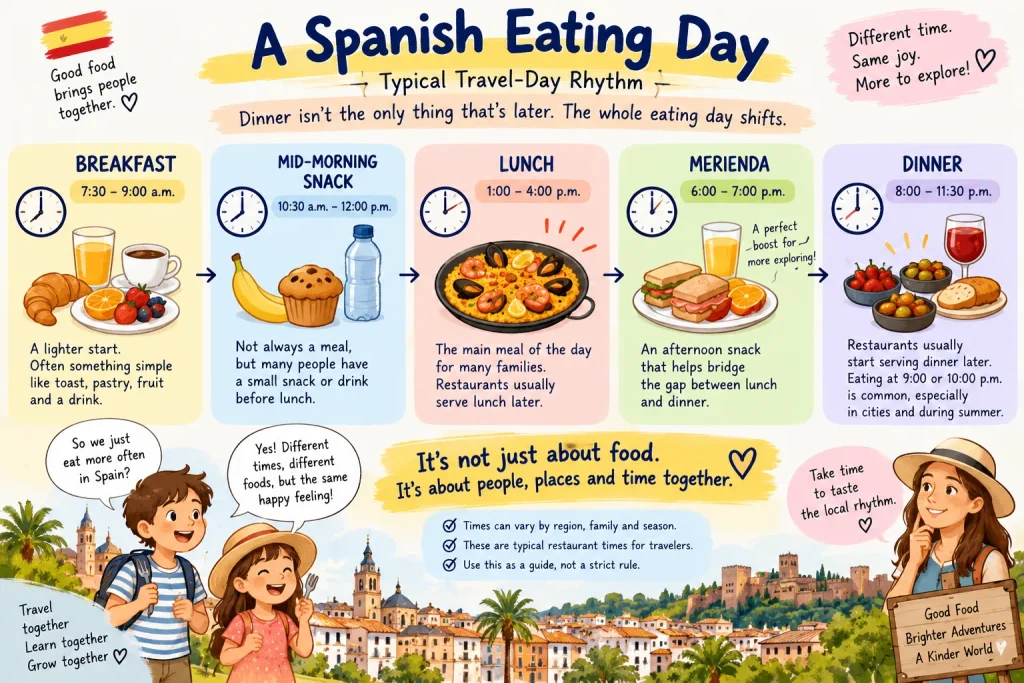
Depending on the family and situation, a merienda might be something simple such as fruit, bread, a sandwich, yogurt, pastries or another snack.
Traveling families do not need to copy a Spanish household exactly.
But understanding the concept can save your evening.
A Family Travel Trick: Don’t Fight the Spanish Clock
Imagine this plan:
5:30 p.m. — Kids hungry
Parents:
“No snacks! We’re having dinner soon.”
6:30 p.m. — Search for restaurant
Kitchen not serving dinner.
7:15 p.m. — Everyone angry
8:00 p.m. — Restaurant finally works
Nobody is enjoying Spain anymore.
There is an easier solution.
Have a merienda.
Then let dinner happen later.
This is one of those moments when understanding local culture can actually make family travel easier.
You do not need to force a tired four-year-old to stay awake until 10:30 p.m.
But you also do not need to organize the entire country around your normal dinner hour.
Adapt somewhere in the middle.
Is This All Because Spanish People Take a Siesta?
This is probably the most common explanation.
It is also far too simple.
The stereotype goes something like this:
Spanish people sleep for hours every afternoon → everything restarts late → therefore dinner happens at 10 p.m.
That is not a good explanation of modern Spain.
Yes, siesta is a real Spanish word and a real cultural practice.
Yes, some people rest after lunch.
Yes, some businesses—particularly in certain places and seasons—may close for part of the afternoon.
Spain’s official tourism information notes that some shops close between roughly 2:00 and 5:00 p.m., especially during summer.
But that does not mean the entire Spanish population goes home and sleeps every afternoon.
Modern work schedules, commuting, schools, large cities, chain stores, tourism and changing lifestyles make everyday life much more complicated than the postcard version of Spain.
So tell the kids:
“Siesta exists. But no, Spain does not stop because everyone is asleep.”
The Clock Gives Us Another Big Clue
Now things get more interesting.
Take a map of Europe.
Find Spain.
Then find countries such as France, Germany and Italy.
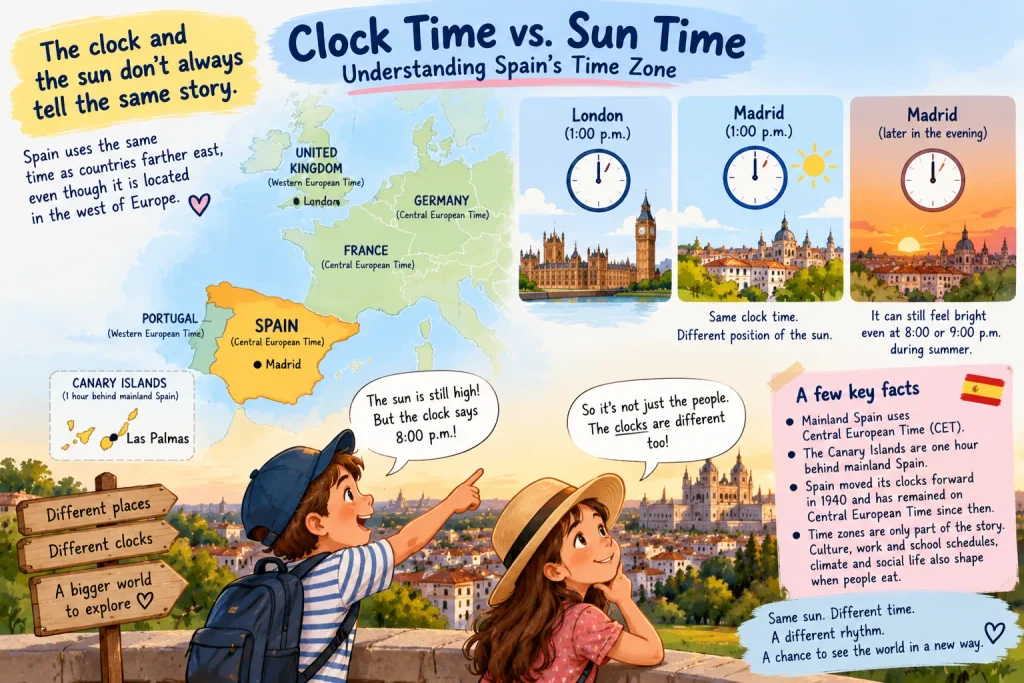
Mainland Spain uses Central European Time, the same standard time zone as countries considerably farther east. The Canary Islands are one hour behind mainland Spain.
Geographically, however, much of Spain lies quite far west.
Madrid is west of London in longitude.
Yet their clocks do not normally show the same time.
That creates an interesting gap between:
what the clock says
and:
where the sun is in the sky.
Clock Time vs. Sun Time
Here is an easy experiment for kids.
Imagine two towns.
In both places, the sun reaches roughly the same position in the sky.
But in Town A the clock says:
12:00
and in Town B it says:
1:00.
Did the sun suddenly become late?
No.
The clocks are labeling the same part of the solar day differently.
This helps explain why simply saying:
“Spanish people eat at 9:00!”
can make the schedule sound more extreme than it feels locally.
Part of Spain’s late-clock lifestyle happens in a country where official clock time is relatively advanced compared with its longitude. Timeanddate notes that Spain’s current Central European time does not closely match its geographic solar time.
But be careful.
This does not mean:
“Spain eats late only because it is in the wrong time zone.”
Human schedules do not work that simply.
Meal times are cultural habits shaped over generations.
Work, school, family life, climate, entertainment, restaurant schedules and social customs all reinforce one another.
The time zone is part of the story, not the entire story.
Why Is Spain in Central European Time?
Now your child may ask:
“If Spain is so far west, why doesn’t it use the same time as Britain?”
For much of the early 20th century, mainland Spain did use Western European Time.
In 1940, during Francisco Franco’s dictatorship, Spain moved its clocks forward to Central European Time and did not subsequently return to its previous standard. Timeanddate’s historical summary likewise notes the 1940 change.
You may encounter a popular explanation saying:
“Franco changed the clocks to match Hitler’s Germany.”
This is often repeated in travel articles.
With children, I would avoid turning a complicated historical decision into one dramatic sentence unless we are prepared to examine the historical documentation behind it.
The important point for this article is simpler:
Mainland Spain’s official clock shifted one hour forward in 1940 and remained aligned with Central European Time afterward.
The Canary Islands, meanwhile, remain one hour behind mainland Spain.
Try the Sun Test During Your Trip
This is something children can actually observe.
One evening, look outside around the time you would normally expect the day to feel “late.”
Ask:
“Does it feel as late as the clock says?”
This works particularly well during periods with long daylight hours.
Do not turn it into a scientific measurement.
Just observe.
Where is the sun?
Are people still outside?
Are children playing?
Are terraces busy?
Does the city feel like it is shutting down?
Or does it still feel very much alive?
Now children begin understanding an important travel lesson:
Clock time does not feel identical everywhere.
Lunch Helps Explain Dinner
If lunch moves later, dinner has room to move later too.
Spain’s official tourism information places the usual restaurant lunch window broadly around 1:00–4:00 p.m.
Compare two hypothetical days.
Family A
Breakfast — 7:00
Lunch — 12:00
Dinner — 6:00
Family B
Breakfast — 8:30
Lunch — 2:30
Merienda — 6:00
Dinner — 9:30
Family B has not simply waited an absurd amount of time for dinner.
The entire sequence moved.
This is why travelers sometimes misunderstand Spanish meal times when they compare only dinner.
You need to look at the whole day.
And Then There Is the Aperitivo
There may be another eating moment before lunch.
Spain’s official tourism information describes meeting for drinks or tapas around 12:00–2:00 p.m. before the main meal as a common social custom.
So a Spanish eating day does not always fit neatly into the simple:
breakfast → lunch → dinner
structure children may expect.
There can be smaller food moments between the big ones.
That does not mean every Spanish person eats five meals every day.
Families differ.
Regions differ.
Weekdays differ from weekends.
Working adults differ from children.
Travelers differ from residents.
But it explains why looking only for three fixed meal times can make Spain feel confusing.
Food Is Also Social Time
There is another reason meal schedules cannot be explained by clocks alone.
In Spain, eating and drinking can be strongly social activities.
Spain’s official tourism portal emphasizes going for tapas and sharing lunch or dinner with friends and family as characteristic social customs.
That changes what a meal can mean.
Dinner is not always simply:
consume calories → finish → go home
It can be part of the evening itself.
Conversation.
Shared dishes.
A walk beforehand.
Meeting friends.
Sitting outside.
Children around.
Dessert.
More conversation.
When a meal is also social time, the schedule around it develops differently.
Why Are Children Still Outside So Late?
This may be the question that surprises visiting families most.
You leave dinner.
It is late.
And there are still children around.
Again, avoid turning this into:
“Spanish children always stay up until midnight.”
They don’t all follow one schedule.
School nights, weekends, summer holidays, age, region and individual households all matter.
But family public life can extend later than visitors from some countries expect, particularly during warm evenings and holidays.
That can make a Spanish plaza at 9:30 p.m. feel very different from a neighborhood where children normally disappear indoors much earlier.
Instead of telling your kids:
“Spanish children don’t have bedtime,”
say:
“Families here may organize the evening differently from us.”
That is both more accurate and more interesting.
Warm Weather Matters—But Don’t Make It the Whole Explanation
Another popular explanation says:
“Spain is hot, so everybody waits until nighttime to do anything.”
Climate does matter.
During hot periods, later evenings can be much more pleasant than the middle of the afternoon.
Outdoor dining, walking and socializing become attractive after temperatures fall.
Spain’s official tourism material also notes that summer schedules can extend later, including restaurant service and entertainment.
But Spain is not one climate.
Galicia is not Seville.
Bilbao is not Córdoba.
January is not August.
So:
hot climate = one influence
not:
hot climate = complete explanation of Spanish meal culture.
Does Everyone in Spain Eat at the Same Time?
Definitely not.
This is worth emphasizing because children—and travel articles—like simple rules.
There are differences between:
- families
- regions
- work schedules
- school schedules
- weekdays
- weekends
- seasons
- cities
- rural areas
- tourist destinations
And restaurant serving hours are not the same thing as the exact time every household eats dinner.
Official tourism guidance gives travelers a useful general range, not a national dinner appointment.
So do not tell children:
“Spanish people eat dinner at 10.”
Tell them:
“Dinner often happens later here than we’re used to.”
That’s the useful observation.
So What Should Families Traveling in Spain Actually Do?
Understanding the history is interesting.
But at 6:45 p.m. with three hungry children, parents need something more practical.
The good news is that you do not need to completely adopt a Spanish household schedule.
You only need to understand the rhythm well enough to stop fighting it.
A useful family strategy is:
normal breakfast → flexible lunch → merienda → later but manageable dinner
That one change can make evenings much easier.
Rule #1: Check When the Kitchen Actually Opens
A restaurant can be open without serving the meal you want.
This is particularly important when searching online.
You may see:
Open
and assume:
Dinner available.
Those are not necessarily the same thing.
A café or bar may remain open between meal periods while its full kitchen operates on a different schedule.
Before taking hungry children across town, check:
- current restaurant hours
- kitchen hours if provided
- whether reservations are accepted
- whether the menu you want is currently served
And if dinner begins later than your family can comfortably manage?
Choose somewhere else.
Understanding Spanish culture does not require creating exhausted children.
Rule #2: Use Merienda Strategically
This may be the easiest cultural habit for traveling families to borrow.
Imagine the kids become hungry around 5:30 or 6:00.
Instead of trying to force an early dinner, stop for a small snack.
Depending on where you are, that could be something as simple as:
- fruit
- yogurt
- bread
- a small sandwich
- pastry
- ice cream
- another light snack
Then continue exploring.
Dinner at 8:00 or 8:30 suddenly becomes much more realistic.
The important word is small.
A giant snack followed by:
“Why aren’t you eating dinner?”
creates a different family-travel problem.
Rule #3: Don’t Turn “Eating Like a Local” into a Competition
Travel advice often says:
Eat like a local.
That’s useful—up to a point.
Your seven-year-old does not receive a cultural authenticity medal for staying awake until 11:30 p.m.
A toddler does not need to prove respect for Spain by eating dinner at 10.
Instead, borrow what works.
Maybe your family:
- eats lunch later
- tries merienda
- moves dinner from 6:00 to 8:00
- enjoys an evening plaza
- returns to the hotel before local nightlife really begins
That is still cultural adaptation.
Family travel works best when local rhythm and children’s rhythm meet somewhere in the middle.
What If Our Kids Normally Eat at 6:00?
Then do not wait until 6:00 to solve the problem.
Plan earlier.
You have several options.
Option 1 — Merienda + Later Dinner
Probably the easiest.
Option 2 — Make Lunch the Big Meal
A substantial Spanish lunch can become the main restaurant experience of the day.
Then dinner can be simpler.
Option 3 — Use Flexible Food Options
Depending on destination and current opening hours, cafés, bakeries, markets, casual food businesses or self-catering accommodation may give families more flexibility than a traditional restaurant dinner.
Option 4 — Eat Early Where Early Dinner Is Available
Tourist-heavy areas may have restaurants serving continuously or earlier than traditional Spanish dinner hours.
There is nothing wrong with using them when they fit the family.
The goal is not to win Spain.
The goal is to enjoy it.
Lunch May Be the Better Family Restaurant Meal
This is worth considering seriously.
Parents sometimes save the “nice restaurant” for dinner because that is what they normally do at home.
In Spain, lunch can be an excellent opportunity for the family’s larger meal.
Children are awake.
Parents are less exhausted.
Restaurant kitchens are operating.
You still have time afterward.
And if the children become tired in the evening, you have already had the day’s major food experience.
For some families, this rhythm works beautifully:
big lunch → afternoon exploration/rest → merienda → simple dinner
Try it before assuming every special meal belongs at night.
What About Tapas with Kids?
Tapas can actually work well for families because they allow children to try small amounts of different foods.
But the word tapas does not describe one universal restaurant format across Spain.
Customs, portion sizes, ordering styles and local terminology vary by region and establishment.
So instead of teaching children:
“This is how tapas works in Spain.”
teach:
“Different parts of Spain have different ways of eating small dishes and sharing food.”
That opens the door to another important travel lesson:
Spain has national traditions, but it also has very strong regional food cultures.
Pintxos Are a Great Example
Travel to San Sebastián or elsewhere in the Basque Country and children may start seeing something different.
Pintxos.
They are strongly associated with Basque food culture and bar-going traditions.
Some may sit beautifully arranged on counters.
Others are ordered.
Styles vary.
Instead of reducing them to:
“Basque tapas”
tell children:
“They belong to a different regional food tradition.”
Our San Sebastián Pintxos Guide can help families understand how the experience works rather than assuming every small Spanish dish follows the same rules.
Why Do Spanish Restaurants Sometimes Feel Empty When We’re Hungry?
This is one of my favorite travel observations for kids.
Your family arrives at 7:30.
Tables everywhere.
Almost nobody eating.
Your child says:
“This restaurant isn’t popular.”
Wait.
Come back later mentally—or literally.
The room may look completely different.
This is a wonderful way to demonstrate that travelers often judge places according to their own clock.
The restaurant was not necessarily empty.
You may simply have arrived before its evening had begun.
Try the Restaurant Time Experiment
This is a simple activity for older children.
During one Spain travel day, notice the same restaurant area at two different times.
For example:
7:00 p.m.
and:
9:00 p.m.
Do not photograph individual diners unnecessarily.
Just observe the street.
Ask:
- How many tables are occupied?
- Are families around?
- Are shops still open?
- Does the plaza feel different?
- When does the evening seem busiest?
You are turning cultural observation into evidence.
Instead of telling children:
“Spain eats late.”
they discover:
“Oh. Now I see what you mean.”
Spanish Meal-Time Challenge for Kids
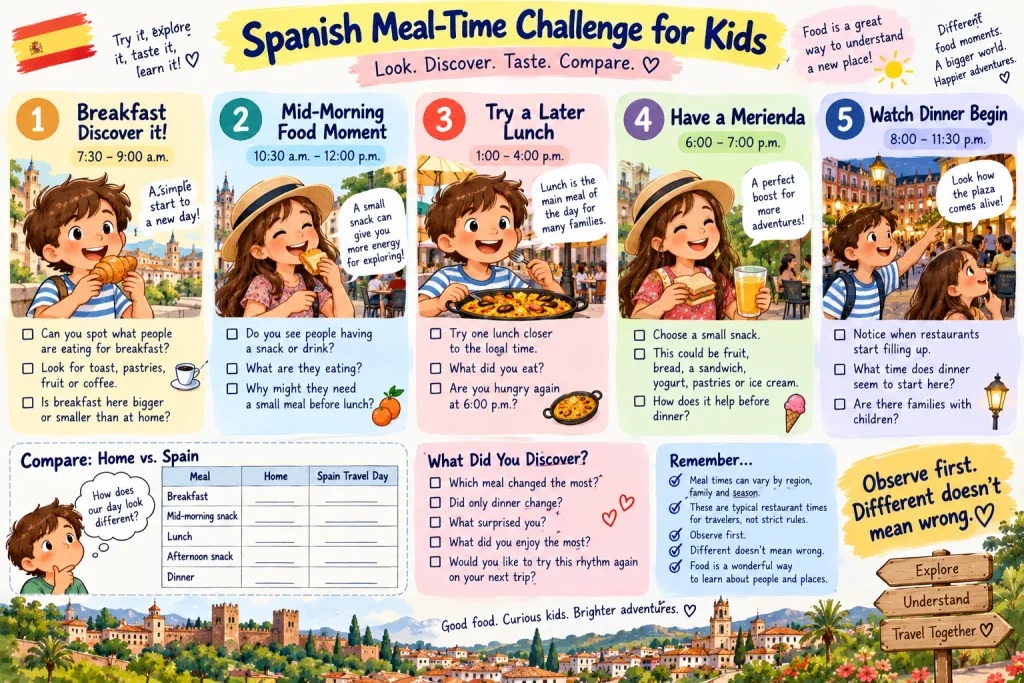
Now turn the entire day into a travel game.
The goal is not to force children to eat five times.
The goal is to notice how food fits into Spanish daily life.
Mission 1 — Breakfast
Find out what people around you are eating in the morning.
Can you spot:
- toast
- pastries
- fruit
- coffee for adults
- other regional or local breakfast foods?
Ask:
“Is breakfast here bigger or smaller than ours?”
There is no single Spanish breakfast, so observe rather than declaring a national rule.
Mission 2 — Find a Mid-Morning Food Moment
Depending on where you are and who you are observing, you may notice people having a snack or drink between breakfast and lunch.
Ask:
“Why might somebody need another small meal before a 2:00 p.m. lunch?”
Now the daily rhythm starts making sense.
Mission 3 — Eat One Later Lunch
You do not need to do this every day.
Try one lunch closer to the local restaurant rhythm.
Then ask the kids:
“Are you hungry again at 6:00?”
Probably.
Excellent.
That leads to Mission 4.
Mission 4 — Have a Merienda
This is likely to be the children’s favorite research assignment.
Choose something small.
Then explain:
“This snack helps connect a later lunch with a later dinner.”
Suddenly culture tastes pretty good.
Mission 5 — Watch Dinner Begin
You do not even need to eat late.
Simply walk through a restaurant area and notice when the evening dining atmosphere begins changing.
Ask:
“When does dinner time seem to start here?”
Your child has now conducted a tiny piece of travel anthropology.
A Clock Challenge: Spain vs. Home
Older children can take the experiment one step further.
Write down:
| Meal | Home | Spain Travel Day |
|---|---|---|
| Breakfast | ___ | ___ |
| Lunch | ___ | ___ |
| Afternoon snack | ___ | ___ |
| Dinner | ___ | ___ |
Then ask:
“Which meal changed the most?”
Probably dinner.
Then:
“Did only dinner change?”
Now they may notice the real answer.
The entire day’s rhythm shifted.
What About Schoolchildren in Spain?
This is where we should avoid overgeneralizing.
School schedules differ according to:
- region
- school
- age
- whether the school uses a continuous or split timetable
- extracurricular activities
- family routine
So there is no useful national schedule saying:
“All Spanish children eat lunch at exactly X and dinner at exactly Y.”
Some children eat lunch through school services.
Others eat at home.
Family schedules differ.
The useful travel takeaway remains:
Spanish meal culture generally runs later than many visiting families expect, but individual Spanish families are not identical.
Do Spanish People Sleep Less Because Dinner Is Later?
Not necessarily, and this is another place where the clock can fool us.
A later dinner does not automatically mean every Spanish person sleeps fewer hours.
Sleep schedules depend on work, school, age, family habits and many other factors.
There has been substantial public discussion in Spain about working hours, time zones, prime-time television, sleep and work-life balance.
But those debates are much more complicated than:
late dinner = nobody sleeps
For children, keep it simple:
“When a whole daily schedule shifts, you can’t understand bedtime by looking at dinner alone.”
Why Doesn’t Spain Just Change Its Time Zone?
People have proposed changes.
Spain’s time zone and daily schedules have been discussed politically and socially for years.
But changing the number displayed on clocks would not instantly move:
- school
- work
- television
- restaurants
- family habits
- social life
by exactly the same amount.
Culture develops habits around clock time.
Once millions of people’s schedules connect with one another, changing them becomes complicated.
Ask older kids:
“What would happen if tomorrow every school and business in our country changed its schedule by one hour?”
Now time zones stop being abstract.
Is Late Dinner Healthy or Unhealthy?
This is not a question I would answer with:
“Spanish dinner times are healthy.”
or:
“Eating at 10 p.m. is unhealthy.”
Health research around meal timing involves factors such as:
- sleep
- individual schedules
- total diet
- metabolic health
- meal size
- consistency
- timing relative to sleep
and the evidence cannot be reduced to judging an entire country’s culture from one clock time.
For a family travel guide, the practical priority is simpler:
keep children adequately fed, hydrated and rested while adapting sensibly to the destination.
This article is explaining Spanish travel culture—not prescribing a medical meal schedule.
Does Dinner Time Change by Season?
It can.
Daily life does not look identical in January and August.
Summer can bring:
- longer daylight
- warmer evenings
- later outdoor activity
- holidays
- seasonal restaurant schedules
- more evening social life in many destinations
But again, avoid:
“Spain eats at X in winter and Y in summer.”
There is too much variation.
Instead, check the actual destination and establishment.
Madrid Is Not Seville, and Seville Is Not San Sebastián
This may be the most important sentence after:
Spain eats late.
Spain is regionally diverse.
Climate differs.
Food differs.
Languages differ.
Local customs differ.
Tourism patterns differ.
City life differs.
So when children start noticing differences, encourage them.
“Did dinner feel the same in Barcelona and San Sebastián?”
“Did the food look the same?”
“Did people use the same words?”
Travel becomes much more interesting when children stop looking for the Spanish way and begin noticing different ways within Spain.
What Kids Can Learn from One Late Dinner
This whole article began with a hungry child outside a restaurant.
But the lesson is bigger than food.
Travel constantly creates moments when children think:
“That’s weird.”
Instead of correcting them immediately, try:
“It’s different from what we’re used to. Why do you think they do it this way?”
Then investigate.
Maybe there is a historical reason.
Maybe geography matters.
Maybe climate matters.
Maybe religion mattered once.
Maybe technology changed something.
Maybe nobody knows one simple answer.
That is one of the best things travel can teach children:
normal is often local.
Common Mistakes Families Make with Spanish Meal Times
1. Waiting Until the Kids Are Starving to Look for Dinner
Check kitchen times earlier.
2. Assuming “Open” Means “Serving Dinner”
It may not.
3. Skipping Merienda Because Dinner Is “Soon”
Spanish soon may be later than your family’s soon.
4. Forcing Children to Eat Extremely Late for Authenticity
Adapt intelligently.
5. Blaming Everything on Siesta
Modern Spanish schedules are much more complicated.
6. Explaining Everything with the Time Zone
It matters, but it is not the whole story.
7. Assuming Every Spanish Family Eats at 10 p.m.
They don’t.
8. Assuming Tapas Work the Same Everywhere
Regional food cultures matter.
9. Saving Every Important Restaurant Meal for Dinner
Lunch may work better with children.
10. Treating Different as Wrong
The point of travel is partly discovering that your family’s schedule is not the world’s schedule.
FAQ: Why Do Spanish People Eat Dinner So Late?
Why do people in Spain eat dinner so late?
There is no single cause.
Spain’s later meal rhythm reflects a combination of cultural habits, later lunch times, social routines, climate and evening life, while mainland Spain’s official time zone is also relatively advanced compared with much of its geographic longitude.
What time do people eat dinner in Spain?
Spain’s official tourism information describes restaurant dinner service as generally running from around 8:00 p.m. to 11:30 p.m., although actual household and restaurant meal times vary.
What time is lunch in Spain?
Restaurant lunch service is generally later than in many countries, broadly around 1:00–4:00 p.m. according to Spain’s official tourism guidance.
Individual schedules vary.
What is merienda in Spain?
Merienda is an afternoon snack between lunch and dinner.
For traveling families, it can be particularly useful because Spanish dinner often begins later than children from other countries expect.
Do Spanish people eat late because of siesta?
Siesta is part of Spanish cultural history and remains a real practice for some people, but it does not explain modern Spanish meal times by itself.
Work patterns, cultural habits, the timing of lunch, social life, climate and clock time all contribute.
Is Spain in the wrong time zone?
“Wrong” is an oversimplification.
Mainland Spain uses Central European Time even though much of the country lies geographically far west within that zone.
Spain shifted its standard clock forward in 1940 and remained aligned with Central European Time afterward.
Do children in Spain eat dinner late too?
Many Spanish families may eat later than families in some other countries, but there is no single schedule followed by every child.
Age, school, household, region, weekday, weekend and season all affect family routines.
Should families visiting Spain eat dinner at 10 p.m.?
Not necessarily.
Families can adapt by eating a substantial lunch, having a merienda, choosing restaurants with earlier service or moving dinner somewhat later without forcing young children into an unsuitable schedule.
Final Thoughts: Your Clock Is Traveling Too
At first, Spain’s meal times can feel inconvenient.
The children are hungry.
The restaurant is quiet.
The kitchen is not ready.
And the clock clearly says:
Dinner.
But after a few days, something interesting may happen.
Lunch moves.
You discover merienda.
The plaza fills later.
The evening lasts longer.
And 8:30 does not feel quite as strange as it did on the first night.
That is when children begin learning something much bigger than Spanish restaurant hours.
Time is cultural.
The clock gives us a number.
Society decides what people usually do when that number appears.
In one country:
6:00 p.m. = dinner.
Somewhere else:
6:00 p.m. = snack, walk, playground, shopping, still not dinner.
Neither clock is wrong.
The routines are different.
So when your child stands outside a Spanish restaurant and asks:
“Why aren’t they eating dinner yet?”
you now have an answer.
Not:
“Because Spain is weird.”
Not:
“Because everyone took a siesta.”
But:
“Because the whole day works a little later here. Let’s get a merienda and watch what happens.”
Then let Spain show them.
Because sometimes the best way for children to understand another culture is not through a museum label or history book.
Sometimes it starts because they got hungry at the wrong time.
Continue Exploring Spain with Kids
Spain Family Travel Tips Before You Go
Our Spain Family Travel Tips Before You Go guide can help you prepare for everyday differences—from schedules and transportation to family routines—before they become surprises during the trip.
Spanish Food and Family Travel
Explore our Spain food guides to help children discover regional dishes, markets and eating traditions without assuming there is only one way to eat across the country.
Why Are There So Many Castles in Spain?
If your children keep asking “why?” as you travel, read Why Are There So Many Castles in Spain? A Story of Kingdoms, Borders and Battles for Kids and turn the next fortress on the horizon into another question worth investigating.