
Planning ten days in Spain with children sounds easy at first.
Barcelona.
Madrid.
Seville.
Granada.
Valencia.
Maybe Toledo.
Maybe Segovia.
Perhaps squeeze in Córdoba too.
And suddenly your ten-day family vacation contains seven cities, six hotels and a suspicious amount of time dragging suitcases through railway stations.
Spain makes overplanning especially tempting because there are so many places worth visiting.
But a good Spain with kids itinerary is not the itinerary that covers the most cities.
It is the one where the family still has enough energy to enjoy Day 10.
For a first 10-day family trip to Spain, I would build the journey around just two hotel bases:
Barcelona — 4 nights
Madrid — 5 nights
Then use Madrid for carefully chosen day trips to Toledo and Segovia.
That gives your family four dramatically different Spanish experiences without changing hotels every two days:
Barcelona — Gaudí + Mediterranean + beach
Madrid — royal history + museums + parks + football
Toledo — medieval Spain + Three Cultures
Segovia — Roman engineering + fairytale castle
The result is not the itinerary with the greatest number of pins on Google Maps.
It is a trip families can actually enjoy.
10-Day Spain Family Itinerary at a Glance
| Day | Base | Main Plan | Family Travel Style |
|---|---|---|---|
| Day 1 | Barcelona | Arrival + easy neighborhood evening | Recover |
| Day 2 | Barcelona | Sagrada Família + historic Barcelona | Iconic sights |
| Day 3 | Barcelona | Park Güell + Gràcia + beach | Gaudí + outdoors |
| Day 4 | Barcelona | Montjuïc + family choice | Flexible day |
| Day 5 | Madrid | Train to Madrid + easy evening | Transfer day |
| Day 6 | Madrid | Royal Palace + historic center | Royal Madrid |
| Day 7 | Madrid | Prado/Reina Sofía + Retiro | Culture + park |
| Day 8 | Madrid | Toledo day trip | Medieval Spain |
| Day 9 | Madrid | Segovia day trip | Romans + castle |
| Day 10 | Madrid | Football / shopping / park + departure | Family choice |
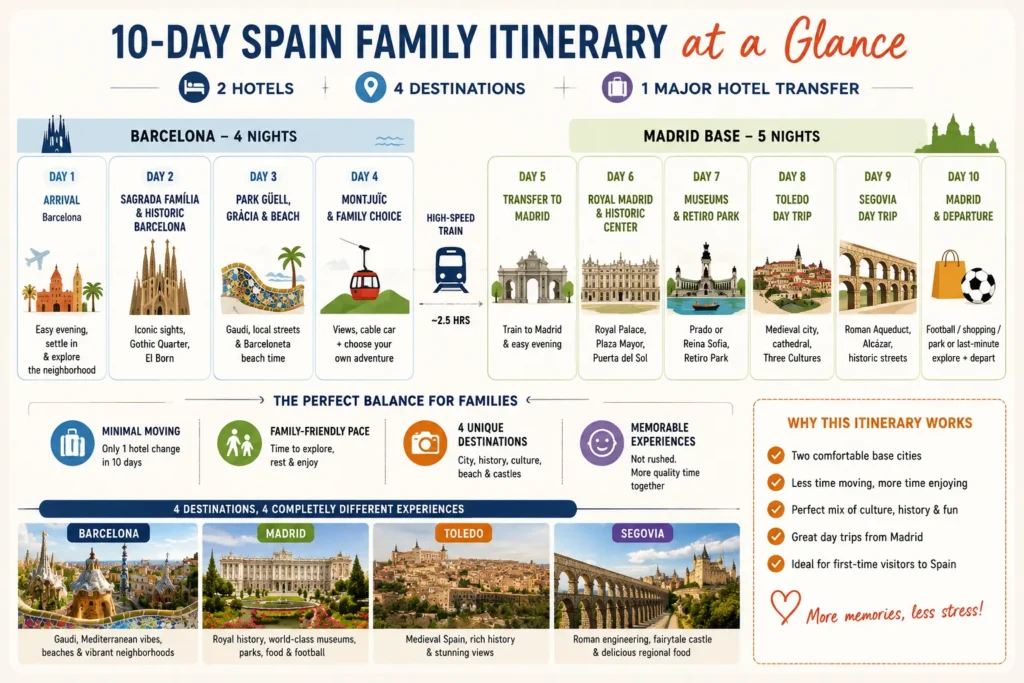
Hotel Changes
Only one.
Barcelona → Madrid.
That is intentional.
Why I Would Not Visit 5 or 6 Cities in 10 Days With Kids
Spain’s high-speed trains make ambitious itineraries look deceptively easy.
Barcelona to Madrid?
Fast.
Madrid to Seville?
Fast.
Madrid to Valencia?
Fast.
So why not keep moving?
Because train time is only one part of a family transfer day.
Changing cities means:
packing everyone’s luggage,
checking under beds for forgotten chargers,
checking out,
getting to the station,
arriving early enough for the train,
boarding with bags,
traveling,
leaving the next station,
getting to the new accommodation,
waiting for check-in if necessary,
unpacking,
and helping everyone adjust to another unfamiliar neighborhood.
A two-and-a-half-hour train ride can easily consume much of the useful middle of the day.
Do that four times and you have sacrificed a substantial portion of the vacation to logistics.
Children Experience Transfers Differently
Adults often see transportation as part of travel.
Children may experience it as:
the day when nothing happened.
That is why I would rather give a family:
4 excellent nights in Barcelona
than:
2 nights Barcelona + 1 night Valencia + 1 night somewhere else.
There will always be another Spanish city worth seeing.
There will not always be another Day 7 when everyone is still happy to put on their shoes.
Why Barcelona + Madrid Works So Well
These two cities complement each other unusually well.
Barcelona gives the trip an immediate visual impact.
Gaudí architecture.
Mediterranean light.
Beach.
Montjuïc.
Color.
Madrid then changes the mood.
Royal history.
Major museums.
Retiro Park.
Football.
Castilian food.
And access to Central Spain.
The family does not simply visit two large Spanish cities.
The second half of the trip feels different from the first.
And Madrid Gives You Two More Cities Without More Hotels
This is the key.
From Madrid, families can make separate day trips to:
Toledo
and
Segovia.
So the trip effectively contains:
Barcelona,
Madrid,
Toledo,
and Segovia
while the family sleeps in only two accommodations.
For me, that is the sweet spot for a first 10-day Spain family trip.
Day 1 — Arrive in Barcelona and Do Less Than You Think
The first day of an international family trip is not a normal sightseeing day.
Flights are delayed.
Children sleep badly.
Parents sleep badly.
Luggage takes time.
Airport transportation takes time.
Rooms may not be ready.
Someone will probably be hungry at an inconvenient moment.
So I would deliberately not book an expensive timed attraction on arrival day.
A Better Arrival Day
Check in.
Unpack enough to make the room functional.
Find food.
Walk around the neighborhood.
Buy water and anything the family forgot.
If everyone still has energy, explore somewhere nearby.
Then stop.
Why This Matters
Suppose you book Sagrada Família for 16:00 on arrival day.
Your flight is delayed by 90 minutes.
Now the entire first day becomes a race against a ticket reservation.
That is the opposite of how I want a family vacation to begin.
Sagrada Família will still be there tomorrow.
Day 1 Goal
The goal is not:
See Barcelona.
The goal is:
Arrive in Barcelona without exhausting the family.
That is enough.
Day 2 — Sagrada Família + Historic Barcelona
Now the trip properly begins.
Make the Sagrada Família the major reservation of the morning.
If your family visits only one paid architectural attraction in Barcelona, this is the one I would prioritize.
Morning — Sagrada Família
Allow roughly 1–1.5 hours for the main visit for many families.
Do not try to turn children into Gaudí scholars before entering.
Instead, ask them to look.
What do the columns resemble?
Where is the colored light coming from?
Why does the interior feel different from other churches?
Children often respond better to discovery than explanation.
Lunch — Stay Reasonably Close
Do not cross Barcelona because an influencer said the city’s third-best sandwich is in another neighborhood.
Find somewhere that works.
Sit down.
Eat.
The itinerary still has eight days after this one.
Early Afternoon — Break
This is particularly important in summer.
Return to the accommodation if practical.
Or find somewhere easy to sit.
A break is not wasted Barcelona time.
It is what allows the family to enjoy Barcelona later.
Late Afternoon — Gothic Quarter + El Born
This is the part of the day I would leave relatively unstructured.
Walk through the Gothic Quarter.
Continue toward El Born if everyone is enjoying it.
Stop when something looks interesting.
Food.
Shops.
Historic streets.
A plaza.
Street life.
Do not convert every historic building into another admission ticket.
Evening
Dinner.
Walk.
Then stop when the family is ready.
Barcelona does not need to be completed on Day 2.
Day 3 — Park Güell + Gràcia + Mediterranean Beach
Day 3 deliberately feels different.
Less indoor sightseeing.
More space.
More flexibility.
Morning — Park Güell
During warmer months, morning is particularly useful.
Park Güell provides another Gaudí experience without feeling like another museum.
Children get:
mosaics,
views,
strange architectural forms,
paths,
and outdoor space.
But remember:
Park Güell is hilly.
Families with strollers or younger children should think about the route to the entrance rather than simply looking at the distance on a map.
Lunch — Gràcia
Stay in the area.
This is a simple itinerary trick that saves enormous amounts of unnecessary transportation.
If you are already near Gràcia, eat there.
Explore a little.
Do not automatically cross the city after every attraction.
Early Afternoon — Reset
Return to the hotel.
Rest.
Or simply choose something that requires very little effort.
This is particularly valuable in July and August.
Late Afternoon — Barceloneta
Now give the children something completely different.
Beach.
Sand.
Mediterranean Sea.
No architecture explanation required.
Barcelona is not necessarily Spain’s ultimate beach destination.
But as a city-break family reset, the beach is extraordinarily useful.
Don’t Put a One-Hour Limit on the Beach
If everyone is enjoying it, stay.
If it is overcrowded or conditions are poor, leave.
This is why the beach belongs late in the day rather than squeezed between two reservations.
It gives the itinerary room to change.
Day 4 — Montjuïc + Let the Family Choose
By Day 4, parents usually know something they did not know while planning at home:
what their children actually enjoy in Barcelona.
Use that information.
This is why I would deliberately keep part of Day 4 flexible.
Morning — Montjuïc
Montjuïc gives families:
views,
gardens,
historic sites,
museums,
open space,
and one experience many children particularly enjoy:
the cable car.
Adults may think of cable cars as transportation.
Children often think of them as attractions.
Let them.
Don’t Try to Complete Montjuïc
Choose what fits.
For example:
Cable car + views + outdoor time
or
museum + gardens
or
castle + cable car
You do not need everything.
Afternoon — Family Choice
This is where the itinerary branches.
Option 1 — Football
For a football-loving family, use the afternoon for the current FC Barcelona visitor experience.
Because the stadium situation and visitor access have changed during redevelopment, check current official information for your dates rather than relying on an old travel guide.
Option 2 — Casa Batlló
Best for families who want another major Gaudí interior.
Option 3 — More Beach
Absolutely valid.
Option 4 — Tibidabo
Best for families whose children would value rides and amusement-park time more than another cultural attraction.
Option 5 — Nothing Major
Shopping.
Park.
Food.
Neighborhood wandering.
That is also a legitimate Day 4.
Barcelona: What I Would NOT Add to These Four Days
This is where restraint becomes important.
Could you add:
another Gaudí house?
another museum?
another market?
another neighborhood?
another famous restaurant?
Of course.
But the itinerary already contains:
Sagrada Família,
historic Barcelona,
Park Güell,
Gràcia,
the beach,
Montjuïc,
and one family-selected experience.
That is enough to understand why Barcelona is special.
Families wanting much more detail can use our Barcelona with Kids family travel guide for attractions, neighborhoods, food, accommodation and a complete city strategy.
Day 5 — Barcelona to Madrid: Treat It as a Transfer Day
This is the only day in the entire itinerary when the family changes hotels.
That makes it important.
Do not ruin the benefit by trying to turn Day 5 into two full sightseeing days.
Morning — Leave Barcelona Without Rushing
Breakfast.
Pack.
Check the room.
Make sure nobody left:
chargers,
passports,
favorite stuffed animals,
or half the family’s clothes in a drawer.
Then head to the station.
Barcelona to Madrid by High-Speed Train
High-speed rail makes Barcelona and Madrid one of the easiest major-city combinations in Spain.
For families, train travel has several advantages over flying this route.
City-center stations.
No airport-style journey far outside both cities.
More space to move.
No baggage carousel at the destination.
And the journey itself becomes part of the European travel experience.
Always check current schedules, fares and baggage conditions with the rail operator when booking.
Where Should You Sit?
If seat selection is available, keeping the family together is obviously useful.
For younger children, having:
snacks,
water,
something quiet to do,
headphones,
and easy access to whatever they inevitably ask for after the train starts moving
makes the journey easier.
Do not pack the children’s entertainment at the bottom of the largest suitcase.
That lesson only needs to be learned once.
Arriving in Madrid
Check in.
Then resist the urge to compensate for the “lost” transfer time by immediately attacking Madrid’s attraction list.
Walk around the neighborhood.
Eat.
Maybe visit Puerta del Sol or Gran Vía if they are convenient.
Let Madrid introduce itself.
Tomorrow is the real sightseeing day.
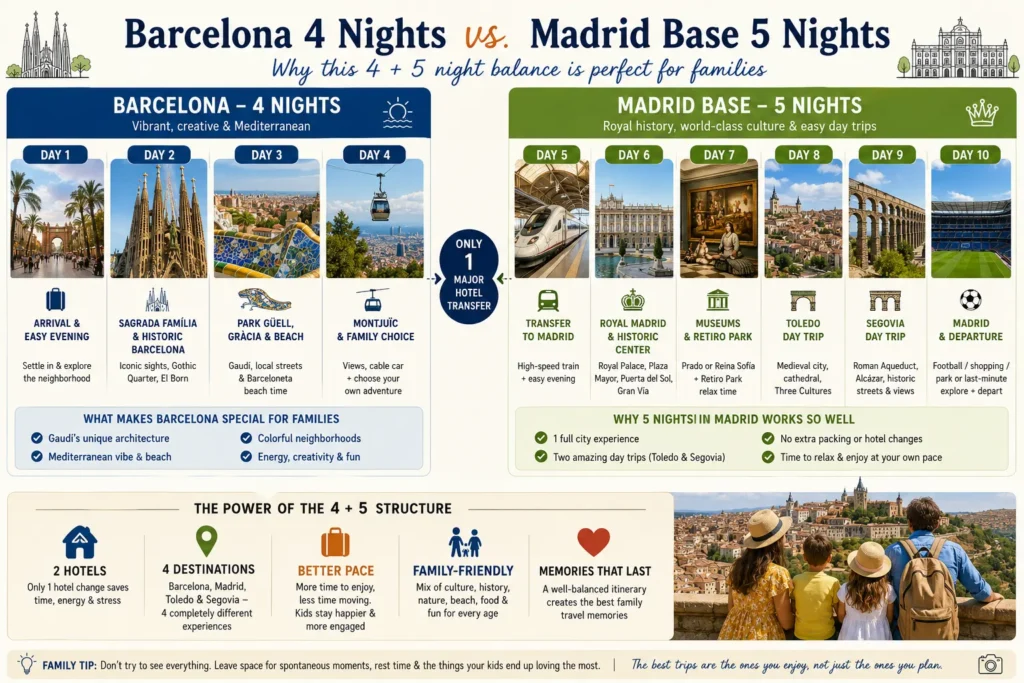
Why Madrid Gets Five Nights
Barcelona gets four nights.
Madrid gets five.
Not because Madrid necessarily requires more city sightseeing.
Because Madrid is doing two jobs:
destination
and
base.
Those five nights allow the family to experience Madrid properly while also making day trips to Toledo and Segovia.
That is what keeps the entire 10-day itinerary from becoming a hotel-changing marathon.
Day 6 — Royal Madrid + Historic Center
The first full Madrid day begins with something children can understand immediately:
a palace.
Morning — Royal Palace of Madrid
The Royal Palace is one of my preferred major Madrid attractions for families because its story is tangible.
Royal rooms.
Ceremonial spaces.
Decorated ceilings.
History.
Children can imagine people living and working there.
For many families, around 1.5–2 hours is enough.
Leave while everyone is still interested.
Late Morning — Plaza de Oriente
Get outside.
Walk.
Take photographs.
Let the family reset before lunch.
Lunch
Stay central.
Madrid has plenty of options without turning lunch into another cross-city expedition.
Afternoon — Plaza Mayor + Puerta del Sol
Now explore historic central Madrid without another major timed ticket.
Plaza Mayor.
A calamari sandwich if the family wants to try one.
Puerta del Sol.
The Bear and the Strawberry Tree statue.
Shops.
Streets.
Food.
Evening — Gran Vía
Madrid evenings are part of the experience.
Walk Gran Vía.
Shop.
Eat.
Let older children experience a capital city that remains active long after the formal attractions close.
Day 7 — One Museum + Retiro Park
Madrid has extraordinary museums.
That does not mean children need all of them.
My rule for Day 7 is simple:
choose one.
Option 1 — Prado Museum
Best for families interested in:
Velázquez,
Goya,
classical European art,
and one of the world’s great museum collections.
With children, do not try to “do the Prado.”
Choose a handful of works.
Make the visit focused.
For many families, 60–90 minutes can be far more successful than a three-hour museum marathon.
Option 2 — Reina Sofía
This can work particularly well with older children and teenagers interested in:
modern art,
Picasso,
20th-century Spanish history,
and the story surrounding Guernica.
Again:
one focused museum experience.
Lunch
Sit down.
Because the afternoon is intentionally different.
Afternoon — Retiro Park
This is Madrid’s family reset.
After a museum:
go outside.
Walk.
Sit.
Spend time around the lake.
Let children move.
If boating is available and everyone wants to do it, consider it.
Or do absolutely nothing ambitious.
That contrast is what makes the day work.
Seven Days In: Check the Family, Not the Checklist
At this point the family has experienced:
Barcelona,
Gaudí,
the Mediterranean,
Madrid,
royal history,
art,
and parks.
Before the two Central Spain day trips begin, ask a simple question:
How is everyone doing?
If the children are exhausted, the answer is not necessarily:
push harder because Toledo is already on the spreadsheet.
Day trips can be adjusted.
Plans can change.
A family itinerary should provide structure.
It should not become a contract.
Day 8 — Toledo: Medieval Spain Without Changing Hotels
Day 8 is where the logic behind using Madrid as a base really pays off.
The family wakes up in the same hotel.
No suitcases.
No checkout.
No new accommodation address.
Instead, take only what you need for the day and travel to a city that feels completely different from Madrid.
Toledo.
Toledo rises above the Tagus River with narrow medieval streets, a massive cathedral, a fortress, historic synagogues, sword shops and viewpoints that reveal the entire hilltop city.
For children, the transition can feel dramatic.
Yesterday:
Madrid.
Today:
medieval Spain.
Tonight:
back to the same bed.
That is exactly why Toledo belongs in this itinerary.
Morning — Madrid to Toledo
Fast trains make Toledo an easy day trip from Madrid, with the rail journey itself typically taking roughly half an hour depending on the service.
But remember:
train time is not door-to-door time.
The family still needs to reach the Madrid departure station and then travel from Toledo’s railway station toward the historic center.
Toledo is built on a hill.
Saving children’s legs at the beginning of the day can be a very good decision.
First Major Attraction — Choose Cathedral or Alcázar
Do not automatically begin by purchasing tickets to everything.
Choose according to your children.
Toledo Cathedral
Best for families interested in:
architecture,
religious history,
art,
and monumental medieval interiors.
Alcázar of Toledo
Potentially more immediately appealing to children interested in:
fortresses,
armor,
military history,
and castles.
If everyone is enthusiastic and you have enough time, visit both.
But you do not need both for Toledo to feel worthwhile.
Late Morning — Let Toledo Become the Attraction
Walk.
This is important.
Toledo should not become:
cathedral → museum → synagogue → church → museum.
Its streets are part of the experience.
Let children notice:
swords,
stone buildings,
tiny alleys,
old doors,
views,
and architectural details.
Toledo’s history becomes much easier to understand when the family experiences the city rather than simply entering its monuments.
Lunch — Stop Properly
Toledo is not a good place to skip lunch so you can squeeze in another attraction.
The hills will win.
Sit down.
Drink.
Try something regional if the family is interested.
And afterward, look for one of Toledo’s most famous specialties:
mazapán — marzipan.
Almonds and sugar may provide a much easier introduction to Toledo’s culinary history than a complicated traditional dish.
Afternoon — Jewish Quarter
Spend part of the afternoon in Toledo’s historic Jewish Quarter.
This is where the city’s famous Three Cultures story becomes much more tangible.
Christian.
Muslim.
Jewish.
Different communities and political eras left layers throughout the city.
With older children and teenagers, this can become one of the most educational parts of the entire Spain trip.
With younger children, keep the explanation simple:
Different groups of people lived here over hundreds of years, and each left something behind.
Late Afternoon — Mirador del Valle
If family energy and logistics allow, finish with Toledo’s classic panorama.
From across the Tagus, children can see:
the Alcázar,
the cathedral,
the historic center,
the river,
and the hill they have spent the day exploring.
It is one of those viewpoints that explains the geography of a city immediately.
Think about transportation rather than assuming the viewpoint belongs conveniently on a walking loop.
Evening — Return to Madrid
Return to Toledo station with enough time for the train.
Then go back to Madrid.
Same hotel.
No luggage.
No check-in.
No unpacking.
Tomorrow, do it again in a completely different direction.
Families wanting the detailed version can use our Toledo with Kids family travel guide, including walking strategy, elevation, food and a realistic day-trip route.
Day 9 — Segovia: Romans, a Castle and a Completely Different Story
Toledo gives children medieval complexity.
Segovia gives them enormous visual hooks.
A Roman aqueduct.
A Gothic cathedral.
A castle on a rocky promontory.
For many school-age children, Segovia may be one of the easiest historic cities in Spain to understand.
Morning — Madrid to Segovia
Fast trains connect Madrid with Segovia-Guiomar.
Again, do not confuse rail time with total journey time.
Segovia-Guiomar is outside the historic center.
After arriving, families need a local bus, taxi or another current transport option to reach the main sightseeing area.
For a first visit, I would begin around the Roman Aqueduct.
First Stop — Roman Aqueduct
This is one of those rare historical monuments that requires almost no introduction.
It is enormous.
It stands directly above the modern city.
And the visible monumental section was built from granite blocks fitted together without mortar.
Ask children:
How is that still standing?
Now Roman engineering becomes interesting before anyone has read an information panel.
Allow time to walk around and underneath the aqueduct rather than taking one photograph and immediately leaving.
Late Morning — Walk Through Old Segovia
From the aqueduct, move through the historic streets toward Plaza Mayor.
Do not rush.
The route itself is part of the experience.
Segovia works particularly well because its major sights form a relatively natural progression through the city.
Plaza Mayor + Cathedral Decision
Reach Plaza Mayor and stop.
Then decide whether your family wants to enter Segovia Cathedral.
If everyone still loves monumental churches:
go.
If the children have reached cathedral saturation:
enjoy the exterior.
The Alcázar is still ahead.
Saving energy for the attraction children care about most is not bad sightseeing.
It is good family planning.
Lunch — Make Segovia’s Food Part of the Day
Segovia is famous for cochinillo asado, roast suckling pig.
Families interested in regional food may want to make this the day’s main meal.
Another regional specialty is judiones, large white beans traditionally associated with nearby La Granja.
And for dessert:
Ponche Segoviano.
A proper lunch also gives everyone a substantial break before the castle.
Afternoon — Alcázar of Segovia
For many children, this will be the highlight.
The Alcázar stands dramatically above the surrounding valleys and looks much closer to the castle children imagine when hearing the word “castle” than many historic fortresses do.
Royal rooms.
Armor.
Towers.
Views.
History.
Give it time.
If tower access is available and everyone still has enough energy, decide whether the climb makes sense.
Do not climb because a guide said you must.
Look at your children.
Then look at the stairs.
Decide in that order.
Late Afternoon — One Last Choice
If everyone still has energy, consider heading toward Pradera de San Marcos for a dramatic exterior view back toward the Alcázar.
If not:
walk slowly back through the historic center.
Get something to eat.
Shop.
Sit down.
Or simply start the return journey.
The family does not receive extra points for reaching Madrid exhausted.
Evening — Return to Madrid
Back to the same hotel again.
By now, the family has experienced:
Barcelona
Madrid
Toledo
and
Segovia
with exactly one hotel change during the entire trip.
That is the core logic of this itinerary.
For detailed transportation, food and walking advice, our Segovia with Kids family travel guide covers the complete Madrid day trip.
Day 10 — Madrid Family Choice + Departure
Do not make the final day unnecessarily ambitious.
Exactly how much time you have depends on the departure schedule.
A 20:00 flight creates a very different Day 10 from a 10:30 flight.
So Day 10 should remain deliberately flexible.
Option 1 — Football
If football matters to the family and you have not yet visited the Santiago Bernabéu, this can become the final major Madrid experience.
Check current official visitor information, tour access and match-day restrictions.
Option 2 — Retiro Park
If everyone has had enough formal sightseeing:
go back to the park.
There is nothing wrong with repeating somewhere the family liked.
Travel itineraries sometimes behave as though visiting the same place twice is inefficient.
Children rarely think that way.
Option 3 — Shopping + Food
Use the final hours for:
souvenirs,
Spanish food products,
clothes,
football merchandise,
or the things everyone noticed earlier in the trip but did not want to carry for ten days.
This is one reason I prefer shopping near the end.
Option 4 — Churros
End the trip with something extremely uncomplicated.
Churros.
Chocolate.
Done.
Not every final travel memory needs to be culturally profound.
What If Your Flight Leaves Early?
Then Day 10 is:
breakfast → airport.
That is fine.
Do not schedule a 09:00 museum because the itinerary said there should be ten sightseeing days.
The vacation already happened.
The Real Transportation Strategy Behind This Itinerary
The route is intentionally simple.
Barcelona
↓
high-speed train
↓
Madrid
Then Madrid becomes the hub:
Madrid ↔ Toledo
Madrid ↔ Segovia
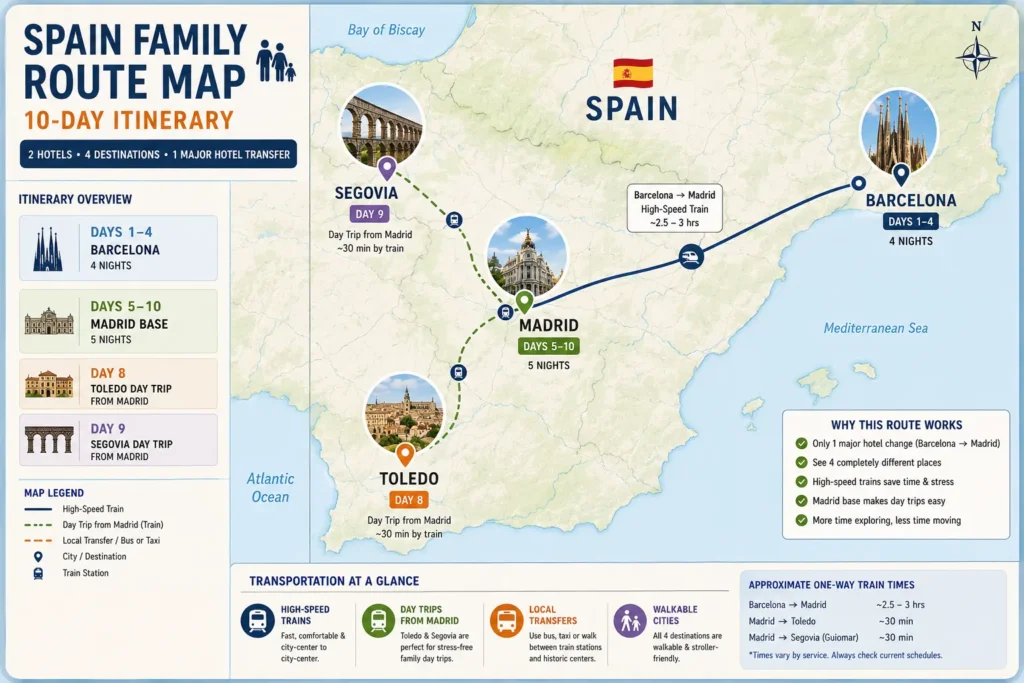
This avoids several unnecessary hotel changes while still giving families four distinct destinations.
Why Train Works Better Than Flying Between Barcelona and Madrid
For most families on this route, I would look at high-speed rail before domestic flights.
The important comparison is not:
flight duration vs train duration.
It is:
hotel door → hotel door.
Flying adds:
airport transportation,
earlier arrival requirements,
security,
boarding,
flight,
baggage procedures,
and transportation back into the next city.
High-speed rail connects major urban stations much more directly.
Exact prices vary dramatically according to operator, date and booking time, so compare current fares rather than relying on a fixed price from an old travel article.
Should You Rent a Car?
For this exact itinerary:
I would not.
Barcelona does not require one.
Madrid does not require one.
Toledo works well by train.
Segovia works well by train plus local transport.
A car adds:
parking,
city traffic,
restricted areas,
fuel,
rental costs,
and another thing for parents to manage.
If you expand the trip into:
rural Catalonia,
small villages,
Costa Brava,
Andalusia countryside,
or other areas poorly served by rail,
then the calculation changes.
But for this route, trains are part of what makes the itinerary so simple.
How Much Should Families Budget?
There is no single useful number for a 10-day Spain family trip.
A family staying in central four-star hotels during August has a completely different budget from a family using apartments in November.
Instead of pretending there is one correct total, break the budget into categories.
Accommodation
This will usually be one of the largest expenses.
But remember the advantage of our route:
only two accommodations.
That can also reduce:
transfer costs,
luggage-storage problems,
and the temptation to pay extra for awkward one-night stays.
Transportation
Budget for:
airport transfers,
Barcelona public transportation,
Barcelona → Madrid train,
Madrid public transportation,
Madrid → Toledo return,
Madrid → Segovia return,
and local transportation between stations and historic centers where necessary.
Booking longer-distance trains earlier can sometimes provide better fare choices, but ticket conditions vary by operator.
Attractions
This category can become expensive quickly for a family.
Four tickets to:
Sagrada Família,
Park Güell,
Royal Palace,
Prado,
Alcázar,
another cathedral,
another museum,
another tower
add up.
The solution is not necessarily searching for free attractions.
It is choosing fewer paid attractions deliberately.
Our itinerary already uses:
historic streets,
parks,
plazas,
beaches,
viewpoints,
and neighborhoods
to balance the paid experiences.
Food
You do not need three restaurant meals every day.
A realistic family trip may include:
hotel breakfast,
bakery breakfast,
market snacks,
casual lunch,
proper regional lunch,
supermarket supplies,
and occasional memorable dinners.
Mix them.
Food should be part of Spain.
It does not need to become a financial event three times per day.
How to Adjust This Itinerary for Summer
Summer requires the biggest structural change.
Not different destinations.
Different hours.
Barcelona and especially Madrid can become very hot.
Toledo’s hills amplify the problem.
Summer Rule
Think:
morning attraction
↓
proper lunch
↓
midday rest / indoor activity
↓
late afternoon restart
↓
evening outside
This is more realistic than trying to sightsee continuously from 09:00 to 18:00.
Carry Water
Simple.
Obvious.
Frequently ignored.
Do not wait until children say they are thirsty.
Book the Hard-to-Replace Attractions
In peak periods, prioritize advance reservations for the attractions that would genuinely disappoint the family if missed.
Do not pre-book every hour.
A family itinerary needs both:
certainty
and
flexibility.
Spring and Autumn
For this particular itinerary, spring and autumn can be excellent.
Walking becomes easier.
Toledo and Segovia become less physically demanding.
Parks are more enjoyable.
The main trade-off is that Barcelona beach time becomes less predictable depending on the exact dates and weather.
But remember:
Barceloneta is only one component of Barcelona.
The city works without swimming.
Winter
This itinerary still works.
Barcelona becomes more city-focused.
Madrid’s museums become particularly useful.
Toledo remains atmospheric.
Segovia can become genuinely cold, so families need proper layers.
Shorter daylight also matters for day trips.
Check sunset times and attraction schedules before copying a summer itinerary into December.
How to Adjust the Trip for Younger Children
If traveling with toddlers or younger primary-school children, I would make one major change:
remove one day trip if necessary.
Do not feel obligated to visit both Toledo and Segovia.
Choose one.
Then give Madrid an extra low-pressure day.
For example:
Day 8 — Toledo
Day 9 — Madrid park + football + nothing ambitious
That may create a better vacation.
Which Day Trip for Younger Kids?
If choosing purely on immediate visual accessibility:
Segovia may have the edge.
Roman aqueduct.
Castle.
Easy stories.
Toledo is magnificent but its historical importance is more layered and its hills can be more demanding.
That does not mean young children cannot enjoy Toledo.
It means parents should choose according to their own children.
How to Adjust the Trip for Teenagers
With teenagers, the itinerary can become deeper rather than simply busier.
Barcelona:
architecture,
football,
shopping,
food.
Madrid:
art,
football,
urban culture.
Toledo:
religion,
identity,
medieval politics,
Jewish history.
Segovia:
Roman engineering,
royal history.
Teenagers can engage with why these places matter rather than simply seeing them.
Give them some control too.
Let each teenager choose one major experience.
You may learn more about what they value than you expected.
What If You Only Have 7 Days?
Do not compress the entire 10-day itinerary into seven days.
Cut something.
My preferred first-trip version would be:
Day 1 — Barcelona arrival
Day 2 — Barcelona
Day 3 — Barcelona
Day 4 — Barcelona → Madrid
Day 5 — Madrid
Day 6 — Toledo OR Segovia
Day 7 — Madrid + departure
One day trip.
Not two.
Again:
cut destinations before cutting sleep and recovery.
What If You Have 14 Days?
Now we can add another region properly.
Do not simply stretch Barcelona and Madrid to seven nights each unless your family wants that.
After Madrid, consider continuing to:
Seville + Granada
for Andalusia,
or
Valencia
for another Mediterranean city,
or spend several days at a coastal resort.
The key is adding a meaningfully different experience.
Example 14-Day Structure
Days 1–4 — Barcelona
Days 5–9 — Madrid + Toledo + Segovia
Days 10–12 — Seville
Days 13–14 — Granada
That creates:
Mediterranean Barcelona,
Central Spain,
and Andalusia
without turning every second day into a transfer.
Families comparing possible destinations can use our 15 Best Places to Visit in Spain with Kids guide before deciding which region deserves the extra days.
What I Would NOT Add to the 10-Day Version
This is important.
I would not add Valencia simply because the train is fast.
I would not add Seville because “we are already in Spain.”
I would not add Granada because everyone says the Alhambra is essential.
I would not add Mallorca because flights are available.
All four are excellent destinations.
They belong in different versions of the trip.
The 10-day itinerary works because it knows when to stop.
Common Mistakes When Planning 10 Days in Spain With Kids
Mistake 1 — Counting Nights as Full Days
Four nights does not automatically mean four full sightseeing days.
Arrival and departure matter.
Mistake 2 — Adding Cities Because Transportation Looks Fast
Door-to-door time matters more than train time.
Mistake 3 — Booking Every Major Attraction
Children need unstructured time too.
Mistake 4 — Changing Hotels Every Two Nights
Every transfer has a hidden energy cost.
Mistake 5 — Ignoring Summer Heat
A geographically efficient itinerary can still fail if the daily timing is unrealistic.
Mistake 6 — Making Every Day Equally Intense
Museum day.
Beach day.
Castle day.
Park afternoon.
Variety helps families recover.
Mistake 7 — Assuming Children’s Interests Before the Trip
Leave room to adapt after discovering what they actually enjoy.
Mistake 8 — Treating a Missed Attraction as Failure
If the family skips Casa Batlló because everyone wants another two hours at the beach:
the vacation is not broken.
It may be working exactly as intended.
Why This Itinerary Works
The mathematics are simple.
10 days
4 destinations
2 hotels
1 major intercity hotel transfer
But the experience does not feel simple.
The family still gets:
Gaudí,
Mediterranean Barcelona,
royal Madrid,
world-class art,
parks,
football,
Roman engineering,
medieval history,
Jewish heritage,
castles,
regional food,
and high-speed trains.
The trick is not seeing less Spain.
It is organizing Spain better.
How This 10-Day Itinerary Fits Into Our Spain Family Guides
If you are still deciding whether Barcelona and Madrid are the right anchors, start with our 15 Best Places to Visit in Spain with Kids guide.
Once the route is decided, use the detailed city guides rather than trying to plan every attraction from this overview:
Barcelona with Kids — Gaudí, neighborhoods, beach, food and a realistic city itinerary.
Madrid with Kids — Royal Palace, museums, Retiro, football, food, day trips and a realistic three-day family itinerary.
Toledo with Kids — how to handle the hills, what to prioritize, the Three Cultures story and how to make the Madrid day trip work without exhausting everyone.
Segovia with Kids — Roman Aqueduct, Alcázar, regional food, Segovia-Guiomar transportation and a realistic Madrid day-trip route.
Think of this article as the framework.
The individual destination guides are where you can decide exactly which attractions deserve your family’s time.
One Thing I Have Learned From Traveling With Kids
There is a point during family travel when an itinerary stops being helpful and starts controlling the trip.
It usually happens quietly.
Everyone is tired, but there is another reservation.
The children want to stay somewhere longer, but the schedule says it is time to leave.
Someone is hungry, but the restaurant you planned is another thirty minutes away.
And because so much effort went into planning the trip, it becomes surprisingly difficult to say:
Let’s skip it.
I think that is one of the biggest differences between traveling alone and traveling with children.
When traveling alone, I can push myself.
I can walk farther.
Eat later.
Take another train.
Add one more attraction.
With a family, every additional decision affects several people at once.
Over time, I have become much more interested in how easily a trip flows than in how many famous places we can say we visited.
That is the thinking behind this 10-day itinerary.
Why I Would Choose Two Hotels Instead of Four
On paper, adding Valencia and Seville might make this itinerary look better.
Imagine:
Barcelona → Valencia → Madrid → Seville.
Four major Spanish cities in ten days.
It sounds impressive.
But I would rather have the family remember:
the colored light inside Sagrada Família,
an afternoon at the beach,
the Royal Palace,
Retiro Park,
the streets of Toledo,
and Segovia’s castle
than remember repeatedly asking:
“Where are we sleeping tonight?”
Hotel changes have a hidden cost.
It is not only the train ticket.
It is packing.
Unpacking.
Finding the station.
Finding the next hotel.
Waiting for rooms.
Moving luggage.
Learning another neighborhood.
And doing all of that while trying to keep children fed, rested and interested.
For me, reducing those transitions is not seeing less of Spain. It is buying more usable vacation time.
That is why Madrid becomes so valuable.
It lets the family see more without moving more.
The Best Family Itinerary Is Not Necessarily the Most Efficient One
There is another trap in itinerary planning:
efficiency.
We naturally try to optimize everything.
Attraction A is 700 meters from Attraction B.
Restaurant C is on the route.
Museum D closes at 18:00.
Therefore, if everyone walks quickly enough, we can fit all four in.
Mathematically, the itinerary works.
Family travel is not mathematics.
A child may spend forty minutes watching something you expected to take ten.
Lunch may take longer.
Someone may want another churro.
The beach may suddenly become the best part of Barcelona.
Retiro may be more enjoyable than the museum you planned afterward.
Some of our best travel moments happen precisely because we stop optimizing the day.
That is why this itinerary contains deliberately flexible afternoons.
They are not empty spaces waiting to be filled.
They are part of the plan.
Let the Children Change the Itinerary
By Day 3 or Day 4, you will know much more about the trip than you knew while planning it.
Maybe your children love castles.
Then Segovia becomes essential.
Maybe they unexpectedly enjoy art.
Give Madrid’s museums more time.
Maybe they could not care less about cathedrals.
Stop entering them.
Maybe the Barcelona beach becomes everyone’s favorite place.
Go back.
Maybe a teenager desperately wants a football experience.
Make room for it.
I would rather change an itinerary because I learned something about my children than stubbornly follow a plan created months before the trip.
The itinerary should serve the family.
The family should never have to serve the itinerary.
What I Would Book Before Leaving Home
Flexibility does not mean planning nothing.
Some things are much easier when arranged in advance.
For this particular trip, I would prioritize booking:
- accommodation in Barcelona,
- accommodation in Madrid,
- Barcelona → Madrid high-speed train,
- Sagrada Família,
- Park Güell during busy periods,
- major football experiences if important to the family,
- Madrid → Toledo trains once the day-trip date is fixed,
- Madrid → Segovia trains once the day-trip date is fixed,
- and any attraction that would genuinely disappoint the family if it sold out.
Everything else does not need to become a reservation.
That distinction matters.
Book the things that protect the trip. Leave the rest flexible enough to enjoy it.
What I Would Leave Unbooked
I would not normally pre-book:
every lunch,
every dinner,
every museum,
every minor attraction,
every afternoon,
or every hour.
If the family already has:
a 10:00 attraction,
a 13:00 restaurant,
a 15:00 museum,
a 17:00 activity,
and a 20:00 dinner reservation,
you have not created flexibility.
You have created a work schedule in Spain.
Leave gaps.
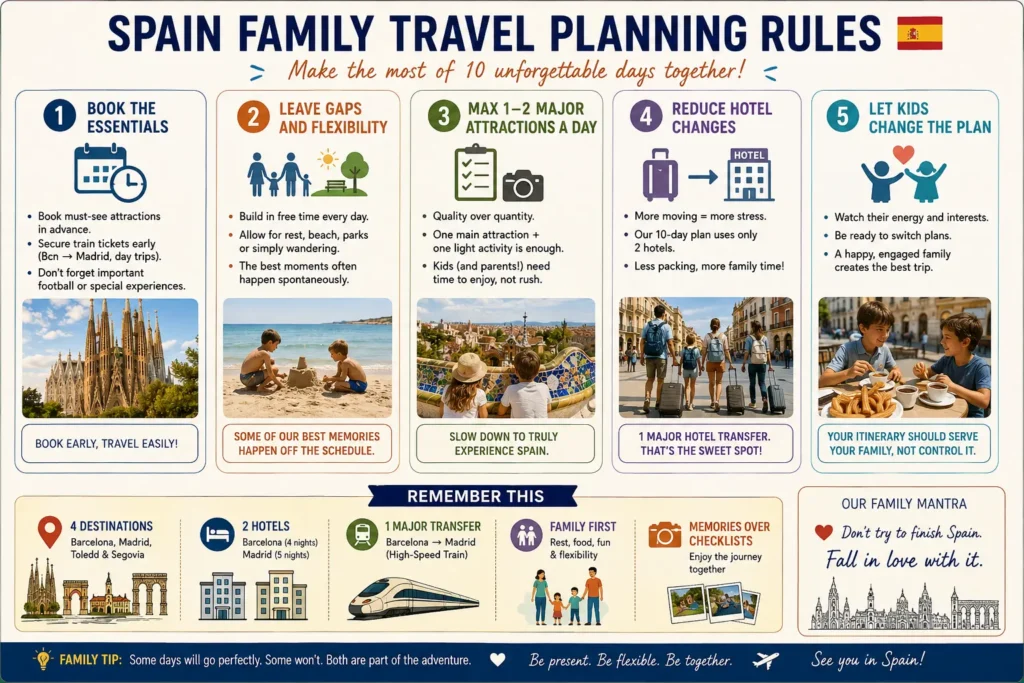
Before You Book: Ask These Five Questions
Before paying for the final itinerary, I would ask:
1. How many times are we changing hotels?
For this itinerary:
once.
Good.
2. How many days contain more than two major attractions?
Hopefully very few.
3. Where can the children simply play or relax?
Barcelona beach.
Montjuïc.
Retiro.
Hotel.
Plazas.
Unstructured afternoons.
4. What happens if one day goes wrong?
There should be enough flexibility that one missed attraction does not destroy the itinerary.
5. Does every family member have something they are genuinely excited about?
Architecture.
Beach.
Football.
Art.
Castles.
Food.
Trains.
Shopping.
History.
Not everyone needs the same answer.
But everyone should have an answer.
Final Thoughts: Don’t Try to Finish Spain
Ten days in Spain is enough for an extraordinary family trip.
It is not enough to finish Spain.
And that is perfectly fine.
There will still be:
Seville.
Granada.
Valencia.
Córdoba.
Málaga.
Mallorca.
Bilbao.
San Sebastián.
Santiago de Compostela.
The Costa Brava.
The Canary Islands.
And dozens of smaller cities and towns worth an entirely separate trip.
Trying to squeeze those places into the same ten days does not make the vacation more complete.
It makes each destination smaller.
For a first family trip, I would rather give Barcelona enough time to feel like Barcelona.
Give Madrid enough time to become more than a train station between other cities.
Give Toledo a full day.
Give Segovia a full day.
And give the family enough empty space to discover something none of us planned.
The older I get, the less I think a great family trip is measured by how much ground we covered.
I think it is measured by something much simpler:
Did the children still want to explore?
Did we have time to sit together?
Did everyone find something they loved?
And when the trip ended, did Spain feel like somewhere we wanted to return to rather than somewhere we had finally completed?
If the answer is yes, ten days was enough.
Not enough to see Spain.
Enough to fall in love with it.