Florence with kids can be one of the most rewarding cultural experiences in Italy, but the secret to enjoying the city is knowing what to explore and what to leave out. With Renaissance masterpieces, extraordinary architecture, historic bridges, museums and Tuscan food traditions concentrated within a relatively compact historic center, Florence offers families far more than a conventional sightseeing trip.
The challenge is that many of its most famous attractions were not designed with children in mind. A visit to the Uffizi Gallery can be unforgettable for a child fascinated by painting, but exhausting for one who has already spent several hours in museums. Climbing Brunelleschi’s Dome may be exciting for an energetic teenager, while a younger child might prefer investigating the cathedral from the piazza below.
That does not make Florence unsuitable for families. It means the city works best when parents choose experiences according to their children’s interests, ages and energy levels rather than attempting to complete a list of famous Renaissance landmarks.
This guide explores Florence’s most meaningful family experiences, explains how to introduce Renaissance history without overwhelming children, and provides practical advice on accommodation, transportation, food and realistic itineraries. Along the way, it also introduces questions and activities that can turn ordinary sightseeing into opportunities for discovery.
Is Florence Worth Visiting with Kids?
Yes. Florence is particularly appealing for families interested in art, architecture, engineering, history and food. Even children who are not enthusiastic about museums may enjoy the city’s monumental buildings, public squares, bridges and lively streets.
One of Florence’s greatest advantages is the concentration of important landmarks within its historic center. The cathedral, Piazza della Signoria, Ponte Vecchio and several major museums can be explored without repeatedly traveling across a large city.
However, compact does not necessarily mean effortless. Popular attractions can involve long queues, the historic streets can become crowded, and summer temperatures may make extended walking uncomfortable. Families should also remember that Florence’s museums often require considerable standing and concentration.
The best approach is to combine one major cultural experience with lighter activities, allowing children to enjoy the city without feeling that every hour is another history lesson.
Quick Answer: What Should Families Prioritize in Florence?
| If Your Child Enjoys… | Experience to Consider | Why It May Be Interesting |
|---|---|---|
| Engineering and inventions | Florence Cathedral and Brunelleschi’s Dome | Discover how an enormous dome was constructed |
| Sculpture | Accademia Gallery | See Michelangelo’s David |
| Painting and mythology | Uffizi Gallery | Explore Renaissance art through stories and details |
| Castles and political history | Palazzo Vecchio | Investigate Florence’s government and powerful families |
| Bridges and unusual buildings | Ponte Vecchio | Discover why shops were built along a bridge |
| Science and technology | Museo Galileo | Explore historic scientific instruments |
| Gardens and outdoor space | Boboli Gardens | Balance indoor sightseeing with time outside |
| Food and local culture | Markets and traditional restaurants | Discover Tuscan ingredients and dishes |
| City views | Piazzale Michelangelo | See Florence’s historic skyline |
| Exploring without tickets | Historic center and piazzas | Observe architecture and everyday city life |
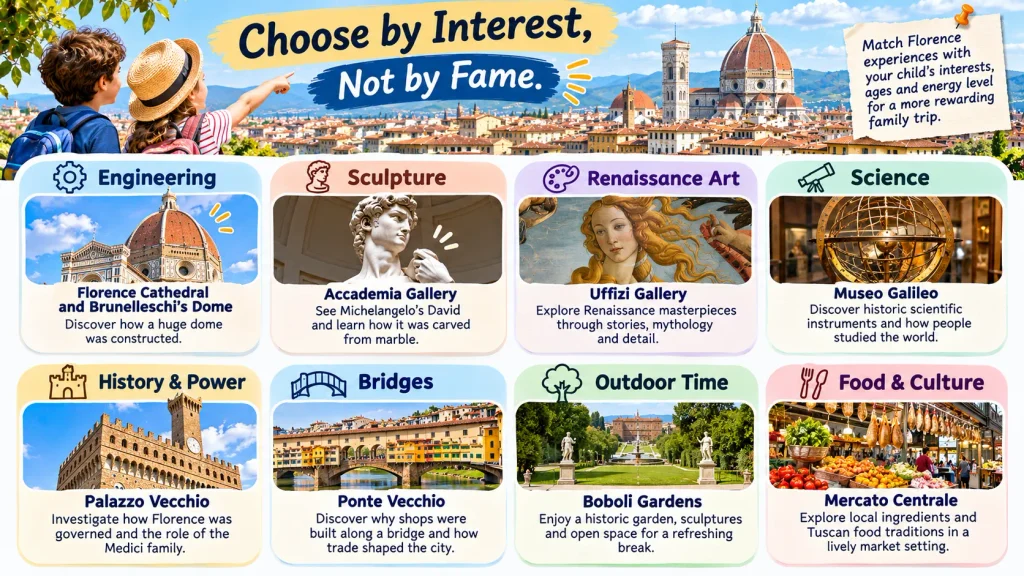
These experiences are not ranked from best to worst. A child fascinated by inventions may enjoy the Museo Galileo more than another famous painting, while a younger child may remember watching the Arno from Ponte Vecchio more vividly than an expensive museum visit.
For a first family trip, I would normally choose the cathedral area, one major indoor attraction and enough flexible time to explore Florence on foot. Families with additional days can add museums, gardens or experiences outside the historic center.
Why Is Florence So Important in Renaissance History?
Florence played a major role in the cultural and intellectual developments associated with the Renaissance, especially during the fifteenth and sixteenth centuries.
Artists, architects, scholars and wealthy patrons contributed to changes in painting, sculpture, architecture and the study of the natural world. Commercial wealth, banking networks and political competition helped finance ambitious public and private projects.
For children, however, the word Renaissance can sound like another complicated historical period to memorize.
A better starting point is to ask what happens when people begin exploring new ways to represent and understand the world.
Renaissance artists developed increasingly sophisticated methods for depicting space, anatomy and human expression. Architects studied geometry and ancient building traditions, while engineers experimented with construction techniques and mechanical devices.
Florence allows children to encounter many of these developments in the buildings and artworks that survive today.
Was Florence the Only Renaissance City?
No. The Renaissance was not invented by one person or confined to one city. Important developments occurred in other Italian centers and across Europe, influenced by exchanges of knowledge, artistic traditions and commercial connections.
Florence became especially influential because of its concentration of wealth, artistic patronage, political institutions and talented individuals.
This distinction is worth explaining to older children. Historical achievements rarely belong to one place alone, even when a particular city becomes strongly associated with them.
Who Were the Medici?
The Medici were a powerful Florentine family whose influence developed through banking, politics, cultural patronage and connections with important institutions.
Different members of the family supported artists, architects and scholars, helping shape the city’s cultural landscape. Their political history also involved rivalry, conflict and changing forms of authority.
For children, the Medici provide an opportunity to explore why wealthy families invested so heavily in art and architecture.
Beautiful buildings and paintings could express religious devotion, civic pride, personal prestige and political power. Patronage was not simply a matter of wealthy people purchasing decorations for their homes.
When children visit Florence, encourage them to consider who commissioned an artwork or building and what message its appearance may have communicated.
1. Florence Cathedral: The Best Introduction to Renaissance Engineering
The Cathedral of Santa Maria del Fiore dominates Florence’s historic center. Its enormous dome, elaborate marble exterior and neighboring bell tower make it one of the city’s most recognizable landmarks.
For children, the cathedral is particularly effective because its scale creates an immediate question: how did people build something this large centuries before modern cranes and computerized engineering?
The answer involves mathematics, construction technology, skilled labor and the extraordinary engineering work associated with Filippo Brunelleschi.
How Did Brunelleschi Build the Dome?
Construction of Florence Cathedral began in the late thirteenth century, but completing its enormous dome presented a major engineering challenge.
In the fifteenth century, Brunelleschi developed the construction approach that made the dome possible. The project used a double-shell design, carefully arranged masonry and specialized lifting equipment.
One of its most remarkable achievements was constructing the vast dome without the enormous full-scale wooden centering that might otherwise have been expected for a masonry structure of such size.
Children do not need to understand every technical detail to appreciate the challenge.
Ask them to imagine building a large arch from individual blocks. What would prevent the blocks from falling before the arch was complete? How would the problem become more difficult if the structure were much larger and higher above the ground?
Brunelleschi had to solve a sophisticated version of that problem while coordinating materials, workers and machinery.
The dome is therefore not simply an architectural masterpiece. It is evidence of how engineering can change what people believe is possible.
Should Families Climb Brunelleschi’s Dome?
Climbing the dome can be memorable, particularly for older children who enjoy physical challenges and panoramic views.
However, the ascent involves 463 steps, narrow passages and physically demanding sections. There is no elevator to the top.
Families should consider children’s stamina, comfort with enclosed spaces and any mobility limitations before booking.
The dome climb also requires an appropriate ticket and timed access under the current visitor arrangements. Check the official Opera di Santa Maria del Fiore website for updated admission conditions, opening schedules and booking requirements.
For younger children, admiring the cathedral from the square and discussing how the dome was built can be just as meaningful as climbing it.
What About Giotto’s Bell Tower?
Giotto’s Campanile stands beside the cathedral and offers another opportunity to examine Florence’s architecture.
Its decorative exterior is worth observing from the piazza, while the tower climb provides elevated views of the city and cathedral.
The climb involves more than 400 steps, making it another substantial physical activity.
Families do not need to climb both the dome and the bell tower simply because both are famous. Choose the experience that best fits the children’s abilities and the day’s schedule.
Florence Cathedral Detective Challenge
Before leaving Piazza del Duomo, give children three things to investigate.
First, ask them to identify the different colors of marble on the cathedral’s exterior. Then have them compare the shape of the dome with the bell tower, noticing how each structure solves a different architectural problem.
Finally, ask which part of the building they believe would have been most difficult to construct and why.
There is no need for every child to reach the same answer. The purpose is to encourage observation before explanation.
2. Accademia Gallery: Is Michelangelo’s David Worth Seeing with Kids?
Michelangelo’s David is one of the most recognizable sculptures in the world. The original marble statue is displayed at Florence’s Galleria dell’Accademia, where visitors can appreciate its enormous scale and extraordinary craftsmanship.
For families, the attraction is not simply the opportunity to see a famous artwork. It is the chance to understand how an artist transformed a block of stone into a convincing human figure.
That process can be fascinating even for children who have little interest in traditional art museums.
How Did Michelangelo Create David?
Michelangelo carved David from marble in the early sixteenth century, working with a large block that had previously presented difficulties for other sculptors.
Unlike modeling with clay, carving stone involves removing material. Once marble has been cut away, it cannot simply be put back.
This makes the sculpture an excellent introduction to planning, observation and craftsmanship.
Ask children to imagine beginning with a large block of marble and deciding which pieces to remove. How would they know where the arms, legs and face should be? What would happen if they removed too much?
The question helps children appreciate the sculpture as the result of careful decisions rather than an object that appeared fully formed.
Why Does David Look So Real?
Renaissance artists studied anatomy, proportion, movement and human expression.
Michelangelo’s David demonstrates extraordinary attention to the human body, but the sculpture is not merely a neutral anatomical model. Its posture, proportions and expression also reflect artistic choices intended to communicate tension and readiness.
Older children may enjoy examining the figure’s stance and considering what David appears to be thinking or preparing to do.
Younger children can simply compare the sculpture with a real person and identify details that make it appear lifelike.
The important thing is to encourage children to look carefully rather than telling them that the sculpture is important because everyone says so.
How Long Should Families Spend at the Accademia?
A focused visit can be more effective than attempting to study every artwork in the museum.
Families primarily interested in David may prefer to spend time examining the sculpture and a selection of nearby works. Children with a stronger interest in art may enjoy exploring the wider collection.
Advance planning is useful because the museum is a major attraction and admission arrangements can vary.
Check current information through the official Galleria dell’Accademia website.
The goal is not to remain inside until children become exhausted. It is to leave with a clear memory of something they found extraordinary.
3. Uffizi Gallery: How to Make Renaissance Art Interesting for Kids
The Uffizi Gallery houses one of the world’s most important collections of Renaissance art, including works associated with Botticelli, Leonardo da Vinci, Michelangelo and many other influential artists.
For adults, its reputation may be enough to justify a visit. For children, the experience becomes more rewarding when they have a specific reason to examine the paintings.
A large museum can quickly become tiring when every room contains another artwork described as essential. Instead of attempting to see the entire collection, choose a small number of works that connect with your children’s interests.
Turn Renaissance Paintings into Detective Stories
Before explaining a painting, ask children what they can discover by looking.
Who appears in the picture? What are the characters doing? Which details seem unusual? What might have happened immediately before the moment depicted?
Children may notice clothing, animals, objects or facial expressions that adults overlook.
These observations can lead naturally to discussions about mythology, religion, history and artistic symbolism.
For younger children, the goal is simply to identify a few memorable details. Older children may enjoy investigating how artists used perspective, composition and color to guide the viewer’s attention.
Why Did Renaissance Painters Care About Perspective?
Perspective allows artists to create the illusion of three-dimensional space on a flat surface.
Children can understand the basic idea by looking down a long street. Buildings and parallel lines appear to become smaller or converge as they extend into the distance.
Artists developed mathematical and visual techniques to reproduce these effects in paintings.
Ask children to find a picture where a road, floor or building seems to extend away from the viewer. Then compare the image with what they see outside the museum.
This turns a technical artistic concept into something they can observe in everyday life.
Should Families Visit the Uffizi and Accademia on the Same Day?
It is possible, but it should not be the default plan for every family.
Both museums require standing, walking and concentration. Visiting them back-to-back may be rewarding for teenagers who genuinely love art, but exhausting for younger children.
For many families, choosing one major museum per day creates a better experience.
If time is limited, consider whether your children are more interested in seeing Michelangelo’s David or exploring a broader collection of Renaissance paintings.
For current exhibitions, admission and booking information, consult the official Uffizi Galleries website.
4. Palazzo Vecchio: Discover Florence’s Political History
Palazzo Vecchio stands in Piazza della Signoria and remains one of Florence’s most recognizable civic buildings.
Its fortress-like appearance, tall tower and richly decorated interiors make it particularly appealing to children interested in castles, political history and stories about powerful families.
The palace was originally associated with the government of the Florentine Republic and later became closely connected with Medici rule.
Its changing functions offer an opportunity to explore how Florence’s political institutions developed over time.
Why Does Palazzo Vecchio Look Like a Fortress?
Before entering, encourage children to examine the building from Piazza della Signoria.
Its imposing stone walls, tower and defensive architectural features communicate authority. They also reflect a period when political competition and security were important concerns in Florentine civic life.
Ask children how the building compares with a modern city hall.
Both serve governmental purposes, but their appearance reveals different ideas about power, security and public identity.
Is Palazzo Vecchio Suitable for Young Children?
The palace can be particularly rewarding for school-age children who enjoy impressive rooms, decorative details and historical stories.
However, the suitability of a visit depends on the museum route and the child’s interests.
Florence’s civic museum system offers educational activities and family-oriented experiences, although availability and schedules should be checked before visiting.
For current information, consult Muse Firenze.
A family-oriented activity may provide more value than a long adult-focused tour, particularly for children who are new to Renaissance history.
5. Ponte Vecchio: Why Are There Shops on a Bridge?
Ponte Vecchio is one of Florence’s most unusual landmarks because shops occupy structures built along the bridge itself.
For children, this creates an immediate question: why would anyone build shops on a bridge rather than beside a normal street?
The answer connects the history of commerce with the practical use of limited urban space.
Ponte Vecchio has long been associated with trade, although the businesses operating there have changed over time. Today, jewelry shops are particularly prominent.
What Should Children Notice at Ponte Vecchio?
Before crossing the bridge, view it from a suitable position along the Arno.
Children can observe how buildings extend along the bridge and compare its appearance with more conventional river crossings.
Then walk across and notice how the bridge functions as both a pedestrian route and a commercial street.
This creates an interesting comparison with Venice, where bridges connect neighborhoods across canals but do not generally resemble Ponte Vecchio’s distinctive arrangement of shops.
The bridge can be explored without purchasing an admission ticket, making it a natural part of a family walk through the historic center.
What Is the Vasari Corridor?
Above part of the Ponte Vecchio area runs the historic Vasari Corridor, constructed in the sixteenth century to connect important Medici residences and governmental spaces.
The elevated passage allowed members of the ruling family to move between locations without using the ordinary streets below.
For children, this creates a question about political power and architecture: why might powerful people want a private route through a city?
Access to the corridor is subject to current museum arrangements, so families interested in visiting should check official information through the Uffizi Galleries.
Even without entering, understanding its purpose adds another historical layer to Ponte Vecchio.
How Should Families Choose Their First Florence Experiences?
By now, Florence has already offered five very different experiences.
The cathedral introduces engineering, the Accademia highlights sculpture, the Uffizi explores painting, Palazzo Vecchio reveals political history, and Ponte Vecchio connects architecture with commerce.
Rather than automatically visiting all five, choose according to the questions your children are most interested in answering.
For a first visit, the cathedral area and one major indoor attraction provide a strong foundation. Piazza della Signoria, Ponte Vecchio and the surrounding historic streets can then become part of a more flexible walking experience.
This allows children to discover Florence without feeling that every famous building requires another ticket or lengthy explanation.
The city also has another side beyond its Renaissance masterpieces. Scientific instruments, gardens, viewpoints, food markets and quieter neighborhoods can provide the contrast that makes a family trip more enjoyable.
6. Museo Galileo: Discover the Science Behind Renaissance Italy
Florence is famous for its paintings and sculptures, but the city’s intellectual history extends far beyond art. For families whose children are fascinated by astronomy, inventions, mathematics or the way scientific ideas develop, Museo Galileo offers a different kind of cultural experience.
Located near the Uffizi Gallery, the museum houses an important collection of historical scientific instruments, including telescopes, globes, measuring devices and objects connected with the development of experimental science.
Unlike a modern hands-on science center, Museo Galileo primarily presents historical instruments and their scientific significance. This distinction matters for families expecting children to operate interactive exhibits throughout the visit.
The museum can be particularly rewarding when parents give children a few specific questions to investigate rather than expecting them to understand every instrument on display.
Who Was Galileo Galilei?
Galileo Galilei was an Italian scientist whose work contributed significantly to astronomy, physics and the development of experimental approaches to understanding nature.
He was born in Pisa in 1564 and later became closely connected with Florence and the Medici court.
Galileo did not invent the telescope, but he improved its design and used it to make important astronomical observations. His discoveries included the four largest moons of Jupiter and evidence that challenged established ideas about the heavens.
For children, Galileo’s story raises an important question: what happens when careful observations contradict what powerful institutions and respected scholars believe?
That question connects science with history, philosophy and the challenges of changing accepted knowledge.
What Should Children Look for at Museo Galileo?
Rather than attempting to explain every scientific instrument, choose three categories to investigate.
Start with instruments used to observe the sky. Ask children how astronomers studied distant objects before satellites and modern space telescopes existed.
Next, look for devices designed to measure time, distance, angles or other quantities. Children can consider why accurate measurement matters when investigating the natural world.
Finally, explore the relationship between science and craftsmanship. Many historical instruments were not only functional devices but also beautifully designed objects requiring exceptional technical skill.
This approach gives children a reason to observe even when they do not fully understand the underlying mathematics.
Is Museo Galileo Worth Visiting with Younger Children?
For older elementary-school children and teenagers interested in science, the museum can be an excellent alternative to another art gallery.
Younger children may enjoy individual objects but find the collection less engaging if they expect extensive hands-on activities.
The best choice depends on the child’s interests rather than age alone.
Families can check current exhibitions, educational programs and visitor information through the official Museo Galileo website.
7. Boboli Gardens: A Different Side of Florence
After several hours of Renaissance paintings, sculpture and historic interiors, children may need an experience that does not require continuous concentration.
The Boboli Gardens, located behind Palazzo Pitti in the Oltrarno area, provide an opportunity to explore an important historic landscape while spending time outdoors.
These gardens are not simply a modern recreational park. They form part of a historic designed landscape associated with the Medici and later rulers, featuring formal layouts, sculptures, fountains and architectural features.
For families, the appeal lies in combining outdoor exploration with a different kind of cultural history.
Are Boboli Gardens Good for Young Children?
The gardens offer outdoor space, but families should not assume that every path is flat, shaded or easy with a stroller.
The landscape includes slopes, steps and uneven surfaces. Walking can become demanding, particularly in hot weather.
For children who enjoy exploring gardens and discovering sculptures, Boboli can be rewarding. For families simply looking for a playground, another location may be more appropriate.
Choose the gardens because your family wants to experience a historic landscape, not because the word garden automatically suggests an effortless afternoon.
Turn the Gardens into an Outdoor Art Hunt
Children can explore how sculpture and landscape design work together.
Ask them to find a statue that seems to tell a story, a viewpoint that appears deliberately arranged and a place where architecture and nature meet.
Older children can investigate why powerful families invested in elaborate gardens. These spaces were associated with recreation, status, political representation and ideas about controlling and organizing nature.
A garden can communicate power just as effectively as a palace.
For current tickets, access conditions and opening hours, consult the official Uffizi Galleries website, which also manages Palazzo Pitti and the Boboli Gardens.
8. Piazzale Michelangelo: See Florence from Above
Piazzale Michelangelo offers one of Florence’s most recognizable panoramic views. From the elevated square south of the Arno, visitors can see the historic center, the cathedral dome, major churches and the surrounding hills.
For families, the viewpoint is more than a photography stop. It helps children understand the city’s geography after spending time walking through its narrow streets.
Buildings that appeared enormous from street level become part of a wider urban landscape.
The Arno River becomes easier to follow, and the relationship between Florence’s historic center and the surrounding hills becomes more visible.
Is the Walk to Piazzale Michelangelo Difficult?
The climb from the river involves uphill walking and steps on some routes. The level of difficulty depends on the starting point, chosen path, weather and children’s walking ability.
Families with young children or mobility limitations may prefer suitable public transportation or another transport arrangement.
There is no reason to turn the journey into a physical challenge unless the family actually wants one.
The viewpoint itself is the experience.
A Florence Skyline Challenge
Once everyone has reached the viewpoint, ask children to identify places they have already visited.
Can they find Brunelleschi’s Dome? Can they locate the Arno? Can they recognize Palazzo Vecchio’s tower?
This simple activity helps children connect individual landmarks with the larger city.
Instead of remembering Florence as a series of disconnected attractions, they begin to understand how its important places relate geographically.
9. Florence’s Historic Squares: Enjoy the City Without Another Ticket
Some of Florence’s most rewarding family experiences happen in its public spaces rather than inside museums.
Piazza del Duomo, Piazza della Signoria and Piazza della Repubblica each offer a different view of the city’s history and everyday life.
These spaces allow families to observe architecture, public art and urban activity without committing to another lengthy attraction.
For children who have already spent a morning in a museum, a slower walk through Florence’s squares can provide a welcome change of pace.
Piazza della Signoria: An Outdoor Sculpture Lesson
Piazza della Signoria contains important sculptures and historic buildings that reflect Florence’s political and artistic heritage.
The Loggia dei Lanzi, for example, provides an opportunity to see major sculptures in an open architectural setting.
Children can compare the expressions, poses and stories represented by different works.
However, families should explain that some artworks depict violent mythological or historical scenes. Parents can choose which sculptures to discuss according to their children’s ages and sensitivities.
The aim is not to identify every statue correctly. It is to encourage children to notice how public art communicates stories and ideas.
Piazza della Repubblica: Look for the Layers of Florence
Piazza della Repubblica occupies an area associated with Florence’s historic urban center, but its present appearance reflects substantial redevelopment during the nineteenth century.
This makes it useful for discussing how cities change.
A square can occupy an ancient location without preserving the same buildings or street layout from every earlier period.
Ask children why a city might demolish older structures and redesign a public space. What might be gained, and what might be lost?
The question introduces urban planning and heritage conservation without requiring a formal museum visit.
10. Florence Food Experiences with Kids
Florence offers families an opportunity to explore Tuscan food traditions alongside the city’s artistic and architectural heritage.
Food can also provide a natural break between demanding cultural experiences. A relaxed lunch after the Accademia or cathedral area may be more valuable than immediately adding another museum.
For children, the most interesting approach is not to complete a list of famous dishes. It is to notice how food reflects local ingredients, agricultural traditions and regional history.
What Foods Are Associated with Florence and Tuscany?
Florentine and Tuscan cuisine includes dishes associated with bread, beans, vegetables, meat, olive oil and regional pasta traditions.
Families may encounter foods such as ribollita, a hearty vegetable-and-bread soup, or pappa al pomodoro, a tomato-and-bread dish.
Another recognizable local food is schiacciata, a flatbread that can be eaten in different ways, including as a sandwich.
Florence is also famous for bistecca alla fiorentina, traditionally a large cut of beef prepared according to local culinary conventions.
Not every dish will appeal to every child, and that is perfectly reasonable.
The purpose is to discover that Italian cuisine changes from region to region.
Mercato Centrale: Is It Worth Visiting with Kids?
The Mercato Centrale area can be a useful introduction to Florence’s food culture, although families should distinguish between the traditional market activity and the modern food-hall experience.
Different areas and businesses may operate according to different schedules.
For children, the market can become an opportunity to investigate ingredients rather than simply choose lunch.
Ask them to identify products associated with Tuscany. Which ingredients come from agriculture? Which foods require preservation or processing? How do these ingredients differ from those the family encountered in Rome or Venice?
Check current opening information through the Mercato Centrale Firenze website.
Should Families Book a Cooking Class in Florence?
A cooking class can be a meaningful experience for families whose children enjoy preparing food.
However, not every class is suitable for every age. Some involve sharp tools, hot equipment, long sessions or menus that may not interest younger children.
Before booking, confirm minimum ages, the level of participation expected, allergy accommodations and whether children prepare food themselves or mainly observe.
A well-chosen class can help children connect Italian food with practical skills, but it should not be treated as compulsory.
Florence can be enjoyed perfectly well without one.
Florence with Toddlers and Preschoolers
Florence’s compact historic center can be an advantage for families with younger children, but the city still requires careful pacing.
A preschooler may enjoy the enormous cathedral, public squares and views of the Arno without understanding the historical significance of the Renaissance.
That is not a problem.
Young children can engage with Florence through shapes, colors, movement and observation.
Rather than attempting several major museums in one day, choose a single attraction and allow plenty of time for meals, rest and unstructured exploration.
Is Florence Stroller-Friendly?
Florence is generally more straightforward for stroller travel than a city with numerous stepped canal bridges, but it is not uniformly accessible.
Historic paving, narrow pavements, crowds, steps and older buildings can create difficulties.
A lightweight stroller may be useful for children who cannot comfortably walk long distances. Families should still check the accessibility arrangements of individual museums, accommodation and attractions.
The cathedral dome and major tower climbs, for example, are not suitable stroller activities.
Florence with Elementary-School Kids
Elementary-school children are often at an age where Florence’s art and engineering can become especially engaging.
They can understand the challenge of building Brunelleschi’s Dome, the physical process of carving Michelangelo’s David and the idea of perspective in Renaissance painting.
The most effective approach is to select one question for each major experience.
At the cathedral, investigate engineering. At the Accademia, explore sculpture. At Museo Galileo, examine scientific instruments.
These questions give children a clear reason to look carefully without requiring them to memorize large amounts of historical information.
Florence with Teenagers
Teenagers can engage with Florence at a deeper level, particularly when they have a role in choosing the itinerary.
Some may be interested in art history, fashion, photography, architecture or Renaissance politics. Others may prefer food, scientific discoveries or exploring the city independently within appropriate family arrangements.
Rather than assuming every teenager wants to visit the Uffizi, offer meaningful choices.
Would they prefer a major art museum or Museo Galileo? Would they rather climb a historic tower or spend time photographing the city from Piazzale Michelangelo?
Florence becomes more rewarding when older children can connect the destination with their own interests.
Florence Renaissance Detective Challenge for Kids
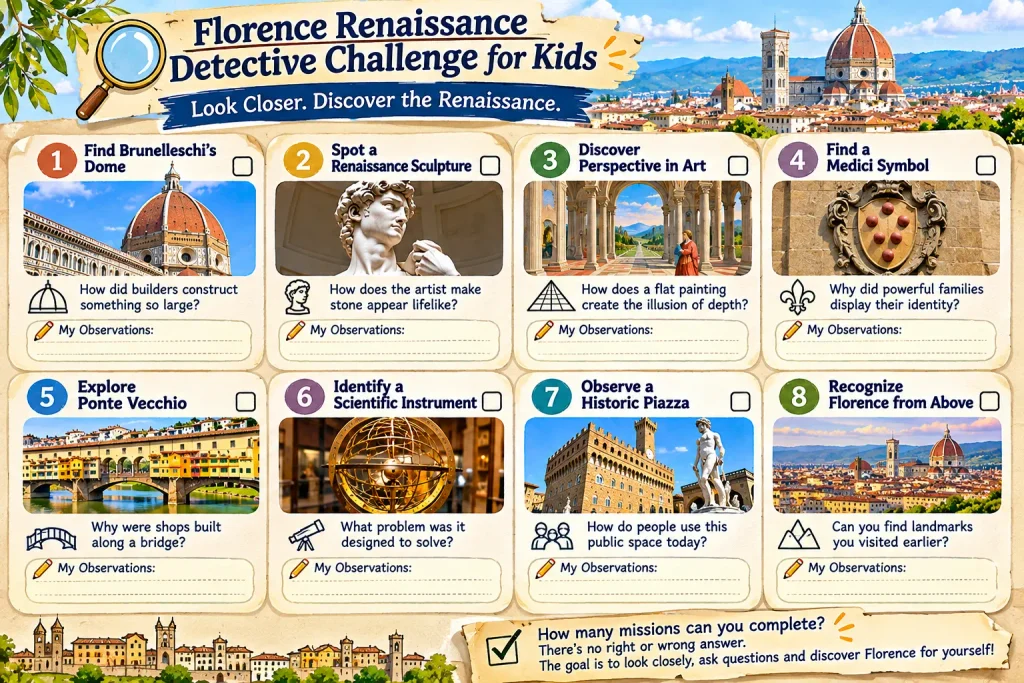
Florence is an excellent place for an observation-based activity because many of its major landmarks are close enough to explore during a walk through the historic center.
Instead of giving children a long list of historical facts, invite them to investigate how art, architecture, science and political power shaped the city.
The challenge can be completed gradually over one or more days.
| Mission | What to Find | Question to Investigate |
|---|---|---|
| 1 | Brunelleschi’s Dome | How did builders construct something so large? |
| 2 | A Renaissance sculpture | How does the artist make stone appear lifelike? |
| 3 | A painting using perspective | How does a flat picture create the illusion of depth? |
| 4 | A Medici symbol or coat of arms | Why did powerful families display their identity? |
| 5 | Ponte Vecchio | Why were shops built along a bridge? |
| 6 | A scientific instrument | What problem was it designed to solve? |
| 7 | A historic piazza | How do people use this public space today? |
| 8 | A panoramic viewpoint | Can you recognize landmarks you visited earlier? |
Children do not need to complete every mission.
A child who spends ten minutes investigating one sculpture may learn more than another who rushes through all eight tasks.
The goal is to develop curiosity, observation and the ability to connect what children see with the history of the city.
Where Should Families Stay in Florence?
Choosing where to stay in Florence can make a significant difference to a family trip. Although many major attractions are concentrated within the historic center, accommodation location still affects walking distances, transport connections, noise and the ease of returning to your room during the day.
For families with younger children, the ability to take an afternoon break may be more valuable than staying beside the most famous landmark. Families arriving by train may prioritize access to Santa Maria Novella station, while those planning several museum visits may prefer accommodation closer to the historic center.
The best neighborhood is not necessarily the most famous or the cheapest. It is the one that supports the way your family plans to explore Florence.
Historic Center and Duomo Area: Best for First-Time Visitors
Staying near Piazza del Duomo places families within walking distance of many of Florence’s most recognizable attractions, including the cathedral, Piazza della Signoria and major museums.
This can be particularly convenient for short visits. Families can explore the city in manageable sections and return to their accommodation without spending considerable time on public transportation.
However, central accommodation can be expensive, and streets around major attractions may remain busy throughout much of the day.
Before booking, check whether the property has an elevator, how much street noise reaches the rooms and whether the building is accessible with luggage or a stroller.
Santa Maria Novella: Best for Families Traveling by Train
The area around Firenze Santa Maria Novella railway station can be practical for families arriving from Rome, Bologna, Milan or other Italian cities.
Its main advantage is transportation convenience. Families carrying luggage may appreciate reaching their accommodation without a long transfer across the historic center.
Many important attractions are also accessible on foot from parts of the neighborhood.
However, the exact street matters. A hotel close to the station may be convenient for arrival but less suitable for a family seeking a particularly quiet environment.
Compare the walking route to your accommodation with the attractions you plan to visit most often.
Oltrarno and Santo Spirito: Best for a Different Florence Experience
Oltrarno lies south of the Arno River and includes neighborhoods associated with artisan traditions, historic streets, restaurants and local life.
The Santo Spirito area can appeal to families who want to experience Florence beyond the busiest museum corridors.
It also provides access to attractions such as Palazzo Pitti and the Boboli Gardens.
For some families, Oltrarno offers a pleasant balance between sightseeing and neighborhood exploration. Others may prefer to stay north of the river, particularly if most planned activities are concentrated around the cathedral and Accademia.
The exact location is more important than the district name alone.
Santa Croce: Best for Historic Streets and Neighborhood Exploration
The Santa Croce area offers another option within Florence’s historic center.
Families may appreciate its proximity to historic squares, restaurants and cultural attractions, as well as its walking connections to other parts of central Florence.
However, some streets can be lively in the evening. Parents traveling with younger children should check recent accommodation reviews for noise and access conditions.
As elsewhere in Florence, do not assume that every property within the same neighborhood provides an identical experience.
Should Families Stay Outside Florence?
Accommodation outside the historic center may offer more space, parking or lower prices, particularly for families traveling by car.
The trade-off is additional transportation.
If your family plans to spend most days exploring central Florence, staying farther away may create repeated journeys that consume time and energy.
For a longer Tuscany itinerary, countryside accommodation can be attractive. For a short Florence city break, convenient access to the historic center may be more valuable.
How to Get to Florence with Kids
Florence is well connected to other major Italian cities, making it a natural stop on many family itineraries.
The best transportation option depends on whether Florence is part of a city-focused rail trip or a broader journey through the Tuscan countryside.
Arriving by Train
Firenze Santa Maria Novella is the principal railway station for many visitors arriving in central Florence.
High-speed trains connect Florence with major destinations such as Rome, Bologna and Milan, while other rail services connect the city with towns and cities throughout Tuscany.
For families traveling between major Italian cities, rail can be particularly convenient because it avoids the need to drive into restricted historic areas or find parking.
Check current schedules and fares through Trenitalia or Italo.
When comparing tickets, consider the complete journey, including luggage, the route from the station to your accommodation and any connections.
Arriving by Plane
Florence Airport, also known as Amerigo Vespucci Airport, serves the city and surrounding region.
Travelers can reach Florence through public transportation and other transfer options, depending on their arrival time and accommodation.
Some families may also consider flights arriving at Pisa or Bologna, followed by onward transportation to Florence.
The most convenient airport is not necessarily the one geographically closest to the city. Flight schedules, transfer times, luggage and total costs all matter.
For current airport information, consult the official Florence Airport website.
Arriving by Car
Driving can be useful when Florence is combined with smaller Tuscan towns, countryside accommodation or areas that are less convenient to reach by public transportation.
However, Florence’s historic center contains restricted traffic zones, commonly known as ZTL areas.
Entering a restricted zone without the appropriate authorization can result in fines, including for visitors driving rental cars.
Families should confirm parking arrangements and the permitted driving route before arriving.
If Florence is part of a rail-based city itinerary, renting a car solely for sightseeing within the historic center is generally unnecessary.
Getting Around Florence with Children
Florence is a city where walking is often the most practical way to explore major historic attractions.
The cathedral, Piazza della Signoria, Ponte Vecchio and many museums are concentrated within a relatively small central area.
However, walking distances can accumulate quickly when children are tired, the weather is hot or several attractions are scheduled on the same day.
A sensible family plan groups activities geographically and allows enough time between them.
Is Public Transportation Necessary?
Florence has a public transportation network that includes buses and trams.
Families staying outside the historic center or traveling to particular destinations may find these services useful.
However, public transportation does not eliminate the need to walk through the central pedestrian areas.
For current routes, fares and ticket conditions, consult Autolinee Toscane, the regional bus operator, and GEST for Florence tram information.
Before purchasing tickets, check the rules for children’s fares and the particular transport services your family intends to use.
How Much Walking Should Families Expect?
The amount of walking depends on the itinerary rather than the city’s size alone.
A family visiting the cathedral, Accademia, Uffizi and Ponte Vecchio in one day may cover substantial distances while also spending hours standing inside attractions.
For younger children, it is usually better to combine one major cultural experience with a shorter neighborhood walk or another flexible activity.
The historic center rewards slow exploration. Families often discover memorable details between famous landmarks, so walking should not be treated merely as transportation between tickets.
Florence with Kids: A Realistic 1-Day, 2-Day and 3-Day Itinerary
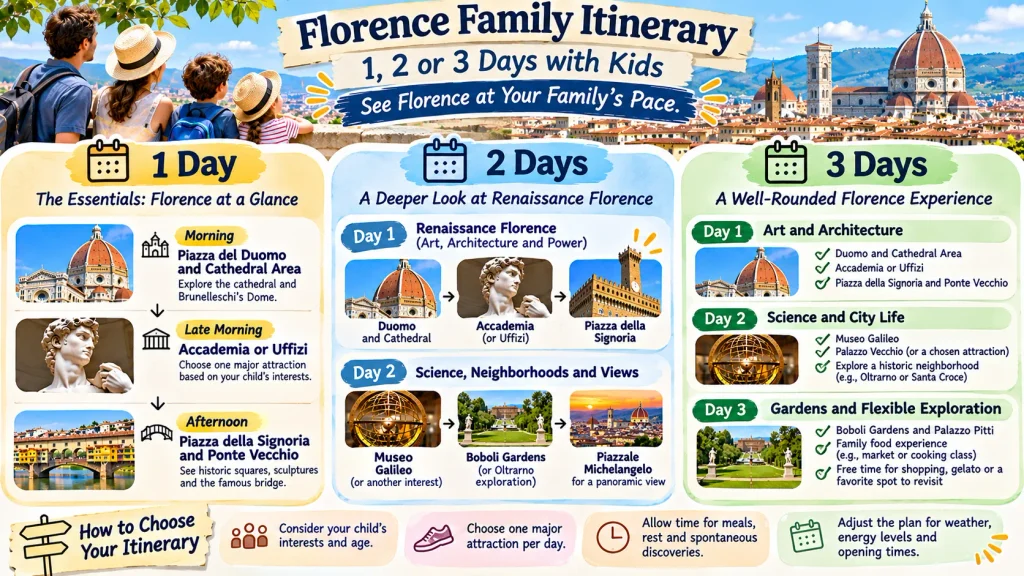
Florence can fit into a short Italian city trip or become the main base for several days of cultural exploration.
The following itineraries are designed as flexible planning frameworks rather than schedules that must be followed exactly.
Families should adjust them according to their children’s ages, interests, arrival times and the availability of major attractions.
One Day in Florence: Focus on the Historic Center
If you have only one full day, resist the temptation to visit every major museum.
Instead, focus on the city’s most recognizable landmarks and choose one substantial cultural experience if your children are interested.
| Time of Day | Suggested Experience | Family Planning Note |
|---|---|---|
| Morning | Piazza del Duomo and cathedral area | Observe the architecture and dome |
| Late morning | Accademia or another chosen attraction | Book ahead where necessary |
| Lunch | Historic center | Allow a proper break |
| Afternoon | Piazza della Signoria and Ponte Vecchio | Explore at a flexible pace |
| Late afternoon | Arno riverside or another relaxed walk | Adjust according to energy |
| Evening | Dinner or departure | Leave time for transport |
Families who prefer painting over sculpture may choose the Uffizi instead of the Accademia.
Others may skip indoor museums entirely and spend the day exploring the historic center.
The important decision is to give the day one major purpose rather than treating Florence as a collection of attractions that must all be completed.
Two Days in Florence: Art, Architecture and City Life
Two days allows families to explore Florence more comfortably.
Day 1: Renaissance Florence
Begin with the cathedral area and investigate Brunelleschi’s Dome. Depending on your children’s interests, include either the Accademia or another major cultural attraction.
Spend the afternoon exploring Piazza della Signoria, Palazzo Vecchio’s surroundings and Ponte Vecchio.
This introduces several important aspects of Florence without requiring the family to spend the entire day inside museums.
Day 2: Choose a Different Side of Florence
The second day can focus on the Uffizi, Museo Galileo, Palazzo Vecchio or another attraction that suits your children.
Afterward, explore Oltrarno, enjoy a slower meal or consider a panoramic viewpoint such as Piazzale Michelangelo.
This structure works because the two days have different purposes. One introduces the city’s famous landmarks, while the other allows the family to pursue a more personal interest.
Three Days in Florence: Add Gardens, Science or a Slower Experience
A third day provides room for Florence to become more than a rapid introduction to Renaissance art.
Families can use the extra time for Museo Galileo, the Boboli Gardens, a carefully selected cooking experience or additional neighborhood exploration.
For children interested in science, Museo Galileo may be more memorable than another art museum. Families seeking outdoor time may prefer a garden or an easy day with fewer scheduled activities.
Three days also creates flexibility if weather, queues or fatigue affect the earlier itinerary.
A longer stay should not automatically mean adding more attractions. It should allow the family to enjoy the experiences they choose more fully.
Should You Take a Day Trip from Florence with Kids?
Florence is a useful base for exploring parts of Tuscany, but day trips should be chosen according to the family’s interests and transportation preferences.
If you have only one or two days in Florence, I would generally prioritize the city itself.
With three or more days, a day trip becomes easier to justify, especially if it introduces a different kind of experience.
Pisa: More Than the Leaning Tower
Pisa is famous for its Leaning Tower, but the surrounding Piazza dei Miracoli contains several important historic buildings.
For children, the tower creates an immediate engineering question: why does it lean, and how has it remained standing?
The city can be reached by rail from Florence, although families should check the complete journey from the station to the monuments.
Climbing the tower is subject to age and access restrictions, so confirm current conditions before planning it as a family activity.
The official Opera della Primaziale Pisana website provides visitor information.
Siena: A Medieval City with a Different Identity
Siena offers a contrast with Renaissance Florence through its medieval urban character, Piazza del Campo and distinctive civic history.
Children may enjoy investigating the shape of Piazza del Campo and learning about the city’s famous Palio horse race.
However, the Palio should not be presented merely as a colorful tourist performance. It is a historic civic tradition deeply connected with Siena’s contrade, or neighborhood communities.
A Siena day trip can be rewarding for families interested in medieval history, but transportation and walking conditions should be considered carefully.
Tuscany Countryside: When a Day Trip Is Not Enough
The Tuscan countryside offers vineyards, olive groves, hill towns, farms and landscapes that provide a different experience from central Florence.
For families whose main goal is countryside exploration, staying outside Florence for several nights may be more rewarding than attempting multiple long day trips.
This is particularly true when visiting smaller towns or rural accommodation that is less convenient by public transportation.
Our Italy Family Itinerary: 7 Days, 10 Days & 2 Weeks with Kids explains how to combine Florence with a broader Tuscany stay without creating unnecessary hotel changes.
How Much Does Florence Cost for a Family?
Florence can be expensive during busy travel periods, particularly when accommodation and several major museum tickets are included.
However, families have considerable control over how they allocate their budget.
The historic center offers meaningful experiences that do not require admission fees, while paid attractions can be selected according to children’s interests.
| Expense | What Affects the Cost? | Planning Approach |
|---|---|---|
| Accommodation | Season, location and room size | Compare convenience with nightly price |
| Museums | Number of attractions and concessions | Choose major visits selectively |
| Dome and tower climbs | Ticket type and access conditions | Avoid booking multiple demanding climbs automatically |
| Food | Restaurant location and dining preferences | Review menus and prices before ordering |
| Transportation | Arrival route and accommodation location | Use walking and public transport where practical |
| Day trips | Destination and travel method | Compare complete journey costs |
Instead of setting an unrealistic universal daily budget, calculate the experiences your family actually intends to purchase.
A family visiting one museum and spending the rest of the day exploring Florence will have a different budget from one booking several guided tours and major attractions.
Are Florence’s Free Attractions Enough?
For some families, yes.
The cathedral exterior, historic piazzas, Ponte Vecchio and walking routes through the center provide substantial opportunities for discovery.
Children can investigate architecture, public art and urban history without entering every museum.
Paid attractions become most valuable when they provide access to something the family genuinely wants to experience, such as Michelangelo’s David or the Uffizi collection.
When Is the Best Time to Visit Florence with Kids?
Florence can be visited throughout the year, but the experience changes significantly with weather, daylight and visitor numbers.
Spring
Spring can provide pleasant conditions for walking and outdoor exploration, although rain and busy holiday periods remain possible.
Families should check the actual forecast and attraction schedules rather than assuming the season guarantees comfortable conditions.
Summer
Summer can bring significant heat and crowds, particularly around the historic center and exposed public spaces.
Families may benefit from scheduling demanding outdoor activities earlier in the day and allowing longer breaks during hotter periods.
Museum reservations should be planned carefully so that children are not expected to move continuously between crowded attractions.
Autumn
Autumn can offer enjoyable conditions for cultural sightseeing, although temperatures and rainfall vary.
Families combining Florence with the Tuscan countryside may also encounter seasonal agricultural activities, depending on the region and dates.
Winter
Winter offers a different atmosphere, with shorter days and cooler weather.
City museums and indoor attractions remain important options, while some outdoor activities may be less appealing during cold or rainy conditions.
Holiday periods can still attract substantial visitor numbers, so winter should not automatically be considered crowd-free.
Common Mistakes Families Make in Florence
Trying to Visit Every Famous Museum
The Uffizi, Accademia and other major collections are extraordinary, but children may struggle with several intensive museum visits in succession.
Choose according to interests rather than reputation alone.
Booking Too Many Dome and Tower Climbs
Climbing Brunelleschi’s Dome and Giotto’s Bell Tower can be physically demanding.
Families do not need to complete both to appreciate Florence’s architecture.
Treating Florence as Only an Art Museum
The city also offers science, food, gardens, architecture, public spaces and everyday urban experiences.
Ignoring Summer Heat
Hot conditions can make walking and climbing much harder than expected.
Choosing Accommodation Without Considering the Route
A cheaper hotel may create repeated journeys that reduce the family’s usable sightseeing time.
Making Every Attraction a History Lesson
Children often engage more when given a question to investigate rather than a long explanation to memorize.
Forgetting to Leave Time for Florence Itself
Some of the city’s most memorable experiences happen while walking through its streets and squares.
FAQ: Florence with Kids
Is Florence worth visiting with children?
Yes. Florence offers families opportunities to explore Renaissance art, architecture, engineering, science and food within a relatively compact historic center.
The best experience depends on choosing attractions that match children’s interests and allowing enough time between major visits.
How many days should families spend in Florence?
Two full days is a useful starting point for many first-time families. Three days provides more flexibility for museums, gardens, science attractions or slower exploration.
A one-day visit can also be rewarding if the itinerary remains focused.
Is Florence stroller-friendly?
Florence can be manageable with a stroller, but historic paving, crowds, steps and older buildings create challenges.
Families should check accessibility for individual attractions, particularly tower and dome climbs.
Is the Uffizi Gallery suitable for kids?
It can be, especially for children interested in painting, mythology or visual storytelling.
A focused visit centered on selected artworks is often more effective than attempting to see the entire collection.
Should families visit the Uffizi or Accademia?
Choose according to your children’s interests.
The Accademia is particularly appealing for families wanting to see Michelangelo’s David, while the Uffizi offers a broader exploration of Renaissance painting.
Can children climb Brunelleschi’s Dome?
Access depends on current visitor rules, and the climb involves 463 steps without an elevator.
Families should check age restrictions, physical requirements and booking conditions through the official cathedral website.
Do families need a car in Florence?
Most families exploring central Florence do not need a car.
A car may be useful for some countryside itineraries, but restricted traffic zones and parking make driving within the historic center less convenient.
Is Florence or Rome better for kids?
Neither is universally better.
Rome offers monumental ancient history and archaeological sites, while Florence is particularly strong for Renaissance art, architecture and engineering.
The best choice depends on children’s interests and the wider Italy itinerary.
Final Thoughts: Florence Is More Than a City of Famous Artworks
Florence can feel overwhelming when every guidebook insists that another museum, painting or historic building is essential.
But children do not need to see every Renaissance masterpiece to understand why the city matters.
A child who learns how Brunelleschi solved the challenge of building the cathedral dome has discovered something about engineering and human creativity. Another who studies Michelangelo’s David may begin to understand the skill involved in transforming stone into sculpture.
At the Uffizi, paintings can become stories rather than objects to admire silently. At Museo Galileo, scientific instruments reveal how people investigated the world before modern technology.
And beyond the museums, Florence continues to offer discoveries through its bridges, public squares, food traditions and surrounding landscape.
The most rewarding family visit is not necessarily the one with the longest attraction list. It is the one where children have enough time to notice what makes Florence different.
Choose a few meaningful experiences, allow room for exploration and let children’s questions guide part of the journey.
Florence becomes more memorable when families stop trying to complete the Renaissance and start discovering the ideas that made it extraordinary.
Continue Exploring Italy with Kids
15 Best Places to Visit in Italy with Kids
Still deciding whether Florence belongs in your family itinerary? Our 15 Best Places to Visit in Italy with Kids compares Rome, Venice, Florence, Tuscany, Lake Garda, the Dolomites and other Italian destinations to help families choose experiences that match their children’s interests.
From Renaissance cities and ancient ruins to mountain adventures and coastal escapes, the guide helps you discover which parts of Italy are right for your family.
Italy Family Itinerary: 7 Days, 10 Days & 2 Weeks with Kids
Planning to combine Florence with other destinations? Our Italy Family Itinerary: 7 Days, 10 Days & 2 Weeks with Kids offers realistic routes connecting Florence with Rome, Venice, Tuscany and other regions.
The guide focuses on manageable travel distances, fewer accommodation changes and a balance between major attractions and family relaxation.
Rome with Kids: A Family Guide to Italy’s Eternal City
If your family is exploring more of Italy’s historic cities, our Rome with Kids: A Family Guide to Italy’s Eternal City provides practical advice on visiting the Colosseum, Roman Forum, Pantheon and Vatican City with children.
Rome and Florence offer contrasting experiences. Rome introduces the ancient world and its engineering achievements, while Florence reveals the art, architecture and scientific ideas associated with the Renaissance. Together, they provide children with two fascinating chapters of Italian history.