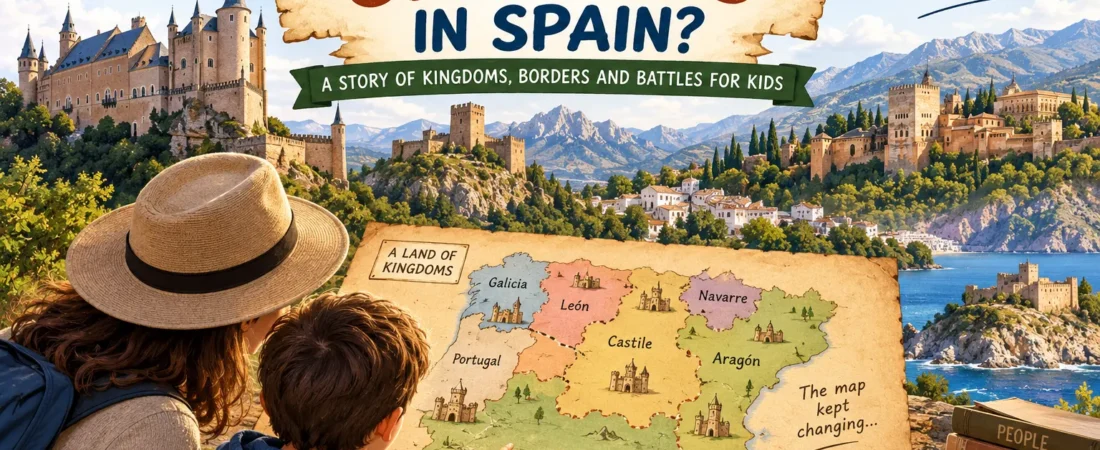
Why are there so many castles in Spain?
It is a question children may start asking without even realizing it.
You drive toward Segovia.
Castle.
You cross Aragón.
Another castle.
You visit Granada.
An enormous fortified palace rises above the city.
You travel through Castilla y León and see ruined towers standing on hills beside roads and villages.
After a while, Spain can begin to look as though someone scattered castles across the country.
But they were not built because medieval Spain had an unusual obsession with fairy tales.
They were built because, for centuries, the map of the Iberian Peninsula looked very different from the map children see today.
There were different kingdoms, changing frontiers, competing rulers, strategic roads, towns that needed protection, and territories that repeatedly changed hands.
A castle could defend a road.
Control a valley.
Protect a town.
Watch a frontier.
House a ruler.
Demonstrate power.
And sometimes do several of those things at once.
So when your children see another castle on a Spanish hill, try asking:
“Why do you think they built it there?”
That question can turn an old stone fortress into a clue.
And if we follow enough clues, we can begin reconstructing a Spain that no longer exists.
Imagine Spain 1,000 Years Ago
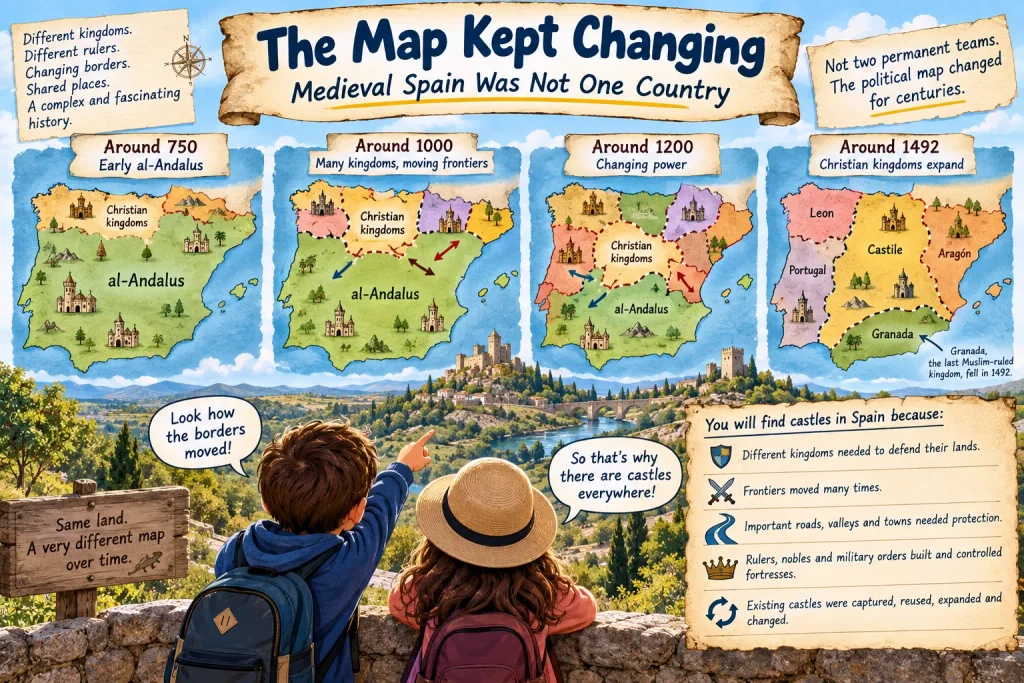
First, erase today’s map.
No modern autonomous communities.
No highways connecting Madrid, Seville, Valencia and Barcelona.
And most importantly, do not imagine the Iberian Peninsula as one unified country called Spain.
Around the 11th century, the peninsula contained multiple Christian kingdoms and counties in the north and territories ruled by Muslim dynasties in al-Andalus, while political borders and alliances changed repeatedly.
Even that description is a simplification.
Rulers fought.
Rulers negotiated.
Kingdoms divided.
Kingdoms united.
Muslim and Christian rulers sometimes fought one another.
They also sometimes formed alliances across religious lines when political interests aligned.
Territories changed hands.
New political powers appeared.
Old ones disappeared.
So instead of imagining two perfectly neat teams facing each other across one permanent border, tell older children:
“Imagine a map whose lines keep moving.”
Now castles begin to make sense.
Castles Were Part of the Map
Today, borders often appear as lines.
On a medieval landscape, control had to become physical.
A ruler needed places from which people could:
- watch roads
- control passes
- protect settlements
- store supplies
- station soldiers
- communicate danger
- defend strategic territory
A fortress on a hill was not simply a building.
It was a statement:
“We control this place.”
And if control changed?
The castle might remain.
A new ruler could occupy it, repair it, expand it or change its purpose.
That is why a castle’s history does not always belong to one ruler, one culture or even one century.
Why Put Castles on Hills?
This is one of the easiest castle questions for children to solve themselves.
Do not explain immediately.
Stand below a hilltop fortress and ask:
“If you had to defend this place, would you rather be up there or down here?”
Most children will choose the hill.
Then ask why.
They may say:
“You can see people coming.”
Exactly.
Height can provide several advantages.
From elevated ground, defenders may be able to:
- see farther
- observe roads or valleys
- detect approaching forces
- make an attack more difficult
- use the terrain as part of the defense
Attackers climbing uphill also have a different problem from defenders already occupying the high ground.
Suddenly the dramatic castle location is not merely beautiful.
The landscape itself becomes part of the fortification.
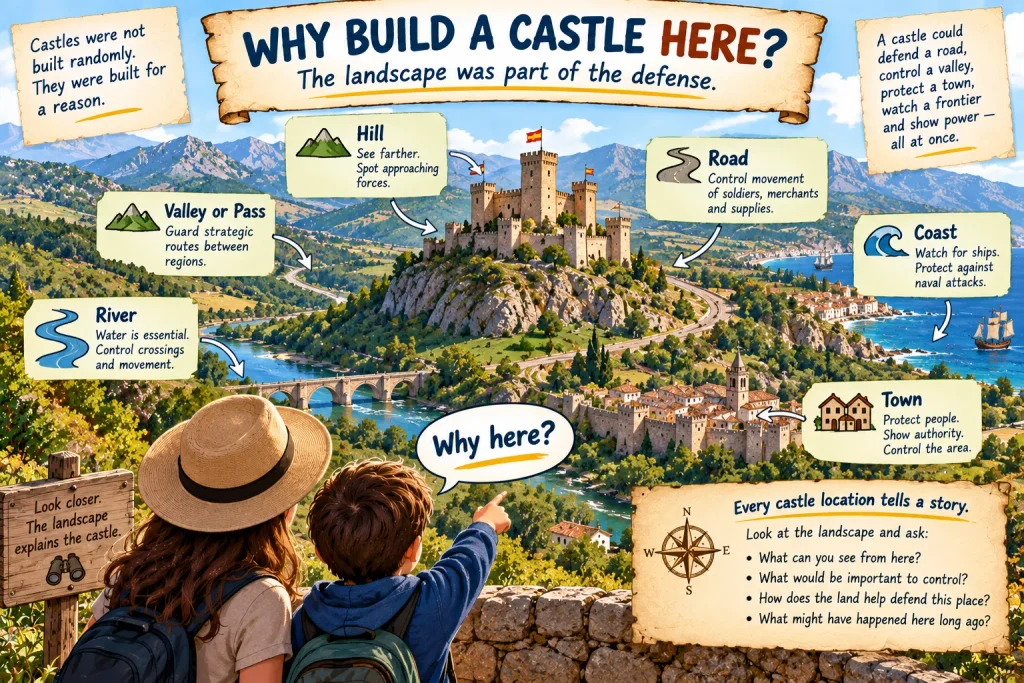
Castle Detective Question #1: What Can You See From Here?
Whenever your family reaches a castle viewpoint in Spain, ask children to look outward instead of immediately taking a photograph.
What can they see?
A river?
Road?
Mountain pass?
Valley?
Town?
Coast?
Farmland?
Another hill?
Then ask:
“Which of those things might have been important to control?”
There may not always be one simple answer.
That’s good.
History is more interesting when children learn to investigate instead of waiting for adults to provide the next fact.
711 Changed the Story of the Iberian Peninsula
To understand why medieval Spain developed so many fortified landscapes, children need one major historical turning point.
In 711, Muslim-led forces crossed into the Iberian Peninsula from North Africa.
Over the following years, much of the peninsula came under Muslim rule.
The territories known broadly as al-Andalus would change enormously over the centuries.
At different times they were governed under different political structures and dynasties.
Meanwhile, Christian political powers survived and developed in northern parts of the peninsula.
Over many centuries, territories expanded, contracted, fragmented and changed rulers.
This long history eventually became associated with the term Reconquista.
But this is where we need to be careful.
How Should We Explain the Reconquista to Kids?
The easiest version sounds like this:
“The Muslims conquered Spain, and then the Christians spent hundreds of years taking Spain back.”
It is easy to remember.
It is also too simple.
For children, I would use this instead:
“For hundreds of years, different Muslim and Christian rulers controlled different parts of the Iberian Peninsula. They fought many wars, but they also traded, negotiated and sometimes formed alliances. Over time, Christian kingdoms expanded southward until Granada, the last Muslim-ruled kingdom on the peninsula, was conquered by the Catholic Monarchs in 1492.”
Still simplified.
But much better.
Why?
Because the people living in the medieval Iberian Peninsula did not spend nearly eight centuries participating in one continuous war with two unchanging teams.
Politics changed.
Dynasties changed.
Alliances changed.
Identities changed.
The map changed.
And castles help children see that complexity.
A Moving Frontier Needs Fortresses
Imagine that your family owns a village.
Beyond the hills is territory controlled by another ruler.
The road through your valley matters.
People use it to move:
- soldiers
- livestock
- food
- messages
- merchants
- supplies
What would you build?
Probably something fortified.
Now imagine the frontier moves.
Your side gains territory.
The castle that once guarded the edge of your lands may now sit farther inside them.
A new fortress may be needed farther ahead.
Or the enemy captures the old one.
Or a later ruler expands it.
Multiply that process across centuries.
Now you begin to understand why Spain accumulated so many fortified places.
The Word “Castle” Is Hiding in Spain’s Geography
Here is a fun clue children can discover before seeing a single fortress.
Look at the names:
Castilla
Castile
They are historically connected with the idea of castles.
The medieval County of Castile emerged in a frontier environment where fortifications played an important role, and the name itself is traditionally associated with Latin castella, the plural of castellum, referring to fortified places.
In other words, castles became so closely associated with part of medieval Iberia that their presence is reflected in the name Castile itself.
Tell the kids:
“There were so many fortifications here that castles helped give the region its name.”
Now a word on the map has a history.
Castle Detective Question #2: Can You Find the Defense?
When children arrive at a castle, give them another mission.
Find something designed to make attacking difficult.
Maybe:
- thick walls
- towers
- a moat
- a narrow entrance
- a steep approach
- battlements
- a protected gate
- a commanding position
Then ask:
“What problem was this supposed to solve?”
A wall is no longer just a wall.
It is an answer to a problem.
Loarre: A Castle That Makes Defense Easy to Understand
The Castle of Loarre in Aragón is particularly useful for this kind of conversation.
It rises dramatically above the surrounding landscape near the foothills of the Pyrenees.
Instead of beginning with dates, stand back and ask:
“Why here?”
Children can see the strategic logic.
Height.
Visibility.
Terrain.
Control of the surrounding area.
Loarre developed during a period when Christian and Muslim-controlled territories met and changed across this part of the peninsula.
Its history therefore helps families understand something that a modern political map hides:
frontiers were once landscapes you could actually see and defend.
If your children enjoyed looking for defenses in our Best Castles in Spain for Families guide, Loarre is exactly the kind of place where that game becomes real history.
But Castles Were Not Only About Muslims and Christians
This distinction matters.
If we explain every Spanish castle as:
Christian vs. Muslim
we create another misleading story.
Medieval Christian kingdoms fought other Christian kingdoms.
Muslim rulers fought other Muslim rulers.
Political factions competed internally.
Nobles challenged monarchs.
Succession disputes created conflict.
Castles also protected:
- noble estates
- towns
- roads
- economic interests
- royal authority
And fortifications continued to be built, altered and used as political circumstances changed.
Religion mattered enormously in medieval Iberian history.
But it was not the only thing people fought over.
Power mattered too.
Who Actually Lived in a Castle?
Children often answer:
“The king.”
Sometimes.
But castles could contain many more people.
Depending on the period and site, you might find:
- soldiers
- guards
- servants
- craftspeople
- administrators
- nobles
- clergy
- cooks
- stable workers
- messengers
- prisoners
A castle was not simply a giant medieval house.
It could function as:
home + military base + administrative center + storage facility + political symbol
all at once.
Ask your children:
“If fifty people lived inside during a siege, what would they need?”
The answers usually begin:
Food.
Water.
Beds.
Then come:
Animals.
Firewood.
Weapons.
Toilets.
Medicine.
Suddenly castle life becomes much more interesting than princess bedrooms.
Water Could Matter More Than the Walls
Imagine a fortress with enormous walls.
No enemy can get inside.
Excellent.
But then the water runs out.
The walls cannot drink.
A castle under siege needed access to essential resources.
That could make:
- wells
- cisterns
- stored food
- protected supply systems
as important to survival as towers.
So the next time children are impressed by a giant wall, ask:
“Where would everyone get water if they couldn’t leave for a month?”
This is one of the best ways to move children from castle fantasy to castle engineering.
Castle Detective Question #3: How Would You Survive Here?
Give the children five problems.
Water
Where does it come from?
Food
Where could it be stored?
Cooking
Where would people prepare meals?
Warmth
How would rooms be heated?
Waste
Where would everything people didn’t want go?
That final question usually gets more attention than the kings.
Good.
Everyday history is history too.
The Alhambra Shows Why “Castle” Is Not Enough
Now take the family to Granada.
The Alhambra immediately complicates everything.
It contains defensive structures.
But calling it simply:
“a Muslim castle”
misses most of the story.
Under the Nasrid dynasty, the Alhambra developed as a fortified palatine city containing royal palaces, administrative and residential spaces, military areas, gardens and other structures.
This was not merely somewhere to hide from an attacking army.
It was somewhere to govern and live.
That means children can compare:
Loarre → defense becomes obvious
with:
Alhambra → defense + government + palace life + gardens + water + court
Now they understand why not every fortified place should look the same.
Water at the Alhambra Tells Another Story
At the Alhambra, water is not simply about surviving a siege.
It becomes part of:
- gardens
- fountains
- pools
- architecture
- cooling
- sound
- visual design
- everyday palace life
Ask:
“Why does this fortress-palace have so much water everywhere?”
Now the same resource children investigated as a survival problem becomes part of beauty and power.
One material.
Different purposes.
That is how buildings reveal the societies that created them.
Our Granada with Kids: A Family Travel Guide can help you decide how to explore the Alhambra without turning the family visit into a marathon of dates and architectural vocabulary.
A Castle Could Say “I Am Powerful” Without Firing an Arrow
Fortifications were practical.
They were also symbolic.
Imagine approaching a ruler’s enormous castle.
High walls.
Towers.
Flags.
Guards.
Stone everywhere.
Before anybody says a word, the building communicates something:
“The person who controls this place has resources.”
Building large fortifications required:
- labor
- materials
- organization
- money
- political authority
A castle could therefore project power even when nobody was attacking it.
This idea works particularly well with older children.
Ask:
“What buildings today are designed to make governments, companies or institutions look powerful?”
Now medieval architecture connects with the modern world.
Castles Changed When Warfare Changed
A castle was not automatically useful forever.
Weapons changed.
Military tactics changed.
Political borders changed.
States became more centralized.
Artillery became increasingly important.
Fortifications had to adapt.
Some castles were modified.
Others lost military importance.
Some became:
- residences
- prisons
- administrative buildings
- ruins
- heritage sites
That explains another thing children will notice in Spain:
“Why is this castle broken while that one looks almost complete?”
Because monuments have biographies too.
Construction is only the first chapter.
What Happened When Castles Stopped Being Useful for War?
A castle can survive long after the reason it was built disappears.
The frontier moves.
A kingdom becomes part of a larger political territory.
A new weapon makes old defenses less effective.
The ruler moves somewhere more comfortable.
The soldiers leave.
What happens to the castle?
There is no single answer.
Some Spanish castles became royal residences.
Some became prisons.
Some were adapted for administrative or military purposes.
Some were abandoned.
Some were damaged by warfare.
Some were dismantled for building material.
Others were restored centuries later because people began to see them not as obsolete infrastructure but as heritage worth protecting.
That means when children visit a Spanish castle today, they are rarely seeing a building frozen at one moment in medieval history.
They are seeing the result of centuries of use, change, damage, repair and preservation.
Segovia: From Fortress to Royal Palace to Prison
The Alcázar of Segovia is a perfect example.
Its dramatic towers make it easy for children to imagine knights and medieval kings.
But its story did not stop there.
Over its long history, the Alcázar served different functions, including royal residence, fortress and later prison. It was also associated with military education before becoming the historic monument visitors explore today.
That gives children an excellent question:
“Can one building have more than one job?”
Of course.
Their school can become a voting place.
A historic factory can become a museum.
A train station can become something else entirely.
Buildings change because societies change.
The Alcázar did too.
A Fire Can Become Part of a Castle’s Story
In 1862, a major fire severely damaged the Alcázar of Segovia.
What families see today therefore reflects not only medieval construction but later restoration.
This is an important heritage lesson.
When children see an old castle, they may assume:
“Everything here has looked exactly like this for 700 years.”
Usually, history is more complicated.
Ask:
“If an old castle is damaged, should we rebuild it?”
Then:
“How do we know what it looked like before?”
Now you can introduce:
- drawings
- documents
- photographs where available
- archaeology
- architectural evidence
- historical research
Restoration is another kind of detective work.
Ponferrada: History, Templars and the Stories That Came Later
The Castle of Ponferrada gives families another useful example.
The site is strongly associated with the Knights Templar, a medieval Christian military order whose history has attracted an extraordinary amount of later legend.
Children may already have heard stories involving:
- secret treasure
- mysterious symbols
- hidden knowledge
- secret societies
That can make the castle immediately exciting.
But it also gives parents an opportunity.
Say:
“Let’s separate what historians know from what later stories added.”
That is exactly the skill we used with the Devil legend at Segovia’s aqueduct.
Exciting stories are allowed.
They just need labels.
LEGEND
and:
HISTORY
are not enemies.
Why Are the Knights Templar So Famous?
The Templars were founded in the context of the Crusades in the early 12th century and developed into an influential military religious order.
They acquired property and political influence across parts of Europe.
Then, in the early 14th century, the order was suppressed.
That dramatic ending helped create fertile ground for later legends.
Secret treasure is more exciting than property administration.
Mystery is more exciting than legal documents.
So stories grew.
For older children, ask:
“Why do mysterious groups attract more legends than ordinary people?”
Then ask an even better question:
“How would we decide whether one of those stories is true?”
Now the castle has become a lesson in evaluating evidence.
Castle Detective Question #4: What Is Original?
This is a difficult challenge, even for adults.
When visiting a restored castle, ask children:
“Do you think everything we see was built at the same time?”
Look for differences.
Different stone.
Different brick.
Different window shapes.
Different decorative styles.
Areas that look newer.
Parts that seem repaired.
You may not be able to identify every construction phase yourselves.
That’s fine.
The goal is to notice that historic buildings change through time.
Then use official interpretation at the site to find out what happened.
Why Does Spain Have So Many Ruined Castles?
Not every fortress became a beautifully restored attraction.
Many survived only partially.
Why?
Because keeping a giant defensive structure standing is expensive.
Once a castle no longer served an important military, political or residential function, maintaining it might make little sense to the people living nearby.
Stone could also be reused.
Wars caused damage.
Weather caused damage.
Neglect caused damage.
Centuries passed.
So a ruined tower on a Spanish hillside is not necessarily a failed monument.
The ruin itself tells a story.
Ask:
“What disappeared?”
Then:
“What survived?”
Sometimes absence is historical evidence too.
Why Are Some Castles in the Middle of Towns Today?
Another good child question.
A castle may originally have occupied a strategic edge, hill or defensive position.
Then the settlement grew.
Centuries of houses, roads and modern development expanded around it.
The castle did not move.
The city did.
This gives children an easy way to understand urban history.
Stand at the castle.
Look at the modern city.
Then ask:
“What do you think this view looked like 500 years ago?”
Remove:
cars.
apartment buildings.
streetlights.
modern roads.
Then imagine what remains.
Landscape can become a time machine.
Why Do Spanish Castles Look So Different?
By now, children may have noticed that there is no single “Spanish castle style.”
That makes sense.
Spain’s fortified architecture developed across:
- different centuries
- different kingdoms
- different cultural traditions
- different landscapes
- different building materials
- different military technologies
A castle in Castilla y León does not need to look like a fortress in Andalusia.
A Mallorcan castle does not need to look like Loarre.
A Nasrid fortification does not need to resemble a later Christian royal residence.
Even castles built relatively close together can have different histories.
Spain’s castles look different because Spain’s history was different in different places.
Brick, Stone and the Landscape Around Them
Take Coca Castle.
Its extensive brick construction immediately challenges the childhood assumption that every medieval castle should be gray stone.
Why brick?
Building materials depend partly on:
- local resources
- building traditions
- available technology
- architectural culture
- cost
- intended design
Now children can start looking at the landscape around a monument.
Ask:
“Where do you think all this building material came from?”
A castle did not arrive in a box.
Its materials had to be obtained, transported and worked by people.
Who Built the Castles?
This question deserves more attention than it usually gets.
Travel stories often focus on the person who ordered a building.
King X built this.
But kings generally did not spend their afternoons carrying stone up scaffolding.
Real construction required:
- stonecutters
- masons
- carpenters
- metalworkers
- laborers
- engineers or master builders
- transport workers
- craftspeople
And depending on the site and period, many other people.
So when children see a castle, ask:
“How many people do you think it took to build this?”
Then:
“Whose names do we remember?”
That introduces another historical lesson.
The people who commissioned great buildings often remain famous.
Many of the people who physically created them do not.
Castle Detective Question #5: Find the Human Work
Look closely.
Can you see:
- individual blocks
- tool marks
- wooden structures or reconstructed elements
- metal fittings
- carved decoration
- different masonry patterns?
Ask:
“How long would it take you to make one of these?”
Then multiply that by an entire fortress.
The castle stops being a magical medieval object.
It becomes the product of thousands upon thousands of human decisions and hours of work.
Were Castles Comfortable?
Usually not in the way children imagine.
A royal residence could contain impressive rooms, decoration and luxury by the standards of its time.
But medieval comfort was not modern comfort.
Depending on place and period, castle life could involve problems with:
- cold
- heat
- smoke
- lighting
- sanitation
- water
- insects
- food preservation
- privacy
Ask:
“Would you rather sleep here or in our hotel?”
Then make the choice harder.
“But you get to be king or queen.”
Some children will reconsider.
What Did Children Do in Castles?
Not every child living around a castle was a prince or princess.
Children’s lives depended heavily on:
- family status
- wealth
- occupation
- period
- location
Some elite children were raised within noble or royal households.
Other children belonged to families working in or around the castle.
They might grow up around:
- kitchens
- workshops
- stables
- farms
- servants’ work
- military life
- religious institutions
So instead of asking only:
“Where did the princess sleep?”
try:
“How many different children might have lived or worked around this place?”
History becomes much larger.
Were There Really Knights Everywhere?
Knights were real.
But medieval society was not populated entirely by knights, kings and princesses.
Most people were doing ordinary things.
Growing food.
Making objects.
Trading.
Cooking.
Repairing buildings.
Moving animals.
Raising children.
Working.
The castle dominates the landscape because it survived.
That does not mean it represented the everyday life of everyone who lived nearby.
This is an important historical habit:
The biggest surviving building does not automatically tell the whole story.
What About Princesses?
Yes, royal and noble women lived in castles and palaces.
But the fairy-tale princess waiting passively in a tower is a literary idea, not a useful description of medieval women’s lives.
Women in elite households could participate in:
- dynastic politics
- estate management
- religious patronage
- diplomacy
- education
- court networks
Their power and freedom varied enormously depending on period and circumstance.
With younger children, keep it simple:
“Real princesses had responsibilities. Their lives were not fairy tales.”
That alone is an improvement.
Why Did Christian Rulers Keep Islamic Buildings?
This is one of the most interesting questions children can ask in Spain.
If one ruler conquers another ruler’s territory, why not destroy everything and start again?
Sometimes buildings were destroyed or transformed dramatically.
But in other cases, new rulers used, adapted and admired what already existed.
The Real Alcázar of Seville is an especially rich place to explore this idea.
After Seville came under Castilian rule in the 13th century, Christian monarchs continued developing the palace complex.
Later, Pedro I commissioned a magnificent palace using Mudéjar craftsmanship and artistic traditions.
That means children can stand inside a Christian royal palace and see architectural traditions deeply connected with al-Andalus.
History is not always:
old culture disappears → new culture begins.
Sometimes it is:
old + new + adaptation + appropriation + continuity + change.
What Does “Mudéjar” Mean?
You will encounter this word repeatedly while traveling in Spain.
For children, keep the first explanation simple.
Mudéjar broadly refers to artistic and architectural traditions developed in Christian-ruled Iberia that incorporated techniques, forms and decorative traditions strongly associated with Islamic art and craftsmanship.
You may notice:
- geometric decoration
- brickwork
- carved plaster
- wood ceilings
- tilework
But do not teach children that every geometric pattern is automatically Mudéjar.
Use the site’s own interpretation to understand the specific building.
The important idea is:
“Different cultures can influence the same building.”
1492 Did Not Make Spain Instantly Become Modern Spain
Children may hear:
1492 → Granada falls → Spain begins.
Again, too simple.
The conquest of Granada by the Catholic Monarchs was enormously important.
But political unification was a longer and more complicated process.
The crowns of Castile and Aragón remained distinct political entities under the same monarchs, with their own institutions and legal traditions.
Navarre had its own history.
Portugal remained independent.
And the social, religious and cultural consequences of late medieval and early modern state-building unfolded over generations.
So when children ask:
“When did Spain become Spain?”
the best answer may be:
“Slowly.”
Countries are historical processes, not birthday cakes.
So What Does “Reconquista” Really Mean?
The term remains widely used to describe the long processes through which Christian-ruled territories expanded across areas of the Iberian Peninsula that had been under Muslim rule.
But historians debate how the term can oversimplify centuries of changing political realities when it is imagined as one continuous national campaign beginning in 711 and ending inevitably in 1492.
For children, the useful takeaway is:
The medieval Iberian Peninsula contained many competing political powers. Over centuries, Christian kingdoms expanded, Muslim-ruled territories contracted and changed, alliances crossed religious boundaries, and Granada was conquered in 1492.
That is enough to understand why castles appear across so many changing frontier landscapes without pretending history was a simple eight-century football match.
A Map Game for Kids: Move the Border
You do not need a historically precise map for this activity.
Draw an imaginary kingdom on paper.
Add:
- a mountain
- river
- road
- town
- coastal port
Now draw a border.
Ask:
“Where would you build the castle?”
Let the child choose.
Then move the border.
“Your kingdom gained this valley. Do we need another castle?”
Then:
“The neighboring kingdom captured your old castle. What happens now?”
Within five minutes, children understand why changing frontiers can create layers of fortifications.
No battle dates required.
Castle Explorer Challenge: Read the Building Like a Historian
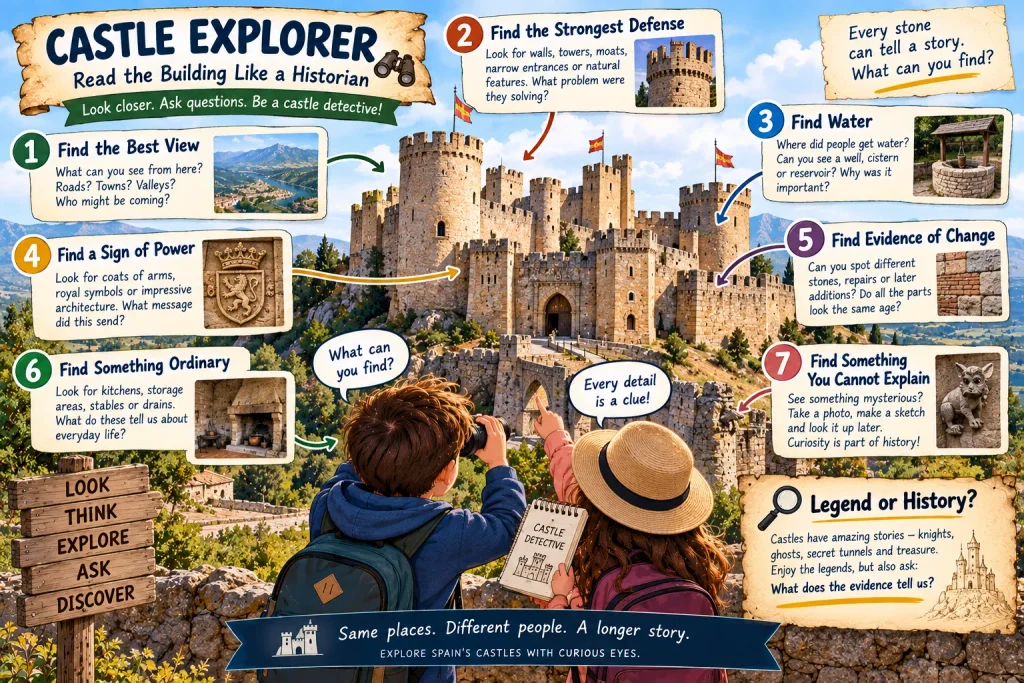
At the next Spanish castle, give children seven missions.
1. Find the Best View
Why would that view matter?
2. Find the Strongest Defense
Wall?
Tower?
Gate?
Terrain?
3. Find Water
Or work out where it might have come from.
4. Find a Sign of Power
Coat of arms?
Decorated room?
Royal symbol?
Monumental entrance?
5. Find Evidence of Change
Different materials?
Restoration?
Blocked doorway?
Newer construction?
6. Find Something Ordinary
Kitchen?
Storage?
Stables?
Drain?
Fireplace?
Ordinary life matters.
7. Find Something You Cannot Explain
This is the best one.
Take a photograph if permitted.
Look it up later.
Curiosity does not need to finish before you leave the castle.
Legend or History?
Spain’s castles collect stories.
Knights.
Ghosts.
Hidden tunnels.
Treasure.
Secret prisoners.
Impossible escapes.
Some may have historical foundations.
Others may be folklore.
Do not eliminate the legends.
Label them.
Try:
“Here’s the story people tell.”
Then:
“Now here’s what we actually have evidence for.”
That distinction allows children to enjoy both imagination and history without confusing the two.
Our The Legend of Segovia’s Aqueduct: A Story to Tell Your Kids in Spain uses exactly this approach with one of Segovia’s most famous legends.
Why Protect a Ruined Castle?
Ask children:
“If nobody lives here anymore, why don’t we remove it?”
Possible answers include:
- history
- archaeology
- architecture
- local identity
- education
- tourism
- landscape
- cultural memory
Then make it harder:
“How much should we rebuild?”
If you rebuild everything, is it still ancient?
If you rebuild nothing, could it disappear?
There is no simple answer.
Welcome to heritage conservation.
Castles Can Tell Us Who Controlled the Land—But Not Everything About the People
This is an important final historical caution.
Castles are monuments of power.
That means they tell us a lot about:
- rulers
- warfare
- political authority
- elites
- territory
But ordinary people often left fewer monumental buildings.
If we learn medieval Spain only through castles, we risk seeing history almost entirely from the top of the hill.
So when leaving a castle, look down toward:
- farms
- villages
- streets
- rivers
- fields
and ask:
“What was everybody outside the castle doing?”
That question makes the historical world much larger.
Common Mistakes When Explaining Spain’s Castles to Kids
1. “Spain Was One Country Fighting the Muslims for 800 Years”
Too simple.
The medieval peninsula contained changing Muslim and Christian political powers, conflicts, alliances and shifting frontiers.
2. “Every Castle Was Built by a King”
Many different rulers, nobles, military orders and political authorities built and controlled fortifications.
3. “Castles Were Just Houses”
Many were military, administrative and political structures as well as residences.
4. “Everyone Living There Was Rich”
Castles depended on large numbers of workers and communities.
5. “Everything We See Is Original”
Historic buildings are frequently altered, damaged and restored.
6. “Every Story About a Castle Is True”
Separate folklore from evidence.
7. “1492 Instantly Created Modern Spain”
Political development was much more complicated.
8. “Christian Architecture Replaced Islamic Architecture”
Spanish buildings frequently contain layers, adaptation and cultural influence.
9. “The Castle Tells Us Everything About Medieval Life”
It mostly tells us about particular forms of power.
10. Giving Children All the Answers
Ask:
“Why do you think…?”
first.
FAQ: Why Are There So Many Castles in Spain?
Why does Spain have so many castles?
Spain’s large number of castles and fortifications reflects centuries of changing kingdoms, frontier warfare, territorial control, local power and strategic defense across the Iberian Peninsula.
Many fortifications were later modified, reused, abandoned or restored.
Were Spanish castles built during the Reconquista?
Many fortifications were built, expanded or reused during the centuries associated with Christian expansion and changing frontiers between Muslim- and Christian-ruled territories.
However, Spanish castle history is broader than a simple two-sided Reconquista narrative.
What does Castile have to do with castles?
The name Castile is historically associated with fortified places and is commonly connected to the Latin castella, plural of castellum.
Fortifications were particularly important in the region’s medieval frontier history.
Did Muslims build castles in Spain?
Muslim rulers built and developed numerous fortifications, citadels and fortified palatial complexes in al-Andalus.
Christian rulers also built, captured, expanded and reused fortifications across the peninsula.
Many sites therefore contain architectural layers created under different rulers and in different periods rather than belonging neatly to only one culture.
Did Christians and Muslims always fight each other in medieval Spain?
No.
Warfare between Muslim- and Christian-ruled territories was an important part of medieval Iberian history, but the political reality was much more complicated.
Christian rulers fought other Christian rulers.
Muslim rulers fought other Muslim rulers.
And alliances could cross religious boundaries when political interests aligned.
That is why it is misleading to imagine medieval Iberia as two permanent teams fighting continuously for almost eight centuries.
What was a Spanish alcázar?
The word alcázar comes from the Arabic al-qaṣr and became part of Spanish architectural vocabulary for castles, palaces and fortified residences.
Places called alcázares can have very different histories and functions.
The Alcázar of Segovia, for example, does not tell the same architectural story as the Real Alcázar of Seville.
Were castles only used for fighting?
No.
Depending on the site and period, castles could function as:
- fortresses
- royal or noble residences
- administrative centers
- prisons
- military bases
- storage and supply centers
- symbols of political power
Their functions could also change over centuries.
Why are so many Spanish castles on hills?
Elevated positions could provide strategic advantages such as better visibility over roads, valleys, settlements or approaching forces while making access more difficult for attackers.
However, not every castle was built on a hill, and the reason for a particular location should be understood from that site’s geography and history.
Which castles are good places to explain this history to kids?
Different castles illustrate different parts of the story.
Loarre can help children think about frontiers and defense.
The Alhambra demonstrates how a fortified complex could also contain palaces, government, residences, gardens and court life.
The Real Alcázar of Seville reveals architectural and cultural layers created under different rulers.
Segovia’s Alcázar shows how one building could change functions over centuries.
Ponferrada provides an opportunity to explore the Knights Templar while separating documented history from later legends.
Our Best Castles in Spain for Families: Which Castle Is Right for Your Kids? can help you choose the castle that fits your family’s route and interests.
Final Thoughts: Every Castle Is a Clue to an Older Map
The next time your children ask:
“Why does Spain have so many castles?”
you do not need to give them an eight-century history lesson.
Tell them to imagine that today’s map has disappeared.
Instead of one Spain, picture different kingdoms and territories.
Move the borders.
Add roads.
Mountains.
Rivers.
Ports.
Towns.
Now put rulers on different sides of those changing lines.
Suddenly the castles begin appearing for a reason.
One watches a road.
Another controls a valley.
One protects a town.
Another houses a ruler.
One guards a frontier that disappeared centuries ago.
And another remains standing long after the kingdom that built it has vanished.
That is why castles are such useful places for children to encounter history.
They make an invisible map visible again.
But there is an equally important lesson.
Do not turn medieval Iberia into one simple story of Christians versus Muslims.
The reality contained wars and conquest, but also changing dynasties, internal conflicts, political alliances, cultural exchange, migration, trade and centuries of people simply living their lives.
The castle gives us one piece of that enormous story.
So when you arrive at the next fortress, resist the urge to begin with:
“This was built in the year…”
Start with the hill.
Look outward.
Ask:
“Why here?”
Then find the walls.
The gate.
The water.
The signs of repair.
The places where ordinary people worked.
Let the children form a theory.
And only then give them the history.
Because after visiting enough Spanish castles, children may eventually realize something important:
Castles are not scattered randomly across Spain.
They are footprints left behind by borders, kingdoms and systems of power that disappeared long ago.
The modern map changed.
The stones stayed.
Continue Exploring Spain with Kids
Best Castles in Spain for Families
Our Best Castles in Spain for Families: Which Castle Is Right for Your Kids? helps you choose between royal castles, medieval fortresses, Islamic palatial complexes and other historic sites according to your children’s interests and Spain itinerary.
The Legend of Segovia’s Aqueduct
Read The Legend of Segovia’s Aqueduct: A Story to Tell Your Kids in Spain to see how we separate a fantastic local legend from the remarkable Roman engineering behind the real monument.
Segovia with Kids
Our Segovia with Kids: A Family Travel Guide can help you turn the aqueduct, Alcázar, cathedral and Old Town into a family day where the history children have just learned becomes something they can actually see.