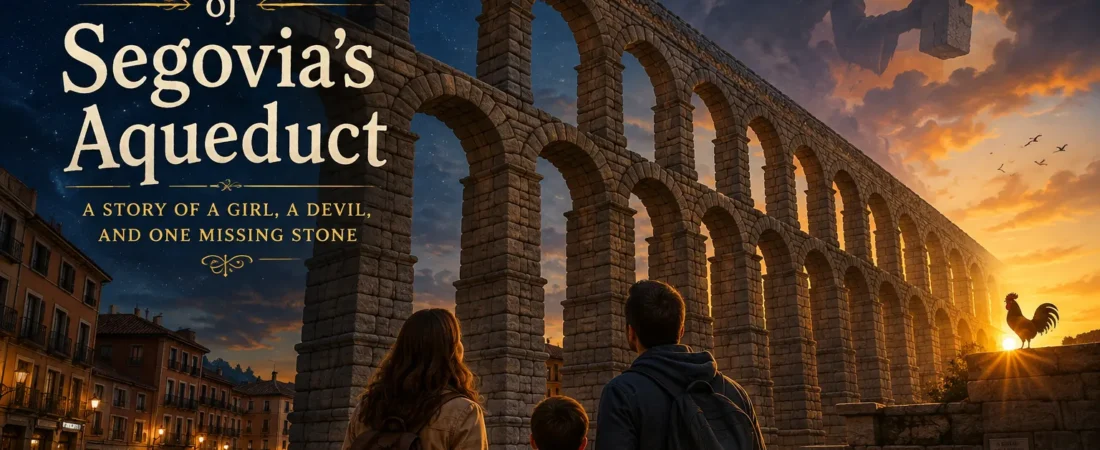
The legend of Segovia’s aqueduct turns one of Spain’s greatest Roman monuments into a story of a tired girl, the Devil, a race against sunrise, and one missing stone.
You could explain how water once traveled toward the city, how enormous granite blocks were fitted together, and how the structure has survived for centuries.
All of that is fascinating.
But there is another way to begin.
Look up at the arches and ask:
“Do you know who people once said built this aqueduct?”
Give the kids a moment to guess.
The Romans?
A king?
Hundreds of workers?
Then tell them:
“According to an old Segovian legend, it was the Devil.”
Now you probably have their attention.
This is one of Spain’s wonderful examples of how a real historic monument can collect an entirely different story over the centuries.
So if you are visiting Segovia with kids, here is a story you can actually tell while standing in front of the aqueduct.
Just remember one important distinction:
The Devil story is a legend.
The aqueduct itself is a remarkable work of Roman engineering.
We’ll enjoy the legend first.
Then we’ll discover what really happened.
The Story: The Girl Who Was Tired of Carrying Water
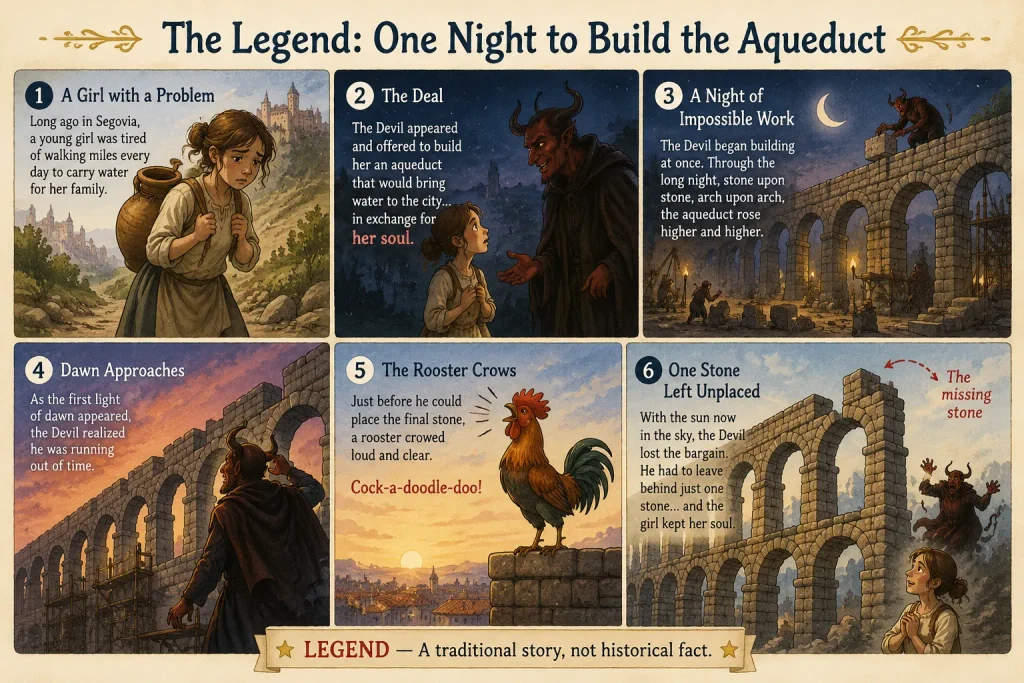
A long, long time ago, according to the legend, there lived a young girl in Segovia.
Every day she had the same exhausting job.
She had to leave the city, collect water, fill her container, and carry the heavy water all the way back home.
Again.
And again.
And again.
Imagine doing that without a tap.
No kitchen faucet.
No bottle of water waiting in the refrigerator.
Every bit of water your family needed had to come from somewhere—and somebody had to carry it.
One day, the girl had finally had enough.
She looked at the long journey ahead of her and complained.
If only, she wished, the water could somehow reach the city by itself.
And according to the legend, someone heard her.
Someone she definitely should not have been talking to.
The Devil.
The Devil Makes an Offer
The Devil appeared and offered the girl a deal.
He would solve her problem.
He would build something extraordinary—something capable of bringing water to the city.
And he would do it incredibly quickly.
But there was a price.
The Devil wanted her soul.
There was one condition.
According to the most familiar version of the legend, the Devil had to finish the aqueduct before the rooster crowed at dawn.
If he completed it in time, he would win.
If he failed…
the girl would keep her soul.
The girl agreed.
And the Devil began to work.
A Race Against Sunrise
Now look at the aqueduct.
Really look at it.
There are stone blocks everywhere.
Huge ones.
Stacked high above the plaza.
Arch after arch after arch.
Imagine trying to build all of that during one night.
According to the legend, that is exactly what the Devil attempted.
He worked furiously through the darkness.
Stone after stone went into place.
The structure grew.
The arches rose.
The water route stretched toward the city.
And as the night passed, the girl began to understand what she had done.
The impossible structure was actually appearing.
The Devil might win.
The Girl Regrets Her Deal
The girl became terrified.
She had wanted an easier way to carry water.
She had not truly wanted to lose her soul.
So she prayed.
She begged for help.
Meanwhile, the Devil continued building.
The sky began to change.
Night was almost over.
And the aqueduct was almost complete.
One stone remained.
Just one.
The Devil reached for it.
And then—
the rooster crowed.
Morning had arrived.
The Devil had lost.
One Missing Stone
According to the legend, the aqueduct was completed except for the final stone.
The girl’s soul was saved.
And the Devil disappeared.
Different tellings of the legend contain different details, as old legends often do. In some versions, prayer and divine intervention play an especially important role in the Devil’s defeat.
But the central idea remains wonderfully simple:
The Devil almost completed Segovia’s enormous aqueduct in a single night—but dawn arrived before he could place the final stone.
And that gives parents a perfect question to ask children standing underneath it:
“Can you find the stone the Devil supposedly forgot?”
Of course, there isn’t really a magical missing construction stone proving the Devil built the aqueduct.
That’s the legend.
But suddenly the children are looking at the monument.
And that is exactly what we wanted.
Legend vs. History: Did the Devil Really Build the Aqueduct?
No.
Now we switch from STORY to HISTORY.
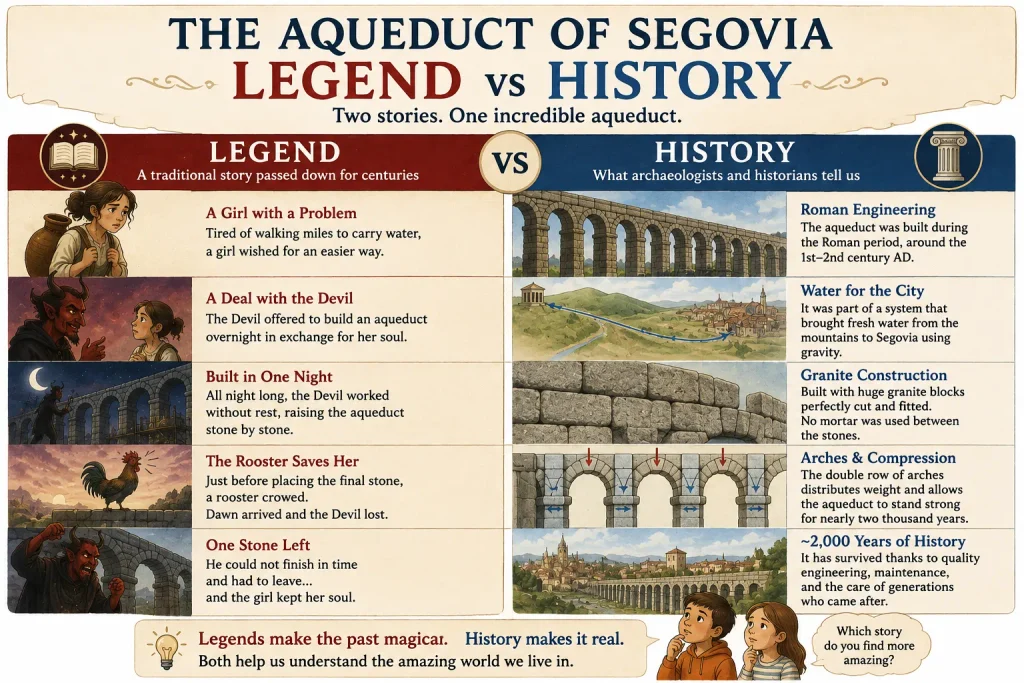
The Aqueduct of Segovia is a Roman aqueduct.
It was constructed during the Roman period to transport water toward ancient Segovia.
The exact dating of the structure has been debated and refined by archaeological and historical research, so it is better not to give children a dramatically precise construction year as though somebody found the original Roman building permit.
What we can say confidently is much more interesting:
Roman engineers and workers created it roughly two thousand years ago.
No supernatural builder required.
And when you stand beneath it, the real story may actually be more impressive than the legend.
The Stones Are Not Held Together by Mortar
This is the detail I would tell children immediately after revealing that the Devil story is not true.
Look at the enormous granite blocks forming the famous elevated section of the aqueduct.
They were assembled using remarkably precise stone construction.
The blocks in the monumental arcade are famously fitted without mortar holding them together.
That usually produces the next question:
“Then why doesn’t it fall down?”
Now you have an engineering lesson.
The carefully shaped blocks, arches, gravity, compression, and distribution of forces allow the structure to stand.
Instead of glue holding the monument together, the stones and the geometry work together.
For a child, I would explain it like this:
“The stones are pushing against each other in exactly the right way.”
Suddenly those arches are not merely old.
They are a puzzle.
How Does an Arch Stay Up?
Ask the children to imagine building a doorway from rectangular toy blocks.
If you simply stack blocks across an empty space, the middle falls.
An arch solves the problem differently.
Its wedge-shaped pieces transfer forces outward and downward toward the supports.
At the top is the central area traditionally associated with the keystone.
Once the arch is properly constructed, compression helps keep the structure stable.
The Romans became exceptionally skilled at using arches in:
- aqueducts
- bridges
- amphitheaters
- monumental buildings
- other infrastructure
So when children look at Segovia’s repeated arches, they are seeing the same engineering principle used again and again.
One arch supports.
Then another.
Then another.
Until engineering becomes architecture.
A Mini Experiment for Kids
You can demonstrate the basic idea later at the hotel.
You do not need granite.
Try building an arch using:
- wooden blocks
- cardboard pieces
- books
- other safe objects you already have
The challenge is:
Can you create an opening that stays standing without putting a pillar directly underneath the middle?
It will not reproduce Roman engineering perfectly.
That’s not the point.
The goal is to make children think about the problem the Romans had to solve.
After trying—and probably knocking their first structure down—the real aqueduct becomes much more impressive.
Why Did Segovia Need an Aqueduct?
The Romans did not build this enormous structure because they wanted future tourists to take photographs underneath it.
They needed to move water.
That is the key to understanding aqueducts.
Cities need reliable water for everyday life.
But water sources are not always conveniently located where people live.
Roman engineers developed sophisticated systems that could transport water across considerable distances.
And here is the part children often misunderstand:
The water did not need to be pumped uphill through the aqueduct.
Gravity did most of the work.
The Aqueduct Is Really a Very Long, Gentle Slope
When children see the towering arches in Segovia, they may imagine that the Romans somehow pushed water up to the top.
The opposite idea is more useful.
An aqueduct system works by maintaining a carefully controlled downward gradient.
The water begins higher.
Then gravity carries it gradually along the route.
The monumental arches are needed where the water channel has to maintain that gradient while crossing lower ground.
So the enormous structure you see in Segovia is only the most spectacular visible portion of a larger water-supply system.
Tell the kids:
“The Romans weren’t trying to make the water climb. They were giving it a very long downhill road.”
That is usually much easier to visualize.
A Challenge: Can Your Kids Spot the Two Levels of Arches?
At the most famous section around Plaza del Azoguejo, look upward.
The aqueduct rises dramatically above the city.
Ask the children:
“How many rows of arches can you see?”
At its monumental section, they will notice two tiers.
Then ask:
“Why do you think the arches at the bottom and the arches at the top aren’t exactly the same?”
You do not need an immediate answer.
Let them look.
Travel becomes more interesting when children are allowed to observe before adults explain everything.
How Big Is the Aqueduct?
The most famous monumental section reaches approximately 28 meters in height at its highest point.
That is roughly the height of a modern multi-story building.
But again, the number matters less when children can compare it with themselves.
Stand underneath.
Look up.
Then ask:
“How many of you would we need to stack on top of each other to reach the top?”
Please do not actually attempt the experiment.
The question is enough.
The aqueduct also contains more than a hundred arches along its monumental arcade.
Instead of making children memorize the exact count, challenge them to count a section.
They will probably give up.
That is useful too.
Now they understand scale.
Can You Find the Roman Writing?
There is another detail older children may enjoy searching for.
The aqueduct once carried a monumental inscription.
The original metal letters are gone, but traces associated with the fastening of those letters can still help researchers investigate what may once have been written there.
Do not promise children that they will be able to read a perfect Roman sentence carved across the aqueduct.
They won’t.
Instead say:
“Some of the clues are tiny marks left behind by letters that disappeared a very long time ago.”
Now the monument becomes an archaeological detective story.
History is often like that.
We do not always receive a complete answer.
Sometimes we receive holes, marks, fragments, and clues—and historians try to reconstruct what they mean.
Why Invent a Devil Story About Something the Romans Built?
This may be the most interesting question in the entire article.
Imagine living centuries after the Roman Empire.
You see an enormous stone structure crossing your city.
You do not have modern cranes.
You do not have trucks.
You do not have power tools.
The structure is already ancient.
And perhaps you do not fully understand how people so long ago constructed something so enormous.
How do you explain it?
One answer found in folklore across Europe is:
Something supernatural must have built it.
The Devil appears in legends connected with bridges, rocks, buildings, and other structures in many places.
When human engineering seems almost impossible, folklore gives the impossible builder a name.
That does not make the legend useless because it is historically untrue.
Quite the opposite.
The legend tells us something about how later generations looked at the Roman monument with amazement.
The real builders were humans.
But what they accomplished looked almost supernatural.
What Happened to the Girl in the Legend?
This is a good place to return to the story.
The girl wanted one simple thing:
an easier way to get water.
Instead, she made a terrible bargain, regretted it, prayed for help, and—according to the legend—escaped with her soul when dawn arrived before the Devil could finish his work.
But legends survive because people keep telling them.
And Segovia has not forgotten this one.
Today, visitors can even find a modern sculpture connected to the legend near the aqueduct: a representation of the Devil himself, looking toward the monument traditionally associated with his impossible night’s work.
For children, that creates another small challenge.
“Can we find the Devil?”
The sculpture is modern.
The legend is much older.
The aqueduct is much, much older still.
That gives families three different layers of time in one place:
Roman history → centuries-old folklore → modern Segovia remembering the folklore
And that distinction is worth explaining.
A statue of the Devil does not prove the legend happened.
It proves that the story became part of Segovia’s cultural memory.
Why Is the Aqueduct Still Standing?
Once children understand that humans built the aqueduct, another question becomes almost inevitable.
“How can something this old still be here?”
There is no magical answer.
There are several real ones.
The quality of Roman engineering matters.
The granite construction matters.
The structural logic of the arches matters.
And so does everything that happened after the Romans.
Ancient monuments do not survive two thousand years simply because their original builders were clever.
Later generations also:
- used them
- repaired them
- protected them
- changed the areas around them
- eventually recognized their historical importance
The Aqueduct of Segovia survived because it continued to matter.
That is another useful lesson for children:
History does not preserve itself. People decide what to protect.
Did Water Really Travel Across the Top?
Yes.
That is the entire reason the aqueduct existed.
The dramatic arches were not built merely to support themselves.
At the upper part of the structure was the channel associated with transporting water.
The complete Roman water system extended beyond the famous monumental arcade tourists photograph today.
Water traveled toward Segovia from outside the city through a carefully engineered route.
So when children stand underneath the highest arches, ask them to imagine something very ordinary happening high above:
water moving toward people’s homes and public spaces.
That contrast is wonderful.
From below, the aqueduct looks monumental.
To Roman engineers, it was also infrastructure.
It solved a practical problem.
Could Romans Turn on a Tap?
Not the way we do.
Roman water systems could supply fountains, public baths, public facilities, and—in some circumstances—private users, although access to water was not identical for everyone.
That gives children an interesting comparison.
Today, they may turn on a tap without thinking about where the water came from.
The Romans also needed to answer the same fundamental questions:
Where is our water?
How do we move it?
How do we keep it flowing?
How do we distribute it?
The technology changed.
The problem did not.
That is one of the reasons ancient engineering can feel surprisingly modern.
A Family Game: Legend or History?
After telling the story, try this while standing near the aqueduct.
Read each statement and let the children decide:
LEGEND or HISTORY?
1. The Devil built the aqueduct overnight.
LEGEND
2. The aqueduct was created during the Roman period.
HISTORY
3. A girl made a bargain because she was tired of carrying water.
LEGEND
4. The aqueduct transported water toward Segovia.
HISTORY
5. The Devil lost because the rooster crowed before he placed the final stone.
LEGEND
6. The famous granite arcade was constructed without mortar between its blocks.
HISTORY
7. The aqueduct survived because of magic.
LEGEND
8. Human engineering allowed the arches to support enormous weight.
HISTORY
Then ask the harder question:
“Which story is more amazing?”
Some children will choose the Devil.
Others may decide that humans building this almost two thousand years ago is actually more unbelievable.
There is no wrong answer.
What Should Kids Look for at the Aqueduct?
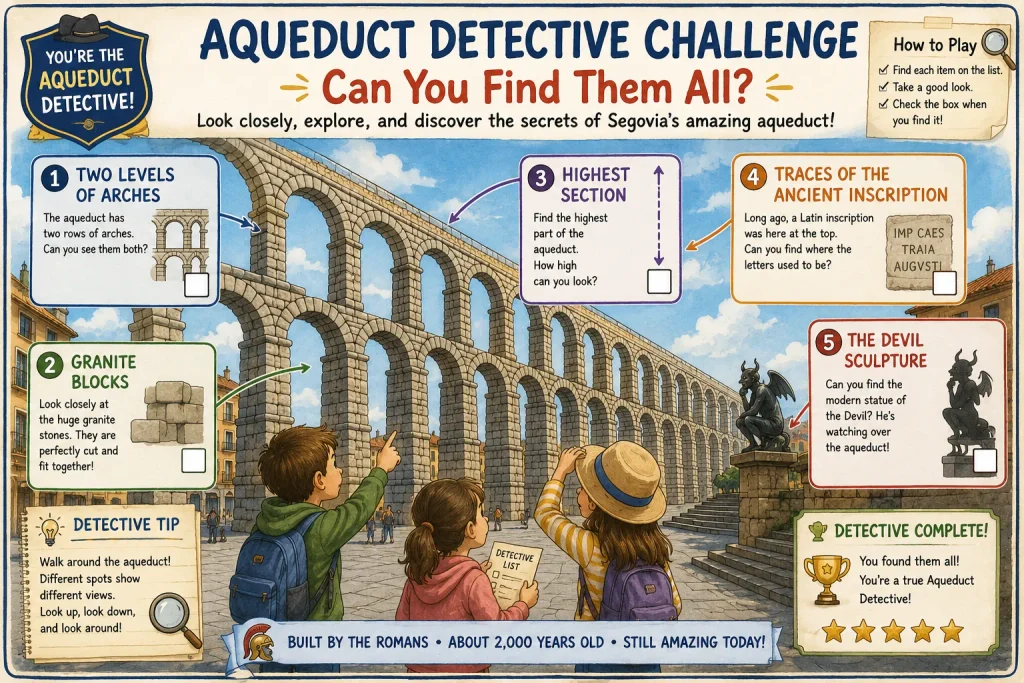
Instead of simply taking the photograph and moving on, give children five things to find.
1. The Two Rows of Arches
Find the point where the aqueduct rises high enough to show its dramatic double arcade.
2. The Granite Blocks
Look at the individual stones.
Ask:
“How would you lift one of those without a modern crane?”
3. The Highest Point
Stand near Plaza del Azoguejo and look up.
This is where the scale becomes obvious.
4. Signs of the Lost Inscription
Older children can look for the area associated with the former Roman inscription and imagine the metal letters once attached there.
5. The Devil
Look for the modern sculpture inspired by Segovia’s famous aqueduct legend.
Now the children are not merely following adults through another historic city.
They have a mission.
Why This Story Works So Well with Kids
Children often encounter historic monuments in the wrong order.
Adults begin with:
date → emperor → architectural style → dimensions → UNESCO
and lose them before the monument has had a chance to become interesting.
A story reverses the order.
Start with:
a tired girl + an impossible bargain + the Devil + one missing stone + a rooster
and suddenly the aqueduct matters.
Then reveal:
“But that’s not what really happened.”
Now history becomes the answer to a mystery the child already cares about.
That is why legends can be useful in family travel even when they are not historically true.
They create curiosity.
The important part is making the boundary clear:
This is what people told.
This is what historians and archaeologists tell us happened.
Children are perfectly capable of enjoying both.
The Real Story May Be Better Than the Legend
The Devil had magic.
The Romans did not.
They had:
- mathematics
- surveying
- stoneworking
- engineering knowledge
- organization
- labor
- time
They had to understand the landscape.
They had to determine where the water would travel.
They had to maintain a gradient gentle enough for gravity to keep working.
They had to cross uneven terrain.
They had to build arches capable of supporting enormous loads.
And they had to do all of that without:
- excavators
- trucks
- electric saws
- modern cranes
- computers
- laser measuring equipment
The legend explains the aqueduct by saying:
“Only the Devil could build something like this.”
History gives us a more remarkable answer:
People did.
A Question for Older Kids: Why Do Legends Change?
There is no single frozen version of an old legend.
Stories change when people tell them.
One storyteller adds a detail.
Another removes one.
A religious interpretation becomes stronger.
A character changes.
A location becomes more specific.
Eventually several versions of the same legend can coexist.
This is not necessarily evidence that somebody is telling the story “wrong.”
It is how folklore works.
Ask older children:
“If you told this story to your friends when we get home, which parts do you think you would remember?”
The Devil?
The girl?
The rooster?
The missing stone?
Now imagine people doing that for generations.
That is how stories travel through time.
Why Is the Aqueduct a UNESCO World Heritage Site?
Segovia’s Old Town and Aqueduct were inscribed on the UNESCO World Heritage List in 1985.
UNESCO highlights the aqueduct as one of the major monuments associated with the historic city and an outstanding example of Roman engineering.
But with children, I would avoid turning UNESCO into a stamp meaning:
“This is important, so you must be impressed.”
Instead explain:
“People from many countries agreed that places like this are important enough that we should try to protect them for the future.”
Then ask:
“What do you think people visiting here 500 years from now should still be able to see?”
Now preservation becomes something children can understand.
How Long Do Families Need at the Aqueduct?
You do not need hours just to stand beneath it.
The aqueduct works best as part of exploring Segovia rather than as an isolated attraction.
A family might:
see the aqueduct → tell the legend → walk through the historic center → visit the Alcázar → stop for food → continue exploring
The story itself may take only a few minutes.
But it changes what happens during those minutes.
Instead of:
“Kids, stand there. Photo.”
you get:
“Wait—where’s the stone the Devil didn’t finish?”
That is a much better beginning to Segovia.
Our Segovia with Kids: A Family Travel Guide can help you build the aqueduct, Alcázar, cathedral, Old Town, food, and realistic family pacing into the rest of the visit.
Questions to Ask Your Kids at the Aqueduct
You do not need to ask all of these.
Pick one or two according to age.
Younger Kids
Who do you think really built this?
How many arches can you count?
Can you find the Devil?
How did the water get to the top?
School-Age Kids
Why do arches stay standing?
Why would a Roman city need an aqueduct?
Which part of the Devil story sounds impossible?
How would you build this without modern machines?
Older Kids and Teenagers
Why do people invent supernatural explanations for ancient structures?
Why might later generations preserve a Roman structure instead of dismantling it?
Can a legend be culturally important even when it isn’t historically true?
What evidence would historians need to understand when and why the aqueduct was built?
One monument.
Completely different conversations depending on the child.
FAQ: The Legend of Segovia’s Aqueduct
Did the Devil build the Aqueduct of Segovia?
No.
The Devil story is a traditional legend associated with the aqueduct.
The structure itself is a work of Roman engineering.
What is the legend of Segovia’s aqueduct?
A popular version tells of a girl who was tired of carrying water and made a bargain with the Devil. He promised to build a way to bring water to the city before dawn in exchange for her soul.
The Devil nearly completed the aqueduct, but the rooster crowed before he could place the final stone.
Why was the Aqueduct of Segovia really built?
The Roman aqueduct formed part of a system designed to transport water toward ancient Segovia.
Is the Aqueduct of Segovia really built without mortar?
The monumental granite arcade for which Segovia’s aqueduct is famous was constructed from precisely fitted stone blocks without mortar binding those blocks together.
How old is the Aqueduct of Segovia?
It dates to the Roman period, making it roughly two thousand years old. Its precise construction dating has been the subject of historical and archaeological study.
Can children see the Devil in Segovia?
Families can find a modern sculpture inspired by the aqueduct’s Devil legend near the monument.
The sculpture commemorates the folklore; it is not evidence that the story actually happened.
Is the Aqueduct of Segovia a UNESCO World Heritage Site?
The Old Town of Segovia and its Aqueduct were inscribed on UNESCO’s World Heritage List in 1985.
Final Thoughts: Tell the Story, Then Show Them the History
When you first arrive at the Aqueduct of Segovia, resist the urge to explain everything.
Let the children look up.
Then tell them about the girl.
Tell them about the water.
Tell them about the bargain.
Tell them about the Devil racing against sunrise.
And when you reach the moment when only one stone remains—
let the rooster crow.
Then smile and say:
“Of course, that’s the legend.”
Now show them the granite.
The arches.
The height.
The route the water followed.
The engineering.
Because that is the wonderful thing about Segovia’s aqueduct.
The imaginary story requires the Devil to build it.
The real story only requires humans to have done something extraordinary.
And they did.
Continue Exploring Segovia and Spain with Kids
Segovia with Kids
Our Segovia with Kids: A Family Travel Guide can help you turn the aqueduct story into a full family day with the Alcázar, cathedral, Old Town, food, viewpoints, and realistic pacing.
Languages in Spain
Our Languages in Spain: Why Does Spain Have So Many Languages? shows another way to turn things children notice during a Spain trip into stories about the country’s history and regional identities.
Best Places to Visit in Spain with Kids
Use our Best Places to Visit in Spain with Kids guide to decide where Segovia fits among Spain’s major family destinations.