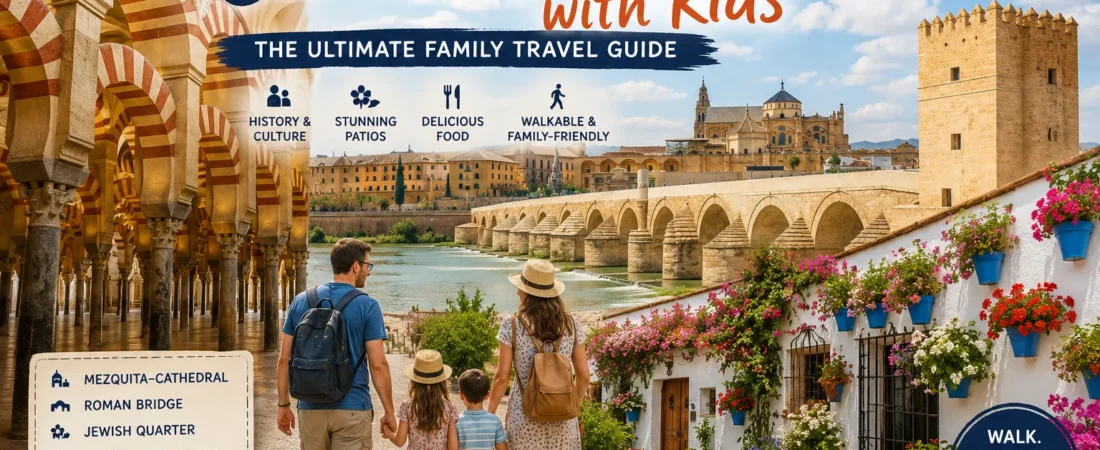
Córdoba is easy to underestimate when planning a family trip through Spain.
On a map of Andalusia, it can look like the city you squeeze between Seville and Granada.
Arrive in the morning.
See the Mezquita.
Cross the Roman Bridge.
Eat lunch.
Leave.
And yes, that is possible.
But Córdoba becomes much more interesting when you stop treating it as a single-monument destination.
Within a remarkably compact historic center, families can encounter:
a mosque transformed into a cathedral,
Roman remains,
a medieval Jewish quarter,
an ancient synagogue,
Islamic and Christian architecture,
flower-filled patios,
a fortress and gardens,
and one of Andalusia’s strongest food identities.
There is also a practical advantage.
If you’re searching for Cordoba with kids, the first thing to know is that this compact Andalusian city is much easier to explore than its extraordinary history might suggest.
You do not need a car.
You do not need complicated daily transportation.
And unlike Granada, you are not constantly negotiating steep hills.
But Córdoba has one enormous family-travel challenge:
heat.
In the hottest part of summer, that is not a small weather detail.
It can determine the structure of the entire day.
Plan around it, however, and Córdoba can become one of the most rewarding stops on a family trip through Andalusia.
Córdoba with Kids: Quick Family Guide
| Question | Recommendation |
|---|---|
| Ideal stay | 1–2 nights |
| Minimum worthwhile visit | 1 full day |
| Best for | History, architecture, patios, food |
| Best ages | School-age children and teenagers especially |
| Getting around | Mostly walking |
| Car needed? | No for the historic center |
| Walking difficulty | Relatively easy, though expect cobbles and summer heat |
| Essential attraction | Mosque-Cathedral of Córdoba |
| Best outdoor experience | Alcázar gardens / Roman Bridge |
| Best neighborhood | Judería |
| Best seasonal experience | Córdoba Patios |
| Biggest family challenge | Extreme summer heat |
| Best food introduction | Salmorejo + shared local dishes |
| Day trip possible? | Yes |
| Worth staying overnight? | Also yes — for the right itinerary |
For a first family visit, I would not build a huge checklist.
The core Córdoba experience can be:
Mosque-Cathedral
↓
Judería
↓
Alcázar
↓
Roman Bridge
↓
patios
↓
Cordoban food
That is already enough to understand why this relatively small city occupies such an extraordinary place in Spanish history.
Why Córdoba Works With Kids
Córdoba’s greatest family advantage is not one particular attraction.
It is proximity.
In some major European destinations, a family can lose surprising amounts of time:
waiting for transport,
changing Metro lines,
walking between distant neighborhoods,
or repeatedly getting everyone organized for the next journey.
Historic Córdoba works differently.
Many of the places families want to see are concentrated around the old city.
That means the day can feel more like exploration and less like transportation.
But Compact Does Not Mean You Should Rush
This is the trap.
Because everything looks close, parents start adding:
one more monument,
one more courtyard,
one more church,
one more museum.
Suddenly the supposedly easy Córdoba day becomes exhausting.
I would use Córdoba’s compact size to slow the family down, not to fit more attractions into the day.
Walk.
Stop.
Eat.
Look into courtyards.
Sit somewhere cool.
Then continue.
That rhythm suits Córdoba far better than racing through it.
Córdoba’s UNESCO Story Is Bigger Than the Mezquita
Many visitors associate Córdoba’s UNESCO status only with its most famous monument.
The story is broader.
The Historic Centre of Córdoba is recognized as a UNESCO World Heritage property, with the Mosque-Cathedral at its heart.
That larger designation makes sense once you walk through the city.
The significance is not confined inside one building.
It extends through an urban landscape shaped by different periods and communities.
Roman Córdoba.
Islamic Qurtuba.
Jewish Córdoba.
Christian Córdoba.
Modern Córdoba.
The layers remain unusually close to one another.
Córdoba’s Patios Are a Different Kind of UNESCO Heritage
This distinction is useful, especially for older children.
Córdoba’s historic center is tangible heritage:
buildings,
streets,
monuments,
physical places.
The traditional Fiesta of the Patios of Córdoba, meanwhile, is recognized by UNESCO as Intangible Cultural Heritage.
That means UNESCO is not simply protecting a particular flowerpot or courtyard.
The heritage includes the traditions and community practices surrounding the patios.
For children, I would explain it like this:
A historic building can be heritage because of what was built.
A tradition can be heritage because of what people continue to do.
Córdoba gives families examples of both.
1. Mosque-Cathedral of Córdoba — The Essential Experience
If you visit only one major monument in Córdoba, this is it.
The Mosque-Cathedral of Córdoba, often simply called the Mezquita, is one of Spain’s most extraordinary buildings.
And the reason is not merely its beauty.
It contains different historical identities inside the same structure.
Start With the Columns
You do not need to begin with a long historical explanation.
Walk inside.
Let children look.
Rows of columns seem to continue into the distance.
Above them are the famous alternating arches.
The repetition creates an environment completely unlike a conventional European cathedral.
Ask children:
How many columns do you think there are?
Why do the arches repeat?
Does this feel like a church you have seen before?
Let the building create the questions first.
Then give them the history.
Explain the Story in Three Steps
For school-age children, I would simplify Córdoba’s complicated history into three broad stages.
1. Córdoba Became One of the Great Cities of Islamic Iberia
Following the Muslim conquest of much of the Iberian Peninsula in the eighth century, Córdoba developed into a major political and cultural center of Al-Andalus.
Construction of the Great Mosque began under Abd al-Rahman I in the eighth century and the complex was expanded by later rulers.
2. The Mosque Grew With the City
As Córdoba became increasingly important, the mosque expanded.
That helps explain the extraordinary forest of columns and architectural layers visitors see today.
3. After the Christian Conquest, It Became a Cathedral
Córdoba came under Christian rule in 1236.
The former mosque was consecrated as a Catholic cathedral, and Christian architectural elements were subsequently added and developed within the existing structure.
That is why visitors today encounter something visually extraordinary:
Islamic architecture surrounding a Christian cathedral interior.
Don’t Teach the Building as a Simple Before-and-After Story
With older children and teenagers, Córdoba provides an opportunity to go a little deeper.
History is rarely:
one civilization disappears → another civilization appears.
Buildings are reused.
Political power changes.
Religious meanings change.
Architecture is modified.
Communities remain, move, adapt or disappear.
Memory changes too.
The Mosque-Cathedral makes those layers physically visible.
This is one reason I think Córdoba can be more powerful for older children than a conventional museum.
You are not looking at an illustration of historical change.
You are standing inside it.
The Mihrab
One of the most visually remarkable parts of the former mosque is the richly decorated mihrab area.
This is where slowing down matters.
Children may not understand the religious or architectural significance immediately.
Start with observation.
Gold.
Patterns.
Arabic inscriptions.
Geometry.
Light.
Then explain what the space represented within the mosque.
A family visit does not require understanding every architectural term.
It requires noticing.
Then Find the Cathedral Inside the Mosque
After children become accustomed to the repeating Islamic architectural space, move toward the later Christian additions.
The visual transition can be startling.
That is the moment to ask:
Why would people build this here instead of destroying everything and starting again?
There is no one-sentence answer.
That is exactly why the question is worth asking.
How Long Should Families Allow?
Do not treat the Mosque-Cathedral as a ten-minute photo stop.
For many families, roughly one to two hours can work, depending on:
children’s ages,
interest in history,
crowds,
and whether you use an audio or guided experience.
Some families will need less.
History-focused teenagers may want more.
Go Early in Hot Weather
During warmer months, I would make this one of the day’s first major activities.
Not because the building disappears later.
Because the family still has:
energy,
patience,
and cooler morning conditions.
Córdoba’s most important attraction deserves the family’s best hour, not whatever energy remains after lunch.
Family rating: ★★★★★
Best for: School-age children and teenagers
Planning priority: High
Biggest advantage: One building makes Córdoba’s layered history visible
2. The Roman Bridge — History Children Can Walk Across
After an intense architectural experience, the Roman Bridge provides exactly what many families need:
outside.
Movement.
Space.
Views.
No audio guide.
No need to whisper.
The bridge crosses the Guadalquivir and connects the historic side of Córdoba with the area around the Calahorra Tower.
Is the Bridge Really Roman?
This is a useful historical question.
The crossing has Roman origins, but what visitors see today reflects centuries of rebuilding and modification.
That is another good lesson for children.
A historic monument does not necessarily survive unchanged from the day it was first constructed.
Cities continuously rebuild themselves.
The Best View May Be Behind You
Walk across the bridge.
Then turn around.
The view back toward the Mosque-Cathedral and historic Córdoba helps children understand the city’s geography.
This is especially effective if they have already visited the monument.
Now the enormous building they were inside becomes part of a skyline.
Morning or Evening?
Both can work.
In hot weather, I would avoid deliberately crossing the exposed bridge during the harshest part of the afternoon simply because it appears next on the itinerary.
Morning light can be beautiful.
Evening can be particularly atmospheric.
And the bridge is free, so there is no timed-ticket pressure forcing the family into the wrong moment.
Family rating: ★★★★½
Best for: All ages
Cost: Free
Combine with: Mosque-Cathedral / Calahorra area / riverside walk
3. Calahorra Tower — Optional, Not Mandatory
At the southern end of the Roman Bridge stands the Torre de la Calahorra.
The fortified structure helps tell another part of Córdoba’s long defensive and urban history.
Depending on current exhibitions and family interest, the interior can add historical context.
But I would categorize this as:
optional.
If children are still curious:
go.
If they have just completed a substantial Mosque-Cathedral visit and want to stay outside:
keep walking.
Not every historic structure needs to become an interior visit.
4. Alcázar de los Reyes Cristianos — Fortress, History and Gardens
Córdoba’s Alcázar gives families another historical layer.
The complex is associated with Christian monarchs and later periods of Córdoba’s history, while the site itself reflects a much longer sequence of occupation and change.
For children, however, the easiest entry point may be:
fortress + gardens.
Why the Gardens Matter
Historic sightseeing works better when environments change.
Inside.
Outside.
Architecture.
Water.
Trees.
Space.
The Alcázar gardens can provide that contrast.
Fountains, pools and formal planting create a completely different experience from the dense streets of the Judería or the interior of the Mosque-Cathedral.
Don’t Turn the Alcázar Into “Another Alhambra”
Families arriving from Granada may instinctively compare every Andalusian palace or fortress with the Alhambra.
I would avoid that.
The Alcázar in Córdoba tells a different story and operates on a different scale.
Let it be Córdoba.
Should You Climb?
Where current access permits elevated viewpoints or towers, use the same family rule we apply elsewhere:
climb because the family wants the view, not because a guide says the tower exists.
Heat matters.
Energy matters.
The next three hours matter.
5. Judería — Córdoba’s Historic Jewish Quarter
Around the Mosque-Cathedral lies one of the most atmospheric parts of historic Córdoba.
The Judería is associated with the city’s medieval Jewish community and forms an essential part of understanding Córdoba’s multicultural past.
Expect:
narrow streets,
whitewashed walls,
small plazas,
shops,
flowers,
and heavy visitor traffic around popular routes.
Don’t Reduce Córdoba to “Three Cultures Living Happily Together”
This is important, particularly with teenagers.
Córdoba is often presented through a simplified story of:
Muslims,
Christians,
and Jews
coexisting peacefully.
There were periods of remarkable cultural exchange and intellectual activity.
There were also:
political conflict,
changing legal status,
religious pressure,
persecution,
and eventual expulsion.
The real history is more interesting than the tourism slogan.
You do not need to turn a family vacation into a seminar.
But older children deserve something more accurate than a perfect fairy tale of medieval harmony.
6. Córdoba Synagogue — Small Building, Big Story
The Córdoba Synagogue is much smaller than the Mosque-Cathedral.
That does not make it insignificant.
Its survival gives families a physical connection to the history of Córdoba’s Jewish community.
Because the site is compact, it can work particularly well as part of a Judería walk rather than as a major standalone attraction.
Use Scale to Your Advantage
This is a good place for a shorter historical stop.
Children do not need every attraction to take an hour.
Sometimes:
ten minutes of context,
a small historic space,
and one memorable question
are enough.
With older children, this can lead naturally into the history of Jewish life in medieval Spain and what changed around the end of the fifteenth century.
Check current opening and access conditions before visiting.
Maimonides and Córdoba
The Judería also provides an opportunity to introduce older children to Maimonides, the influential medieval Jewish philosopher, physician and scholar born in Córdoba.
Do not turn this into a biography lesson.
The interesting idea is simpler:
Córdoba was not important only because rulers built impressive buildings.
It also produced and attracted people involved in:
medicine,
philosophy,
science,
religion,
and scholarship.
Cities become historically important through ideas as well as monuments.
7. Córdoba’s Patios — When Private Space Becomes Part of the City
Córdoba’s patios provide a completely different experience from its major monuments.
White walls.
Flowerpots.
Courtyards.
Water.
Shade.
Color.
The tradition developed partly in response to something families visiting in summer will understand immediately:
Córdoba gets hot.
Courtyard architecture can help create shade, ventilation and cooler interior environments.
Suddenly the flowers are not just decoration.
The architecture responds to climate.
The Patios Festival
Córdoba’s famous Patio Festival traditionally takes place in spring, when participating courtyards open and compete as part of the city’s celebrated patio tradition.
This can be an extraordinary time to visit.
It can also mean:
more visitors,
greater demand,
and a different travel rhythm.
If the patios are a primary reason for the trip, check the official dates and participation arrangements for your specific year before booking transportation or accommodation.
Do not rely on an old article’s festival dates.
Can You See Patios Outside the Festival?
Yes, Córdoba’s courtyard culture does not vanish when the festival ends.
However, access varies because many patios are associated with private homes or specific visitor arrangements.
Some can be visited through organized routes or publicly accessible spaces at other times.
Check current information rather than assuming every beautiful courtyard photographed online will be open when you arrive.
San Basilio and the Patio Experience
The San Basilio area is particularly associated with Córdoba’s patio tradition and can fit naturally into a family exploration around the Alcázar side of the historic center.
But again:
do not make children inspect twenty courtyards.
After several:
flowers become flowers.
Choose enough to understand the tradition.
Then stop while everyone still thinks they are beautiful.
Why Patios Work Particularly Well With Children
They are visual.
They are colorful.
They are relatively easy to understand.
And they provide an excellent contrast with monumental history.
A child does not need to understand the political history of medieval Iberia to decide:
“I like that blue pot.”
That reaction belongs in the trip too.
What I Would Prioritize With Kids
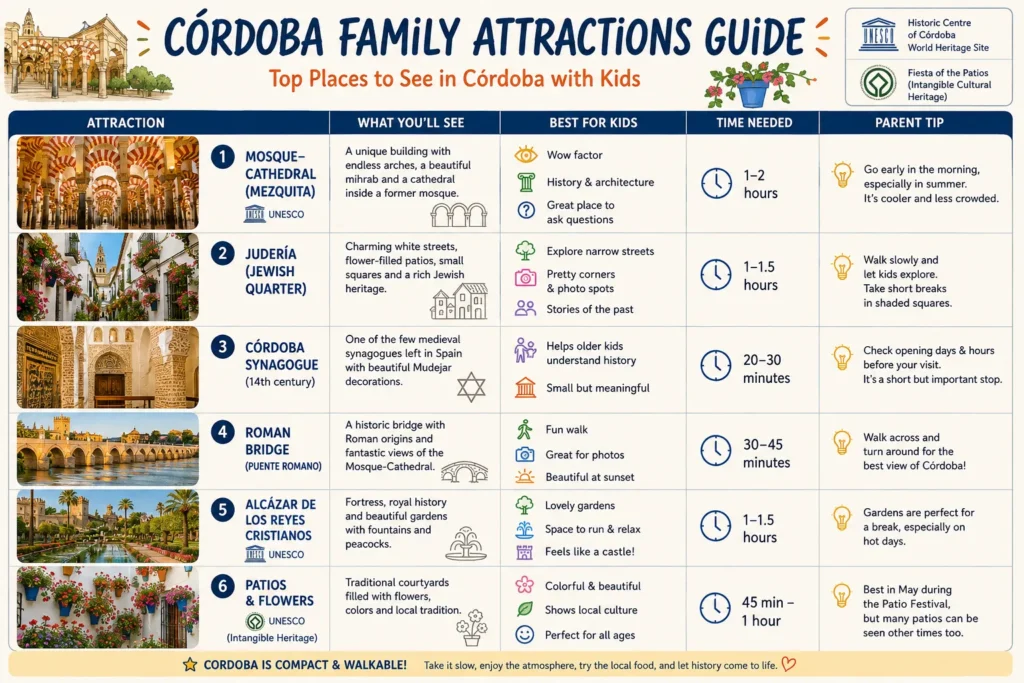
For a first Córdoba family visit, my order would be:
1. Mosque-Cathedral
↓
2. Judería + Synagogue
↓
3. Roman Bridge
↓
4. Alcázar + Gardens
↓
5. Patios
Everything beyond that depends on:
time,
season,
weather,
and children’s interests.
For a one-day visit, I would rather experience those well than add five more minor monuments.
The Córdoba Family Rhythm I Would Use
Córdoba is compact enough that parents can make the mistake of planning everything continuously.
I wouldn’t.
Especially in warm weather, think:
major historic experience in the morning
↓
short neighborhood exploration
↓
proper lunch
↓
rest / indoor time during the hottest hours
↓
one lighter late-afternoon experience
↓
Roman Bridge or old-town walk in the evening
That structure becomes even more important in summer.
Córdoba is a city where the thermometer should be allowed to edit the itinerary.
A schedule written three months before the trip should not outrank the conditions your children are actually walking through.
What to Eat in Córdoba With Kids
Córdoba’s food deserves more than a quick list of dishes at the end of the guide.
This is another way families can understand the city.
The climate matters.
Agriculture matters.
Andalusian traditions matter.
History matters.
And fortunately, several Cordoban specialties are easy to share, which is exactly how I prefer to introduce unfamiliar food to children.
Order a few dishes.
Put them in the middle.
Let everyone taste.
Nobody needs to commit to an enormous plate of something they have never seen before.
Salmorejo Cordobés — Start Here
If there is one dish I would make sure the family tries in Córdoba, it is salmorejo.
At first glance, children may think:
tomato soup.
But traditional Cordoban salmorejo is much thicker.
It is generally made from ingredients including:
tomatoes,
bread,
olive oil,
garlic,
and salt.
It is commonly served cold and often topped with ingredients such as chopped egg and cured ham.
Why It Makes Sense in Córdoba
Eat salmorejo on a hot Córdoba day and the dish immediately makes more sense.
Cold.
Simple.
Rich enough to feel substantial.
Built around ingredients strongly associated with southern Spanish cooking.
Food becomes connected to climate.
Is It Easy for Kids?
Potentially very easy.
Children who like tomato-based flavors may accept it immediately.
Others may find the texture unfamiliar.
Order one.
Share it.
I would much rather let a child taste three spoonfuls of a local specialty willingly than order an entire dish and spend lunch negotiating over it.
Flamenquín — Probably the Easier Sell
Flamenquín is a Cordoban specialty traditionally involving pork loin wrapped around cured ham, breaded and fried.
For many children, the concept is considerably less challenging than it sounds.
Meat.
Ham.
Breadcrumbs.
Fried.
This can be one of the easier introductions to local Cordoban food.
Share First
Portions can be substantial depending on the restaurant.
Instead of automatically ordering one per person, consider sharing alongside other dishes.
That also leaves room for the next local specialty.
Berenjenas con Miel — The Dish That Creates a Question
Berenjenas con miel typically combines fried aubergine — eggplant — with a sweet accompaniment, often associated in Córdoba with cane honey or syrup.
Children may look at the combination and ask:
Sweet eggplant?
Exactly.
Try it.
The contrast between:
crisp,
soft,
savory,
and sweet
makes this a particularly fun sharing dish.
Not everyone will love it.
That is fine.
Trying is the experience.
What About Children Who Want Familiar Food?
Feed them.
Córdoba is not a test of culinary courage.
If one child happily eats salmorejo and another wants something familiar, the family has not failed at cultural immersion.
Spanish restaurants generally provide enough variety that families can combine:
local dishes,
shared plates,
meat,
potatoes,
bread,
and simpler options.
Travel food works better when curiosity is invited rather than enforced.
Where to Stay in Córdoba With Kids
Because Córdoba’s main historic sights are concentrated relatively closely together, accommodation location can make the visit extremely easy.
For a first family trip, I would prioritize:
walking convenience,
air conditioning,
quiet enough sleeping conditions,
and easy access back to the hotel during the afternoon.
That final point becomes especially important in summer.
Judería / Mosque-Cathedral Area — Best for Historic Atmosphere
Staying around the historic center puts families close to:
the Mosque-Cathedral,
Judería,
Roman Bridge,
restaurants,
and many major sights.
Best for
Short stays and families who want to do most sightseeing on foot.
Trade-off
Historic streets can mean:
cobbles,
limited vehicle access,
tourist traffic,
and rooms in older buildings with varying layouts.
Check the exact property rather than assuming every historic hotel is equally convenient for children.
Centro — Best for Practical Convenience
Staying slightly outside the tightest historic core can provide a useful balance.
Families may gain:
easier transportation,
more conventional streets,
shops,
restaurants,
and potentially simpler luggage logistics
while remaining within walking distance of the old city.
Best for
Families prioritizing practicality over sleeping beside the Mezquita.
Near the Train Station — Useful for a Short Rail Stop
This can make sense if Córdoba is a one-night stop between other Spanish cities.
Arrive.
Leave luggage.
Explore.
Return.
Depart the following morning.
But I would not choose the station area solely to save a few minutes if the family values evening atmosphere in the historic center.
Hotel or Apartment?
For one night, I generally see a strong argument for a hotel.
Check in.
Drop luggage.
Explore.
Breakfast.
Leave.
Simple.
For two or more nights, an apartment can become more attractive if the family values:
separate sleeping spaces,
kitchen facilities,
laundry,
and more room.
In Summer, Air Conditioning Is Not Optional in My Search
This is one filter I would apply immediately.
Not:
“It would be nice.”
But:
Does this property have effective air conditioning?
Córdoba can experience intense summer heat.
A beautiful historic room does not compensate for a family that cannot sleep.
If the hotel has a pool, that can also dramatically change the usefulness of the afternoon.
Getting Around Córdoba With Kids
For most family sightseeing:
walk.
That is one of Córdoba’s advantages.
The historic core is compact enough that public transportation does not need to dominate the itinerary.
But there are exceptions.
Taxi
An occasional taxi can be useful for:
the train station,
luggage,
very hot weather,
tired younger children,
or accommodation outside the historic center.
There is no reason to turn a short family trip into an endurance test just because the city is technically walkable.
Bus
Local buses can help with journeys beyond the historic core or accommodation farther away.
Check current routes for your specific stay rather than memorizing route numbers from an article that may become outdated.
Car
A rental car is unnecessary for a normal central Córdoba visit.
If Córdoba is part of a wider Andalusian road trip, the car may be useful between destinations.
Inside the historic center, it becomes something you need to park and manage.
Check your accommodation’s parking arrangements and current access restrictions before driving toward narrow central streets.
Córdoba With a Stroller
Compared with Granada, Córdoba is considerably easier in terms of elevation.
That does not mean perfectly smooth.
Expect:
cobbles,
narrow historic streets,
occasional uneven surfaces,
crowds,
and accessibility differences inside historic monuments.
A lightweight stroller can work well for much of the city.
The bigger stroller problem in July may not be the stones.
It may be the temperature.
Córdoba’s Biggest Family Challenge: Summer Heat
This deserves its own section because it changes the answer to almost every other question.
Can we walk from the hotel?
Normally, yes.
Can we spend two hours wandering the Judería?
Normally, yes.
Should we cross the Roman Bridge?
Of course.
At 16:00 on an extremely hot August afternoon?
Those answers can change.
Do Not Plan Summer Córdoba Like Spring Córdoba
This is the mistake.
Parents create a perfectly sensible itinerary:
09:00 Mosque-Cathedral
11:00 Judería
13:00 Alcázar
15:00 lunch
16:30 Roman Bridge
18:00 patios
Then the actual day arrives with punishing heat.
The schedule should lose.
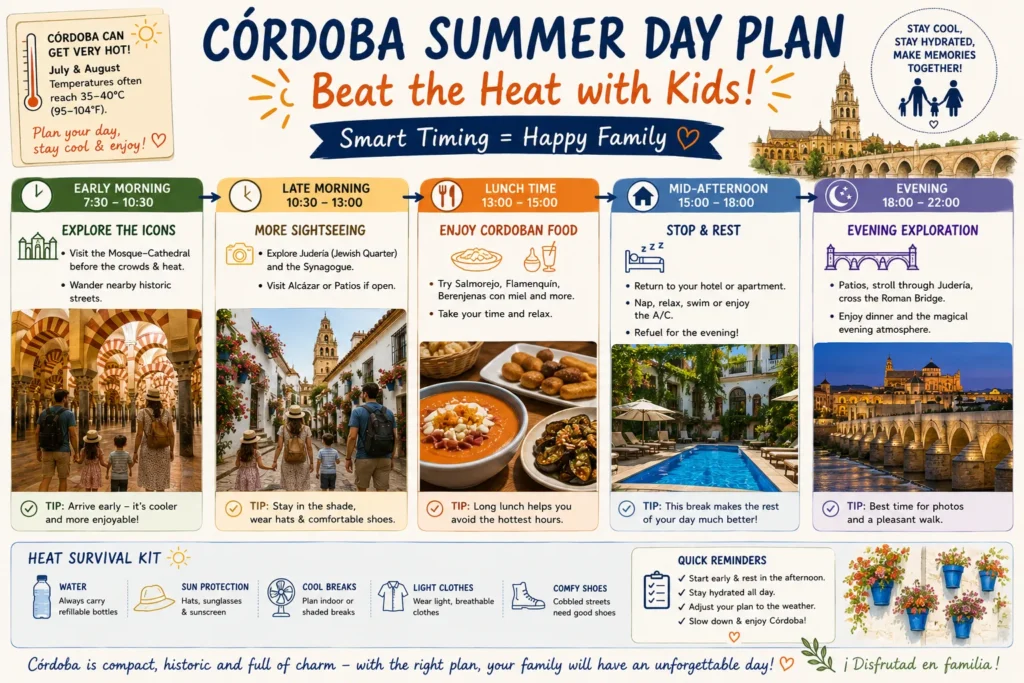
The Summer Córdoba Day I Would Use
Early Morning
Start early.
Use the most comfortable hours for:
Mosque-Cathedral,
historic streets,
or another priority sight.
Late Morning
Continue with one nearby attraction.
Do not waste the cooler part of the day sitting in the hotel if everyone is ready to explore.
Lunch
Make it a proper break.
Salmorejo suddenly feels like an extremely logical invention.
Mid-Afternoon
Stop.
Hotel.
Pool.
Air conditioning.
Nap.
Indoor space.
Anything that prevents the family from spending the harshest hours marching across exposed streets.
Late Afternoon / Evening
Restart.
Judería.
Patios according to access.
Roman Bridge.
Dinner.
Walk.
Córdoba can feel like a different city once the worst heat begins to ease.
Hydration Is Part of the Itinerary
This should not be relegated to a packing-list footnote.
Carry water.
Refill when appropriate.
Use hats and sun protection.
Look for shade.
Pay attention to children rather than waiting for them to announce that they are overheating.
If weather warnings or extreme conditions are issued, change the plan.
No monument in Córdoba is important enough to compete with heat safety.
Best Time to Visit Córdoba With Kids
Spring
For many families, this is the obvious standout.
Temperatures can be more comfortable for sightseeing.
Flowers transform the city.
And Córdoba’s famous patio traditions become particularly visible.
May and the Patios
This can be one of the most beautiful times to experience Córdoba.
It can also be one of the busiest.
If visiting specifically for the Patio Festival:
check official dates,
book accommodation early,
expect crowds,
and understand that you are choosing an event-focused version of Córdoba rather than an ordinary quiet city break.
Summer
Possible?
Yes.
Would I choose it over spring or autumn if the dates were completely flexible?
No.
If summer is when the family can travel, go — but design the itinerary around heat rather than pretending it does not exist.
Autumn
Potentially excellent for:
walking,
history,
food,
and combining Córdoba with Seville and Granada.
Winter
Córdoba remains a strong cultural destination.
The patio experience will obviously differ from spring, but major historical attractions do not disappear.
Check weather and seasonal opening schedules for your actual dates.
A Realistic 2-Day Córdoba Family Itinerary
Two days gives Córdoba enough room to breathe.
This is the version I prefer if the wider Spain itinerary can afford the night.
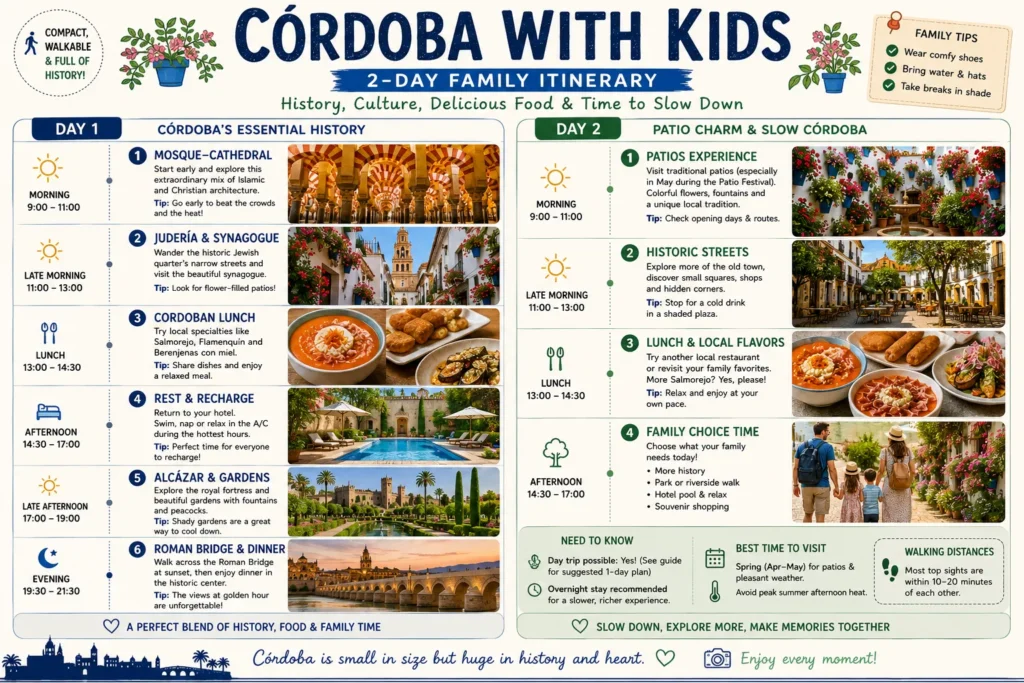
Day 1 — Córdoba’s Essential History
Morning — Mosque-Cathedral
Make this the first major experience.
Give it proper time.
Do not arrive already tired from three other attractions.
Late Morning — Judería
Walk slowly.
Include the Synagogue if current access works.
Introduce older children to Córdoba’s Jewish history and Maimonides.
Do not attempt every minor monument.
Lunch — Cordoban Food
This is the moment for:
salmorejo,
flamenquín,
berenjenas con miel,
or several dishes shared across the table.
Take your time.
Afternoon — Rest
In warm weather, this is non-negotiable in my itinerary.
In cooler seasons, families can shorten the break or continue exploring according to energy.
Late Afternoon — Alcázar
Visit the historic complex and gardens.
Let the outdoor space change the pace after the morning’s dense historical experience.
Evening — Roman Bridge
Walk toward the Guadalquivir.
Cross if everyone wants to.
Turn around.
Look back at the Mosque-Cathedral.
Now the family can see much of the day’s history in one view.
Dinner afterward.
Done.
Day 2 — Patios + Slow Córdoba
Day 2 does not need another blockbuster monument.
That is the point.
Morning — Patio Experience
Explore accessible patios according to:
season,
current opening arrangements,
and family interest.
If visiting during the festival, the patio experience may become a much larger part of the day.
Late Morning — Historic Streets
Return to somewhere you rushed yesterday.
Find a plaza.
Explore another part of the old city.
Have something cold to drink.
Lunch
One more proper Cordoban meal.
Try whatever the family missed on Day 1.
Afternoon — Choose One
Option A — More History
For children who genuinely want it.
Option B — Park / Relaxed Walk
For families who have had enough monuments.
Option C — Hotel Pool
An excellent cultural institution in August.
Option D — Leave for the Next City
Also completely reasonable.
Two days does not have to mean two full days.
Córdoba as a Day Trip — Is One Day Enough?
Yes.
This is important.
You do not need to manufacture a two-night stay just because this is called the Ultimate Family Travel Guide.
Córdoba works unusually well as a day trip because:
the historic center is compact,
the train station is manageable,
and the essential sights are concentrated.
A strong day trip can include:
Mosque-Cathedral
↓
Judería
↓
lunch
↓
Alcázar OR patios
↓
Roman Bridge
Then leave.
That is a legitimate Córdoba experience.
So Why Stay Overnight?
Because the city changes when you stop treating the departure time as the day’s final deadline.
Day visitors leave.
The light changes.
The Roman Bridge becomes an evening walk instead of another attraction.
Dinner becomes part of the destination.
And the family can return to the historic center the following morning without trying to accomplish everything at once.
If the wider itinerary has room, I prefer one night in Córdoba to a rushed day trip.
Not because Córdoba requires forty-eight hours of sightseeing.
Because having more time allows you to see less per hour.
That is often better family travel.
When I Would Choose the Day Trip Instead
If adding Córdoba overnight means:
another hotel change,
packing five people’s luggage again,
losing a comfortable Seville base,
and making the wider trip more complicated,
I would seriously consider the day trip.
Hotel changes have a cost that does not appear on Google Maps.
Pack.
Check out.
Move luggage.
Travel.
Wait.
Check in.
Unpack.
Repeat.
An overnight stay is not automatically superior simply because it sounds slower.
Look at the entire family itinerary.
Córdoba With Younger Children
With younger children, I would simplify aggressively.
Prioritize:
Mosque-Cathedral,
Roman Bridge,
Alcázar gardens,
patios,
food,
and plenty of breaks.
Reduce:
long historical explanations,
multiple religious interiors,
tower climbing,
and minor monuments.
The Mosque-Cathedral can become:
arches + columns + giant historic building
before it becomes a detailed lesson about medieval Iberian politics.
That is enough.
Córdoba With Teenagers
This is where Córdoba can become exceptional.
Teenagers can engage with:
Roman history,
Al-Andalus,
Islamic architecture,
Christian conquest,
Judaism in medieval Iberia,
Maimonides,
religious conversion of buildings,
historical memory,
and the difference between coexistence as an idealized story and coexistence as complicated historical reality.
The city provides a rare opportunity to ask:
Who gets to define what a building means after political power changes?
That is a much more interesting question than memorizing dates.
Córdoba, Seville or Granada With Kids?
All three belong to Andalusia.
They should not feel interchangeable.
| Córdoba | Seville | Granada | |
|---|---|---|---|
| Essential monument | Mosque-Cathedral | Royal Alcázar | Alhambra |
| Ideal first stay | 1–2 nights | 3 nights | 3 nights |
| Historic-center scale | Compact | Larger | Compact but hilly |
| Walking difficulty | Relatively easy | Moderate | Hills |
| Major family challenge | Summer heat | Extreme summer heat | Heat + hills |
| Best distinctive experience | Mezquita + patios | Flamenco + monumental city | Alhambra + Albaicín |
| Strong science attraction | Limited | Limited | Parque de las Ciencias |
| Easy day trip? | Excellent | Better as a stay | Better as a stay |
| Food identity | Very strong | Very strong | Tapas culture |
| Best for history-focused teens | Excellent | Excellent | Excellent |
Should Córdoba Replace Seville or Granada?
Usually, no.
For a first Andalusia trip, Córdoba works brilliantly because it complements the other cities.
Seville provides the scale and energy of a major Andalusian capital.
Granada provides the Alhambra and dramatic hillside landscape.
Córdoba provides something different:
historical density in a remarkably compact city.
If the trip is short, Córdoba may become the day trip.
If the trip is longer, give it the night.
How Córdoba Fits Into a Southern Spain Family Trip
A very natural Andalusian sequence is:
Seville → Córdoba → Granada
or the reverse depending on the wider route.
Rail connections make Córdoba particularly useful because families can integrate it without necessarily renting a car.
Families planning the full region can use our Southern Spain family itinerary to decide how many nights each Andalusian city deserves.
For the larger city experience, our Seville with Kids family travel guide covers the Alcázar, Plaza de España, flamenco, summer heat and a realistic three-day itinerary.
And families continuing east can use our Granada with Kids family travel guide for the Alhambra, Albaicín, Science Park and Granada’s very different hill-based travel strategy.
Families still deciding where Córdoba fits into their first Spain trip can compare destinations in our 15 Best Places to Visit in Spain with Kids guide.
Common Mistakes Families Make in Córdoba
Treating Córdoba as Only the Mezquita
The Mosque-Cathedral is essential.
The city around it explains why it matters.
Trying to Visit Every Historic Building
You do not need to complete Córdoba.
Ignoring the Temperature
A compact city can still become exhausting in extreme heat.
Scheduling the Roman Bridge at the Worst Time of Day
It is free.
Move it.
Turning the Patios Into a Collection Challenge
Five memorable courtyards are better than twenty children no longer care about.
Driving Into the Historic Center Without Planning
Check access and parking first.
Repeating the “Three Cultures” Story Without Nuance
Córdoba’s history is more complicated — and more interesting.
Adding an Overnight Stay Without Considering the Cost of Another Hotel Change
Look at the whole trip, not just Córdoba.
What I Would Protect in a Córdoba Family Itinerary
If I had to protect only three things, I would choose:
the Mosque-Cathedral when everyone still has energy
a proper Cordoban meal
and
an evening when the family is not racing for a train.
The third is obviously impossible on a day trip.
And that is exactly why the overnight decision matters.
Personally, if I had enough days in Andalusia, I would stay one night.
Not because there are twice as many things to see after sunset.
There aren’t.
I would stay because Córdoba seems like exactly the kind of city where slowing down changes the experience.
The famous sights are close.
That should create free time.
It should not become an excuse to double the sightseeing list.
A Small City Can Carry an Enormous Amount of History
This is what I find most compelling about Córdoba.
A family can walk a surprisingly short distance and move between stories separated by centuries.
Roman bridge.
Islamic mosque.
Christian cathedral.
Jewish quarter.
Synagogue.
Royal fortress.
Living patio tradition.
Those are not six versions of the same places.
They represent different political systems, religions, communities and ways of understanding the city.
And they overlap.
That is what makes Córdoba particularly valuable for older children and teenagers.
History stops looking like a row of separate chapters.
It becomes layers.
One generation builds something. Another changes it. Another gives it a different meaning. Hundreds of years later, we arrive with a camera and try to understand all of them at once.
That is far more interesting than simply collecting monuments.
Don’t Make Children Remember Every Civilization
There is also a danger in a city this historically dense.
Parents can start explaining everything.
Dates.
Dynasties.
Conquests.
Architectural terminology.
Religious history.
Important people.
Eventually, children stop listening.
I would choose a few ideas instead.
For younger children:
“This city has been rebuilt by different people for a very long time.”
For older children:
“Look for evidence of what changed — and what remained.”
That single question can follow the family through almost the entire city.
At the Mosque-Cathedral, it is obvious.
In the Judería, the surviving street pattern and synagogue tell another story.
At the Roman Bridge, centuries of reconstruction complicate the word “Roman.”
At the patios, the history is not simply preserved architecture but a tradition people continue to practice.
The children do not need to remember every date.
If they leave Córdoba understanding that cities accumulate history rather than replacing it neatly, the visit has already done something valuable.
One Córdoba Evening I Would Leave Almost Empty
If you stay overnight, I would deliberately resist booking every evening hour.
After the worst heat has passed:
leave the hotel.
Walk toward the historic center.
Cross part or all of the Roman Bridge if everyone feels like it.
Find dinner.
Get something cold.
Return through streets that looked completely different when they were crowded earlier in the day.
No ticket.
No audio guide.
No requirement to learn anything.
This is one of the reasons I prefer one night in Córdoba when the wider itinerary allows it.
A day trip can show you the city’s major sights.
An overnight stay gives you time when you are no longer trying to see them.
Those are different experiences.
Before You Book Córdoba: My Family Checklist
1. Decide Day Trip or Overnight First
Do not choose automatically.
Look at the entire Andalusia itinerary.
If staying overnight creates an inconvenient extra hotel change, a day trip can work extremely well.
If you have enough time, one night gives Córdoba a much better rhythm.
2. Check the Weather, Not Just the Season
Especially in summer.
The actual forecast should influence:
walking,
meal times,
rest,
and outdoor sightseeing.
3. Put the Mosque-Cathedral at the Center of the Plan
Check current opening information, ticket arrangements and any access conditions before the visit.
Build the rest of the historic-center day around it rather than squeezing it between smaller sights.
4. Check Patio Access
If patios are important to the family, verify what will actually be accessible during your dates.
The Patio Festival and ordinary visits are different experiences.
5. Book Air-Conditioned Accommodation in Hot Weather
I would not compromise on this to obtain a prettier historic room.
6. Plan One Proper Cordoban Meal
Salmorejo.
Flamenquín.
Berenjenas con miel.
Share.
Taste.
Let lunch become part of the sightseeing.
7. Leave Something Out
This may be the most important one.
Córdoba is compact enough that another attraction will always look possible.
It does not mean the family needs it.
Is Córdoba Worth Visiting With Kids?
Yes — but the reason changes according to the children’s ages.
With younger children, Córdoba works because it can be kept relatively simple.
A spectacular building.
A bridge.
Gardens.
Flowers.
Food.
Short walking distances.
With teenagers, it becomes something much deeper.
Few cities allow families to encounter so many complicated parts of Iberian history within such a small area.
Islamic rule.
Christian conquest.
Jewish intellectual history.
Religious architecture.
Political power.
Trade.
Urban adaptation.
Living traditions.
And the way modern tourism packages all of those histories for visitors today.
Is It as Immediately Child-Friendly as Valencia?
Probably not.
Valencia gives younger children:
Oceanogràfic,
Gulliver Park,
Turia Garden,
science,
and beach.
Córdoba asks for more interest in:
history,
architecture,
streets,
and food.
That is a different proposition.
Does That Mean Families With Young Children Should Skip Córdoba?
No.
It means the parents should change the expectations.
Do not ask a six-year-old to appreciate Córdoba in the same way a sixteen-year-old can.
Let the younger child remember:
the red-and-white arches,
the bridge,
the flowers,
the fountains,
and perhaps the fried food.
That is enough.
Córdoba Should Not Be a Checklist Between Seville and Granada
This is the biggest change I would make to the way many families plan the city.
Córdoba often appears in an itinerary like punctuation:
Seville — Córdoba — Granada.
Arrive.
Mezquita.
Lunch.
Bridge.
Train.
Technically, that works.
And if the trip only has enough time for a day visit, I would absolutely still go.
But if the family has the extra night, Córdoba rewards a different approach.
Not because you suddenly unlock fifteen additional must-see attractions.
Because you can stop treating every hour as scarce.
Sometimes the greatest benefit of adding a night is not seeing more. It is needing to see less today.
Final Thoughts: Córdoba Is Small Enough to Slow Down
Córdoba contains an extraordinary amount of history in a relatively small space.
That is its advantage.
It can also become its trap.
Parents see how close everything is and think:
We can fit one more thing in.
I would resist.
Start with the Mosque-Cathedral.
Give children enough context to understand why the building is so unusual.
Walk through the Judería without turning every doorway into a lesson.
Visit the Synagogue if it suits the family.
Eat salmorejo.
Explore the Alcázar gardens.
Look at patios.
Cross the Roman Bridge when the temperature and family energy make sense.
Then stop.
Córdoba does not become more meaningful because the family visited twelve monuments instead of six.
For me, the city’s strongest lesson is almost the opposite.
Look carefully at one place and you may discover several histories occupying it at the same time.
A mosque becomes a cathedral without completely ceasing to look like a mosque.
A Roman crossing survives through later reconstruction.
A medieval Jewish neighborhood remains part of a modern Spanish city.
A practical courtyard tradition becomes internationally recognized cultural heritage.
And a food created for this climate can make immediate sense after one hot afternoon.
That is Córdoba.
Its history is not neatly separated.
It sits on top of itself.
For families, that creates an opportunity that is much more valuable than another list of attractions:
children can begin to understand that the places we travel through today were never finished products.
People built them.
Changed them.
Reused them.
Argued over them.
Protected them.
And gave them new meanings.
Then, centuries later, we walk through.
If children leave Córdoba remembering only the endless arches, the flowers and the bridge, that is fine.
But if somewhere along the way they also begin to wonder:
“How can one place belong to so many different stories?”
then Córdoba has given them something that lasts much longer than a sightseeing checklist.