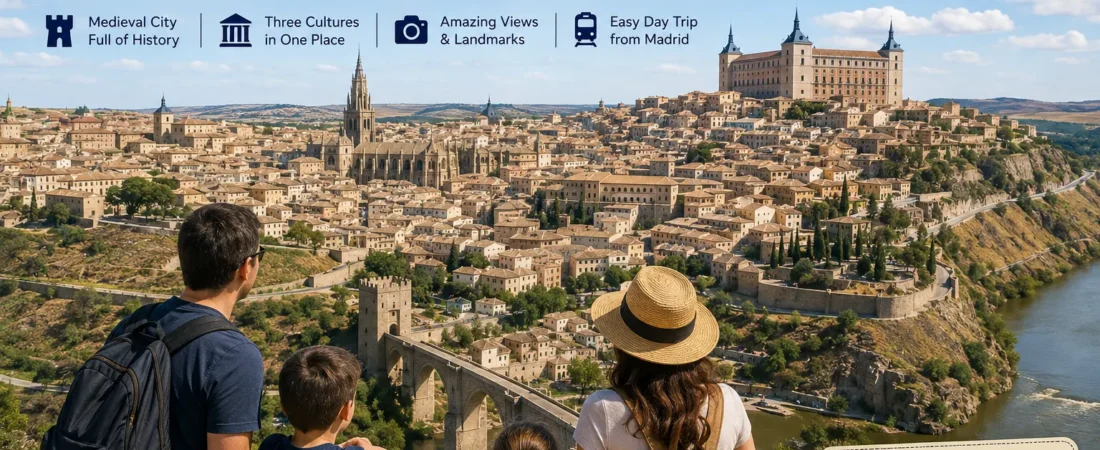
Toledo looks almost designed for children who imagine what a medieval European city should look like.
A fortress dominates the skyline.
Stone walls surround parts of the city.
Narrow streets twist between centuries-old buildings.
A medieval bridge crosses the Tagus River below.
Sword shops appear throughout the historic center.
And from across the valley, the entire city rises dramatically above the surrounding landscape.
But Toledo with kids comes with one important warning:
the distances are short, but the walking is not always easy.
Toledo is built on a hill.
Cobblestones, slopes, stairs and summer heat can turn what looks like a simple one-kilometer walk into something very different with younger children.
That does not make Toledo a poor family destination.
It means Toledo rewards families who plan around its geography rather than simply following a list of monuments.
And that is exactly what makes the city such an excellent contrast to Madrid.
You can leave Spain’s modern capital in the morning, spend the day inside a city shaped by Roman, Islamic, Jewish and Christian history, and return to the same Madrid hotel that evening.
No new accommodation.
No unpacking.
No additional luggage.
Just a completely different Spain for one day.
Toledo with Kids: Quick Family Guide
| Question | Recommendation |
|---|---|
| Ideal stay | Day trip or 1 night |
| Best base | Madrid |
| Best for | Medieval history, castles, architecture, older children |
| Best ages | School-age children and teenagers |
| Getting around | Mostly walking |
| Car needed? | No for a Madrid day trip |
| Biggest challenge | Hills + cobblestones + summer heat |
| Best first major sight | Toledo Cathedral or Alcázar |
| Best family viewpoint | Mirador del Valle |
| Best strategy | 2–3 major sights + wandering |
| Day trip possible? | Yes — one of Madrid’s strongest family day trips |
Toledo is compact enough to experience in a day.
But compact does not mean effortless.
The smartest family itinerary is not the one that sees the greatest number of monuments.
It is the one that avoids walking up the same hill three times.
Why Toledo Is Different: The City of Three Cultures
Toledo is often described as the City of Three Cultures.
That phrase refers to the long historical presence and influence of:
Christians
Muslims
and
Jews
within the city.
The reality of medieval coexistence was much more complicated than a simple story of three communities living together peacefully, but the phrase provides families with a useful way to understand why Toledo looks and feels different.
Churches.
Synagogues.
Islamic architectural influences.
Christian buildings incorporating Mudéjar design.
Different historical neighborhoods.
Instead of explaining this history to children as an abstract lesson before arriving, let the city reveal it gradually.
A Simple Way to Explain Toledo to Children
Younger children do not need a lecture about medieval Iberian politics.
Try something simpler:
“Different groups of people lived in this city over hundreds of years, and each one left something behind.”
Then look for those layers while walking.
That turns Toledo into a historical treasure hunt.
For teenagers, the story can become much deeper.
Why did Toledo become important?
How did political power change?
What happened to Spain’s Jewish communities?
What was Al-Andalus?
Why do some Christian buildings contain architectural styles associated with Islamic Spain?
Toledo becomes much more interesting once the buildings are connected to those questions.
1. Toledo Cathedral — The City’s Great Interior
The Cathedral of Saint Mary of Toledo is one of the city’s defining monuments.
From outside, children may initially see:
another cathedral.
Inside, the scale changes the experience.
High Gothic architecture, chapels, religious art, elaborate decoration and centuries of history make it one of Toledo’s major cultural sites.
Why It Can Work With Kids
The cathedral works best when parents resist the temptation to explain everything.
Choose a few things to notice.
How high is the ceiling?
How did people build something this large without modern machinery?
Why are there so many chapels?
What details look different from churches the family has already visited?
Older children interested in art can also encounter works connected with El Greco, whose life and career became deeply associated with Toledo.
How Long Should Families Spend Here?
For many families:
45–75 minutes
is enough.
Families particularly interested in religious architecture or art may naturally stay longer.
But Toledo contains too much else to turn the cathedral into a two-hour endurance test for children who are already losing interest.
Parent Reality Check
The cathedral is a major paid attraction, so check the current official visitor information for ticket options and opening times before the trip.
Religious services and special dates can also affect tourist access.
Family rating: ★★★★½
Best for: School-age children and teenagers
Allow: Around 45–75 minutes
Best strategy: Focus on scale and a few memorable details
2. Alcázar of Toledo — The Easiest Toledo Story for Many Kids
The Alcázar sits at one of Toledo’s highest points.
Its massive rectangular form dominates the skyline and immediately communicates something children understand:
fortress.
The site has been rebuilt and transformed repeatedly over centuries and today houses Spain’s Army Museum.
That makes it particularly appealing to children and teenagers interested in:
armor,
weapons,
fortifications,
military history,
and how cities were defended.
Why the Alcázar May Work Better Than Another Church
Toledo contains many important religious buildings.
A family that tries to visit all of them may quickly discover that historical significance does not automatically translate into children’s enthusiasm.
The Alcázar changes the subject.
Now the conversation can be about:
fortresses,
armies,
defense,
Spanish history,
and why controlling a hilltop city mattered.
Variety matters.
Should Every Family Enter?
No.
The building itself is important to Toledo’s skyline, but the museum’s subject matter will naturally appeal more to some children than others.
If nobody in the family cares about military history and you only have six hours in Toledo, it may not deserve a long indoor visit.
If your child loves castles, armor and history, it may become one of the day’s strongest attractions.
Family rating: ★★★★½
Best for: School-age children and teenagers interested in history
Biggest advantage: A completely different experience from Toledo’s churches
3. Jewish Quarter — Where the “Three Cultures” Story Becomes Real
The Jewish Quarter is not one attraction.
That is part of its value.
Walking through this side of Toledo allows families to connect the city’s famous Three Cultures story with actual streets and buildings.
Several important sites are concentrated here, including historic synagogues and the area around the El Greco Museum.
Families do not necessarily need to enter everything.
Choose according to time and children’s interests.
Synagogue of Santa María la Blanca
This building is particularly interesting because its appearance immediately challenges simple assumptions about architectural identity.
A synagogue built with strong Mudéjar architectural characteristics and later converted for Christian use becomes a physical example of Toledo’s layered history.
For older children, that can lead to much more interesting conversations than memorizing dates.
Synagogue of El Tránsito
Another major Jewish heritage site, associated with the Sephardic Museum.
Families with older children interested in Spanish Jewish history may find this particularly worthwhile.
Again, you do not need to visit every historical interior in Toledo.
One carefully chosen synagogue may communicate more than rushing through two.
Parent Reality Check
This is an area where Toledo’s streets themselves matter.
Do not turn the Jewish Quarter into:
synagogue → museum → church → museum.
Walk.
Look at the architecture.
Stop somewhere.
Let the neighborhood connect the individual sites.
Family rating: ★★★★½
Best for: Older children and teenagers interested in history
Best approach: One major interior + neighborhood walking
4. Puente de San Martín — Medieval Toledo Without Museum Fatigue
The San Martín Bridge is one of my favorite types of family attraction.
It is historically interesting.
Visually dramatic.
Outdoors.
And free to experience.
After several interiors, that combination becomes extremely valuable.
The medieval bridge crosses the Tagus River below the historic city, with defensive towers helping create exactly the kind of scene children may associate with medieval Europe.
Why It Works So Well in a Family Itinerary
Children do not need another audio guide.
Parents do not need another ticket.
Everyone gets fresh air.
And the bridge helps children understand Toledo’s geography.
The city is not simply a collection of monuments.
It occupies a defensive hill surrounded on several sides by the Tagus.
Once children see that landscape, the location of the city starts making sense.
But Remember the Hill
Getting down toward the river is one thing.
Getting back up is another.
This is where route planning matters.
Do not casually add the bridge because it looks close to something else on Google Maps without considering elevation.
Family rating: ★★★★½
Best for: All ages capable of the walk
Cost: Free
Biggest consideration: What goes down may have to walk back up
5. Mirador del Valle — The View That Explains Toledo
If you want children to understand Toledo as a city rather than a collection of buildings, take them somewhere they can see the whole thing.
Mirador del Valle provides the classic panorama across the Tagus toward Toledo.
From here, the city’s geography becomes obvious.
The Alcázar.
The cathedral tower.
The dense historic center.
The river.
The hill.
Suddenly the medieval city makes sense.
When Should Families Visit?
Many visitors like the viewpoint toward the end of the day because the light can be particularly beautiful.
But for families, the “best” time is the time that fits the itinerary without creating unnecessary transportation.
It can also work well earlier in the day as an introduction:
That is where we’re going.
Then children can identify buildings from the viewpoint before exploring them.
How Do You Get There?
Mirador del Valle sits outside the historic center, so families should think about transportation rather than assuming it belongs naturally on a walking loop.
Options can include:
taxi,
tourist transport,
organized sightseeing services,
or a car if Toledo is part of a wider road trip.
Specific tourist-train routes, schedules and prices can change, so check current information rather than relying on an old article saying a train leaves every hour for a fixed price.
Family rating: ★★★★★
Best for: Everyone
Best feature: Makes Toledo’s geography understandable
Planning issue: Transportation
6. Toledo’s Tourist Train — Useful Transportation Disguised as an Attraction
This is one of those experiences adults and children may interpret differently.
Parents see:
transportation and sightseeing.
Children see:
a train.
That makes it potentially useful.
The tourist train typically provides a route around Toledo that includes views outside the historic center, making it one way to reach perspectives that would otherwise require substantial walking.
For families with younger children, it can also provide a physical break.
Should Every Family Take It?
No.
If you enjoy walking, have older children and already have another plan for Mirador del Valle, it may be unnecessary.
But if the children are tired and the alternative is another long uphill walk, suddenly a tourist train becomes much more attractive.
Check the current route, departure point, schedule and ticket price for your travel date.
Family rating: ★★★★
Best for: Younger children and tired legs
Biggest advantage: Sightseeing + rest
7. Toledo’s Swords — The Unexpected Kid Magnet
Walk through Toledo and you will probably notice something children notice immediately:
swords.
Shop windows display swords, armor and replicas connected with Toledo’s centuries-old metalworking reputation.
For children who arrived thinking medieval history sounded boring, this can change the conversation very quickly.
Toledo Steel and the City’s Identity
Toledo became famous for sword making and metalworking over centuries.
Today, many items in tourist shops are souvenirs rather than historical artifacts, but the tradition gives families an easy entry point into the city’s past.
Why did Toledo become famous for blades?
Who made them?
Who used them?
How were they produced before modern factories?
Those questions can make the surrounding history more tangible.
Parent Reality Check
A souvenir sword is not automatically a good travel purchase.
Airline baggage rules, security regulations and laws at your destination matter.
Do not buy a realistic blade first and investigate transportation rules afterward.
For most families, looking may be considerably easier than buying.
Toledo With Kids: What I Would Prioritize
Toledo contains enough historical sites to fill more than one day.
Most families do not need all of them.
If You Have About 5–6 Hours
Prioritize:
historic center walk
Toledo Cathedral OR Alcázar
Jewish Quarter
one outdoor landmark
Mirador del Valle if logistics work
That already provides a strong introduction.
If You Have a Full Day
You can comfortably add:
another major interior,
more time in the Jewish Quarter,
the tourist train,
or a slower lunch.
The important word is:
comfortably.
Do not turn the extra time into permission to enter every church and museum.
If You Stay Overnight
Now Toledo becomes a different destination.
Day-trip crowds decrease.
The historic streets become quieter.
There is no train back to Madrid dictating when the experience must end.
An overnight stay makes particular sense for families who:
love history,
want photography around sunset or early morning,
or are deliberately building a slower Central Spain itinerary.
For everyone else, Toledo remains extremely effective as a Madrid day trip.
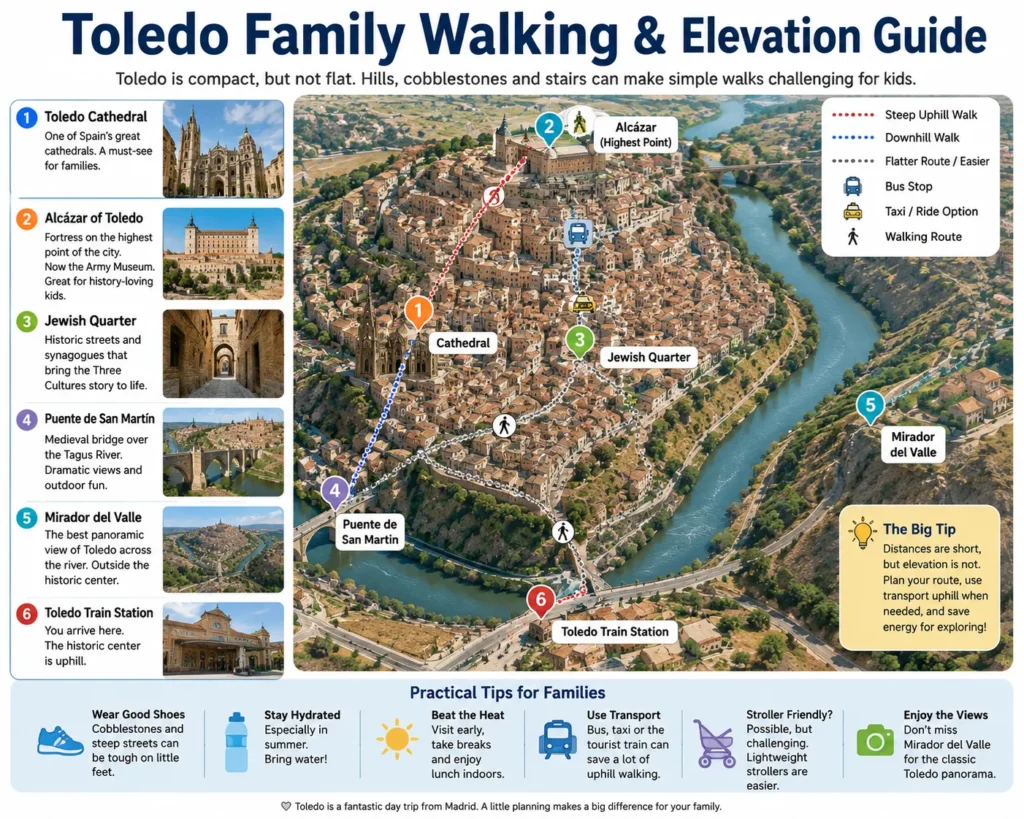
The Most Important Toledo Family Tip: Plan for Elevation, Not Distance
This may be the most useful practical advice in the entire guide.
On a flat map, Toledo looks easy.
Everything appears close.
And geographically, many attractions are close.
But a 700-meter route downhill followed by a 700-meter route uphill is not the same family experience as walking 1.4 kilometers through a flat city.
Before deciding:
“We can just walk there.”
look at the elevation.
This matters particularly for:
young children,
strollers,
older family members,
and summer travel.
Sometimes a short taxi or tourist transport ride is not laziness.
It is good itinerary design.
How to Get to Toledo From Madrid With Kids
For most families visiting Toledo as a day trip, Madrid is the obvious starting point.
The important thing is to separate two ideas:
train journey time
and
actual door-to-door travel time.
The rail journey itself can be remarkably quick.
But your family still needs to:
leave the Madrid hotel,
reach the departure station,
arrive before the train,
travel to Toledo,
and then get from Toledo railway station up to the historic center.
That does not make Toledo difficult.
It simply means you should treat it as a proper day trip, not as a place that is somehow “30 minutes from Madrid.”
Madrid to Toledo by Train
Fast trains between Madrid and Toledo make rail the most straightforward option for many families.
The journey itself is typically around half an hour, depending on the service.
The major advantage is predictability.
No parking.
No navigating Toledo’s old streets by car.
No need to worry about driving back to Madrid after a long sightseeing day.
For families already staying centrally in Madrid, train travel usually fits naturally into the trip.
Book the Return Too
On popular travel dates, I would not assume the family can simply arrive at Toledo station whenever everyone feels finished and immediately board the next convenient train.
Check schedules in advance and consider reserving both directions.
The return ticket also creates a useful boundary:
We need to be heading toward the station by this time.
That helps prevent the classic family-travel problem of adding “just one more thing” until everyone suddenly has to rush.
Always verify current schedules and fares through the official rail operator before traveling.
Toledo Station Is Not the Historic Center
This is important.
You arrive at a beautiful railway station.
You have not arrived at Toledo Cathedral.
The historic center sits uphill.
Families generally need to decide how they want to handle that final section.
Depending on current services, options can include:
bus,
taxi,
or walking.
Walking is possible.
Whether it is how you want to begin a full sightseeing day with children is another question.
My Family Strategy
If younger children are involved, I would seriously consider saving their legs at the beginning of the day.
Getting transportation uphill toward the historic center and doing more walking once inside can make more sense than spending everyone’s energy before the sightseeing has properly started.
Then later, depending on the route, you can decide whether walking downhill toward the station makes sense.
Energy is a resource on family trips.
Use it where the experience is worth it.
Do You Need a Car in Toledo?
For a Madrid day trip:
No.
Train plus local transportation is generally enough.
A car becomes more useful when Toledo is part of a wider Castilla-La Mancha or Spanish road trip.
Even then, driving into the historic core is not necessarily the goal.
Old Toledo was not designed around modern family SUVs.
Parking outside the most difficult central streets and exploring on foot is usually more sensible.
Check current parking and traffic restrictions before driving.
Where to Stay in Toledo With Kids
Many families will not need accommodation at all.
That is one of Toledo’s strengths.
But if you decide to stay overnight, location becomes important because of the hills.
Historic Center — Best for Atmosphere
Staying inside Toledo’s old city gives families the experience that day visitors miss.
Walk outside in the evening and the medieval streets are still there.
The difference is that many visitors have left.
This is particularly appealing for:
older children,
history-loving families,
photographers,
and travelers who deliberately want a slower stay.
Check before booking
Elevator access.
Parking if driving.
How far luggage must be carried.
Street accessibility.
And most importantly:
elevation.
A hotel that looks 500 meters from the cathedral may involve a very different walk from another hotel 500 meters away.
Near Easier Access Routes — Better for Practicality
Families with:
young children,
large luggage,
a stroller,
or mobility concerns
may prefer accommodation that sacrifices a little medieval atmosphere for easier access.
Do not choose a hotel solely because its map pin sits in the middle of the old city.
Look at how you will actually reach the front door.
What to Eat in Toledo With Kids
The original version of this guide promised readers what to “see, eat and experience” in Toledo but barely discussed food.
That was a missed opportunity.
Toledo has a distinctive Castilian food culture, and several specialties are easy to incorporate into a family visit.
Marzipan — Toledo’s Easiest Family Food Experience
If there is one Toledo specialty that is easy to turn into a family travel experience, it is mazapán de Toledo.
Marzipan has deep historical associations with the city and remains one of Toledo’s best-known sweets.
For children, the explanation can be wonderfully simple:
almonds + sugar.
Walk into a traditional shop.
Choose a few pieces.
Share.
Now the family has tasted something connected directly to Toledo rather than simply stopping for generic ice cream.
Carcamusas
Carcamusas is one of Toledo’s characteristic savory dishes, generally involving pork cooked with tomato and other ingredients.
This is the kind of local dish worth looking for if the family wants something more distinctly Toledan than standard tapas.
Game and Castilian Cooking
Traditional restaurants may feature substantial meat dishes, stews and game associated with the cuisine of Castilla-La Mancha.
Whether children enjoy those dishes depends entirely on the child.
Do not force “authentic food” to become another obligation.
Order something local for the table and let everyone try it.
Lunch Is Part of the Toledo Strategy
Toledo is a place where I would deliberately use lunch as a break.
Especially in summer.
Sit down.
Get out of the sun.
Drink water.
Let everyone stop walking.
A 60–90 minute lunch may look inefficient when you are planning a day trip.
It may make the entire second half of the day better.
Toledo in Summer With Kids
Summer changes Toledo significantly.
The combination of:
strong sun,
stone streets,
hills,
and limited shade on some routes
can make afternoon walking difficult.
This is not the city where I would plan the most demanding uphill route at 15:00 in July.
A Better Summer Rhythm
Morning
Arrive early enough to use the cooler part of the day.
Visit the main historic attraction.
Lunch
Take a proper indoor break.
Early Afternoon
Choose something less physically demanding.
A museum.
An interior.
Tourist transport.
Or simply a longer rest.
Late Afternoon
Return outside for wandering and viewpoints when conditions improve.
Best Time to Visit Toledo With Kids
Spring
One of the easiest periods for walking and sightseeing.
Summer
Completely possible, but heat management becomes part of the itinerary.
Autumn
Excellent for walking-heavy exploration when temperatures are comfortable.
Winter
Toledo remains a strong cultural destination, although shorter daylight and colder conditions change how you structure the day.
There is no need to wait for a perfect season.
You simply need a different itinerary for August than for April.
A Realistic Toledo Day Trip From Madrid
This is how I would structure the day with children.
Not to maximize attractions.
To minimize unnecessary walking while still experiencing what makes Toledo special.
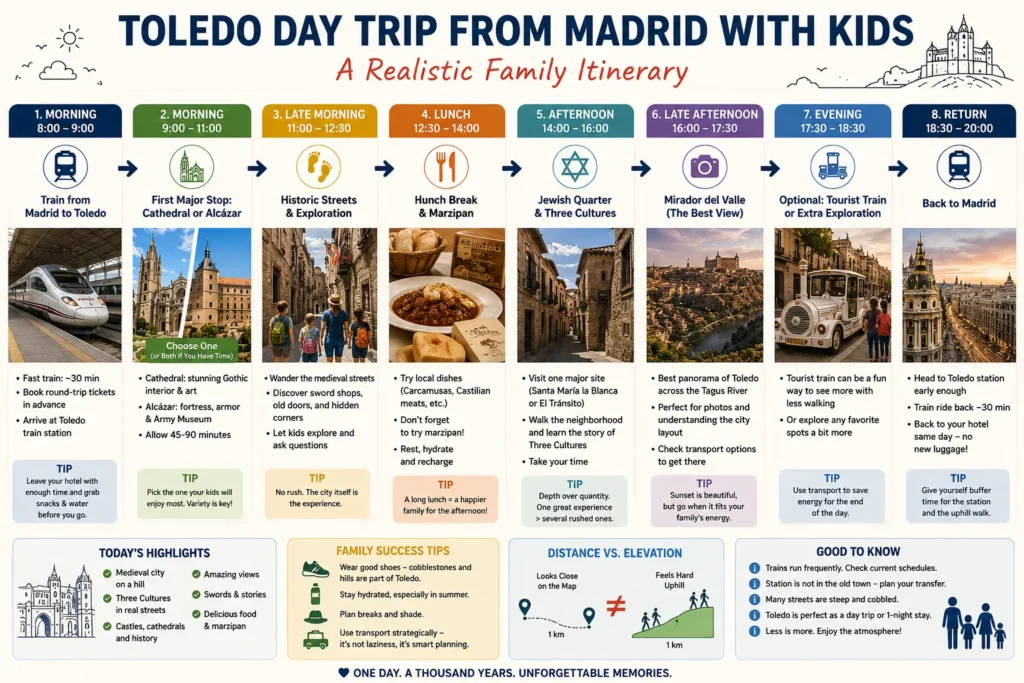
Morning — Madrid to Toledo
Take a morning train from Madrid.
Do not book an absurdly early departure simply because you feel guilty about “losing sightseeing time.”
A rested family is useful.
On arrival, consider transportation toward the historic center rather than automatically beginning with an uphill walk.
First Major Stop — Cathedral or Alcázar
Choose one as the morning’s main interior.
Choose Toledo Cathedral if:
the family is interested in architecture,
religious history,
art,
or major European cathedrals.
Choose the Alcázar if:
children are more interested in:
castles,
fortifications,
armor,
and military history.
Families with enough time can certainly visit both.
But you do not need both to justify the trip.
Late Morning — Historic Streets
Now wander.
This is when Toledo itself becomes the attraction.
Do not rush directly from ticketed site to ticketed site.
Let children notice:
swords,
old doors,
tiny streets,
views,
shops,
and unexpected corners.
Lunch — Stop Properly
Try something regional.
Add marzipan afterward.
Sit down long enough for everyone to recover.
Afternoon — Jewish Quarter
Choose one major Jewish heritage site rather than automatically entering everything.
Walk the neighborhood.
Connect the buildings to the Three Cultures story.
Late Afternoon — Mirador del Valle
If logistics and family energy allow, finish with the panorama.
Seeing Toledo from across the river is a fitting conclusion because the family can now recognize the places they spent the day exploring.
Return to Madrid
Leave enough time to reach Toledo station comfortably.
This is not the moment to discover that “the station is close” means:
close horizontally, not vertically.
Return to Madrid.
Same hotel.
No luggage.
That is why Toledo works so well as part of a Madrid family trip.
What If You Stay One Night?
An overnight stay changes the rhythm completely.
Instead of asking:
How much can we see before the return train?
you can ask:
Where do we want to be at sunset?
That is a much nicer question.
Day 1
Arrive from Madrid.
Cathedral or Alcázar.
Historic center.
Long lunch.
Jewish Quarter.
Mirador around late afternoon or evening.
Dinner.
Walk through Toledo after many day visitors have left.
Day 2
Slow breakfast.
Visit whichever major site you skipped.
Explore smaller streets.
Buy marzipan.
Return to Madrid or continue elsewhere.
Is One Night Worth It?
Yes, for the right family.
Stay overnight if:
- history is a major family interest,
- you dislike rushed day trips,
- Toledo is part of a broader road trip,
- or you want the old city after the daytime crowds thin out.
Stay in Madrid if:
- you are minimizing hotel changes,
- the children are happy with one strong day,
- or Toledo is one component of a larger Spain itinerary.
Neither approach is inherently better.
Toledo or Segovia With Kids?
Madrid families often face this decision.
Both are excellent day trips.
They offer very different experiences.
| Toledo | Segovia | |
|---|---|---|
| Main appeal | Medieval city + Three Cultures | Roman aqueduct + castle |
| History | Deep and layered | Highly visual |
| Walking | Hilly | Hilly but different layout |
| Best iconic sight | Cathedral / city panorama | Aqueduct / Alcázar |
| Food identity | Marzipan + Castilian cuisine | Cochinillo + Castilian cuisine |
| Easy story for younger kids | Good | Excellent |
| Older history-loving kids | Excellent | Excellent |
| Best for | Culture + medieval atmosphere | Romans + castles |
Choose Toledo If Your Children Like:
medieval cities,
religious and cultural history,
swords,
complex historical stories,
and atmospheric old streets.
Choose Segovia If Your Children Like:
castles,
Roman engineering,
dramatic landmarks,
and history that can be understood visually very quickly.
If You Have Time, Don’t Choose
With four or five nights in Madrid, families can potentially visit both on separate days.
That is one of Madrid’s great advantages.
You can experience:
Madrid
Toledo
and
Segovia
without changing hotels.
Toledo With a Stroller
This deserves a direct answer.
Possible? Yes.
Effortless? No.
Cobblestones, slopes and stairs make Toledo more complicated with a stroller than a flat modern city.
A lightweight stroller may be considerably easier than a large travel system.
Use transportation strategically.
Do not interpret taking a taxi uphill as somehow failing to experience Toledo properly.
The objective is to explore the historic city.
Not prove that your family can push a stroller up every hill.
Common Mistakes Families Make in Toledo
Assuming Compact Means Flat
This is probably the biggest one.
Check elevation.
Trying to Enter Every Historic Building
Toledo’s streets are part of the attraction.
Leave time to walk them.
Starting the Day by Exhausting Everyone
Consider transportation from the station toward the historic center.
Ignoring Summer Heat
Stone + hills + afternoon sun can become brutal.
Treating Mirador del Valle as a Casual Walking Stop
Think about how you are getting there and back.
Buying a Sword Without Thinking About the Journey Home
Airport security is considerably less romantic than medieval Toledo.
Forgetting the Return Train
Do not let one final souvenir shop turn into a sprint to the station.
How Toledo Fits Into a Spain Family Trip
For most first-time families, Toledo fits most naturally with Madrid.
A simple structure is:
Madrid — 3 or 4 nights
with
Toledo — day trip
and perhaps:
Segovia — another day trip
That gives the family enormous historical variety without adding hotel changes.
Families using Madrid as their Central Spain base can read our Madrid with Kids family travel guide for a realistic city itinerary and day-trip strategy.
For a broader view of where Toledo fits among Spain’s regions, our 15 Best Places to Visit in Spain with Kids guide compares the country’s major family destinations.
And families still building the overall journey can use our step-by-step guide to planning a family trip to Europe to decide how many destinations belong in the itinerary before booking transportation and accommodation.
Is Toledo Worth Visiting With Kids?
Yes — but not because Toledo contains a long list of “kid attractions.”
That is the wrong way to judge the city.
Toledo works because the city itself is understandable as an adventure.
A fortress on the hill.
A medieval bridge.
Sword shops.
Ancient streets.
Synagogues and churches.
A river surrounding much of the city.
A viewpoint where children can look across the valley and see the entire place they have spent the day exploring.
You do not need a theme park to make history interesting.
Sometimes you just need a city where history is still visible.
Final Thoughts: Toledo Is Better When You Stop Counting Attractions
Toledo can be exhausting if you treat it as a list.
Cathedral.
Alcázar.
Synagogue.
Museum.
Church.
Bridge.
Viewpoint.
Done that way, the city becomes another sightseeing challenge.
Instead, choose a few places that tell different parts of Toledo’s story.
Enter one extraordinary religious building.
See the fortress.
Walk through the Jewish Quarter.
Cross or view a medieval bridge.
Eat marzipan.
Let children look at the swords.
Then step back and see the whole city from across the Tagus.
That is enough.
The goal is not for children to return to Madrid remembering the dates of every dynasty that controlled Toledo.
It is for them to look back at the hilltop city and understand:
people have been building, fighting, praying, trading and living here for a very long time.
If they understand that, Toledo has done its job.