Italy Family Itinerary: 7 Days, 10 Days & 2 Weeks with Kids
An Italy family itinerary with kids works best when you stop trying to fit all of Italy into one vacation.
Rome, Florence and Venice may look close enough when you see them together on a map. Then someone adds Pompeii. Lake Garda looks tempting. The Dolomites are spectacular. Tuscany seems impossible to skip. And perhaps the children would rather spend two days at the beach than visit another cathedral.
Before long, a family holiday becomes a sequence of railway stations, hotel checkouts and suitcases.
This guide takes a different approach.
Instead of building the longest possible Italy itinerary, we will create several realistic routes for 7 days, 10 days and 2 weeks, each designed around a different type of family trip.
The goal is not to see more Italy.
It is to give children enough time to understand where they are.
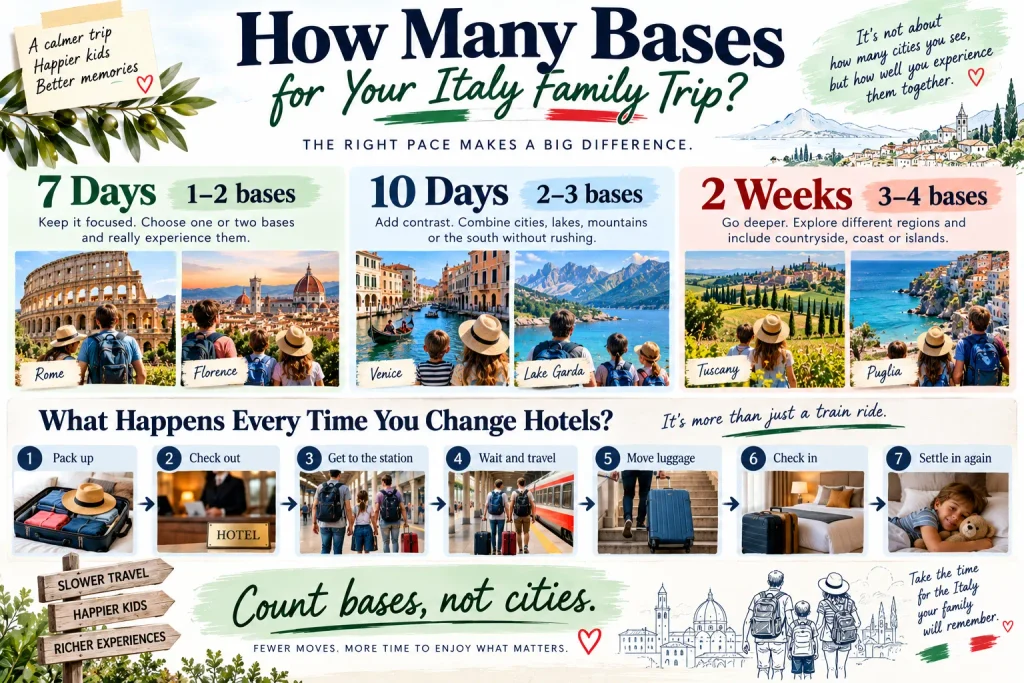
The Most Important Italy Itinerary Rule: Count Bases, Not Cities
Before deciding where to go, count how many times you want to change accommodation.
A family can technically visit several cities in a week. That does not mean it should.
Every change of base involves more than the train or driving time. There is packing, checking out, reaching the station, waiting, transporting luggage, finding the next accommodation and settling in again.
With children, those transitions matter.
For this guide, I would use the following as planning starting points rather than fixed rules:
Trip Length
Good Starting Point
Why
7 days
1–2 bases
Enough time to experience places rather than continually moving
10 days
2–3 bases
Allows contrasting destinations without excessive transfers
2 weeks
3–4 bases
Enough time for cities plus countryside, coast, lake or mountains
A family that loves road trips may happily move more often. A family traveling with a toddler may prefer one apartment for an entire week.
The important question is not:
“How many cities can we fit?”
It is:
“How many transitions will still feel like a vacation?”
Should You Rent a Car or Use Trains in Italy?
There is no single correct answer because Italy contains several very different kinds of family trips.
For Rome, Florence, Milan, Bologna, Naples and Venice, rail is often the more natural way to connect major city centers. Italy’s high-speed network links many major cities, while regional trains extend the system considerably.
A car becomes more useful when the trip shifts toward places such as countryside accommodation, smaller Tuscan towns or some parts of Puglia and the Dolomites.
But renting a car for an entire Italy vacation can create unnecessary problems.
Historic centers may have restricted traffic zones. Parking can be difficult. Venice itself obviously cannot be explored by car.
A useful family strategy is therefore:
train for the major cities, car only for the part of the trip that genuinely benefits from one.
Check current rail schedules, road restrictions, parking rules and seasonal transport before finalizing the itinerary.
Don’t Build an Italy Route from Straight Lines on Google Maps
Distance alone does not tell you how easy a journey will be.
Two destinations may look close geographically but require:
multiple train connections
a bus transfer
ferry timing
mountain driving
difficult parking
a long journey from the station to the accommodation
The opposite can also happen.
Two cities that look far apart may have a convenient direct high-speed rail connection.
For every transfer, ask three questions:
How long is the actual journey?
How many times do we change transport?
What happens between our hotel door and the train, car or boat?
Families travel door to door, not station to station.
Should You Start in Rome, Milan or Venice?
Your arrival airport can shape the entire itinerary.
If international flights make Rome the easiest entry point, there is little reason to begin a seven-day trip by immediately traveling north simply because somebody else’s itinerary started in Venice.
Likewise, Milan can make sense for a northern route involving Lake Garda and the Dolomites.
Venice can work naturally at the beginning or end of a northern or classic itinerary.
Before booking the internal route, compare open-jaw flights as well.
For example:
arrive Rome → depart Venice
can be more efficient than:
arrive Rome → travel north → return all the way to Rome solely for the flight home.
The cheapest airfare is not always the cheapest family trip once extra hotels, trains and transfers are included.
7 Days in Italy with Kids: Keep It Focused
Seven days sounds substantial until arrival and departure days begin consuming parts of the week.
For most families, I would resist trying to create a miniature tour of the entire country.
Instead, choose one of three approaches:
two complementary destinations
or:
one major base with day trips
or:
one focused region.
Here are three routes that work for very different families.
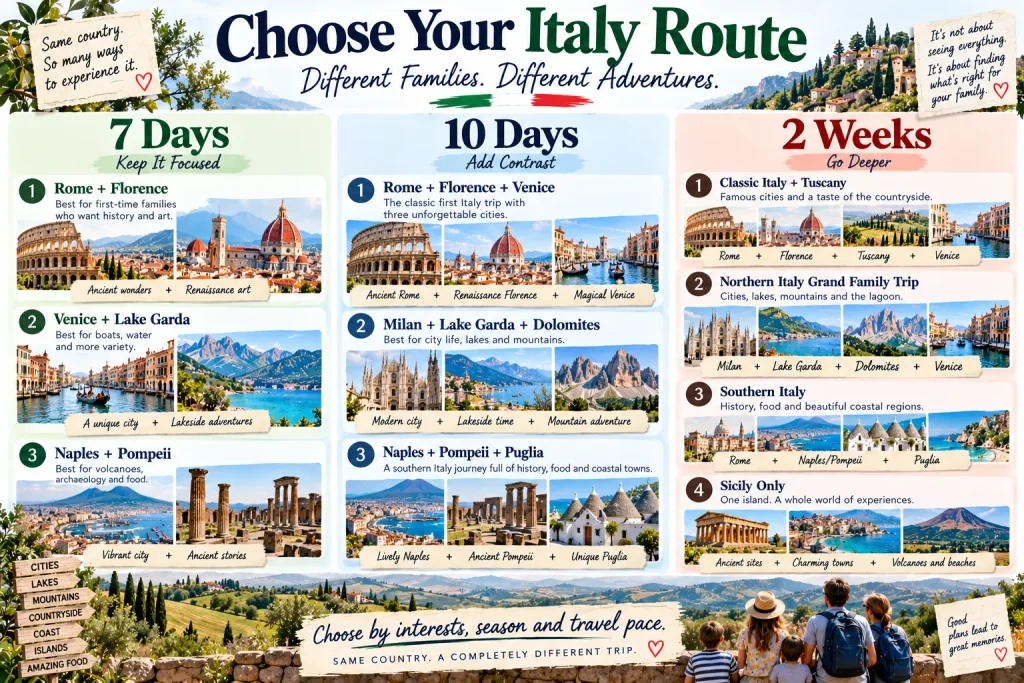
7-Day Route 1: Rome + Florence
Best for: First-Time Families Who Want History and Art
This is probably the most straightforward introduction to Italy without trying to squeeze in Venice as well.
A sensible starting structure is:
Day
Base
Main Idea
1
Rome
Arrive and explore the neighborhood
2
Rome
Ancient Rome
3
Rome
Vatican or another major experience
4
Rome → Florence
Travel and easy Florence afternoon
5
Florence
Historic center + Renaissance
6
Florence
Family-choice day or Tuscany day trip
7
Florence
Final exploration / departure depending on flights
The exact number of nights should be adjusted around flight times. A late arrival on Day 1 is not really a sightseeing day.
Days 1–3: Rome
Do not try to make three Rome days contain everything.
Give each day one major purpose.
One day might focus on Ancient Rome, combining the Colosseum area with enough time to look rather than simply moving between ruins.
Another can focus on the Vatican, although the amount of museum time should match the children rather than an adult bucket list.
The remaining time can belong to the city itself: piazzas, fountains, gelato, parks and walking through streets where ancient structures appear unexpectedly beside modern life.
With children, Rome becomes easier when you stop treating every historic object as compulsory.
A Better Way to Explore Ancient Rome with Kids
At the Colosseum, avoid beginning with a long chronology.
Ask:
“How did tens of thousands of people enter and leave a building like this without modern technology?”
At the Roman Forum:
“Why are the ancient buildings lower than many modern streets?”
At the Pantheon:
“How is that enormous dome still standing?”
Three questions can create more curiosity than thirty dates.
Later in the Italy series, our Rome Ancient City Detective Challenge will turn these questions into an activity families can use while exploring.
After arriving in Florence, check in, walk through the historic center, find the Duomo and let children establish a mental map of their new destination.
The major museum can wait.
This is one of the easiest ways to reduce family travel fatigue: do not pretend transfer days are full sightseeing days.
Days 5–6: Florence and a Choice
Florence is compact enough that families can encounter a remarkable amount of architecture simply by walking.
Choose one major cultural experience rather than stacking museums.
Depending on your family’s interests, that might be art, the Duomo complex, a palace or another specific site.
Then use Day 6 to make the trip more personal.
One family might stay in Florence.
Another might take a carefully selected Tuscany excursion.
Another may decide the children need a slower day.
The itinerary should respond to the family rather than defend itself against an imaginary checklist.
Who Should Choose Rome + Florence?
This route works particularly well if your children are beginning to engage with:
ancient civilizations
engineering
art
architecture
mythology
famous historical figures
It is less ideal if everyone primarily wants mountains, beaches or outdoor activities.
In that case, do not choose the classic route merely because it is famous.
7-Day Route 2: Venice + Lake Garda
Best for: Families Who Want Boats, Water and More Variety
This route creates a completely different first impression of Italy.
Instead of two museum-heavy historic cities, the trip combines one of the world’s most unusual urban environments with several days around a lake.
A possible structure:
Day
Base
Main Idea
1
Venice
Arrive and walk
2
Venice
Main Venice exploration
3
Venice
Islands or slower Venice day
4
Venice → Lake Garda
Transfer and lakeside afternoon
5
Lake Garda
Towns + boat experience
6
Lake Garda
Family-choice day
7
Lake Garda
Final exploration / departure
Again, this is a framework, not a booking instruction.
Where you stay around Lake Garda will affect the logistics enormously.
Days 1–3: Venice
Venice gives children an immediate reason to pay attention because the city does not behave like most cities they know.
The first day does not need an ambitious attraction list.
Walk.
Cross bridges.
Watch boats.
Find a vaporetto.
Notice front doors opening toward canals.
Ask:
“What job would that boat be doing if this were a normal road?”
The next day can include major Venice landmarks, while the third allows room for another neighborhood, islands or simply a slower exploration.
The important thing is to give Venice enough time to become a city, not merely a gondola photograph.
Venice with Young Children: The Walking Problem
Venice’s compact appearance can be deceptive.
Canals interrupt direct routes and bridges frequently involve steps. Families with strollers or mobility requirements should examine their exact accommodation and daily routes rather than relying on broad claims that Venice is either “easy” or “impossible.”
This is also why location matters.
Saving money on accommodation far from the places your family wants to explore can create a much harder trip than expected.
Days 4–6: Lake Garda
Lake Garda changes the rhythm.
The family can choose among lakeside towns, boats, outdoor activities and major family attractions depending on the base and season.
This is precisely why I prefer it after Venice for some families.
Venice asks children to concentrate on a dense historic city.
Lake Garda allows the itinerary to breathe.
Day 6 can become the family’s choice: another lake day, a family attraction, outdoor activity or simply less structured time.
A vacation does not need a major monument every day.
Who Should Choose Venice + Lake Garda?
Consider this route if your children respond strongly to:
boats
water
unusual transportation
outdoor time
varied activities
less museum-heavy travel
It can also work well for families entering or leaving Italy through northern airports.
7-Day Route 3: Naples + Pompeii
Best for: Families Fascinated by Volcanoes, Archaeology and Food
The third seven-day option stays south and avoids the temptation to cross half the country.
Naples becomes the main base, with Pompeii as a major experience rather than another hotel change.
Depending on family pace and season, the wider area can provide additional day trips without requiring a new suitcase every morning.
A simple framework might look like this:
Day
Base
Main Idea
1
Naples
Arrive and neighborhood exploration
2
Naples
Historic Naples
3
Naples
Museum / food / waterfront
4
Naples
Pompeii
5
Naples
Slower day or additional local experience
6
Naples
Family-choice day trip
7
Naples
Final exploration / departure
The advantage is obvious.
One base.
That can be incredibly valuable with children.
Pompeii Deserves a Day, Not a Checkbox
Pompeii should not be treated as:
“Stop for two hours between Naples and somewhere else.”
The site is large, exposed and intellectually rich.
Children can investigate:
streets
houses
shops
public spaces
water systems
entertainment
evidence of ordinary Roman life
The eruption of Vesuvius provides the dramatic story, but everyday life is what makes Pompeii more than a disaster site.
Ask:
“What was happening here the day before the eruption?”
Now children are looking for a city rather than only a catastrophe.
Don’t Automatically Add the Amalfi Coast
This is where many seven-day itineraries become overloaded.
Rome.
Naples.
Pompeii.
Amalfi.
Capri.
Maybe Florence?
The list grows faster than the vacation.
The Amalfi Coast can absolutely be part of a family trip, but it has its own transportation, terrain and seasonal crowd considerations. Add it because your family genuinely wants that experience—not because a southern Italy itinerary supposedly looks incomplete without it.
Seven days around Naples and the surrounding area can already produce a full trip.
Which 7-Day Italy Route Should You Choose?
If this is your first family trip to Italy and children are excited by famous history, Rome + Florence is the strongest conventional introduction.
If transportation itself excites the children and you want city days balanced by water and outdoor activities, Venice + Lake Garda provides more contrast.
If the family loves archaeology, volcanoes and food—or simply hates changing hotels—Naples + Pompeii from one base can be much more satisfying than racing north.
There is no route that wins.
The better itinerary is the one where the family still has enough energy to care about where it is.
10 Days in Italy with Kids: Now You Can Add Contrast
Ten days changes the equation.
There is enough time to connect three distinct experiences without necessarily turning the vacation into continuous transit.
But the extra three days should not become an excuse to add five more destinations.
The best ten-day routes usually gain something different.
City + city + unique city.
City + lake + mountains.
City + archaeology + coast or countryside.
That contrast is what we will build next.
10-Day Route 1: Rome + Florence + Venice
Best for: The Classic First Italy Trip
This is the famous route.
And for many families, it works.
Not because these are automatically the three “best” places in Italy, but because each provides a clearly different experience and the route can be connected efficiently compared with many more complicated combinations.
A family-friendly structure could look like this:
Day
Base
Main Idea
1
Rome
Arrival
2
Rome
Ancient Rome
3
Rome
Vatican / city
4
Rome
Family-choice Rome day
5
Florence
Travel + easy exploration
6
Florence
Florence
7
Florence
Florence / Tuscany option
8
Venice
Travel + explore
9
Venice
Venice
10
Venice
Final exploration / departure
Notice what is missing.
No Pisa dash. No Bologna lunch stop. No Milan detour. No “quick Pompeii.”
Those places are excellent.
They simply belong to another trip—or a longer one.
That is how an itinerary starts becoming a vacation instead of a collection.
Why the Classic Route Works Better with 10 Days Than 7
Rome, Florence and Venice can technically be squeezed into a week.
Ten days gives each city more room to develop its own identity.
In Rome, children can encounter the ancient city without making the Colosseum, Forum and Vatican compete for the same exhausting day. Florence can include one major art or architecture experience plus time to simply walk. Venice gets enough time for children to notice that canals are working streets rather than scenery for tourists.
The extra time also gives parents something valuable:
permission to stop.
If everyone is tired on Day 4, the itinerary does not collapse because every remaining hour has already been assigned to a monument.
10-Day Route 2: Milan + Lake Garda + Dolomites
Best for: Families Who Want City + Lake + Mountains
This is one of my favorite structures for showing children that Italy is much more than historic cities.
Each destination has a completely different job.
Milan introduces urban Italy. Lake Garda changes the pace. The Dolomites make nature the main attraction.
A starting structure could look like this:
Day
Base
Main Idea
1
Milan
Arrival and easy city exploration
2
Milan
Duomo + family-choice attraction
3
Lake Garda
Transfer + lakeside afternoon
4
Lake Garda
Town + boat day
5
Lake Garda
Family activity day
6
Dolomites
Transfer + mountain base
7
Dolomites
Mountain experience
8
Dolomites
Second outdoor day
9
Dolomites
Flexible weather / exploration day
10
Dolomites or departure city
Departure planning
This itinerary requires more careful transportation planning than the classic Rome–Florence–Venice rail route.
That is especially true for the Dolomites.
Days 1–2: Milan
Two nights can be enough for Milan to play a meaningful role without dominating the trip.
Choose the Duomo as the obvious visual centerpiece, then select another experience according to the children. A museum, castle, science-focused attraction, park or neighborhood exploration may fit better than trying to reproduce an adult Milan checklist.
Milan also gives children an important first lesson:
Italy is not only ancient ruins and Renaissance paintings.
It is a modern European country whose cities continue to change.
Days 3–5: Lake Garda
Three days around Lake Garda allow the family to settle into a completely different rhythm.
One day can focus on a lakeside town and boat travel. Another can be chosen according to the children’s interests, whether that means a major family attraction, outdoor activity or simply more time by the lake.
Do not underestimate the importance of choosing the right base.
Lake Garda is large, and a hotel described as being “at Lake Garda” tells you surprisingly little about how convenient it will be for the places your family wants to visit.
Choose the part of the lake after deciding what you want to do.
Days 6–9: The Dolomites
This is where the itinerary needs flexibility.
Mountain weather does not care what your spreadsheet says.
Instead of assigning one irreplaceable mountain experience to one specific day months in advance, identify several possibilities and adjust according to current conditions and operating schedules.
Depending on the season and location, that could mean:
a family walk
a lake
a cable-assisted mountain experience where operating
a scenic drive
a village day
a mountain hut
simply stopping at viewpoints
The goal is not to complete the Dolomites.
It is to experience them.
Don’t Treat “The Dolomites” as One Attraction
The Dolomites cover a large mountain area.
Saying:
“We’re staying in the Dolomites.”
is a little like saying:
“We’re staying in Tuscany.”
It does not tell us enough.
Ortisei and Val Gardena create one type of trip. Cortina d’Ampezzo creates another base. Other valleys and towns create still more possibilities.
Before booking accommodation, decide which landscapes and activities matter most. Then check the actual driving or transport times between them.
Mountain distances can be deceptive.
Who Should Choose the Northern Family Adventure?
This route is especially attractive if the family wants:
fewer major museums
boats and lakes
mountain scenery
outdoor activities
a modern city experience
strong contrast between destinations
It can also work well in a trip that enters Italy through Milan or another northern transport hub.
But season matters enormously.
A Dolomites itinerary cannot simply be copied from summer into winter or from one shoulder-season week into another. Lift operations, snow, trail conditions, weather and mountain services change.
Check current conditions for the actual dates.
10-Day Route 3: Naples + Pompeii + Puglia
Best for: Families Who Want Southern Italy Without Rushing North
Instead of automatically moving from Naples toward Rome and Florence, go the other direction.
This route combines a major southern city, one of the world’s great archaeological sites and a completely different regional experience in Puglia.
A starting framework:
Day
Base
Main Idea
1
Naples
Arrival
2
Naples
Historic center + food
3
Naples
Naples family day
4
Naples
Pompeii
5
Puglia
Transfer
6
Puglia
Town / countryside
7
Puglia
Coast or family activity
8
Puglia
Alberobello / Valle d’Itria area
9
Puglia
Flexible regional day
10
Puglia
Departure planning
The exact Puglia base matters, and the itinerary should change depending on whether the family prioritizes the Valle d’Itria, coast, Bari area, Salento or another part of the region.
Why Stay in Naples Rather Than Moving to Pompeii?
Because changing accommodation has a cost.
For many families, visiting Pompeii as a day trip from a Naples base is simpler than checking out, moving luggage, sleeping somewhere else and moving again shortly afterward.
That does not mean staying near Pompeii is wrong.
It means the hotel change needs to earn its place.
This is a useful rule throughout Italy:
Don’t change bases simply because you changed attractions.
Puglia Needs a Different Pace
Puglia works particularly well after Naples because the experience changes.
Naples is dense, urban and energetic.
Puglia can shift the family toward smaller towns, countryside, coastline and slower regional exploration.
Children can move from asking:
“What happened at Pompeii?”
to:
“Why do these houses have cone-shaped roofs?”
That contrast helps each destination remain memorable.
Should You Rent a Car in Puglia?
For many regional itineraries, a car can provide considerably more flexibility than relying entirely on public transportation, particularly when connecting smaller towns, countryside accommodation or beaches.
But that does not mean every family needs one for every Puglia itinerary.
If your trip concentrates on well-connected urban destinations, public transportation may still work.
Before renting, identify the actual places you plan to visit and compare:
Do not rent a car merely because a travel article says:
“You need a car in Puglia.”
And do not reject one merely because trains exist.
The itinerary decides.
Which 10-Day Route Is Best for Your Family?
The three routes solve different problems.
Rome + Florence + Venice works for families who want the classic first encounter with Italy’s most famous historic cities.
Milan + Lake Garda + Dolomites works for families who want stronger contrast between urban life, water and mountains.
Naples + Pompeii + Puglia works for families interested in archaeology, food and southern Italy who do not need to collect the famous northern cities on the same trip.
None is the correct Italy itinerary.
They are three different versions of Italy.
What About Rome + Amalfi Coast in 10 Days?
Absolutely possible as a concept.
But it deserves its own itinerary rather than being casually added to the Naples route.
The Amalfi Coast brings questions about:
which town to use as a base
road and bus logistics
boats
stairs and steep terrain
seasonal crowds
luggage
connections with Naples and Pompeii
A family staying in Sorrento will experience the region differently from one based in Amalfi or elsewhere.
So instead of squeezing an Amalfi paragraph into every southern itinerary, we will eventually build a dedicated Amalfi Coast with Kids guide.
2 Weeks in Italy with Kids: Choose a Story, Not More Pins
Two weeks is where planning becomes dangerous again.
The family now has enough time to visit several places, so the temptation is to add everything.
Rome.
Florence.
Venice.
Milan.
Lake Garda.
Dolomites.
Naples.
Pompeii.
Maybe Sicily.
Fourteen days disappear very quickly when every destination demands transportation and accommodation changes.
For a two-week family trip, I would still build around three or four main bases in most cases.
The difference is that we can now create a broader story.
2-Week Route 1: Classic Italy + Tuscany
Best for: First-Time Families Who Want the Famous Cities Without Skipping the Countryside
Instead of simply stretching the ten-day Rome–Florence–Venice route, use the extra days to change the type of experience.
A possible structure:
Days
Base
Main Idea
1–4
Rome
Ancient Rome + Vatican + city life
5–7
Florence
Renaissance + historic center
8–10
Tuscany
Countryside + smaller towns
11–14
Venice
Venice + slower exploration / islands
This creates four distinct chapters.
Rome is monumental.
Florence is concentrated.
Tuscany slows the trip down.
Venice changes the transportation system entirely.
Why Tuscany Deserves Its Own Base
A day trip from Florence can introduce families to Tuscany beyond the city.
But several nights create a different experience.
The family can stay somewhere where the landscape itself becomes part of the trip rather than something viewed through a bus window.
Children can begin connecting:
vineyards
olive groves
farms
villages
food
geography
without another major museum being necessary.
This is also where a temporary car rental may make sense depending on the chosen accommodation and towns.
You can use trains for the major city section, rent a car for the countryside portion and return it before Venice.
That is often more sensible than dragging a car through the entire route.
2-Week Route 2: Northern Italy Grand Family Trip
Best for: Lakes, Mountains, Boats and Cities
This route expands the ten-day northern itinerary and adds Venice.
A starting structure:
Days
Base
Main Idea
1–2
Milan
City introduction
3–5
Lake Garda
Lake + family activities
6–9
Dolomites
Mountains + flexible outdoor days
10–14
Venice
Venice + lagoon exploration
At first glance, five days in Venice may seem excessive to families accustomed to one-night Venice itineraries.
It does not have to mean five days around Piazza San Marco.
Depending on interests, those days can include slower neighborhood exploration, lagoon islands, family activities and enough unstructured time that Venice stops feeling like a tourist obstacle course.
Alternatively, families can redistribute one of those nights to Lake Garda or the Dolomites.
The table is a starting point, not a command.
Why This Route Works
Every move changes the environment.
Milan gives you a major contemporary city.
Lake Garda gives you water and recreation.
The Dolomites give you mountains.
Venice gives you a city whose streets and transport work differently from almost anywhere else.
Best for: Families Who Want History, Food and the South
Rome can work naturally as the northern edge of a southern-focused journey.
A possible framework:
Days
Base
Main Idea
1–4
Rome
Ancient and modern Rome
5–8
Naples
Naples + Pompeii
9–14
Puglia
Regional exploration + coast + slower days
Only three bases.
That is deliberate.
The family gets substantial time in each place while still experiencing three very different parts of Italy.
Six Days in Puglia Is Not “Too Much”
This is another consequence of checklist travel.
If a region is represented by one famous sight, travelers assume one day is enough.
Puglia is not Alberobello.
A longer stay allows the family to choose among towns, coast, countryside, food and slower days without spending every morning checking out.
The exact six-day plan will depend on the base, season and family interests.
Some families may even split Puglia into two bases.
Others will be happier with one.
2-Week Route 4: Sicily Only
Best for: Families Who Want One Island to Become the Entire Trip
This may be the most important itinerary in this article because it challenges the assumption that a two-week Italy vacation must cross the mainland.
You can spend two weeks in Sicily.
And still leave things out.
A Sicily family trip can potentially combine:
historic cities
Greek archaeological sites
Roman remains
Norman and Arab-Norman heritage
Mount Etna
beaches
food
smaller towns
coastal landscapes
The difficulty is not finding enough.
It is deciding which part of the island not to visit.
Don’t Circle Sicily Just Because You Can
A common mistake with islands is trying to drive around the entire coastline because the route forms a satisfying shape on a map.
Families do not travel in geometric shapes.
Choose perhaps two or three regional bases according to your priorities and build outward from them.
For example, one trip might focus more heavily on eastern Sicily and Etna. Another may emphasize Palermo and western Sicily. A longer route may connect several areas.
We will build Sicily properly in a dedicated guide rather than pretending one universal two-week circuit fits every family.
Why Isn’t Sardinia in the Main Two-Week Routes?
It could be.
A two-week Sardinia trip can make excellent sense for a family whose priorities are beaches, nature, archaeology and slower island travel.
I have kept Sicily as the island example here because it demonstrates particularly clearly how one destination can contain enough cultural and natural variety for an entire two-week trip.
The broader lesson applies equally well:
You do not need to cross Italy for the vacation to count as an Italy trip.
A focused Sardinia trip can be more coherent than Rome + Venice + Florence + Sardinia squeezed into the same two weeks.
Should You Add Day Trips?
Day trips are useful when they expand the experience without creating another hotel change.
They become counterproductive when every base is merely a launchpad for somewhere else.
A good test is:
“If we removed all the day trips, would we still want to stay here?”
If the answer is no, perhaps you chose the wrong base.
For a ten-day or two-week family trip, I would deliberately protect some days from long excursions.
Children need time to experience the place where they are actually sleeping.
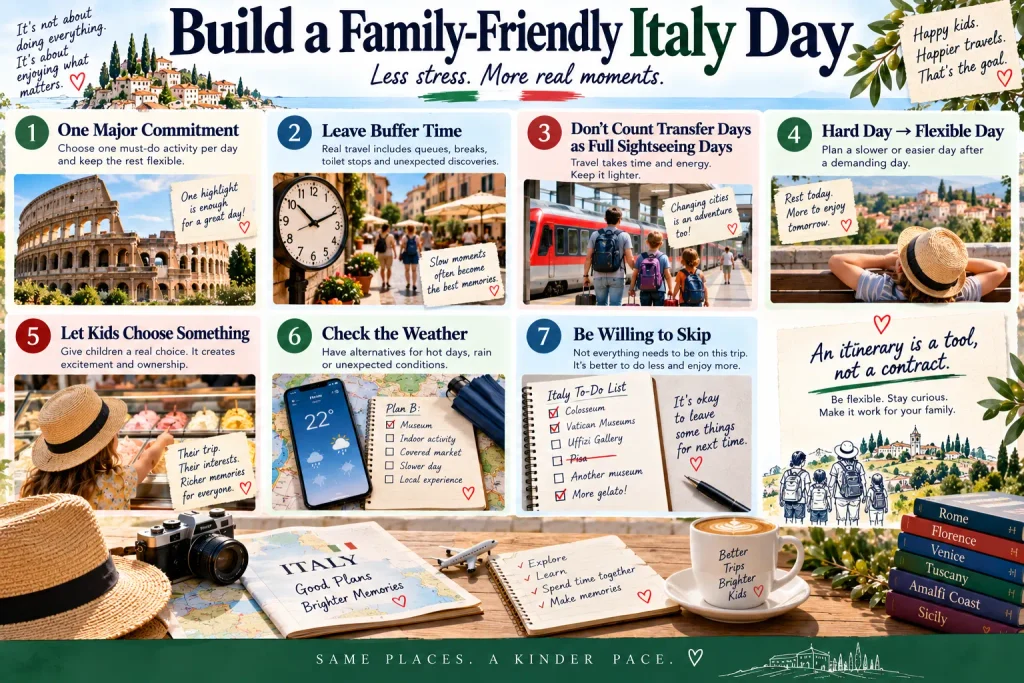
The One-Major-Thing Rule
On sightseeing-heavy days, try giving the itinerary one major commitment.
For example:
Colosseum morning
then a flexible Rome afternoon.
Or:
Uffizi visit
then lunch, a walk and something chosen by the children.
Or:
Pompeii
and nothing else that needs to justify a ticket reservation.
This does not mean families can only do one thing per day.
It means only one thing is allowed to make the day feel like a failure if you miss it.
That distinction creates breathing room.
Arrival Day Is Not Day 1 of Sightseeing
If the plane lands at 4:30 p.m., your itinerary should not say:
Day 1 — Colosseum, Trevi Fountain, Pantheon, Piazza Navona.
Day 1 is:
airport,
bags,
transport,
check-in,
food,
orientation,
sleep.
If everyone still wants to walk afterward, excellent.
Treat it as a bonus.
This simple adjustment makes itinerary planning much more realistic.
Departure Day Is Not a Full Day Either
The same mistake happens at the end.
A 1:00 p.m. flight does not leave a relaxed sightseeing morning once airport travel, check-out and uncertainty are included.
When comparing itineraries, count the usable days, not merely the number of hotel nights.
A seven-night trip can contain significantly fewer than seven full sightseeing days.
Schedule the Hardest Day Before a Flexible Day
This is especially useful with children.
If one day includes:
substantial walking
a major archaeological site
long museum time
mountain activity
make the following day easier when possible.
Pompeii followed by another ten-hour sightseeing marathon is not automatically efficient.
Sometimes:
hard day → flexible day
allows the family to enjoy both more.
Don’t Put Every Child-Friendly Attraction into the Itinerary
Another trap.
Parents discover:
science museum,
zoo,
aquarium,
theme park,
children’s museum,
playground,
interactive attraction.
Suddenly the family has traveled to Italy to visit the same categories of attractions available in many countries.
Children absolutely deserve child-focused activities.
But family travel becomes richer when they also learn how to enjoy the destination itself.
Mix:
Italy-specific experience
with:
child-centered experience.
For example:
Pompeii + pool.
Duomo + playground.
Venice exploration + relaxed boat ride.
Art museum + gelato mission.
Balance is better than turning the entire vacation into either an adult history course or a children’s entertainment schedule.
Build Around Energy, Not Just Geography
A route can make perfect geographic sense and still be a poor family itinerary.
Imagine this sequence:
Rome sightseeing.
Vatican Museums.
Travel to Florence.
Uffizi.
Day trip.
Travel to Venice.
Full Venice sightseeing.
Every individual day may look reasonable. Together, they create a trip with almost no recovery.
When planning, mark each day mentally as:
high-energy, moderate or flexible.
Then look at the pattern.
If four demanding days appear consecutively, change something.
This is especially important in summer, when heat can turn an ordinary walking day into a much harder one.
Let Children Choose One Day
Older children can participate in itinerary planning rather than simply receiving the finished schedule.
Give them realistic choices.
For example:
“On our third Lake Garda day, would you rather take a boat to another town, have an outdoor day or choose a family attraction?”
Or:
“In Florence, would you rather visit another museum or spend the afternoon exploring the city?”
Their answer does not need to control the entire vacation.
But giving children genuine choices creates ownership.
That can be particularly valuable with teenagers.
The Family Reset Afternoon
I would deliberately leave at least one flexible half-day in longer itineraries.
Do not name it:
FREE TIME — MUST RELAX
That somehow turns relaxation into another appointment.
Simply leave the space.
When it arrives, the family might:
return somewhere everyone liked
stay longer over lunch
use a playground
swim
shop
do laundry
have gelato
sit beside the lake
take an unplanned walk
do absolutely nothing ambitious
That time is not wasted.
It is what prevents the rest of the itinerary from becoming work.
What If It Rains?
Do not build an Italy itinerary that only functions under perfect weather.
For every outdoor-heavy destination, keep one or two alternatives in mind.
In cities, that might mean a museum, covered market or another indoor attraction. Around mountains and lakes, the alternatives depend much more on the specific base and season.
The point is not to create two complete itineraries.
It is to avoid waking up to rain and realizing:
“Our entire day only works if the weather is good.”
What If the Children Are Tired?
Change the plan.
This sounds obvious until reservations, ticket prices and adult expectations become involved.
A tired child does not become less tired because the attraction is UNESCO-listed.
Sometimes you continue because an important timed reservation cannot easily be changed.
Sometimes you shorten the visit.
Sometimes one parent continues with an older child while another rests with a younger one, where that arrangement works for the family.
And sometimes you simply skip something.
An itinerary is a tool. It is not a contract.
Should You Pre-Book Everything?
No.
But some high-demand attractions, transport services and experiences can require or strongly benefit from advance booking, particularly during busy periods.
The problem is that families sometimes respond by booking:
9:00 attraction
11:00 attraction
1:00 lunch
3:00 museum
5:30 tour
until there is no room for a child to walk slowly, need the toilet or become fascinated by a fountain.
A better approach is to secure the experiences where advance planning genuinely matters and leave the spaces between them flexible.
Always check the current official booking requirements for your travel dates rather than relying on an old itinerary.
How Early Should Families Book Italian Trains?
There is no single answer for every train.
Italy has different operators and service types, and booking conditions vary.
High-speed services generally work differently from local or regional transport. Families with fixed long-distance travel dates may benefit from planning those journeys earlier, while some regional trips can remain much more flexible.
Instead of applying one booking rule to the entire country, identify:
which journeys are essential long-distance transfers
and:
which are local transportation.
Then check the current operator’s schedule, fares and conditions.
What About Rail Passes?
Do not assume a rail pass is automatically cheaper because the trip contains several trains.
And do not assume individual tickets are automatically better.
Compare the actual journeys your family plans to make.
Consider:
children’s fares
reservation requirements
high-speed trains
flexibility
number of travel days
pass conditions
The best option depends on the route.
This guide deliberately avoids giving a permanent:
“Always buy this rail pass.”
because fares and conditions can change.
What About Luggage?
Luggage is part of itinerary design.
A route that feels easy with two backpacks may feel completely different with:
several large suitcases
stroller
child bags
travel cot
car seats
This matters particularly in places involving:
stairs
bridges
historic centers
trains
boats
accommodation without convenient vehicle access
Venice is the obvious example.
A beautiful hotel can become much less attractive if reaching it requires repeatedly carrying heavy luggage over bridges.
Before booking accommodation, look at the last kilometer, not just the city.
Accommodation Location Can Save More Time Than a Faster Train
Families sometimes spend hours optimizing whether one train takes 20 minutes less than another.
Then they book accommodation 45 minutes from everything they want to do.
For a short city stay, paying more for a convenient location can sometimes reduce:
transport time
tired walking
emergency taxi rides
complicated nap logistics
That does not mean families should always stay beside the main attraction.
It means accommodation should be evaluated as part of the itinerary.
Ask:
“What does staying here make easier every day?”
Apartment or Hotel with Kids?
Both can work.
An apartment may provide:
more space
kitchen access
laundry
separate sleeping areas
A hotel may provide:
reception
housekeeping
luggage services
simpler short stays
facilities depending on property
The right choice depends on the trip.
For a two-night city stop, a hotel may be easier.
For a week in one region, an apartment may transform family logistics.
Choose according to what the accommodation helps you do, not according to a universal family-travel rule.
Should Families Stay Near the Train Station?
Sometimes.
A station-area hotel can make arrival and departure extremely easy.
But the surrounding neighborhood may not be where your family wants to spend most of its time.
Compare:
station convenience
with:
daily sightseeing convenience.
If you arrive late and leave early, station proximity may win.
If you are staying four nights and walking the historic center every day, another location may be better.
Again, itinerary first.
Hotel second.
Italy with Kids in Summer
Summer can make several family destinations easier in one sense and harder in another.
Long daylight and school holidays can help.
But heat and crowds can dramatically affect city sightseeing.
In hot conditions, families may need to shift the rhythm:
earlier major activity → slower middle of the day → later exploration
rather than walking continuously from breakfast until dinner.
Southern cities and exposed archaeological sites deserve particular attention to current heat conditions.
Do not let a prepaid itinerary override sensible decisions about weather.
Italy with Kids in Spring and Autumn
These seasons can provide excellent conditions for many types of family travel, but the phrase shoulder season does not guarantee perfect weather or low crowds.
Mountain conditions can differ enormously from cities.
Coastal services may vary.
Rain happens.
Popular destinations can still be busy.
The advantage is often flexibility rather than certainty.
Check the actual destination rather than planning for a generic thing called:
“Italy weather.”
Italy with Kids in Winter
Winter can completely change the trip.
A city-focused itinerary may still work very well.
Christmas periods can create another atmosphere.
Mountain regions become winter destinations rather than summer hiking destinations.
Coastal and island trips may operate on a different seasonal rhythm.
That means a winter version of:
Milan → Lake Garda → Dolomites → Venice
should not simply copy the activities from July.
The route may survive.
The experiences need to change.
Don’t Pack for “Italy”
Pack for the itinerary.
A Rome-and-Florence city trip creates different needs from:
Dolomites + Lake Garda
or:
Sicily in summer.
Before packing, look at:
destinations
season
altitude
expected weather
planned activities
laundry access
transportation
This also prevents the family from carrying unnecessary equipment through railway stations for two weeks.
Build a Family Travel Buffer
A buffer is simply time that has not already been promised to something.
You need it because real trips contain:
delayed transport
long lunches
bathroom stops
children moving slowly
wrong turns
weather
queues
spontaneous discoveries
Without buffer time, every small delay becomes a problem.
With buffer time, the same delay may barely matter.
The tighter the itinerary, the more fragile it becomes.
What Should You Cut First?
When the itinerary becomes too full, remove something in this order.
First, remove attractions you added only because they are famous.
Next, remove day trips that duplicate an experience you already have elsewhere.
Then reconsider one-night hotel stays that create significant travel for little time at the destination.
Protect the experiences the family genuinely cares about.
A good itinerary is often created by deleting, not adding.
A Simple Family Test Before Booking
Read the itinerary aloud.
Not just the destination names.
Read the actual days.
For example:
“Monday we fly to Rome. Tuesday we walk around Ancient Rome. Wednesday Vatican Museums. Thursday train to Florence. Friday museum. Saturday Tuscany day trip. Sunday train to Venice…”
How does it sound?
Exciting?
Or exhausting?
Now imagine saying it to the youngest child.
That reaction may be more useful than another hour of itinerary optimization.
Common Italy Itinerary Mistakes with Kids
1. Rome, Florence and Venice in Too Few Days
Possible does not mean enjoyable.
2. Treating Transfer Days as Full Sightseeing Days
Travel consumes time and energy.
3. Changing Accommodation for Every Attraction
A day trip may be easier.
4. Renting a Car for Major Historic Cities Without Needing One
Parking and restricted traffic can create unnecessary complexity.
5. Assuming Trains Solve Every Destination
Mountains, islands, countryside and some coastal areas require different planning.
6. Booking Every Hour
Children introduce uncertainty. So does Italy.
7. Planning Only Adult Cultural Attractions
Add experiences children can help choose.
8. Planning Only Child Attractions
Let children experience Italy itself, not only attractions designed for children.
9. Ignoring Weather and Season
The same route can require a completely different daily plan in another season.
10. Refusing to Skip Something
Skipping is one of the most important itinerary skills.
FAQ: Italy Family Itinerary with Kids
How many days do you need in Italy with kids?
A week can work well for one or two main bases, while ten days allows two or three contrasting destinations. Two weeks gives families considerably more flexibility, but there is still no need to cross the entire country.
The right length depends on the route and how frequently your family is comfortable changing accommodation.
What is the best 7-day Italy itinerary with kids?
There is no single best route.
For first-time families interested in famous history and art, Rome and Florence make a logical combination. Venice and Lake Garda offer more contrast between city and water, while Naples with Pompeii can create a strong one-base southern trip.
What is the best 10-day Italy itinerary for families?
Rome–Florence–Venice is a strong classic route. Milan–Lake Garda–Dolomites works well for families prioritizing lakes and mountains, while Naples–Pompeii–Puglia provides a southern alternative.
Choose according to interests rather than assuming the classic route is mandatory.
Is two weeks enough for Italy with kids?
Yes, but two weeks is still not enough to experience all of Italy meaningfully.
For many families, three or four main bases provide a better balance than trying to visit a new destination every couple of days.
Is it better to travel around Italy by train or car with children?
Major cities are often conveniently connected by rail, while cars can be useful for countryside, mountain and some regional itineraries.
Many families benefit from combining the two rather than renting a car for the entire vacation.
Is Rome, Florence and Venice too much in one week?
It can be done, but for many families it creates a fast trip with frequent transfers.
With seven days, Rome plus Florence or Venice plus another complementary destination may provide more breathing room. With ten days, Rome–Florence–Venice becomes much more comfortable.
Should we visit Italy with a stroller?
That depends on the child and destination.
Historic paving, stairs, bridges and archaeological sites can make stroller use easier in some places and more difficult in others. Venice deserves particularly careful route planning because of its many stepped bridges.
Check accessibility for the exact attractions and routes your family intends to use.
How many nights should families spend in Rome?
There is no universal number, but around three to four nights can provide a useful starting point for many first-time family itineraries.
Arrival time, children’s ages and whether the Vatican or multiple archaeological sites are priorities can change that considerably.
Final Thoughts: Build an Italy Trip Your Children Can Remember
A family itinerary does not improve every time you add another city.
Often the opposite happens.
Rome becomes:
“the place before Florence.”
Florence becomes:
“the place before Venice.”
Venice becomes:
“the place before the airport.”
The destinations are famous.
The memories blur together.
A better Italy family itinerary gives each place enough space to become distinct.
Rome can be the place where children discover that an ancient city still exists beneath and between the modern one. Florence can become the city where art and engineering meet. Venice can make them rethink what a street is. Lake Garda can be where everyone slows down, while the Dolomites can remind the family that Italy is a landscape as much as a collection of historic buildings.
Pompeii can turn archaeology into detective work. Naples can connect food with place. Puglia can introduce a different southern rhythm, while Sicily can be large and varied enough to become an entire vacation on its own.
You do not need all of them.
For seven days, choose focus.
For ten days, add contrast.
For two weeks, build a story.
Then leave something out deliberately.
Because the goal is not for your children to return home saying:
Our upcoming Venice with Kids: A Family Guide to the Floating City will focus on the practical decisions families face once Venice is part of the itinerary, including where to stay, walking, boats, pacing and visiting with younger children.
Why Is Venice Built on Water?
When children start asking why Venice has canals instead of normal roads, Why Is Venice Built on Water? The Floating City Explained for Kids turns the lagoon, foundations, bridges and flood protection into a family-friendly engineering story.