Spain Old Town Detective Challenge is a simple family activity that can turn another afternoon of walking around old buildings into a game children actually understand. Instead of asking kids simply to admire historic streets, give them 15 clues to find as they explore.
Spain is full of historic centers.
Madrid, Toledo, Segovia, Córdoba, Seville, Granada, Cádiz, Santiago de Compostela and dozens of smaller cities can place families among:
- narrow streets
- stone walls
- churches
- palaces
- plazas
- fountains
- coats of arms
- balconies
- old doors
- towers
Adults may look around and think:
“This is beautiful.”
Children may look around and think:
“How much longer are we walking?”
That does not mean they dislike history.
Sometimes they simply need something to do with it.
So instead of asking children to admire an old town because adults say it is important, give them a mission.
Find 15 clues that reveal how people lived here before us.
No museum ticket is required.
There is no winner.
You do not need to find everything.
And this challenge can work in many Spanish historic cities because the goal is not to identify one particular monument.
It is to teach children how to look at a city differently.
Before You Start: Become an Old Town Detective
Tell the children:
“Today we’re not just sightseeing. We’re investigating the city.”
Your mission is to find evidence.
Some clues may be hundreds of years old.
Others may show how historic cities have adapted to modern life.
You can:
- take photographs where appropriate
- make sketches
- write down discoveries
- count objects
- guess before looking up the answer
- compare one Spanish city with another
But there is one important rule.
Look, Don’t Damage
Do not:
- climb protected monuments
- scratch walls
- remove stones
- pick pieces from historic buildings
- enter restricted areas
- disturb residents
A good detective leaves the evidence where it belongs.
Ready?
Let’s investigate.
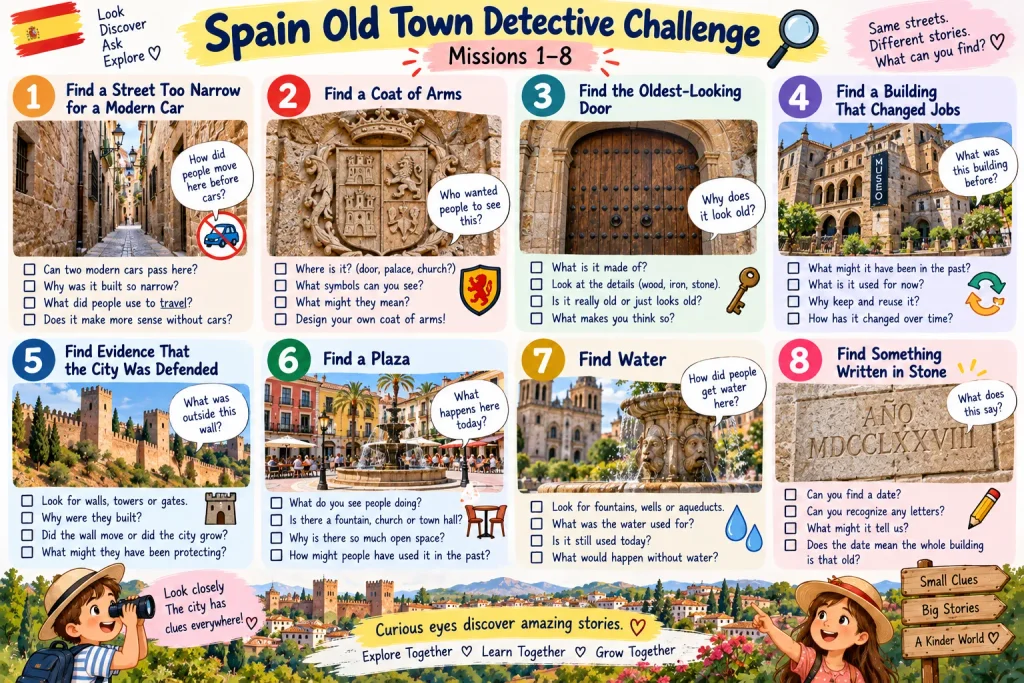
Mission 1: Find a Street Too Narrow for a Modern Car
This may be easier than you expect.
Many historic streets developed long before anyone imagined:
cars + buses + delivery vans + parking spaces
Look for a street where two modern cars would struggle to pass.
Then ask:
“Why would anyone build a street this narrow?”
Before children answer, remind them:
The street may not originally have been designed for modern traffic at all.
People moved through cities:
- on foot
- with animals
- using carts
- using other forms of transport appropriate to their time
And medieval urban streets did not necessarily emerge from one modern-style master plan.
Detective Question
If you removed every car from this street, would its shape make more sense?
Now children are learning to mentally remove the modern city and see the older one underneath.
Mission 2: Find a Coat of Arms
Look above:
- doors
- gates
- palaces
- churches
- civic buildings
- fountains
- old houses
You may discover a shield containing:
- castles
- lions
- crowns
- stripes
- animals
- crosses
- unfamiliar symbols
Do not immediately tell children what it means.
Ask:
“Who wanted people to see this?”
A coat of arms could communicate identity, lineage, authority or institutional affiliation.
It was not simply medieval decoration.
Make Your Own
Later, let each child design a family coat of arms.
Choose:
one animal
one object
one color
one symbol
Then ask:
“What would you want people to understand about your family?”
History has become design.
Mission 3: Find the Oldest-Looking Door
This one sounds easy.
It isn’t.
Ask each child to nominate a door.
Then defend the choice.
Why does it look old?
- wood?
- ironwork?
- shape?
- stone around it?
- size?
- decoration?
Now comes the twist.
Looking old does not prove something is old.
A historic building may have a newer door.
A restored door may imitate an older style.
An old door may have been repaired many times.
Detective Lesson
Appearance is a clue, not proof.
If the building matters, check an official plaque, heritage information or another reliable source afterward.
That is exactly how historical investigation should work.
Mission 4: Find a Building That Changed Jobs
Cities reuse buildings.
Look for a structure that may once have been:
- palace
- monastery
- convent
- hospital
- market
- fortress
- railway building
- private residence
but serves another purpose today.
Perhaps it is now:
- museum
- hotel
- government office
- cultural center
- university building
Ask:
“Why didn’t they just knock it down?”
Possible answers lead naturally to:
- heritage
- usefulness
- cost
- identity
- tourism
- architecture
- conservation
Children begin understanding that old cities survive partly because people continually adapt them.
Mission 5: Find Evidence That the City Was Defended
Look for:
- walls
- towers
- gates
- fortified positions
- remains of defensive structures
Then ask:
“What was outside this wall when it was being used?”
The answer may not be what children expect.
The modern city may have grown far beyond its historic defenses.
A gate that once controlled entry can now stand beside traffic lights, apartment buildings and cafés.
Detective Question
Did the wall move—or did the city grow?
The city grew.
That simple observation can make urban history visible.
If your children become interested in fortifications, our Why Are There So Many Castles in Spain? guide explains how changing kingdoms, borders and strategic landscapes helped create Spain’s extraordinary fortified heritage.
Mission 6: Find a Plaza
This should be easy.
The challenge is figuring out what the plaza does.
Stand still for a minute.
Observe.
Do you see:
- café tables?
- children playing?
- people meeting?
- benches?
- government buildings?
- a church?
- fountain?
- market activity?
- tourists?
- residents crossing?
Then ask:
“Why leave this much empty space in the middle of a crowded city?”
A plaza is not simply an empty gap between buildings.
Public spaces can become places for:
- commerce
- ceremony
- religion
- politics
- festivals
- meetings
- everyday social life
And their functions can change over time.
Mission 7: Find Water
Not bottled water.
Find evidence of how the city handles—or once handled—water.
Look for:
- fountains
- wells
- channels
- cistern references
- public water features
- aqueduct remains
Then ask:
“What would happen if thousands of people lived here but nobody could turn on a tap?”
Suddenly water becomes an urban problem.
People need water for:
- drinking
- cooking
- washing
- animals
- crafts
- gardens
- firefighting
The prettier the fountain, the easier it is to forget that water infrastructure can be fundamental to whether a city works at all.
Mission 8: Find Something Written in Stone
Search for:
- dates
- names
- inscriptions
- plaques
- carved letters
- Roman numerals
- memorials
Do not worry if children cannot understand the language.
Start by identifying what they can understand.
Can they find a date?
Recognize a letter?
Spot a repeated word?
See a symbol?
Detective Challenge
Find the oldest date you can verify during the walk.
But remember:
the date carved on a plaque is not automatically the date the entire building was constructed.
Always ask what the date actually refers to.
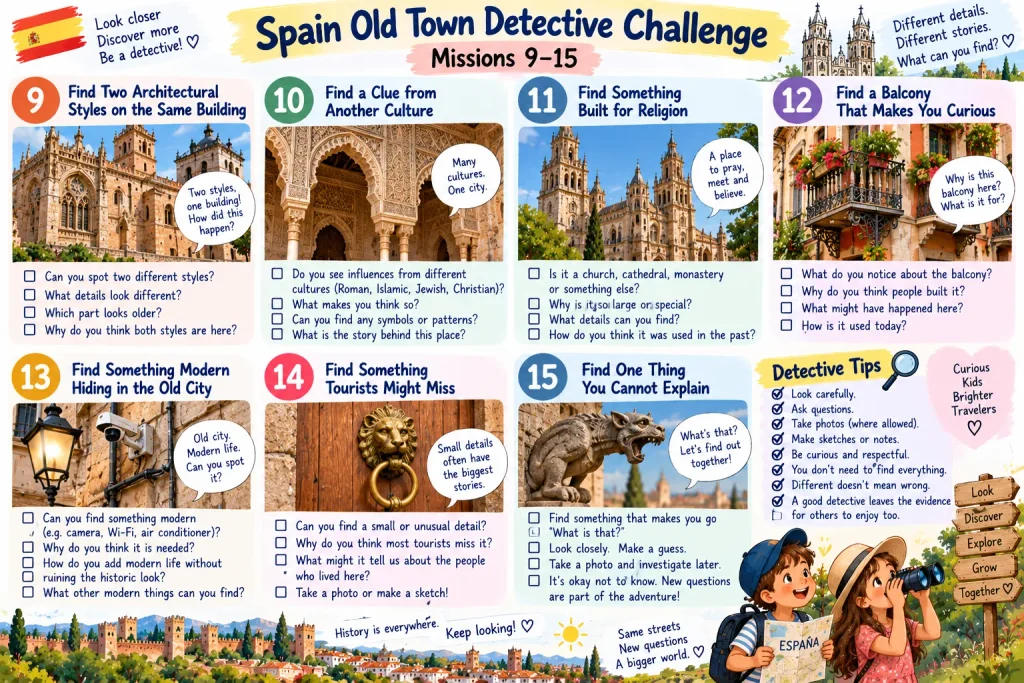
Mission 9: Find Two Architectural Styles on the Same Building
This is harder.
And much more interesting.
Historic buildings can change over centuries.
A structure may be:
- expanded
- repaired
- rebuilt
- given a new façade
- adapted by later rulers
- restored after damage
Look for differences in:
- windows
- stone
- brick
- arches
- towers
- decoration
- rooflines
Ask:
“Do you think everything here was built at the same time?”
Do not worry if you cannot identify the architectural periods.
Noticing the difference is the first step.
Mission 10: Find a Clue from Another Culture
Spain’s historic cities contain layers created by different communities and political periods.
Depending on the city, children might encounter traces associated with:
- Roman history
- Islamic rule
- Christian kingdoms
- Jewish communities
- later European architectural movements
But be careful.
Do not teach children:
horseshoe arch = definitely Muslim
or:
geometric decoration = definitely Islamic
Architectural forms travel, survive, get copied and change meaning.
Instead ask:
“What does the official information say about this building?”
The mission is to notice cultural layers—not guess ethnicity from decoration.
Mission 11: Find Something Built for Religion
This might be:
- cathedral
- church
- monastery
- convent
- chapel
- synagogue
- mosque or former mosque
- religious sculpture
Then move beyond:
“It’s a church.”
Ask:
“Why is this building so large?”
or:
“Why would people spend so much money and labor building it?”
Religion influenced:
- architecture
- art
- education
- politics
- calendars
- festivals
- community life
in profound ways.
A religious building is therefore also a clue to how society was organized.
Mission 12: Find a Balcony That Makes You Curious
Spanish historic centers can contain balconies of many periods and styles.
Pick one.
Ask:
“Why have a balcony here?”
Children might suggest:
- air
- light
- watching the street
- plants
- drying things
- social life
- decoration
Different buildings will have different answers.
The goal is simply to realize that architecture often responds to how people live.
Mission 13: Find Something Modern Hiding in the Old City
This is one of my favorites.
Look carefully.
Can you find:
- security camera
- Wi-Fi equipment
- modern drain
- air conditioner
- electrical cable
- modern window
- elevator sign
- accessibility adaptation
- traffic sensor
Now ask:
“How do you put modern life inside a historic city without destroying what makes it historic?”
That is a real problem faced by old cities around the world.
Residents still need:
- electricity
- internet
- plumbing
- accessibility
- emergency services
- deliveries
- heating and cooling
Historic cities are not museum sets.
People still live in them.
Mission 14: Find Something Tourists Might Miss
Move away from the biggest monument for a moment.
Look for something small.
Maybe:
- unusual door knocker
- tiny shrine
- old shop sign
- worn stone step
- street-name tile
- fountain
- carving
- historic drain
- strange corner
- tree growing somewhere unexpected
Let each child choose one.
There is no correct answer.
Then ask:
“Why did you notice that?”
This mission teaches something travel guides cannot completely provide.
Attention.
Mission 15: Find One Thing You Cannot Explain
This is the most important mission.
Find something that makes the child say:
“What’s that?”
And don’t immediately search for the answer.
First:
Step 1
Look closely.
Step 2
Guess.
Step 3
Explain why you guessed that.
Step 4
Photograph it if appropriate.
Step 5
Investigate later.
Maybe you were right.
Maybe completely wrong.
Both outcomes are useful.
Because a good detective does not need to know everything.
A good detective knows when there is another question to ask.
You Don’t Need to Complete All 15
This is not homework.
If your children find:
4 great clues
and then discover an ice-cream shop, that’s a successful old-town investigation.
If one child spends ten minutes examining a coat of arms, let them.
If another becomes fascinated by a fountain, follow that question.
The challenge exists to make children look, not to make parents say:
“Come on! We still need numbers 12, 13, 14 and 15!”
There is no certificate waiting at the finish line.
Curiosity is the prize.
Try the Challenge in Different Spanish Cities
The activity becomes even more interesting when repeated.
In Segovia, children might notice the Roman aqueduct, medieval walls and the Alcázar.
In Toledo, they may begin seeing how different religious and cultural histories overlap within a dense historic city.
In Córdoba, questions about Roman, Islamic, Jewish and Christian history may appear within a remarkably compact area.
In Seville, royal, religious and Islamic architectural layers can lead to completely different discoveries.
In Cádiz, the sea changes the investigation.
In Santiago de Compostela, pilgrimage becomes part of the city’s story.
Do not ask:
“Which old town is best?”
Ask:
“What clues did this city give us that the last one didn’t?”
Now each destination has a reason to exist.
Make a Family Detective Notebook
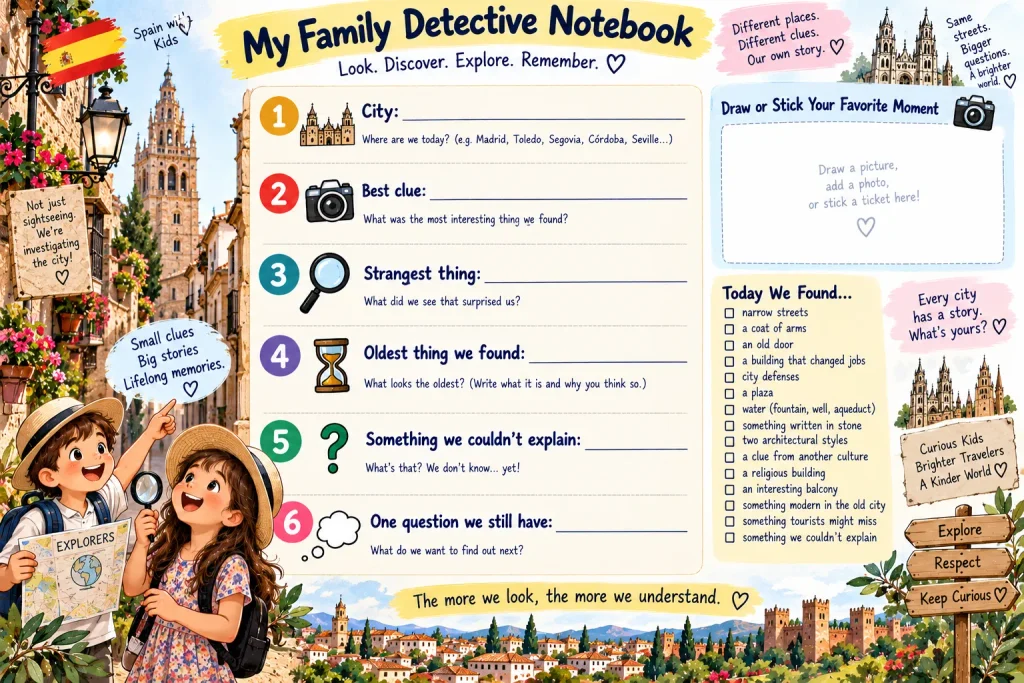
If the children enjoy the game, keep it going throughout Spain.
For each city, record only five things:
City: ________
Best clue: ________
Strangest thing: ________
Oldest thing we found: ________
Something we couldn’t explain: ________
One question we still have: ________
By the end of the trip, children have created their own travel record.
Not:
“What attractions did we visit?”
but:
“What did we notice?”
That’s a much more interesting souvenir.
Final Thoughts: Stop Telling Kids to “Look at the Beautiful Building”
Adults do this constantly.
“Look!”
“Isn’t that beautiful?”
“Look at the cathedral!”
“Look at the old street!”
The child looks.
For three seconds.
Then asks for a snack.
Instead, give them a problem.
“Find where somebody would defend this gate.”
“Which door do you think is oldest?”
“Can you find something modern hidden on this medieval street?”
“Where did people get water?”
Now looking has a purpose.
And once children start asking their own questions, you can stop supplying missions.
They have learned the real game.
A historic city is not just a collection of old buildings.
It is evidence.
Evidence of how people:
lived,
worked,
believed,
protected themselves,
found water,
showed power,
built communities,
and changed their cities over hundreds or even thousands of years.
So the next time your family enters another beautiful Spanish old town, don’t begin with:
“Here are the ten things we have to see.”
Try:
“Detectives, what can you find?”
Then follow them.
Because sometimes children do not need more information about a destination.
They need a reason to notice it.
Continue Exploring Spain with Kids
Why Are There So Many Castles in Spain?
Read Why Are There So Many Castles in Spain? A Story of Kingdoms, Borders and Battles for Kids before investigating city walls, towers and fortified landscapes.
The Legend of Segovia’s Aqueduct
Our The Legend of Segovia’s Aqueduct: A Story to Tell Your Kids in Spain turns one extraordinary Roman monument into a legend, an engineering mystery and an observation game.
Best Castles in Spain for Families
Use Best Castles in Spain for Families: Which Castle Is Right for Your Kids? when your old-town detectives decide they want to explore the fortifications from the inside.