Planning a family trip to Spain can be surprisingly difficult for one simple reason: there are too many good choices.
The best places to visit in Spain with kids range from major cities and historic towns to Mediterranean islands, beaches and food-focused destinations in the north.
Barcelona and Madrid are the obvious starting points, but Spain becomes much more interesting once you look beyond its two biggest tourist cities. There are Moorish palaces in Granada, beaches and seafood in Málaga, medieval streets in Toledo, pintxos in San Sebastián, dramatic cliffs in Ronda, Mediterranean islands, and some of Europe’s most atmospheric smaller cities.
The problem is not finding somewhere worth visiting.
It is deciding which parts of Spain actually fit your family.
A beach-loving family may have a completely different ideal itinerary from one traveling with teenagers interested in football, art and food. A family with younger children may appreciate Mallorca’s slower rhythm, while older children may enjoy moving between Madrid, Seville and Granada by train.
So this is not a checklist of 15 places you should somehow squeeze into one vacation.
Trying to visit all of them in a single trip would mean spending far too much of your holiday packing bags and moving between hotels.
Instead, think of these as 15 building blocks for creating your own Spain family itinerary.
For each destination, we’ll look at what makes it worthwhile, what children are most likely to enjoy, how long families should consider staying, and the practical drawbacks parents should know before booking.
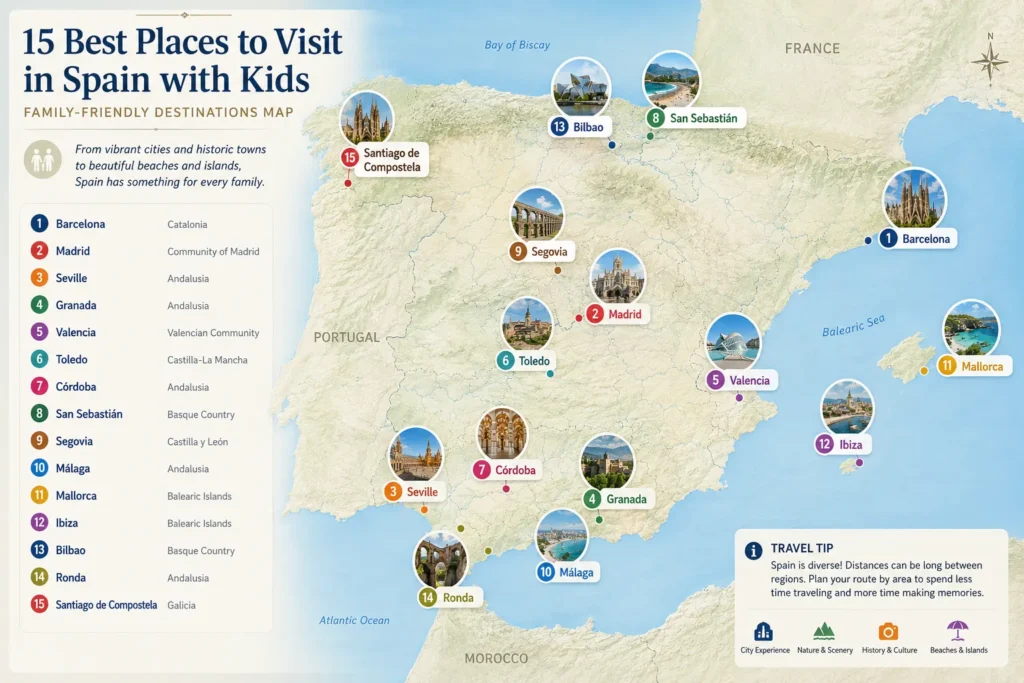
Spain with Kids: Quick Comparison
Before looking at each destination individually, this is the easiest way to narrow down the list.
| Destination | Best For | Suggested Stay | Family Travel Style |
|---|---|---|---|
| Barcelona | First-time visitors, architecture + beach | 3–4 nights | Busy city + activities |
| Madrid | Museums, parks, day trips | 3–4 nights | Big-city base |
| Seville | Andalusian culture, architecture | 2–3 nights | Culture + atmosphere |
| Granada | Alhambra, history | 2 nights | Historic city |
| Valencia | Beach + modern attractions | 2–3 nights | Relaxed city break |
| Toledo | Medieval history | Day trip–1 night | Easy cultural stop |
| Córdoba | Moorish history | 1–2 nights | Compact historic city |
| San Sebastián | Food + beach | 2–3 nights | Food + coastal |
| Segovia | Castle + Roman history | Day trip–1 night | Easy family day trip |
| Málaga | Beach + city | 2–3 nights | Relaxed coastal |
| Mallorca | Beaches + villages + nature | 4–7 nights | Island holiday |
| Ibiza | Beaches + island scenery | 3–5 nights | Island holiday |
| Bilbao | Art + Basque food | 2–3 nights | Culture + food |
| Ronda | Scenery + small-town Spain | 1–2 nights | Slow travel |
| Santiago de Compostela | History + Galicia | 2 nights | Historic + regional |
There is no single winner.
For a first trip, Barcelona and Madrid are the easiest major gateways.
For history, Seville, Granada, Córdoba and Toledo form an extraordinary group.
For food, look north toward San Sebastián and Bilbao, or east toward Valencia.
For a slower Mediterranean vacation, Mallorca may make more sense than adding another major city.
And if you want Spain to feel less like a sightseeing checklist, destinations such as Ronda, Segovia and Santiago de Compostela can completely change the rhythm of the trip.
1. Barcelona — Best First Spain Trip for Many Families
Best for
First-time visitors, architecture, beaches, football, older children and families who want variety.
Ideal stay
3–4 nights
Barcelona is one of the easiest Spanish cities to get excited about before you arrive.
The architecture looks unlike almost anywhere else in Europe, the Mediterranean is right beside the city, neighborhoods feel noticeably different from one another, and there is enough variety to build days that do not revolve entirely around museums.
That combination makes Barcelona particularly useful for families.
Parents can see world-famous architecture without asking children to spend the entire day looking at historic buildings.
You can visit the Sagrada Família in the morning and be near the beach later the same day.
What Families Should See in Barcelona
Sagrada Família
This is the obvious one, but it deserves its reputation.
Even children who have limited interest in churches may find the interior more engaging than a traditional cathedral because of the unusual shapes, enormous columns and colored light.
Timed tickets are important, so this is an attraction worth planning around rather than leaving until the last minute.
Park Güell
Park Güell combines Gaudí’s architecture with outdoor space, which makes it easier to incorporate into a family itinerary than another indoor attraction.
Do not underestimate the slopes around this part of Barcelona, particularly with younger children or in hot weather.
Casa Batlló
Older children interested in design or unusual buildings may enjoy Casa Batlló more than parents expect.
For younger children, whether another Gaudí interior is worth adding depends on how many architectural attractions you already have planned.
Barceloneta and the Waterfront
Barcelona’s beach is not the reason I would travel to Spain for a dedicated beach holiday.
But having a beach inside a major sightseeing city is extremely useful for families.
After several days of architecture and city walking, a few hours beside the Mediterranean can completely reset the pace of the trip.
Montjuïc
Montjuïc gives families parks, viewpoints and attractions in a less compressed environment than the historic center.
Transportation itself can also become part of the fun, particularly if you incorporate one of Barcelona’s cable-car experiences.
What Kids May Remember Most
Possibly not the Sagrada Família.
It might be:
- riding above the city,
- playing at the beach,
- seeing Gaudí’s strange buildings,
- watching street performers,
- visiting a football-related attraction,
- or simply staying out later than they normally would at home.
Barcelona works well because parents do not have to manufacture “kid activities” all day.
The city naturally provides variety.
What to Eat
Barcelona is a good introduction to Catalan food.
Try:
- pa amb tomàquet — bread rubbed with tomato and olive oil,
- seafood,
- crema catalana,
- local pastries,
- and a mixture of tapas-style dishes that children can share rather than committing to one unfamiliar meal.
Do not feel that every meal needs to become a major restaurant experience.
Markets, bakeries and casual meals can be just as useful on family sightseeing days.
Parent Reality Check
Barcelona can become exhausting when too many timed attractions are stacked together.
The city is large enough that transportation and walking add up, and popular attractions can be extremely busy.
For a three-day stay, I would rather choose a few major experiences and leave space for neighborhoods, parks and the waterfront than try to complete every famous Gaudí site.
Family verdict: ★★★★★
Best age range: Almost any age, provided the itinerary matches the children
Biggest advantage: Extraordinary variety
Biggest drawback: Crowds and the temptation to overplan
2. Madrid — Best Big-City Base for Exploring Central Spain
Best for
Museums, parks, football, food, older children and families interested in day trips.
Ideal stay
3–4 nights
Madrid does not have Barcelona’s Mediterranean coastline or Gaudí architecture.
What it does have is something extremely valuable when traveling as a family:
it works exceptionally well as a base.
The city itself offers major museums, royal history, huge parks, food markets, shopping and football.
Then high-speed rail and regional connections open up places such as Toledo and Segovia without requiring another hotel change.
For families who dislike constantly repacking suitcases, that matters.
What Families Should See in Madrid
Royal Palace
The scale alone makes the palace interesting.
Children who are bored by conventional art museums may respond differently to royal rooms, armor, enormous halls and the story of the Spanish monarchy.
Prado Museum
The Prado is extraordinary, but this is exactly the kind of place where family strategy matters.
Trying to “do the Prado” with children can become miserable.
Choosing a limited number of works or sections can be far more successful.
A shorter museum visit where everyone remains interested is better than two hours of dragging increasingly unhappy children through galleries.
Retiro Park
Retiro is one of Madrid’s greatest family assets.
It gives everyone a break from streets, buildings and indoor attractions without requiring you to leave the city.
The lake, open spaces and paths make it easy to build a slower afternoon around the park.
Plaza Mayor and the Historic Center
This is Madrid at its easiest.
Walk.
Stop for food.
Explore side streets.
Get churros.
Do not necessarily turn every historic square into another item requiring an explanation.
Sometimes simply being there is enough.
Madrid’s Secret Weapon: Day Trips
Madrid becomes significantly more valuable when you stop treating the city boundary as the end of the destination.
Two of the places later in this guide — Toledo and Segovia — work extremely well as separate excursions.
That means a family can potentially experience:
a modern European capital,
a medieval hilltop city,
and a Roman aqueduct and fairytale-like castle
while keeping the same hotel room.
That is efficient family travel.
What to Eat
Madrid classics include:
- cocido madrileño
- bocadillo de calamares
- churros con chocolate
Madrid is also home to Restaurante Botín, which Guinness World Records recognizes as the world’s oldest restaurant, founded in 1725.
But families do not need to organize the trip around famous restaurants.
Some of Madrid’s easiest food memories come from simple things: churros after walking, sandwiches around Plaza Mayor, or sharing dishes at a relaxed neighborhood restaurant.
Parent Reality Check
Madrid is large.
Do not assume attractions that look reasonably close on a map will feel close after several days of sightseeing.
Group days geographically and use the metro strategically.
Summer heat is another major consideration. In July and August, building a midday slowdown into the schedule can make an enormous difference.
Family verdict: ★★★★★
Best age range: School-age children and teenagers particularly well suited
Biggest advantage: Excellent city + day-trip combination
Biggest drawback: Size and summer heat
3. Seville — Best for Experiencing Classic Andalusia
Best for
Architecture, flamenco, plazas, food and families looking for a strong sense of place.
Ideal stay
2–3 nights
If Barcelona feels Mediterranean and Madrid feels metropolitan, Seville feels unmistakably Andalusian.
Orange trees.
Courtyards.
Tiles.
Plazas.
Flamenco.
Long evenings.
And some of Spain’s most recognizable historic architecture.
For families, Seville’s appeal is less about having dozens of dedicated children’s attractions and more about the city itself being enjoyable to experience.
What Families Should See in Seville
Plaza de España
This may be one of the easiest major sights in Spain to enjoy as a family.
It is visually spectacular but also open, spacious and less demanding than an indoor museum.
Children can move around while parents actually have time to look at the architecture.
Royal Alcázar of Seville
The Alcázar combines palaces, decorative rooms, courtyards and gardens.
The gardens are particularly useful with children because the visit does not feel entirely indoors.
Advance reservations are sensible during busy periods.
Seville Cathedral
The cathedral’s scale is impressive, but families should consider how many major historic interiors they have already visited.
Older children may be more interested if the visit is connected to the city’s history rather than treated as another mandatory church.
Flamenco
A flamenco performance can become one of the trip’s strongest memories, particularly for older children.
But choose the format carefully.
A late, lengthy performance after an already packed sightseeing day may not produce the experience parents imagined.
Food in Seville
Seville is an excellent city for tapas-style eating because sharing several smaller dishes lets families experiment without committing everyone to the same meal.
Look for:
- gazpacho,
- salmorejo,
- jamón ibérico,
- croquetas,
- grilled meats,
- and seasonal Andalusian dishes.
Tapas also works well with family travel because dinner can become flexible rather than formal.
Parent Reality Check: Heat Changes Everything
This is one of the most important practical points in the entire guide.
Seville in intense summer heat requires a different itinerary from Seville in spring.
Do not build a July afternoon around walking from monument to monument because Google Maps says everything is close.
Use mornings.
Take lunch seriously.
Rest during the hottest part of the day.
Come back outside later.
Seville’s evenings are one of the reasons the city is worth slowing down for anyway.
Family verdict: ★★★★½
Best age range: School-age children and teenagers
Biggest advantage: Extraordinary atmosphere and architecture
Biggest drawback: Summer heat
4. Granada — Best for One Unforgettable Historic Experience
Best for
The Alhambra, Moorish history, atmospheric neighborhoods and families who prefer compact cities.
Ideal stay
2 nights
Granada has an advantage that many destinations do not.
It has a clear centerpiece.
The Alhambra.
That makes planning surprisingly easy.
Instead of constructing a long checklist, families can build one day around the Alhambra and allow the rest of Granada to unfold more slowly.
The Alhambra With Kids
The Alhambra is not one building.
It is a large complex of palaces, gardens, fortifications and views.
That variety helps with children, but the size means families should still arrive prepared.
Comfortable shoes matter.
Water matters.
And tickets matter enormously.
This is not an attraction I would expect to casually visit without planning during a busy travel period.
Once the reservation is fixed, let it become the day’s major experience rather than stacking several other demanding attractions around it.
Beyond the Alhambra
Albaicín
Granada’s old Moorish quarter offers narrow streets and some of the city’s most memorable views.
The tradeoff is terrain.
Granada has hills, cobblestones and slopes that can be more demanding than the distances suggest.
Miradores
A viewpoint over the Alhambra toward the mountains can be more memorable for children than another historic interior.
Sunset is particularly atmospheric, though popular viewpoints can become crowded.
Granada’s Famous Tapas Culture
Granada remains known for bars where a tapa is commonly served with a drink.
The exact experience varies by establishment, but it can make eating around the city fun and informal.
Also look for piononos, small pastries associated with nearby Santa Fe.
Parent Reality Check
Granada looks compact on a map.
Its hills make it feel less compact on your legs.
If traveling with younger children, pay close attention to accommodation location and how you plan to reach the Alhambra and Albaicín.
Family verdict: ★★★★½
Best age range: School age and up
Biggest advantage: The Alhambra gives the trip an unforgettable centerpiece
Biggest drawback: Hills and advance-ticket planning
5. Valencia — Best Balance of City, Beach and Kid-Friendly Attractions
Best for
Families who want city sightseeing without giving up beaches and modern attractions.
Ideal stay
2–3 nights
Valencia is sometimes squeezed between Barcelona and Madrid on Spanish itineraries.
For families, that can be a mistake.
It offers something neither city delivers in quite the same way:
a major historic city,
Mediterranean beaches,
large green spaces,
and one of Spain’s most recognizable modern cultural complexes.
The overall pace can also feel easier than Barcelona.
What Families Should See
City of Arts and Sciences
This is Valencia’s obvious family attraction.
The futuristic architecture itself is worth seeing, while the wider complex provides several ways to build a day depending on children’s interests.
Families can choose rather than trying to visit everything.
Turia Gardens
One of Valencia’s best features is the long green corridor created in the former Turia riverbed.
For families, it provides something incredibly useful:
space.
After days of historic centers and narrow streets, having somewhere children can move freely changes the rhythm of sightseeing.
Central Market
Markets can work surprisingly well with children because visits are informal.
Walk through.
Look at food.
Choose something.
Leave when everyone has had enough.
No timed ticket required.
Malvarrosa Beach
Like Barcelona, Valencia lets families combine city travel with beach time.
For some families, that alone can justify choosing Valencia over another inland city.
Valencia Is the Place to Try Paella
Paella originated in Valencia.
Traditional paella valenciana differs from the seafood versions many international visitors associate with the dish and traditionally includes ingredients such as chicken, rabbit and local beans.
Families interested in food can turn this into an experience rather than simply ordering “paella” at the first tourist restaurant they see.
Also try:
- fideuà,
- horchata,
- and local pastries.
Parent Reality Check
Valencia works particularly well for families who are beginning to experience “historic city fatigue.”
After Madrid, Toledo and Seville, another cathedral-and-old-town destination may not be what everyone needs.
Valencia gives the itinerary a different visual and physical rhythm.
Family verdict: ★★★★★
Best age range: Excellent across a wide range of ages
Biggest advantage: City + beach + modern attractions
Biggest drawback: Families trying to fit Barcelona, Madrid and Andalusia into a short trip may struggle to justify another city stop
6. Toledo — Best Easy Medieval Day Trip
Best for
Castles, medieval streets, history and families based in Madrid.
Ideal stay
Day trip or 1 night
Toledo is exactly the kind of destination that can make a Spain itinerary feel more varied without adding another major travel day.
From Madrid, it can work as a straightforward excursion.
Suddenly the family moves from a modern capital to a compact historic city overlooking the surrounding landscape.
What Families Should See
Toledo Cathedral
One of Spain’s great cathedrals and an important part of understanding the city’s history.
Historic Old Town
Toledo’s real attraction is not one monument.
It is the combination of:
narrow streets,
stone buildings,
views,
religious history,
and the sense that the city belongs to a completely different era from Madrid.
Why Toledo Works With Children
Children who enjoy castles, knights or medieval history may connect with Toledo more easily than with another art museum.
But there is a practical catch:
the city is hilly.
Walking distances can look short while involving significant climbs.
Good shoes and a realistic pace matter.
Day Trip or Overnight?
A day trip is enough for many families.
An overnight stay offers something different.
Once many day visitors leave, the historic center changes atmosphere.
If your itinerary has enough time, one night can provide a slower experience.
If not, keeping your Madrid accommodation and returning in the evening is considerably simpler.
Family verdict: ★★★★
Best age range: School-age children and teenagers
Biggest advantage: Easy contrast with Madrid without changing hotels
Biggest drawback: Hills, cobblestones and significant walking
7. Córdoba — Best Compact City for Moorish History
Best for
History, architecture, families traveling through Andalusia and shorter stays.
Ideal stay
1–2 nights
Córdoba is one of those cities that can look optional when planning a Spain itinerary.
Seville is bigger.
Granada has the Alhambra.
Málaga has the coast.
But Córdoba has one enormous advantage for families:
a remarkable amount of history is concentrated into a relatively compact area.
That makes it particularly useful between larger destinations.
What Families Should See
Mosque-Cathedral of Córdoba
The Mezquita-Catedral is the reason many travelers come to Córdoba.
Its seemingly endless red-and-white arches create an interior unlike almost anything children will have seen elsewhere in Europe.
This is one of those historic buildings where the visual impact can work even when younger travelers do not fully understand the history.
Roman Bridge
The Roman Bridge is easy to combine with the historic center and provides excellent views back toward the city.
It also gives children a break from another indoor attraction.
Historic Center
Córdoba’s old quarter rewards wandering.
Whitewashed buildings, narrow lanes, patios and small plazas mean families do not need to turn every hour into a formal attraction.
What to Eat
Córdoba is closely associated with several substantial Andalusian dishes.
Look for:
- salmorejo
- flamenquín
- rabo de toro
- local olive oil
Salmorejo is particularly associated with Córdoba and can be an easy introduction to regional food.
Parent Reality Check
Córdoba’s compactness is a strength.
The heat is not.
Summer temperatures can be extreme, and this is one destination where the difference between a pleasant morning walk and a difficult afternoon can be enormous.
If traveling during the hottest months, organize the day around temperature rather than simply attraction opening hours.
Family verdict: ★★★★½
Best age range: School age and up
Biggest advantage: Major history concentrated in a manageable area
Biggest drawback: Intense summer heat
8. San Sebastián — Best Spain Destination for Food-Loving Families
Best for
Food, beaches, relaxed walking, older children and families exploring northern Spain.
Ideal stay
2–3 nights
San Sebastián is a very different Spain from Seville or Valencia.
The landscape is greener.
The climate is cooler and wetter.
The food culture is distinctly Basque.
And La Concha Bay gives the city one of Europe’s most attractive urban coastal settings.
For families who enjoy eating their way through a destination, San Sebastián belongs near the top of the list.
But food is not the only reason to come.
What Families Should See
La Concha Beach
The beach sits directly beside the city, which makes it extremely easy to combine with sightseeing.
Families do not need to choose between a city day and a beach day.
They can do both.
Old Town
San Sebastián’s Parte Vieja is the center of the city’s famous pintxos culture.
The fun is not necessarily finding one perfect restaurant.
It is moving between places and trying different things.
For families with older children, that can turn dinner into an activity.
Monte Igueldo
Views over La Concha Bay provide another type of experience after several days of city walking.
The journey upward can also become part of the attraction.
Pintxos With Kids
Pintxos can work remarkably well for families because nobody needs to order a large unfamiliar meal.
Choose several small things.
Share.
Find something everyone likes.
Try another place.
Children who are reluctant to experiment may be more willing when the commitment is one bite rather than an entire plate.
Also look for:
- Basque cheesecake,
- seafood,
- grilled fish,
- and local specialties depending on season.
Parent Reality Check
San Sebastián is not a destination I would add simply to say you visited northern Spain.
It makes most sense as part of a Basque Country or northern Spain route.
If the rest of the vacation is Barcelona–Madrid–Andalusia, traveling all the way north for two nights can create an inefficient itinerary.
But if Bilbao and the northern coast are already part of the plan, San Sebastián becomes an obvious candidate.
Family verdict: ★★★★★
Best age range: School-age children and teenagers
Biggest advantage: Beach + exceptional food + manageable city
Biggest drawback: Geographic location can complicate a southern Spain itinerary
9. Segovia — Best Day Trip for Castles and Roman History
Best for
Castles, Roman history, children who enjoy dramatic landmarks and families staying in Madrid.
Ideal stay
Day trip or 1 night
If Toledo gives families medieval Spain, Segovia offers something slightly different.
A Roman aqueduct dominates the entrance to the historic city.
Then, farther uphill, a castle appears that looks remarkably close to what children imagine when someone says “fairytale castle.”
That combination makes Segovia one of the easiest historical day trips to sell to children.
What Families Should See
Roman Aqueduct
The aqueduct is not hidden behind museum walls.
It is simply there, towering over the city.
That immediacy makes Roman engineering much easier to understand than looking at an artifact behind glass.
Alcázar of Segovia
With towers, defensive walls and its position above the landscape, the Alcázar has the visual drama children often expect from a European castle.
Even families experiencing cathedral fatigue may still have room for a castle.
What to Eat
Segovia is famous for cochinillo asado, roast suckling pig traditionally prepared with crisp skin.
Another regional specialty is judiones de La Granja, large beans often served in a hearty stew.
Whether those become children’s favorite foods is impossible to predict.
But this is a good place for parents interested in traditional Castilian cuisine.
Parent Reality Check
Segovia and Toledo are both excellent Madrid excursions, but on a short trip you may not need both.
Choose based on family interests.
Toledo: denser medieval and multicultural history.
Segovia: Roman aqueduct + castle.
For many younger children, Segovia may be the easier story to understand.
Family verdict: ★★★★½
Best age range: Excellent for school-age children
Biggest advantage: Two visually memorable historic landmarks
Biggest drawback: May compete with Toledo for limited Madrid day-trip time
10. Málaga — Best Easygoing City-and-Beach Stop in Andalusia
Best for
Beach time, relaxed sightseeing, families who want a break from intensive historic cities.
Ideal stay
2–3 nights
Málaga is sometimes treated merely as the airport for the Costa del Sol.
That undersells the city.
It combines beaches, an attractive historic center, museums, hilltop history and one of the easiestgoing rhythms among Spain’s larger coastal cities.
For families traveling through Andalusia, Málaga can serve an important purpose:
it lets everyone slow down.
What Families Should See
Malagueta Beach
The obvious advantage is convenience.
You can explore the city and still finish the afternoon beside the sea.
Alcazaba
Málaga’s Alcazaba provides history and views without requiring another trip to Granada.
Families already visiting the Alhambra may decide how much additional Moorish architecture they want, but the setting remains worthwhile.
Picasso Museum
Picasso was born in Málaga.
Whether the museum belongs on your family itinerary depends heavily on children’s ages and interests.
Do not add it automatically because a guide says it is a must-see.
Historic Center
Málaga is enjoyable without a rigid route.
Pedestrian streets, plazas and restaurants make it easy to have an afternoon where the objective is simply to explore.
Eat Espetos by the Sea
One of Málaga’s most recognizable food experiences is espetos de sardinas — sardines skewered and grilled over open fires, traditionally associated with beachfront restaurants called chiringuitos.
For children, watching food being cooked can sometimes be more interesting than the food itself.
Also look for:
- fried fish,
- seafood,
- and local Málaga wines for adults.
Parent Reality Check
Málaga is most valuable when you allow it to be Málaga.
If you fill every day with excursions to Granada, Ronda, Nerja and white villages, you may end up barely experiencing the city you are staying in.
Choose the excursions that genuinely matter and leave some coastal downtime.
Family verdict: ★★★★½
Best age range: Broadly family-friendly
Biggest advantage: Easy combination of city and beach
Biggest drawback: Temptation to use it only as a base for endless day trips
11. Mallorca — Best Spanish Island for a Full Family Holiday
Best for
Beaches, swimming, scenic drives, villages, outdoor activities and families who want a slower vacation.
Ideal stay
4–7 nights
Mallorca should not be treated as another two-night stop on a fast Spain itinerary.
The island works better when it becomes a different chapter of the vacation.
After several busy cities, Mallorca can provide beaches, mountain scenery, villages and days when the family does not need to enter a museum at all.
That contrast can be extremely valuable.
What Families Should See
Palma
Palma gives the island a genuine city rather than functioning purely as a resort gateway.
The cathedral dominates the waterfront, while the historic center provides restaurants, shopping and easy wandering.
Sóller
Sóller and the surrounding Tramuntana landscape show a completely different side of Mallorca from the beach resorts.
The historic rail connection between Palma and Sóller can also make transportation part of the experience.
Valldemossa
A beautiful mountain village that works well as part of a Tramuntana day.
Cap de Formentor
The scenery can be spectacular, although road access and seasonal transport arrangements can change.
Always check current official access information before planning the drive.
Beaches and Calas
Mallorca has far too many beaches to reduce the island to one “best” option.
Choose based on where you stay, children’s swimming ability, parking or public transportation, and the type of beach day your family prefers.
Do You Need a Car in Mallorca?
A car can make exploring smaller beaches, villages and mountain areas considerably easier.
But saying every family must rent one is too simplistic.
A family staying mainly around Palma may not need a vehicle every day.
Another family planning several rural and coastal excursions may find a car extremely useful.
Decide based on the itinerary rather than renting automatically.
What to Eat
Try:
- ensaimada
- sobrasada
- tumbet
- seafood
- local baked goods
Ensaimada in particular makes an easy family food experience: walk into a bakery, choose one and share.
Parent Reality Check
Mallorca is large enough that accommodation location matters enormously.
A hotel can look close to everything when viewing the island at small scale on a booking site.
It may not be.
Decide which part of Mallorca you actually want to explore before choosing accommodation.
Family verdict: ★★★★★
Best age range: Excellent for almost all ages
Biggest advantage: One of Spain’s best combinations of beaches, nature and towns
Biggest drawback: Distances and accommodation location require planning
12. Ibiza — Best for Families Who Want Beaches, Not Nightclubs
Best for
Beaches, swimming, sunsets and families who want a smaller island experience.
Ideal stay
3–5 nights
Ibiza has one of the strongest reputations of any European island.
Unfortunately for family travelers, that reputation is often summarized in one word:
parties.
That is real.
But it is not the whole island.
Away from the nightlife centers, Ibiza offers coves, beaches, historic Ibiza Town, coastal scenery and relaxed areas that can work extremely well for families.
The key is choosing where you stay.
What Families Should See
Dalt Vila
The fortified old town gives Ibiza historical depth that visitors expecting only beach clubs may not anticipate.
Walking uphill through the old streets leads to wide views over the harbor and surrounding coastline.
Cala Comte
Known for clear water and sunset views.
As with any popular beach, timing matters during peak season.
Cala Bassa
Another popular beach option that can work well as part of a relaxed island day.
Es Vedrà Viewpoints
The dramatic offshore rock formation has become one of Ibiza’s iconic landscapes.
Families should prioritize safe, established viewing areas rather than chasing risky social-media photo locations.
Ibiza With Children Is Mostly About Location
A family holiday in Ibiza can feel completely different depending on where the accommodation is located.
Before booking, investigate the immediate area rather than simply searching “family hotel Ibiza.”
Ask:
Is the beach walkable?
Are restaurants nearby?
Will nightlife noise be an issue?
Do we need a car?
How long will airport transportation take?
Those questions matter more than the island’s party reputation.
When to Visit
For beach-focused family travel, late spring through early autumn generally offers the most reliable conditions, but the busiest summer period also brings higher prices and larger crowds.
Families who are not tied to school holidays may find the shoulder seasons particularly appealing.
Always check seasonal opening schedules because some island businesses operate very differently outside the main tourism period.
What to Eat
Look beyond international resort food and try:
- bullit de peix
- seafood
- flaó
- local Mediterranean dishes
Parent Reality Check
If nightlife has no role in your trip, research accommodation location carefully.
Ibiza can absolutely work for families.
But booking the wrong part of the island because the hotel looked inexpensive can create a very different vacation from the one you imagined.
Family verdict: ★★★★
Best age range: Particularly good for beach-loving families
Biggest advantage: Beautiful coves and manageable island scale
Biggest drawback: Accommodation location matters enormously
13. Bilbao — Best for Modern Culture and Basque Food
Best for
Art, architecture, food, northern Spain road trips and families with older children.
Ideal stay
2–3 nights
Bilbao demonstrates how different northern Spain can feel from the Mediterranean and Andalusia.
The city transformed dramatically from its industrial past, with the Guggenheim Museum becoming the most recognizable symbol of that change.
But Bilbao is not just one museum.
The riverfront, Casco Viejo and Basque food culture make it a strong urban stop on a northern Spain itinerary.
What Families Should See
Guggenheim Museum Bilbao
Even children who are not enthusiastic museum visitors may find the building itself interesting.
The exterior, riverside setting and large-scale artworks can make the experience more accessible than a conventional gallery visit.
How long you spend inside should depend on the family rather than the admission price.
Casco Viejo
Bilbao’s old town provides the historic contrast to the city’s modern architecture.
This is also one of the easiest areas to experience pintxos culture.
Riverfront
Walking along the Nervión gives families room to experience the city’s modern architecture without turning the day into a series of formal attractions.
Food in Bilbao
Basque food culture is one of the main reasons to spend time here.
Try:
- pintxos,
- bacalao al pil-pil,
- seafood,
- Basque-style desserts and cheesecake.
As in San Sebastián, small portions make experimentation easier.
Bilbao or San Sebastián?
Ideally, both.
They complement each other.
Bilbao: architecture, Guggenheim, urban transformation.
San Sebastián: beach, elegant waterfront, intense pintxos culture.
If time forces a choice, decide what the family values more.
For a northern Spain itinerary, combining them makes much more sense than treating either as an isolated detour from Madrid or Barcelona.
Family verdict: ★★★★½
Best age range: School-age children and teenagers
Biggest advantage: Modern culture + Basque food
Biggest drawback: Less obvious for very young children than Spain’s beach-focused destinations
14. Ronda — Best Small-Town Stop for Dramatic Scenery
Best for
Scenery, slower travel, road trips, photography and families who need a break from large cities.
Ideal stay
1–2 nights
Ronda is not somewhere I would add because a Spain checklist says you must.
I would add it because it changes the pace of the trip.
After Madrid, Seville or Málaga, arriving in a smaller hilltop town above a deep gorge feels completely different.
That contrast is exactly why Ronda can work so well.
What Families Should See
Puente Nuevo
The bridge crossing El Tajo gorge is Ronda’s defining image.
Several viewpoints provide different perspectives, but families should pay attention to terrain and safe access rather than attempting every possible photo location.
Old Town
Ronda is best experienced slowly.
Walk.
Stop.
Look at the landscape.
Have lunch.
This is not a destination that needs an aggressive sightseeing schedule.
Alameda del Tajo
An easy place to slow down and enjoy views without turning the afternoon into another major attraction.
Food and Wine
Ronda’s surrounding countryside has a growing wine scene, making it particularly interesting for parents.
Traditional Andalusian food includes dishes such as rabo de toro, cheeses and regional meats.
Wine activities obviously need to be chosen with the entire family in mind, but countryside restaurants can work well without making the day solely about wine tasting.
Day Trip or Overnight?
Ronda is frequently visited as a day trip.
That works.
But one night changes the experience.
When day visitors leave, the town becomes quieter and the entire reason for including a smaller destination becomes more obvious.
If your Spain trip already contains several hotel changes, however, another one-night stay may create more hassle than benefit.
Family verdict: ★★★★½
Best age range: School-age children and teenagers
Biggest advantage: Dramatic scenery and slower pace
Biggest drawback: Another hotel change may not be worthwhile on short itineraries
15. Santiago de Compostela — Best for History, Atmosphere and a Different Side of Spain
Best for
History, Galicia, older children, Camino stories and families exploring northwestern Spain.
Ideal stay
2 nights
Santiago de Compostela does not fit neatly into the stereotypical image of a Spanish vacation.
That is part of its appeal.
The climate, architecture, food and atmosphere of Galicia can feel far removed from Andalusia or the Mediterranean coast.
And then there is the Camino.
Even families who have no intention of walking hundreds of kilometers can feel the influence of the pilgrimage throughout the city.
Backpacks.
Walking poles.
Pilgrims arriving in the square.
People celebrating the end of a journey that may have taken weeks.
That gives Santiago something children can understand surprisingly easily:
people have traveled a very long way to reach this place.
What Families Should See
Santiago de Compostela Cathedral
The cathedral is the obvious centerpiece.
But the experience is not only about entering the building.
Spend time in Praza do Obradoiro and watch pilgrims arrive.
For children, seeing real travelers finishing the Camino can make the history of pilgrimage far more tangible than simply reading about it.
Historic Old Town
Santiago’s compact historic center works well on foot.
Arcaded streets are particularly welcome when Galicia’s famously changeable weather decides not to cooperate.
This is a destination where wandering without a long attraction list can be enough.
Pilgrimage History
Older children may enjoy understanding how the Camino works:
Where do pilgrims start?
How far do they walk?
Why do they carry scallop shells?
Why has Santiago attracted travelers for centuries?
Connecting the city to the journey makes the destination much more interesting than treating the cathedral as another old building.
What to Eat in Galicia
Galicia deserves serious attention from food-loving families.
Look for:
- pulpo a feira / pulpo a la gallega
- Galician seafood
- empanada gallega
- local cheeses
- Tarta de Santiago
Tarta de Santiago is particularly easy to introduce to children: an almond cake traditionally decorated with the Cross of Saint James.
Seafood can become one of the highlights for parents, especially if the Spain itinerary has already included several inland regions.
Parent Reality Check
Santiago makes the most sense when Galicia or northern Spain is already part of the itinerary.
Adding it to a Barcelona–Madrid–Andalusia trip simply because it appears on a “Best of Spain” list can create a major geographic detour.
This is exactly why destination lists should be used to choose, not to collect.
But for families already heading northwest, Santiago offers something genuinely different from almost every other place in this guide.
Family verdict: ★★★★½
Best age range: School-age children and teenagers
Biggest advantage: Distinct atmosphere and fascinating pilgrimage story
Biggest drawback: Geographic location requires deliberate itinerary planning
So Which Places in Spain Should Your Family Actually Choose?
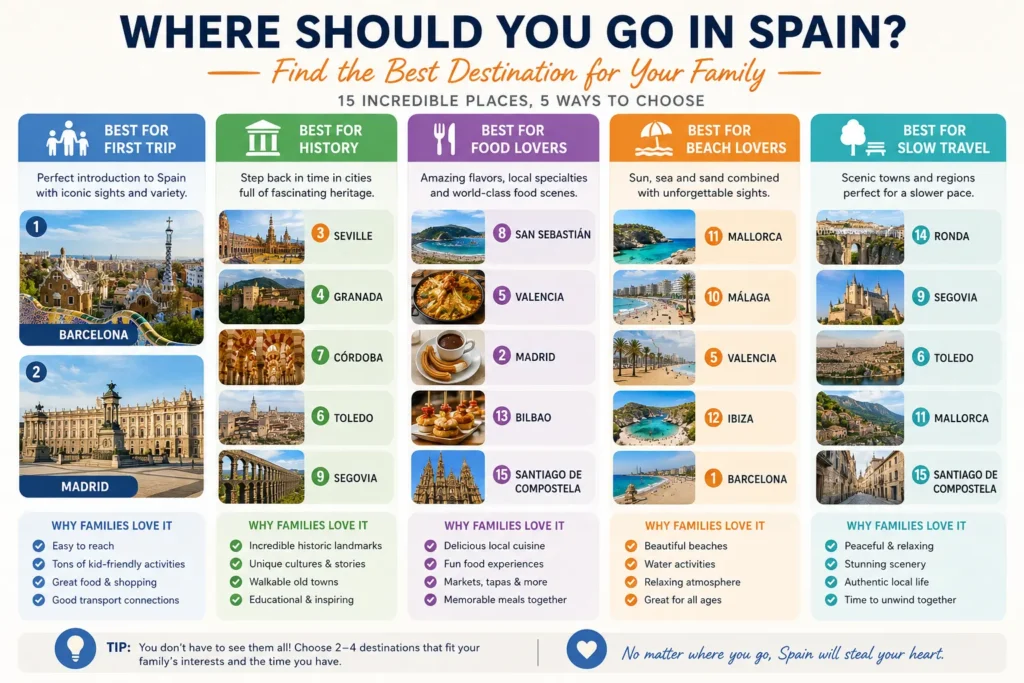
Fifteen destinations are useful for inspiration.
They are terrible as a single itinerary.
The right question is not:
How many of these can we visit?
It is:
Which combination gives our family the best trip?
Here is an easier way to decide.
Best for a First Family Trip to Spain
Barcelona + Madrid
If your family has never visited Spain and wants the broadest introduction, these are the easiest two major anchors.
Barcelona gives you:
architecture,
Mediterranean atmosphere,
beaches,
and distinctive neighborhoods.
Madrid gives you:
royal history,
major museums,
parks,
food,
and excellent access to central-Spain day trips.
Add one smaller destination rather than automatically adding another large city.
For example:
Barcelona → Madrid → Segovia
or
Barcelona → Madrid → Toledo
That creates more contrast than three consecutive major cities.
Best for History-Loving Families
Choose from:
Seville
Granada
Córdoba
Toledo
These cities contain some of Spain’s most compelling layers of Roman, Islamic, Jewish and Christian history.
But do not try to visit every historic monument in each one.
Historic-city fatigue is real, especially for children.
A better Andalusian route might be:
Seville — 3 nights
Córdoba — 1 night or day trip
Granada — 2 nights
That provides major history without turning the entire holiday into one long sequence of palaces and cathedrals.
Best for Food-Loving Families
My shortlist would be:
San Sebastián
Bilbao
Valencia
Madrid
Santiago de Compostela
But each offers a very different food experience.
San Sebastián and Bilbao introduce Basque pintxos culture.
Valencia gives families a direct connection to paella.
Madrid offers traditional central-Spanish food alongside an enormous contemporary restaurant scene.
Santiago introduces the seafood and regional cooking of Galicia.
For families, the best food destination is not necessarily the one with the most acclaimed restaurants.
It is the place where food can become part of the day without turning every meal into a formal event.
Best for Beach-Loving Families
Mallorca
My strongest all-around island choice for families who want a dedicated beach component plus villages, scenery and enough variety for several days.
Valencia
Best when you want a city trip that also contains a beach.
Málaga
Particularly useful in an Andalusian itinerary where a few slower coastal days can balance heavy sightseeing.
Ibiza
Excellent when chosen for the right reasons and with careful attention to accommodation location.
Barcelona
Useful for combining beach time with major sightseeing, though I would not choose Barcelona solely for a beach holiday.
Best for Families Who Want Slower Spain
Choose:
Ronda
Segovia
Toledo
or build more time into Mallorca rather than adding another city.
A slower destination becomes especially valuable after several intense sightseeing days.
This is something that is easy to underestimate while planning.
On paper, adding another famous city looks exciting.
During the trip, what the family may actually need is:
one smaller town,
one long lunch,
one evening with no reservation,
and one morning when nobody needs to rush anywhere.
How Many Places Should You Visit?
This depends on the length of the trip, but family travel generally becomes less enjoyable when every destination lasts only one or two nights.
A reasonable starting framework is:
7 Days
Choose 1–2 bases.
Examples:
Barcelona + Madrid
or
Seville + Granada
or simply
Mallorca
10 Days
Choose 2–3 bases.
Example:
Barcelona — 3 nights
Madrid — 3 nights
Seville — 3 nights
That already provides an enormous amount of variety.
14 Days
Choose roughly 3–4 bases.
Example:
Madrid — 3 nights
Seville — 3 nights
Granada — 2 nights
Málaga — 4 nights
Now you have a capital city, Andalusian culture, the Alhambra and a coastal finish.
Three Weeks
This is where regional variety becomes much easier.
You could combine something like:
Barcelona → Madrid → Andalusia → Mallorca
or concentrate on regions:
Basque Country → Galicia → Madrid
Longer does not automatically mean adding more destinations.
It can also mean staying longer in the good ones.
Don’t Underestimate Spain’s Size
Spain often looks manageable because major cities are connected by excellent transportation.
But the country is large enough that geography still matters.
Barcelona and Seville are not neighboring cities.
San Sebastián and Granada belong to completely different travel regions.
Santiago de Compostela is not a casual day trip from Madrid.
Mallorca and Ibiza require island logistics.
This matters because the cost of adding a destination is not simply the train or flight time.
It includes:
packing,
checking out,
getting to the station or airport,
waiting,
traveling,
finding the next accommodation,
checking in,
and getting everyone settled again.
For a family, a nominal two-hour transfer can consume a significant portion of the day.
Before adding another city, ask:
Is this destination worth another complete travel transition?
Sometimes the answer is absolutely yes.
Sometimes adding one more city makes the overall trip worse.
A Better Way to Build a Spain Family Itinerary
Instead of choosing cities individually, build the trip in regional clusters.
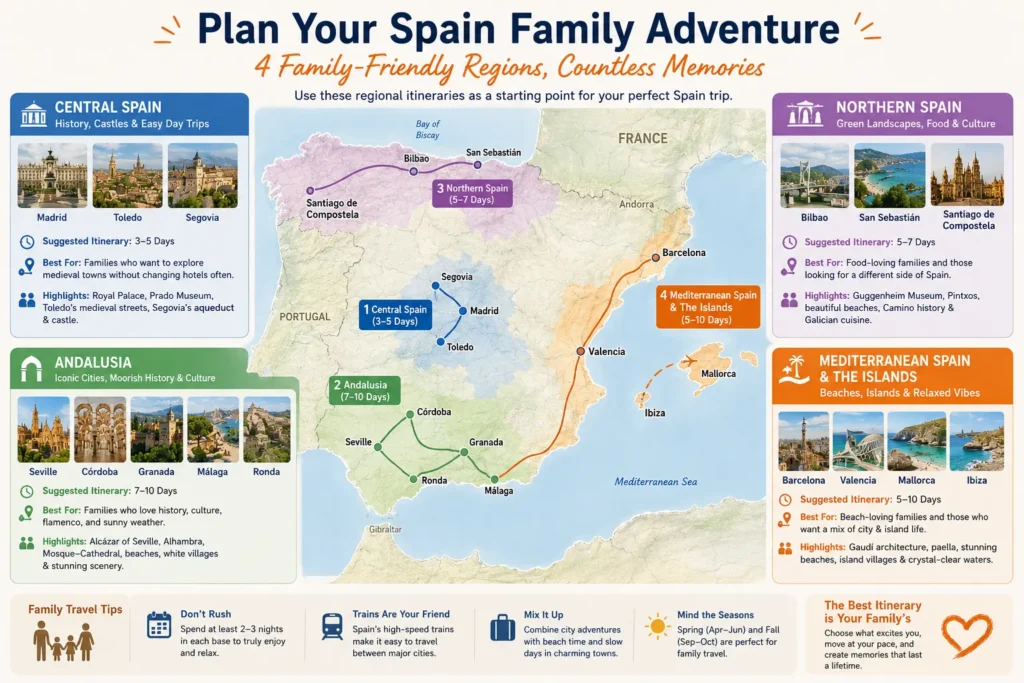
Central Spain
Madrid + Toledo + Segovia
One hotel base can potentially cover all three.
Excellent for families trying to minimize hotel changes.
Andalusia
Seville + Córdoba + Granada + Málaga + Ronda
You do not need all five.
Choose according to interests:
history,
beach,
small-town scenery,
or slower travel.
Northern Spain
Bilbao + San Sebastián + Santiago de Compostela
This works much better as a deliberate northern journey than as several isolated additions to a southern route.
Mediterranean Spain
Barcelona + Valencia + Mallorca
A strong option for families who want cities and beaches in the same vacation.
Again, resist the temptation to add every possible stop.
What We Would Prioritize With Kids
If I were narrowing these 15 destinations specifically for family travel rather than creating a general Spain bucket list, several stand out for different reasons.
Best All-Rounder: Barcelona
There is enough variety to recover when children lose interest in whatever the adults originally planned.
Architecture, beach, parks, transportation experiences and food all work together.
Best Practical Base: Madrid
Especially valuable because Toledo and Segovia can be experienced without repeatedly changing hotels.
Best History Experience: Granada
The Alhambra gives the destination one clear family story rather than ten disconnected monuments.
Best City + Beach Balance: Valencia
Often easier to pace than Barcelona while still offering major family attractions.
Best Island: Mallorca
Strong enough to become an entire holiday rather than simply another stop.
Best Food + Beach Combination: San Sebastián
Particularly strong with older children and teenagers.
Best Small-Town Contrast: Ronda
Not because families need dozens of activities there, but because sometimes they need fewer.
One Important Rule: Don’t Build the Trip for the Adults You Think You’ll Be
This happens constantly during travel planning.
At home, rested and sitting in front of a computer, it seems perfectly reasonable to visit:
a cathedral,
a palace,
a museum,
a market,
a viewpoint,
and a flamenco performance
on the same day.
The family you are planning for does not exist yet.
The real family will be:
jet-lagged,
hot,
hungry,
carrying bags,
occasionally lost,
and several days into the vacation.
Build the itinerary for that family.
Not the imaginary family that wakes up refreshed every morning, never misses a train and enjoys every museum equally.
This simple shift changes which Spain destinations make sense.
It also changes how long you should stay in them.
Use These 15 Places as Building Blocks, Not a Checklist
Spain rewards repeat visits.
You do not need to see everything on the first trip.
In fact, trying to see everything may prevent you from experiencing any one place properly.
A strong first family trip could be only:
Barcelona + Madrid + one day trip.
Another could be:
Seville + Granada + Málaga.
Another:
Mallorca for an entire week.
Another:
Bilbao + San Sebastián + northern coast.
All of them are Spain.
All of them can be excellent.
And none requires completing this list.
Final Thoughts: The Best Place in Spain Depends on Your Family
There is no objectively best family destination in Spain.
There is only the destination that matches what your family needs from this particular trip.
Choose Barcelona if you want variety.
Choose Madrid if you want a city base with great day trips.
Choose Seville for Andalusian atmosphere.
Choose Granada for one extraordinary historic experience.
Choose Valencia for an easy city-and-beach combination.
Choose Toledo or Segovia when Madrid needs a medieval contrast.
Choose Córdoba when history matters but time is limited.
Choose San Sebastián or Bilbao when food and northern Spain are calling.
Choose Málaga when the itinerary needs a coastal slowdown.
Choose Mallorca when the beach deserves to become a major part of the holiday.
Choose Ibiza when your version of the island is coves and sunsets rather than clubs.
Choose Ronda when your Spain itinerary needs less city and more scenery.
Choose Santiago de Compostela when you want to discover a Spain that feels very different from the Mediterranean south.
Most importantly, do not choose fifteen.
Choose the few that fit together.
Give them enough time.
And leave enough space between the famous places for Spain itself to become part of the trip.