
Madrid does not have Barcelona’s Mediterranean beach or Gaudí architecture.
At first glance, that can make Spain’s capital look like the more serious choice for a family trip.
Royal palace.
Major art museums.
Historic plazas.
Monuments.
But Madrid with kids works surprisingly well for a completely different reason:
the city gives families space.
Retiro Park can rescue an afternoon after a museum.
Large pedestrian areas make wandering easier.
Football can become the highlight for sports-loving children.
Food is approachable.
Public transportation is excellent.
And perhaps Madrid’s greatest family-travel advantage is its location.
You can stay in the same hotel and experience Madrid, Toledo and Segovia without repeatedly packing everyone’s suitcases.
For families, that matters.
Madrid therefore works best when you stop treating it as a checklist of famous monuments and instead build the trip around four different experiences:
Royal Madrid
Art Madrid
Outdoor Madrid
Madrid as a Base for Central Spain
This guide is built around that idea.
Not how many Madrid attractions your family can complete.
How to experience Spain’s capital while leaving enough energy to actually enjoy it.
Madrid with Kids: Quick Family Guide
| Question | Recommendation |
|---|---|
| Ideal stay | 3–4 nights |
| Minimum worthwhile stay | 2 full days |
| Best for | Royal history, parks, art, football, food, day trips |
| Best ages | School-age children and teenagers particularly well suited |
| Getting around | Metro + walking + occasional bus/taxi |
| Car needed? | No for a normal Madrid stay |
| Biggest planning issue | Distances + museum fatigue |
| Biggest summer issue | Heat |
| Best family reset | Retiro Park |
| Best major historic attraction | Royal Palace |
| Best cultural strategy | One focused museum visit rather than museum marathon |
| Biggest advantage | Toledo and Segovia without changing hotels |
Madrid is a city where family travel improves dramatically when you resist the temptation to make every important building an attraction.
One palace.
One carefully chosen museum.
One park.
One neighborhood.
One long meal.
That can be a much better day than six famous places connected by hurried metro rides.
1. Royal Palace of Madrid — Best Major Historic Attraction for Families
If I were choosing between Madrid’s major historic attractions for children, the Royal Palace would be near the top of my list.
A palace is easy to understand.
Kings and queens lived here.
There are enormous rooms.
Decorated ceilings.
Ceremonial spaces.
Royal objects.
Armor and history.
Children do not need an art-history background to understand why the building matters.
That gives the Royal Palace an advantage over some more abstract cultural attractions.
Why It Can Work Better Than Another Museum
After several days in Europe, younger travelers may begin to experience what could politely be called museum fatigue.
Another gallery.
Another painting.
Another audio guide.
The Royal Palace provides a more tangible story.
Instead of simply asking children to look at objects, parents can talk about:
Who lived here?
Where would visitors have entered?
What would dinner have looked like?
How many people would it take to run a palace this size?
Suddenly history becomes easier to imagine.
How Long Should Families Allow?
For many families, approximately 1.5–2 hours is plenty.
The objective should not be to examine every room at maximum historical depth.
Leave while everyone is still interested.
That is almost always better than remaining another forty minutes because you feel obligated to get the full value from the ticket.
Combine It With Plaza de Oriente
One reason the palace works well for families is the surrounding area.
You can combine the visit with outdoor space and then continue toward central Madrid without immediately entering another paid attraction.
A reasonable family morning could be:
Royal Palace → Plaza de Oriente → lunch
rather than:
Royal Palace → Cathedral → museum → historic square → another church
The first leaves somewhere for the day to go.
Parent Reality Check
The Royal Palace is popular, and ticketing arrangements can change.
Use the official Royal Palace information when planning your visit and check current opening hours, admission conditions and any free-entry periods before relying on an old itinerary.
Family rating: ★★★★★
Best for: School-age children and teenagers
Allow: Around 1.5–2 hours
Advance planning: Recommended during busy periods
2. Prado Museum — Don’t Try to “Do the Prado” With Kids
The Prado is one of the world’s great art museums.
That does not mean a family needs to see all of it.
In fact, trying to do so may be the fastest way to make children decide they dislike art museums.
A much better strategy is:
choose a small number of works or artists before entering.
Then leave.
Turn the Prado Into a Mission
Instead of saying:
We’re going to spend the morning at the Prado.
try:
We’re going to find five paintings.
Velázquez.
Goya.
Bosch.
Rubens.
Whatever fits your children’s ages and interests.
Older children may want to understand why a particular work became famous.
Younger children may simply look for unusual details.
Either approach is legitimate.
The goal is engagement, not endurance.
How Long With Children?
For many families:
60–90 minutes
can be much more successful than attempting a three-hour comprehensive visit.
Families with art-loving teenagers may naturally stay longer.
But there is no prize for covering every gallery.
The Prado + Retiro Combination
This is where Madrid becomes particularly family-friendly.
Do the focused cultural experience first.
Then go outside.
Prado → lunch → Retiro Park
is one of the strongest family combinations in Madrid.
Children know the museum has an end.
Parents still get one of Europe’s great cultural institutions.
Everyone gets open space afterward.
Family rating: ★★★★½
Best for: School-age children and teenagers
Best strategy: Short and focused
Combine with: Retiro Park
3. Retiro Park — Madrid’s Family Reset Button
If Barceloneta Beach plays this role in Barcelona, Retiro Park plays it in Madrid.
This is not simply another attraction.
It is somewhere to stop being tourists for a while.
After:
palaces,
museums,
metro rides,
historic streets,
and adult conversations about what everyone should see next,
children can simply move.
That is why I would deliberately include Retiro rather than treating it as something to visit only if there is spare time.
What Can Families Do?
Depending on current availability and season, families can:
walk,
sit in the shade,
explore paths,
spend time around the lake,
see the Crystal Palace area,
or simply buy something to eat and stop planning for an hour.
The famous boating lake can be especially appealing to children, but check current operating conditions rather than building an entire day around one activity.
Why Parks Matter More on Family Trips
A park may look less important on an itinerary than another museum.
During the actual trip, it can be more valuable.
Imagine the family has already spent the morning at the Prado.
You could add another cultural attraction because it is nearby.
Or you could spend the afternoon outside.
The second option may mean everyone is still happy at dinner.
That matters more than adding another admission ticket to the trip.
Family rating: ★★★★★
Best for: All ages
Cost: General park access is free
Best use: After museums or a busy morning
4. Plaza Mayor + Puerta del Sol — Historic Madrid Without a Ticket
Not every important part of Madrid needs to become a formal visit.
Plaza Mayor and Puerta del Sol work particularly well because families can experience them while moving naturally through the city.
Walk.
Look around.
Get something to eat.
Watch people.
Continue.
No timed entry.
No audio guide.
No requirement to remain for ninety minutes.
Plaza Mayor
The enclosed historic square provides one of Madrid’s classic city scenes.
It is also associated with one of the capital’s most famous casual foods:
bocadillo de calamares, a fried calamari sandwich.
Whether every child will enthusiastically eat squid in bread is another question.
But food can turn a historic square into something more memorable than another photograph.
Puerta del Sol
Sol is one of Madrid’s central gathering points and a useful orientation landmark.
Children may enjoy finding the famous Bear and the Strawberry Tree statue, one of the symbols of Madrid.
Again, you do not need to create a long sightseeing block around it.
Sometimes ten minutes is enough.
Parent Reality Check
Central Madrid becomes busy.
Keep normal city awareness around belongings and children, particularly in crowded tourist areas and on public transportation.
But do not let the desire to “see the center” turn the day into a march between landmarks.
Family rating: ★★★★
Best for: All ages
Best feature: Easy to combine with food and walking
Cost: Free to explore
5. Santiago Bernabéu — Potentially the Highlight for Football-Loving Kids
For some children, this section should probably have been number one.
Madrid is home to Real Madrid, and for a football-loving child or teenager, a stadium experience can outweigh several days of palaces and museums.
That is useful information for parents.
Not every family member needs to value the same attractions.
Let Football Become Their Madrid Experience
Adults often build the itinerary around what they believe children should appreciate.
Historic architecture.
Art.
Royal history.
There is nothing wrong with those things.
But if your child has spent years watching Real Madrid, entering the stadium environment may create a much stronger connection to the city.
That can become their day.
Match or Stadium Visit?
A match is obviously a different experience from a stadium tour.
If your dates coincide with a game and the family is seriously interested, investigate tickets through official channels.
If not, a stadium visit can still provide:
club history,
football displays,
views into the stadium environment,
and a connection with a team children may already know.
As with Barcelona’s football attractions, stadium experiences evolve over time.
Check current Real Madrid information for tours, access, opening conditions and match-day restrictions before planning.
Family rating: ★★★★★ for football fans
Best for: School-age children and teenagers
Allow: Depends on the current visit format
Advance check: Essential
6. Museo Nacional Thyssen-Bornemisza — A Good Alternative to Another Huge Museum
Madrid’s famous “Golden Triangle of Art” creates another planning trap.
Prado.
Reina Sofía.
Thyssen.
A culture-loving adult may look at those names and think:
We should do all three.
With children on a short Madrid trip, I would rarely make that the default.
Instead, choose according to family interests.
The Thyssen can be useful because its collection provides a broad journey through different periods and artistic styles.
But the same rule applies:
a successful 75-minute museum visit is better than an unsuccessful three-hour one.
7. Reina Sofía — Best for Families With Older Kids Interested in Modern History
The Reina Sofía becomes particularly interesting with teenagers because of Picasso’s Guernica and the history surrounding it.
This is not simply a famous painting to tick off a list.
It can open conversations about:
the Spanish Civil War,
war and civilians,
propaganda,
art as political expression,
and why certain images become symbols.
For younger children, whether the museum belongs on the itinerary depends heavily on interest and maturity.
Prado or Reina Sofía?
For a short family visit, you do not necessarily need both.
Choose Prado if:
you want classical European art,
Velázquez and Goya,
and a traditional major-museum experience.
Choose Reina Sofía if:
older children are interested in modern art,
Picasso,
or 20th-century Spanish history.
Choose both if:
your family genuinely likes museums.
Not because a Madrid checklist told you to.
8. Gran Vía — Madrid After the Museums Close
Gran Vía gives families a different kind of Madrid.
Shops.
Theaters.
Bright signs.
Busy streets.
Restaurants.
People out late.
This can be particularly fun with older children and teenagers who may enjoy the energy more than another daytime monument.
Madrid evenings are part of the travel experience.
Do not necessarily return to the hotel immediately after dinner just because the day’s formal sightseeing is finished.
Which Madrid Attractions Should Families Prioritize?
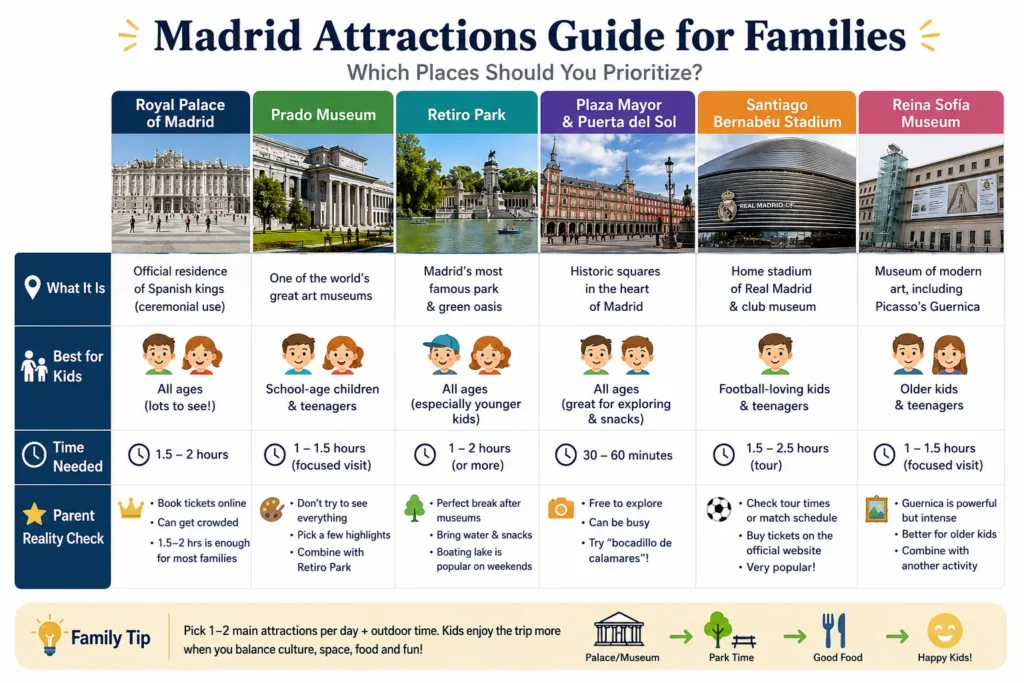
The answer changes dramatically depending on how many days you have.
If You Have 2 Full Days
Prioritize:
Royal Palace
one art museum
Retiro Park
historic center
and one family-specific interest such as football.
That is already a strong Madrid experience.
If You Have 3 Full Days
Add more flexibility.
Consider:
another cultural attraction,
Bernabéu,
more neighborhood exploration,
or simply a slower day.
Do not automatically use the third day for a day trip if Madrid itself still interests the family.
If You Have 4–5 Days
This is where Madrid becomes extremely powerful as a family base.
Instead of adding more Madrid attractions, consider:
Toledo
or
Segovia.
You can experience another side of Spain and still return to the same accommodation at night.
For a family, that is a major advantage.
Madrid’s Greatest Family Advantage: You Don’t Have to Keep Moving Hotels
This deserves its own section.
Multi-city travel looks exciting while planning.
During the trip, every hotel change means:
packing,
checking out,
transporting luggage,
finding the station,
traveling,
finding the next hotel,
checking in,
and unpacking again.
With children, those transitions consume more energy than they appear to on an itinerary.
Madrid gives families another option.
Stay put.
Visit the capital.
Then use one or two days to explore Central Spain.
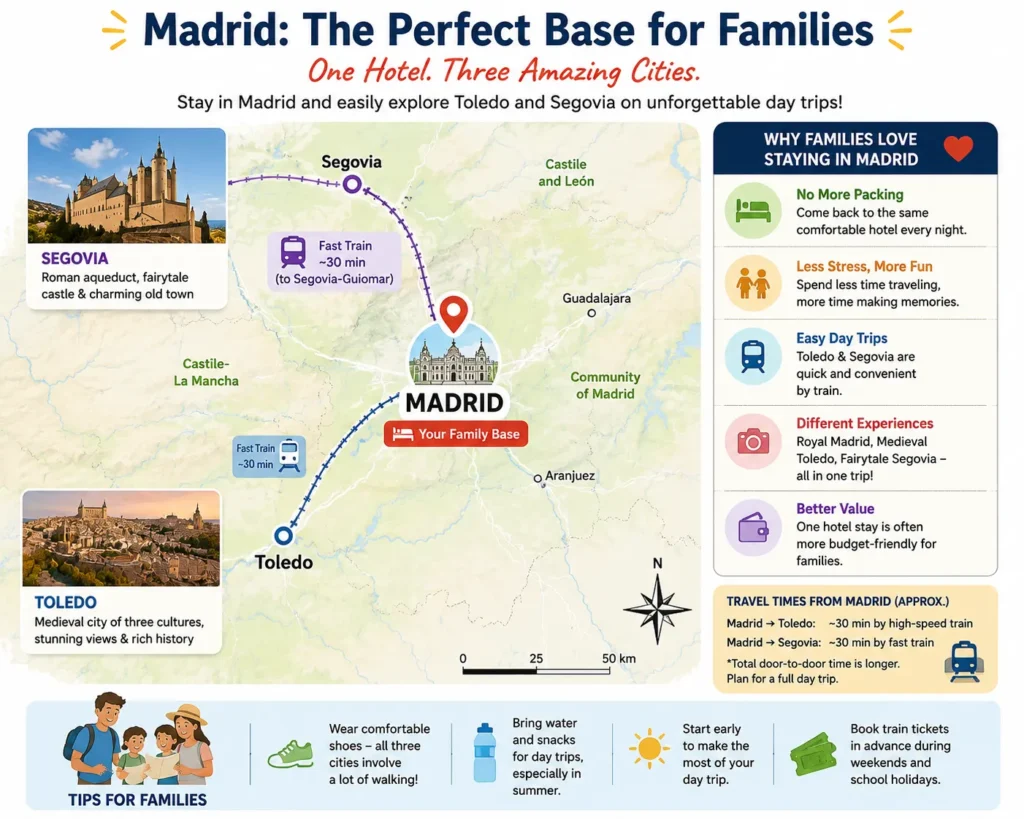
Toledo — Medieval Spain Without Another Hotel
Toledo provides a dramatic contrast with Madrid.
The modern capital disappears and suddenly the family is walking through:
narrow medieval streets,
historic religious quarters,
stone buildings,
and a hilltop city with centuries of layered history.
For children interested in castles, swords, knights or medieval stories, Toledo can be easier to connect with than another art gallery.
Madrid to Toledo
High-speed and fast rail services make Toledo a practical day-trip destination from Madrid, with the train journey typically taking roughly half an hour depending on the service.
But remember:
train time is not total travel time.
You still need to reach the departure station, arrive before the train, and travel from Toledo station into the historic center.
Treat it as a day trip, not a 30-minute activity.
Parent Reality Check
Toledo is hilly.
Distances that look short can involve significant slopes.
Good shoes matter.
A realistic pace matters more.
Family day-trip rating: ★★★★★
Best for: History-loving school-age children and teenagers
Biggest challenge: Hills
Segovia — Roman Engineering + a Fairytale Castle
Segovia offers a different story.
A massive Roman aqueduct.
Then a historic city.
Then an Alcázar that looks much closer to what children imagine when someone says:
castle.
That makes Segovia particularly appealing for school-age children.
Madrid to Segovia
This is where the old version of this article needed correction.
Toledo and Segovia should not simply be described as identical “30-minute AVE trips.”
Fast trains can make the rail portion to Segovia very quick, but Segovia-Guiomar station is outside the historic center, so families need additional local transportation after arriving.
That makes the real door-to-door experience different from Toledo.
When comparing day trips, look at:
hotel → attraction
not simply:
train departure → train arrival.
Toledo or Segovia With Kids?
If your Madrid itinerary only has room for one, I would choose according to the children.
Choose Toledo for:
medieval atmosphere,
religious and cultural history,
winding old streets,
and a city that feels dramatically different from Madrid.
Choose Segovia for:
Roman history,
the aqueduct,
a visually impressive castle,
and an easier historical story for many younger children.
There is no universal winner.
The better choice is the one your family will actually care about.
A Simple Madrid Family Strategy
If you remember nothing else from this first half of the guide, remember this:
Do not build Madrid around museums just because Madrid has famous museums.
Build it around contrast.
Palace → plaza.
Museum → park.
Historic center → food.
Madrid sightseeing → football.
City day → Toledo or Segovia.
That rhythm is what turns Madrid from a serious cultural capital into an excellent family destination.
Where to Stay in Madrid With Kids
Choosing where to stay in Madrid is less about finding the most famous neighborhood and more about reducing unnecessary movement.
Madrid is large.
A hotel can look reasonably central on a booking map while still adding substantial transportation to every day.
For families, I would prioritize:
easy Metro access
restaurants and supermarkets nearby
a neighborhood comfortable enough for evenings
and
the ability to reach several major attractions without complicated transfers.
A slightly more expensive room in the right location can be worth more than a cheaper hotel that turns every morning into a commute.
Centro — Best for First-Time Families Who Want to Walk
Madrid Centro puts many of the city’s most recognizable areas within relatively easy reach.
Depending on the exact location, families can walk to places such as:
Puerta del Sol,
Plaza Mayor,
the Royal Palace,
Gran Vía,
and numerous restaurants and shops.
That convenience is difficult to beat on a short visit.
Best for
First-time visitors, short stays and families who want to minimize transportation.
Main trade-off
Central Madrid can be busy and noisy.
Check recent accommodation reviews carefully, particularly comments about street noise and nighttime activity.
With children, being “right in the center” is only an advantage if everyone can sleep.
Retiro — Best for Families Who Value Space and a Calmer Rhythm
Staying near Retiro can be particularly attractive for families with younger children.
The park becomes part of everyday life rather than a one-time attraction.
After sightseeing, everyone can return to an area where outdoor space is immediately available.
It also places families reasonably well for Madrid’s major art museums.
Best for
Families who like parks, museums and slightly calmer evenings.
Main trade-off
Depending on the exact location, some historic-center attractions may require more Metro or bus travel.
Chamberí — Best for a More Residential Madrid Experience
Chamberí can work well for families who want to stay away from the most tourist-heavy streets while remaining connected to central Madrid.
Neighborhood restaurants, residential streets and Metro connections make it appealing for longer stays.
Best for
Families staying several nights, repeat visitors and travelers who prefer neighborhood life over being beside every major attraction.
Main trade-off
You will probably use public transportation more often.
That is not necessarily a problem if the accommodation is close to a useful Metro station.
Salamanca — Best for Comfort, Shopping and Quieter Evenings
Salamanca is one of Madrid’s more polished districts.
Families may appreciate:
wider streets,
shopping,
restaurants,
and a generally more residential feeling than the busiest parts of Centro.
It can also work particularly well for families interested in Retiro Park.
Best for
Families prioritizing comfort, shopping and a quieter base.
Main trade-off
Accommodation can be expensive, and staying here is unnecessary if your main goal is simply to be as close as possible to Plaza Mayor and the Royal Palace.
Hotel or Apartment in Madrid?
The same decision applies here as in Barcelona, but Madrid’s longer-stay potential makes apartments particularly interesting.
Choose a Hotel If You Want:
- reception,
- luggage storage,
- housekeeping,
- breakfast,
- and minimal check-in complexity.
Choose an Apartment If You Want:
- separate bedrooms,
- more living space,
- kitchen facilities,
- laundry,
- and flexible family meals.
For a family using Madrid as a four- or five-night base while visiting Toledo or Segovia, having extra space can be especially useful.
But always check the exact property rather than assuming every apartment provides the same facilities.
Getting Around Madrid With Kids
Madrid has an extensive public transportation network.
For most visiting families:
you do not need a car.
A rental car becomes much more useful once you leave Madrid for a broader road trip.
Inside the city, it usually creates unnecessary parking and traffic problems.
Metro
Madrid’s Metro is generally the fastest way to cover larger distances.
Children may initially enjoy navigating the system as part of the trip.
Parents may simply appreciate not walking another three kilometers.
The best strategy is similar to Barcelona:
use the Metro to remove boring distance.
Do not take it between every neighboring attraction.
But do not insist on walking everywhere because someone described Madrid as walkable.
Bus
Buses can be useful when the route is direct or when families prefer staying above ground.
They can also be easier than navigating Metro transfers in some situations.
Use route-planning tools rather than assuming Metro is always the fastest option.
Taxi
A taxi can be worth considering when:
everyone is exhausted,
you have luggage,
it is late,
the weather is unpleasant,
or public transportation requires several transfers.
Family travel is not a competition to spend the least possible amount on transportation.
Sometimes €10–€20 spent removing an exhausting journey is money well spent.
Madrid With a Stroller
Central Madrid can work well with a stroller, particularly along broader streets and pedestrian areas.
But the experience varies.
Metro stations do not all have identical accessibility.
Historic areas can contain uneven surfaces.
Crowds around major central attractions can make a large stroller cumbersome.
If you expect to use public transportation frequently, check accessibility for the exact stations your itinerary requires.
And if a child is at the age where they can walk — but perhaps not 15 kilometers every day — a lightweight stroller can still be surprisingly valuable.
What to Eat in Madrid With Kids
Madrid is an excellent city for family food exploration because many of its famous dishes are approachable.
Not every meal needs to involve adventurous eating.
Sometimes a sandwich is genuinely part of the local food experience.
Bocadillo de Calamares
One of Madrid’s classic casual foods.
A fried calamari sandwich may sound unusual to some children and completely normal to others.
The advantage is simplicity.
Bread.
Fried squid.
Eat.
It is particularly associated with the area around Plaza Mayor.
Churros con Chocolate
This may be the easiest Madrid food experience to sell to children.
Churros dipped into thick hot chocolate need very little explanation.
Famous establishments can attract substantial queues, but Madrid has many places serving churros.
You do not necessarily need to spend an hour waiting for the most photographed version.
Tortilla Española
Egg and potato make tortilla one of the easiest traditional Spanish foods to introduce to children.
It works at almost any time of day.
Cocido Madrileño
Madrid’s traditional chickpea-based stew is a much more substantial experience.
It can include meat, vegetables, chickpeas and broth served in stages depending on the restaurant.
This may work better as a deliberate family lunch than something squeezed between attractions.
Madrid’s Food Markets
Markets can provide a useful middle ground between restaurant meals and sightseeing.
Families can look around, choose smaller items and move at their own pace.
Mercado de San Miguel is extremely well known and conveniently located near Plaza Mayor, but popularity also means crowds and tourist demand.
Treat it as one option rather than assuming the most famous market must provide the family’s best meal.
Madrid has plenty of neighborhood food experiences beyond its headline attractions.
Madrid in Summer: Heat Changes the Day
This is one of the biggest differences between planning Madrid on a computer and experiencing Madrid in July or August.
Madrid can become extremely hot.
And unlike Barcelona, there is no Mediterranean beach waiting at the end of the Metro line.
That means families need to create their own midday reset.
A Better Summer Rhythm
Morning
Do the day’s major outdoor or historic attraction.
Royal Palace.
Historic center.
Retiro before the strongest heat.
Lunch
Sit down.
Drink.
Slow down.
Early Afternoon
Museum.
Hotel.
Indoor activity.
Or rest.
Late Afternoon
Return outside when temperatures become more manageable.
Evening
Madrid comes alive late.
Use that.
A summer itinerary does not need to end at 18:00 simply because the family took two hours off in the afternoon.
Best Time to Visit Madrid With Kids
Spring
Excellent for walking, parks and outdoor sightseeing.
Weather can vary, but the city is generally easier to explore than during peak summer heat.
Summer
Works well for families tied to school holidays, but itinerary pacing becomes extremely important.
Shade, water and midday breaks are not optional details.
Autumn
Often a strong period for sightseeing and parks.
As temperatures become more comfortable, Madrid becomes much easier to explore on foot.
Winter
Madrid remains a full city destination throughout winter.
Families focused on museums, food, football and city culture may find winter completely workable.
Always check current opening hours and seasonal schedules for specific attractions.
A Realistic 3-Day Madrid Family Itinerary
This itinerary deliberately avoids trying to complete Madrid.
Each day has one clear identity.
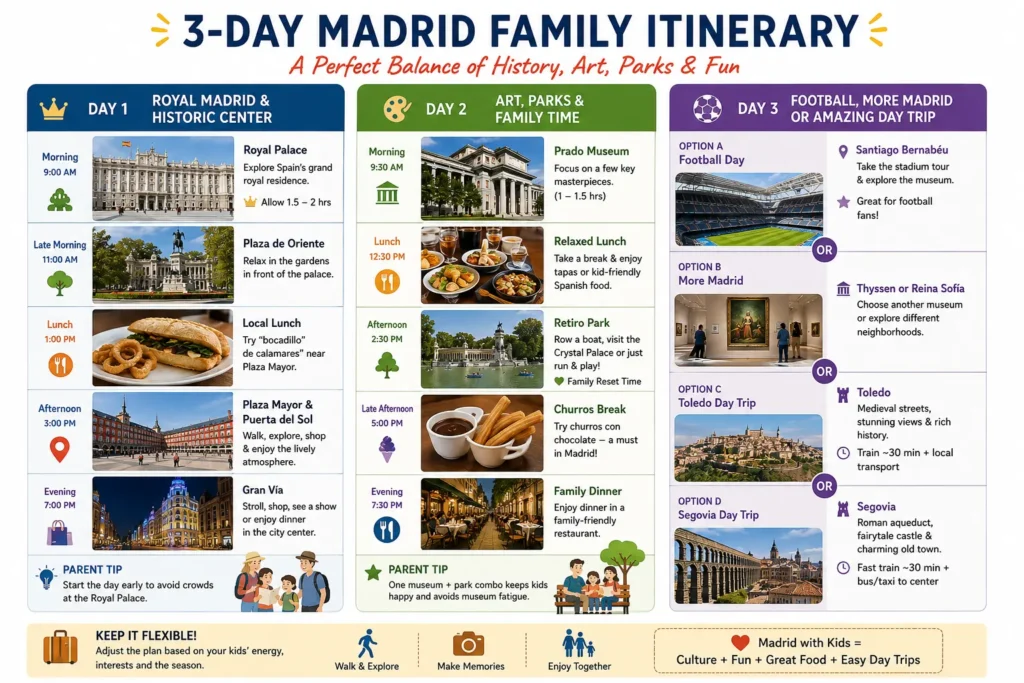
Day 1 — Royal Madrid + Historic Center
Morning — Royal Palace
Make this the day’s main reservation.
Allow enough time to enjoy the palace without trying to study every room.
Late Morning — Plaza de Oriente
Get outside.
Walk.
Let the children reset.
Lunch
Stay somewhere around central Madrid rather than crossing the city for a famous restaurant.
Afternoon — Plaza Mayor + Puerta del Sol
Explore at a relaxed pace.
Try a calamari sandwich or stop somewhere for something sweet.
Evening — Gran Vía
Walk, shop or simply experience Madrid after dark.
No additional museum required.
Day 2 — Art + Retiro + Family Choice
Morning — Prado or Reina Sofía
Choose one unless your children genuinely love art.
Keep the visit focused.
Lunch
Take a proper break.
Afternoon — Retiro Park
This is intentionally the opposite of the morning.
Outside.
Space.
No galleries.
No need to accomplish anything.
Late Afternoon — Family Choice
Depending on interests:
shopping,
another neighborhood,
churros,
football-related experience,
or simply more time in Retiro.
Evening
Dinner without another formal attraction.
Day 3 — Football, Madrid or a Day Trip
This day depends on your family.
Option A — Football Family
Build the day around the Santiago Bernabéu experience.
Then keep the rest flexible.
Option B — More Madrid
Choose something you deliberately skipped:
Thyssen,
Reina Sofía,
another neighborhood,
shopping,
or more park time.
Option C — Toledo
Use the entire day for Toledo rather than pretending it is a half-day attraction.
Option D — Segovia
Do the same for Segovia.
Do not try to visit both Toledo and Segovia in one day simply because they are both reachable from Madrid.
If You Have 4–5 Days in Madrid
This is where Madrid becomes one of Spain’s strongest family bases.
A five-day trip might look like:
Day 1
Royal Palace + historic center
Day 2
Museum + Retiro
Day 3
Toledo
Day 4
Football + neighborhood time
Day 5
Segovia or a completely flexible Madrid day
Notice what is missing:
another hotel.
The family can experience three very different Spanish cities while sleeping in the same accommodation every night.
For parents traveling with several children and luggage, that logistical simplicity should not be underestimated.
Should You Visit Both Toledo and Segovia?
With enough time, yes.
They provide very different experiences.
But if the trip is short, choose one.
Toledo Gives You
medieval atmosphere,
layered Christian, Jewish and Islamic history,
a dramatic hilltop setting,
and narrow historic streets.
Segovia Gives You
a Roman aqueduct,
a castle,
Castilian food,
and a particularly visual introduction to history.
For younger children, Segovia may be easier to understand immediately.
For older children interested in history and culture, Toledo can provide more depth.
Madrid With Kids vs Barcelona With Kids
This is one of the most useful comparisons for first-time Spain families.
Both cities are excellent.
They are excellent for different reasons.
| Madrid | Barcelona | |
|---|---|---|
| Major strength | Museums + parks + day trips | Architecture + beach + variety |
| Best family outdoor reset | Retiro Park | Beach / Montjuïc |
| Iconic architecture | Royal Palace | Gaudí |
| Football | Real Madrid | FC Barcelona |
| Beach | No | Yes |
| Major day trips | Toledo, Segovia | Montserrat, Sitges |
| Best for art | Excellent | Good |
| Best for first visual “wow” | Strong | Exceptional |
| Summer challenge | Heat | Heat + crowds |
| Best base for regional travel | Excellent | Very good |
Choose Madrid If Your Family Wants:
- royal history,
- major art museums,
- large parks,
- Real Madrid,
- Toledo and Segovia,
- and fewer hotel changes.
Choose Barcelona If Your Family Wants:
- Gaudí,
- Mediterranean atmosphere,
- beach time,
- unusual architecture,
- and more obvious child-friendly variety inside the city itself.
Choose Both If You Have Time
High-speed rail makes combining Madrid and Barcelona relatively straightforward.
For a first Spain family trip of around 8–10 days, the two cities can form strong anchors without requiring the family to race across the entire country.
Common Mistakes Families Make in Madrid
Trying to Visit Every Famous Museum
Madrid has extraordinary museums.
Your children do not need all of them.
Treating Retiro as Optional
The park is part of the family itinerary, not leftover space.
Underestimating Summer Heat
Distances that look easy become very different in intense afternoon temperatures.
Assuming Every Day Trip Takes “30 Minutes”
Rail journey time is only one part of the trip.
Door-to-door logistics matter.
Adding Toledo and Segovia to an Already Packed 3-Day Stay
Madrid itself deserves time.
Choosing a Hotel Far Away Just to Save a Little Money
Daily transportation has a cost in both money and energy.
Planning Every Meal
Madrid is a city where spontaneous food stops can become part of the experience.
How Madrid Fits Into a Longer Spain Family Trip
Madrid’s geographic position makes it one of the easiest anchors for a broader Spain itinerary.
Families can arrive from Barcelona by high-speed rail, stay several nights, use Madrid as a base for Toledo or Segovia, and then continue south toward Andalusia.
A route might look like:
Barcelona → Madrid → Seville → Granada
Or:
Madrid → Toledo day trip → Segovia day trip → Andalusia
The second route gives families significantly more variety without adding two additional hotel changes.
Families still deciding where else to go can compare regions in our 15 Best Places to Visit in Spain with Kids guide.
If Barcelona is also part of the trip, our Barcelona with Kids family travel guide covers the city’s attractions, neighborhoods, transportation and realistic family itinerary.
And if you are still deciding how many cities belong in the trip at all, our step-by-step guide to planning a family trip to Europe explains how to balance destinations, transportation, accommodation and family energy before booking.
What Madrid Does Better Than Almost Anywhere Else in Spain
Madrid lets families have a serious cultural trip without requiring every day to feel serious.
You can show children Velázquez in the morning and let them row a boat in the afternoon.
Walk through a royal palace one day and enter a football stadium the next.
Eat traditional cocido for lunch and churros with chocolate later.
Then wake up the following morning and travel to a medieval city without checking out of the hotel.
That combination is Madrid’s strength.
Not one attraction.
Range without constant relocation.
Final Thoughts: Madrid Rewards Families Who Slow It Down
Madrid can look like a city built for adults.
Museums.
Palaces.
Restaurants.
History.
But family travel changes the way those things should be experienced.
You do not need three museums.
Choose one.
You do not need every historic square.
Walk through the center and stop when something interests everyone.
You do not need to move hotels simply because Toledo and Segovia are famous destinations.
Use Madrid as a base.
And you do not need children to appreciate Madrid in exactly the same way adults do.
One child may remember the Royal Palace.
Another may remember the Bernabéu.
Someone else may remember rowing in Retiro or dipping churros into chocolate.
That is fine.
A successful family trip is not one where everyone chooses the same favorite attraction.
It is one where everyone comes home with a favorite of their own.