
Family travel has a strange way of rewriting the itinerary after the trip is over.
Family travel in Europe works best when the itinerary leaves room for both the places parents want to see and the moments children discover for themselves.
Parents may remember finally seeing the Sagrada Família, walking through the Alhambra, or standing in front of a painting they had wanted to see for years.
Ask the kids about the same trip a few months later, and the answer can be completely different.
They may remember the cable car that climbed above the city.
The train ride along the coast.
The tiny bakery where they chose breakfast.
The evening when everyone stopped sightseeing, sat in a plaza, and ordered ice cream.
Or the afternoon when nothing particularly important happened at all.
That difference matters.
Because when we plan a family trip to Europe, it is easy to focus on everything we should see and forget what actually makes a trip enjoyable for the people traveling with us.
A memorable family vacation is not necessarily the one with the longest itinerary.
Very often, it is the one that leaves enough room for something unexpected to become the best part of the trip.
This guide is about planning that kind of journey.
Not a perfect trip.
Not a trip where every hour is optimized.
A trip that works for parents, works for children, and still feels worth remembering years after everyone comes home.
Stop Planning Family Trips Like Adult Trips
One of the easiest mistakes to make when traveling with children is surprisingly simple:
Plan the trip you would take as adults, then bring the kids along.
On paper, the itinerary can look excellent.
Morning at a cathedral.
Museum before lunch.
Historic neighborhood in the afternoon.
Another monument before dinner.
Maybe one more viewpoint because it is only a fifteen-minute walk away.
Every individual stop makes sense.
The problem is what happens when they are combined.
Children experience cities differently from adults. They get tired of standing long before they get tired of walking. A museum that fascinates a parent for two hours may hold a child’s attention for thirty minutes. A “short” walk becomes much longer when it is hot, someone needs a bathroom, or everyone is hungry.
And Europe makes overplanning particularly tempting.
In cities such as Rome, Paris, Barcelona, Madrid, Florence, Seville, and Vienna, there is always another famous place nearby. Skipping something can feel like wasting an opportunity.
That mindset can turn a family vacation into a checklist.
The better question is not:
How many attractions can we fit into today?
It is:
How much can our family realistically enjoy today?
Those are very different questions.
A good family itinerary therefore needs something that ordinary sightseeing itineraries often ignore: energy management.
Think about the day as having a limited family energy budget.
Every queue spends some of it.
Every crowded metro ride spends some.
Heat spends it surprisingly quickly.
So does hunger.
And when that budget reaches zero, the fact that you have tickets for another famous monument does not matter very much.
A Better Rule: Fewer Places, Better Days
For most family sightseeing days, two meaningful activities are often more valuable than five rushed ones.
That does not mean spending the rest of the day in the hotel.
It means distinguishing between planned attractions and everything else that makes travel enjoyable.
A day might include:
- one important attraction in the morning,
- lunch somewhere nearby,
- time to wander,
- a playground or park,
- an interesting form of transportation,
- a snack stop,
- and one flexible activity later in the day.
Technically, you may have “seen” fewer things.
But the family has experienced much more of the destination.
That distinction becomes even more important on longer European trips. A packed schedule can work for one day. Repeating it for seven, ten, or fourteen days is much harder.
Family travel is an endurance event disguised as a vacation.
Plan accordingly.
The One-Big-Moment Rule
One of the simplest ways to improve a family itinerary is to give each day one big moment.
Not necessarily the most expensive attraction.
Not necessarily the place ranked number one on a travel website.
Just one experience that gives the day an identity.
In Barcelona, that might be the Sagrada Família.
In Granada, the Alhambra.
In Madrid, perhaps the Prado for an art-loving family.
But it could just as easily be riding a cable car, taking a scenic train, swimming at a beach, exploring a castle, watching sunset from a viewpoint, or taking a boat across a harbor.
Everything else fits around that experience.
This changes the psychology of the itinerary.
Instead of thinking:
We have six things to complete today.
you are effectively saying:
If we enjoy this one experience together, today has already worked.
That creates breathing room.
If everyone still has energy afterward, continue exploring.
If the children are tired, slow down.
If you discover an interesting market or street performance, stop.
You no longer feel that an unexpected hour has destroyed the schedule.
Why This Works Especially Well With Children
Children often remember experiences as individual stories rather than as a sequence of landmarks.
“The day we rode the train through the mountains.”
“The day we climbed the castle.”
“The day we went swimming.”
“The day we took the cable car.”
Those memories are easy to retrieve because the day has a clear emotional anchor.
Parents can use that intentionally.
Before each day of the trip, ask:
What is today’s one thing?
If you cannot answer easily, the itinerary may be trying to accomplish too much.
Build the Day Around Energy, Not Opening Hours
Opening hours matter.
Reservation times matter.
Train schedules certainly matter.
But once those fixed points are established, the rest of a family day should be built around when everyone is likely to have energy.
For many families, mornings are extremely valuable.
Children are rested. Temperatures are often cooler. Popular attractions may be less crowded. Parents have more patience.
That makes the morning the logical place for the day’s most demanding activity.
A practical sightseeing rhythm often looks something like this:
Morning: Major attraction or activity
Late morning: Easy exploration
Lunch: Proper break
Early afternoon: Low-demand activity or rest
Late afternoon: Flexible second outing
Evening: Dinner, plaza, promenade, beach, or neighborhood walk
It is not a rigid timetable.
It is a rhythm.
And rhythm matters more than squeezing every available opening hour out of a destination.
The Afternoon Trap
This becomes especially important in Southern Europe.
Spain, Italy, Portugal, Greece and parts of southern France can be exhausting during the hottest part of a summer day.
A 20-minute walk that felt perfectly reasonable while planning the trip at home can feel completely different at 3 p.m. with tired children.
Parents sometimes respond by pushing harder because tickets have already been purchased.
Usually that makes the situation worse.
A better strategy is to treat rest as part of the itinerary from the beginning.
Go back to the accommodation.
Find shade.
Have a long lunch.
Spend an hour at a pool.
Sit somewhere without trying to accomplish anything.
Then go out again.
European evenings are often excellent for family travel anyway. Plazas become livelier, temperatures drop, restaurants fill up, and cities can feel completely different from the middle of the afternoon.
Resting does not necessarily shorten the travel day.
Sometimes it extends it.
Give Kids Some Ownership of the Trip
Children do not need to plan the vacation.
But giving them some control over it can dramatically change how they experience it.
The simplest version is to offer choices.
Not:
“What do you want to do in Spain?”
That question is too broad.
Instead:
“Tomorrow we can take the cable car or visit the castle. Which would you choose?”
Or:
“After the museum, would you rather find a playground or go for churros?”
Even small decisions create ownership.
Older children and teenagers can take on more.
Give them a city and ask them to choose one place the family should visit.
Let them navigate to lunch.
Give them a budget to choose a snack.
Let them select one restaurant.
Ask them to research one activity before the trip.
Suddenly, they are not merely passengers following their parents’ itinerary.
Part of the journey belongs to them.
One Choice Per Child
For families traveling with multiple children, a useful approach is to give each child one meaningful choice during the trip.
It does not have to be complicated.
One chooses an attraction.
Another chooses dinner.
Another chooses a beach, activity, dessert stop, or afternoon plan.
This also creates something surprisingly useful later:
Each child tends to remember their choice.
It becomes part of the family’s travel story.
Make the Journey Part of the Adventure
Parents naturally think about transportation as logistics.
How quickly can we get from A to B?
How much does it cost?
How many transfers are there?
Those questions matter, particularly when traveling with luggage and children.
But sometimes the transportation itself deserves to become part of the itinerary.
Europe is unusually good at this.
A train can follow the Mediterranean coastline.
A funicular can climb above an old city.
A ferry can turn an ordinary transfer into a boat trip.
A cable car can become the attraction children talk about afterward.
A mountain railway can be more memorable than the viewpoint waiting at the top.
This is why the fastest transportation option is not automatically the best family option.
Sometimes an extra thirty minutes creates one of the best experiences of the trip.
Turn Transfers Into Memories
Consider the difference between these two descriptions:
“Tuesday: Travel from City A to City B.”
and
“Tuesday: Take the coastal train to City B, sit on the sea-facing side, have lunch near the station, then check into the hotel.”
The destination has not changed.
The transfer has.
This is particularly useful on longer trips because transfer days no longer feel like lost vacation days.
We’ve been exploring this idea throughout Travel With Kids World because some of Spain’s most memorable family experiences are not traditional attractions at all.
They are journeys.
Scenic railways, mountain trains and cable cars can transform the space between destinations into part of the vacation itself.
Related guides:
Best Scenic Train Journeys in Spain: 15 Incredible Rail Trips Families Will Never Forget
Best Cable Cars & Scenic Viewpoints in Spain: 15 Incredible Views Families Shouldn’t Miss
Big Cities Aren’t Always Where the Best Memories Happen
Europe’s famous cities deserve their reputations.
Barcelona is extraordinary.
Rome can fill an entire week.
Paris could fill several.
Madrid combines major museums, neighborhoods, parks, food and easy day trips better than many visitors expect.
But family travel becomes much more interesting when every destination does not have to be famous.
Smaller cities and towns often remove some of the friction that makes big-city travel tiring with children.
Distances become shorter.
The pace slows down.
Restaurants can feel less hurried.
Children have more freedom to look around instead of constantly being moved through crowds.
Parents spend less time thinking about metro lines, timed-entry reservations and the next attraction.
And something else happens.
You start noticing ordinary life.
Children playing football in a square.
Families swimming from a rocky shoreline.
People meeting for dinner long after you expected the town to become quiet.
A bakery that clearly exists for locals rather than tourists.
A beach you did not know existed until that morning.
Those moments rarely appear on a “Top 10 Things to Do” list.
But they are often the moments that make a destination feel like somewhere you actually traveled to rather than somewhere you simply visited.
That is why a strong European family itinerary often benefits from contrast:
big city → smaller destination → big city
or
major attraction → slow day → major attraction
The quieter parts of the journey make the spectacular parts easier to appreciate.
And sometimes, unexpectedly, they become the parts everyone remembers best.
Planning a family trip around Spain? Explore our guide to 15 places in Spain worth visiting at least once for more ideas beyond the biggest cities.
Food Is Part of the Memory
Food can become one of the easiest ways for children to connect with a destination.
It can also become one of the easiest ways to create unnecessary conflict.
Parents sometimes imagine family travel as an opportunity for children to enthusiastically discover an entirely new cuisine.
Reality is usually less predictable.
A child who happily eats unfamiliar food at home may suddenly want plain pasta after three days of traveling. Another may refuse a famous local dish but become obsessed with something completely ordinary from a neighborhood bakery.
That is fine.
The goal does not have to be:
Eat like a local at every meal.
A much more realistic goal is:
Discover something new every day.
In Spain, that could be churros one morning, tortilla española at lunch, a new flavor of gelato in the afternoon, or sharing several tapas at dinner.
In Italy, the memorable discovery might come from comparing pizza in different cities or simply realizing that the pasta they know from home tastes completely different here.
Children do not need to appreciate the culinary significance of every dish.
They need opportunities to discover things for themselves.
Keep One Familiar Option Available
There is also nothing wrong with occasionally choosing familiar food.
After a long sightseeing day, dinner does not need to become another educational activity.
If everyone is tired, hungry and irritable, finding something the children will reliably eat can be the smartest travel decision of the day.
Save experimentation for when everyone has the energy for it.
This is another example of a broader family travel principle:
Not every moment needs to maximize cultural exposure.
Sometimes dinner just needs to be dinner.
Leave Space for Nothing
One of the hardest things to deliberately schedule on a European vacation is nothing.
There is always another church.
Another museum.
Another neighborhood.
Another viewpoint.
Another town only forty minutes away.
When flights, hotels and transportation have already cost a significant amount of money, leaving several hours empty can feel wasteful.
It isn’t.
Unscheduled time is where a trip gains flexibility.
A useful starting point is to leave roughly 15–25% of the itinerary flexible.
That does not mean sitting in the hotel for a quarter of the vacation.
It means resisting the urge to assign every hour a purpose.
For example:
Overplanned day
9:00 Cathedral
10:30 Museum
12:00 Market
13:00 Lunch
14:30 Palace
16:30 Viewpoint
18:00 Shopping
20:00 Dinner
Compare that with:
Family-paced day
9:00 Major attraction
11:00 Explore nearby streets
12:30 Lunch
14:00 Rest / flexible time
17:00 Optional activity
19:30 Dinner and evening walk
The second itinerary looks less impressive on paper.
It may produce a much better day.
Flexible Time Solves Problems Before They Happen
Children get tired.
Weather changes.
Trains are delayed.
Someone sleeps badly.
A restaurant takes longer than expected.
You discover a beach you want to stay at.
A child becomes fascinated by something you had planned to spend ten minutes seeing.
Flexible time absorbs those changes without turning them into emergencies.
And when nothing goes wrong?
You have several hours to follow curiosity.
That is rarely a bad problem to have.
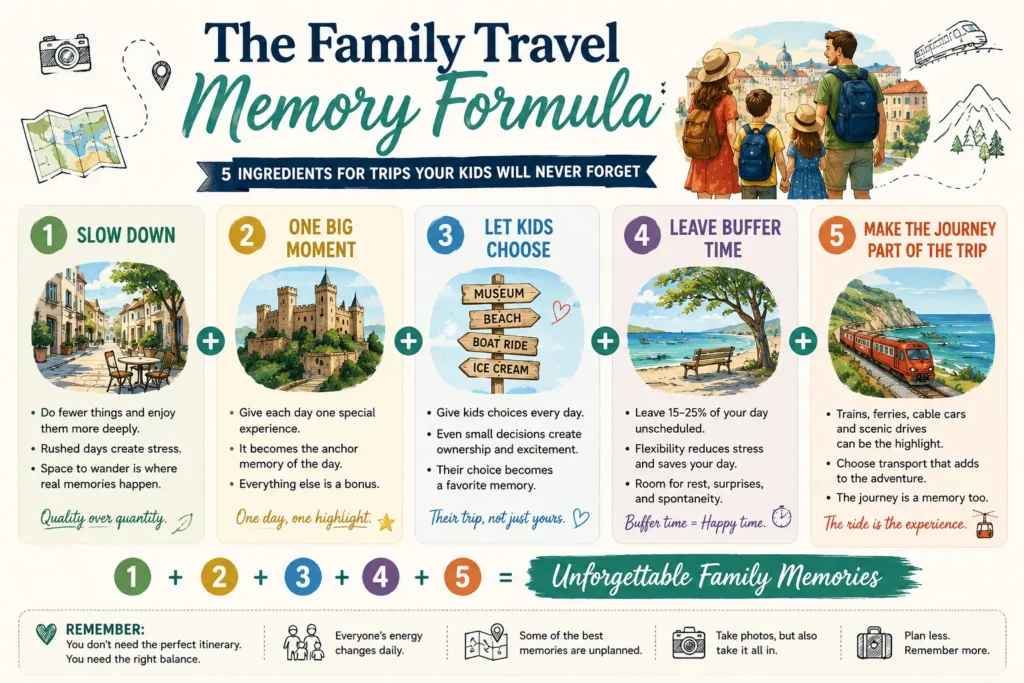
The Family Travel Memory Formula
After planning family trips for a while, a pattern begins to emerge.
The trips most likely to produce good memories usually contain five ingredients.
1. Slow Down
Do fewer things than you think you can fit into the day.
If the itinerary looks slightly too relaxed while you are planning it at home, it may be just right once you are actually traveling.
2. Create One Big Moment
Give each day one experience that makes the day feel complete.
Everything after that is a bonus.
3. Let the Kids Choose Something
Ownership changes the way children experience travel.
Even a small decision can make them feel like participants rather than passengers.
4. Leave Buffer Time
Do not schedule activities back-to-back all day.
The space between plans is what allows the trip to survive real life.
5. Make the Journey Part of the Trip
Whenever possible, choose transportation that adds something to the experience rather than simply moving everyone between locations.
Put those together and the formula is simple:
Slow Down + One Big Moment + Kids Choose + Buffer Time + Enjoy the Journey
It will not guarantee a perfect vacation.
Nothing will.
But it gives a family trip something much more useful than perfection:
room to work.
What Families Often Wish They Had Done Differently
Some of the most useful family travel advice does not come from perfect itineraries.
It comes from the things parents say they would change next time.
Across family travel discussions, trip reports and conversations between parents, several themes appear again and again.
“We Tried to Do Too Much”
This is probably the most common.
The itinerary looked manageable at home.
On the ground, every transition took longer.
Getting everyone out of the accommodation took time.
Finding bathrooms took time.
Choosing lunch took time.
Walking with children took longer than Google Maps suggested.
By the third or fourth day, the family was exhausted.
The lesson is simple:
Build the itinerary for your slowest realistic day, not your most efficient imaginary day.
“We Should Have Stayed Longer in Fewer Places”
Europe makes city-hopping extremely tempting.
Madrid.
Barcelona.
Valencia.
Seville.
Granada.
Córdoba.
All connected by relatively convenient transportation.
It is easy to turn a ten-day vacation into six destinations.
But every hotel change has a hidden cost.
Packing.
Checking out.
Getting to the station.
Waiting.
Traveling.
Finding the next accommodation.
Checking in.
Unpacking.
Then repeating everything two days later.
A two-hour train journey can easily consume half a day once the entire transition is included.
For many families, three nights in one place is significantly more relaxing than two, especially when the destination has worthwhile day trips nearby.
Sometimes the best itinerary improvement is simply deleting a hotel.
“We Underestimated the Heat”
This matters enormously in Southern Europe.
A summer itinerary designed around distances alone can be misleading.
Walking 1.5 kilometers through Seville, Córdoba, Madrid or inland Spain in strong afternoon heat is not equivalent to walking the same distance on a cool spring morning.
Shade matters.
Water matters.
Air-conditioning matters.
And the time of day matters.
A family that can comfortably explore for three hours in the morning may struggle with the same itinerary at 4 p.m.
That is why summer itineraries should not simply contain fewer attractions.
They should be structured differently.
Morning activity.
Long midday slowdown.
Evening exploration.
“The Kids Loved the Things We Almost Skipped”
This is perhaps the most interesting lesson.
Parents may spend months researching major attractions, only to discover that the children’s favorite memories are:
a ferry ride,
a hotel pool,
a street musician,
feeding ducks in a park,
choosing pastries,
watching trains at a station,
a playground beside a cathedral,
or playing in the sea until sunset.
That does not mean famous attractions are a mistake.
It means memorable travel cannot be completely engineered.
The itinerary creates opportunities.
The family creates the memories.
A Simple Family Travel Planning Template
If you’re still building the practical side of your itinerary, our step-by-step guide to planning a family trip to Europe walks through destinations, budget, transportation, accommodation, reservations, and packing in the right order.
So what does all of this look like in practice?
Here is a flexible template that works surprisingly well for many European destinations.
8:00–9:00 — Slow Start
Breakfast.
Check the weather.
Make sure everyone has water.
Do not begin the day by shouting that you are already late.
9:00–12:00 — The Big Experience
This is where the day’s most important attraction belongs.
Museum.
Castle.
Historic site.
Boat trip.
Hike.
Theme park.
Guided tour.
Whatever defines the day.
Book timed-entry tickets when necessary and take advantage of cooler morning temperatures when traveling in summer.
12:00–14:00 — Lunch + Wandering
Do not immediately schedule another major attraction.
Explore the surrounding neighborhood.
Find lunch.
Let children choose dessert.
Sit down.
14:00–16:30 — Reset
Depending on the destination and season:
return to the accommodation,
swim,
rest,
find a shaded park,
visit an easy indoor attraction,
or simply leave this period unplanned.
16:30–19:00 — Optional Adventure
Now ask the most useful question of the day:
How is everyone feeling?
Good?
Go somewhere.
Tired?
Do something easy.
Completely exhausted?
Skip it.
Nothing has failed.
You already had the day’s big experience.
Evening — Experience the City Without Sightseeing
Dinner.
A plaza.
A waterfront.
A promenade.
Ice cream.
A neighborhood walk.
This is often when European cities become particularly enjoyable for families.
You are no longer trying to “see” the city.
You are simply in it.
Adjust the Formula for Your Children’s Ages
There is no single perfect family itinerary because traveling with a four-year-old is fundamentally different from traveling with a fourteen-year-old.
Traveling With Younger Children
Prioritize:
- shorter travel days,
- playgrounds and open spaces,
- predictable meals,
- bathrooms,
- nap or rest opportunities,
- accommodation location,
- and fewer hotel changes.
A centrally located hotel may cost more but save enormous amounts of family energy.
Traveling With School-Age Children
This can be one of the easiest ages for European family travel.
Children can walk farther, understand stories behind attractions, use public transportation comfortably, and begin participating in decisions.
Mix cultural attractions with active experiences.
Castle + beach.
Museum + cable car.
Historic center + bike ride.
Traveling With Teenagers
Teenagers often benefit from more independence and ownership.
Let them research restaurants.
Navigate public transportation.
Choose an activity.
Take photographs.
Have some control over free time.
And accept that sitting in a café with Wi-Fi for an hour may occasionally be exactly what they want.
That hour does not ruin the family vacation.
It may make the next four hours considerably better.
Don’t Measure a Family Trip by How Much You Saw
This may be the hardest mindset shift of all.
When adults travel somewhere they may never visit again, there is understandable pressure to maximize the opportunity.
“We’re already here.”
“We may never come back.”
“It’s only another twenty minutes.”
“We should see it while we can.”
Those sentences have probably added more unnecessary attractions to family itineraries than any guidebook ever written.
But travel is not an exam.
Nobody awards points for completing Barcelona.
You cannot finish Spain.
You cannot complete Italy.
And seeing twenty attractions does not automatically create twice as many memories as seeing ten.
Sometimes it creates half as many because everyone was too tired to notice them.
A better measure of a successful family trip might be:
Did everyone discover something?
Did we have time to talk?
Did the children participate?
Did we experience something different from ordinary life?
Did we have moments when nobody was thinking about the schedule?
And when we came home, did we already have stories we wanted to tell?
If the answer is yes, the trip worked.
Before You Finalize Your Europe Family Itinerary
Before booking the last attraction, look at the itinerary one more time.
Ask yourself:
Is there one major experience per day, or five?
Where can we slow down if someone gets tired?
Have the children chosen anything?
Are we changing hotels too often?
Are transfer days realistic?
Does the itinerary account for heat and weather?
Is there time to eat without rushing?
Is there at least one part of the day where nothing is booked?
Are we choosing some transportation because it is fun, not only because it is fast?
And perhaps most importantly:
Would this itinerary still be enjoyable if we skipped 20% of it?
If the answer is no, the schedule is probably too tight.
Plan Less. Remember More.

Years later, children may not remember which cathedral had the tallest tower.
They probably will not remember whether you visited the third museum on Tuesday.
They may not even remember the name of the restaurant where everyone ate that incredible dinner.
But they may remember sitting beside you on a train while the coastline passed outside the window.
They may remember being allowed to choose the afternoon plan.
They may remember swimming until dinner.
They may remember a tiny town you originally added to the itinerary simply because it was between two larger cities.
They may remember everyone laughing because the day went completely wrong.
That is the strange thing about family travel.
We spend months planning the places.
Then the moments become the memories.
So plan carefully.
Book the things that genuinely need booking.
Research transportation.
Choose good places to stay.
Know what matters.
But leave enough space for the trip to become something you did not plan.
Because sometimes the best family travel itinerary is not the one you follow perfectly.
It is the one your family is comfortable changing together.