
Central Spain is one of the easiest parts of the country to overplan.
Madrid sits in the middle of an extraordinary collection of historic cities. Toledo, Segovia, Ávila, Salamanca, and Cuenca all look close enough on a map that it is tempting to keep adding one more stop.
With kids, I would do almost the opposite.
Use Madrid as a base for as long as it makes sense, take advantage of trains and easy day trips, and only start changing hotels when the extra distance genuinely justifies it.
That makes Central Spain very different from a Northern Spain road trip.
You do not necessarily need to pack the car every morning and move west from one destination to another. A family can stay several nights in the same Madrid hotel, leave most of the luggage behind, explore a completely different historic city for the day, and return to the same room that evening.
For most families, I would divide the trip like this:
| Trip Length | Recommended Route | Best For |
|---|---|---|
| 4 days | Madrid + Toledo or Segovia | First visit, minimal hotel changes |
| 7–8 days | Madrid + Toledo + Segovia + Ávila/Salamanca | Cities, history, and easy day trips |
| 2 weeks | Madrid → Toledo → Segovia → Ávila → Salamanca → León/Burgos → Cuenca | A deeper Central Spain journey |
The important word here is or.
If you have four days, you do not need Madrid, Toledo, Segovia, and Ávila.
If you have a week, you still do not need to sleep in every city.
And if you have two weeks, you finally have enough time to turn the trip into a longer journey rather than a collection of rushed day trips.
This guide focuses on those decisions: where to base your family, which destinations work as day trips, when to change hotels, and when a train makes more sense than renting a car.
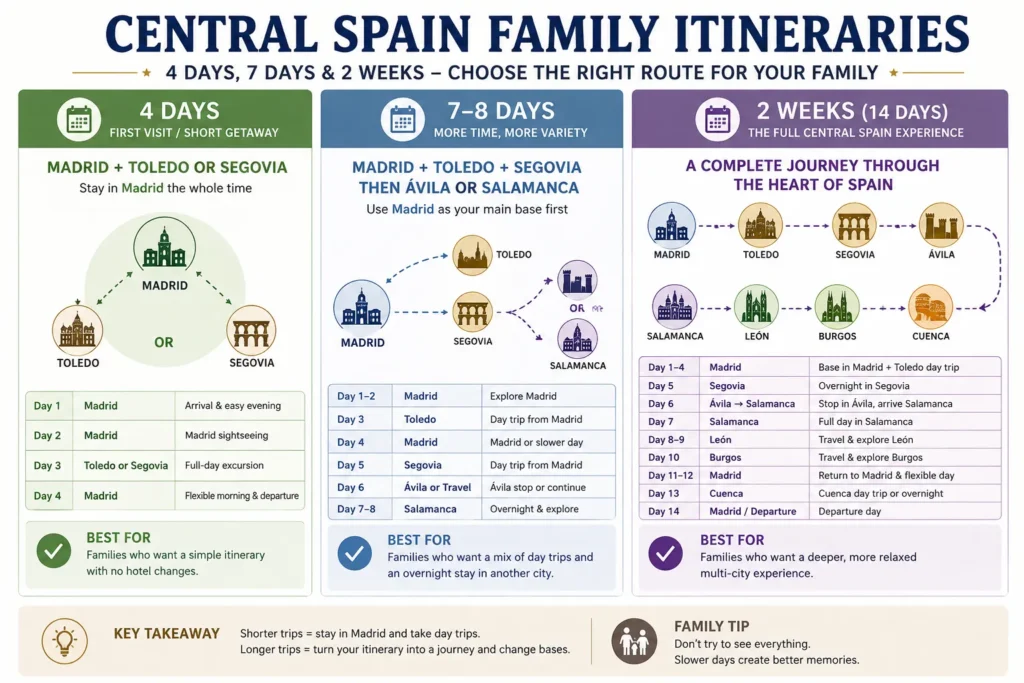
Which Central Spain Itinerary Is Right for Your Family?
Before choosing individual attractions, decide what kind of trip you want.
Central Spain gives families two very different ways to travel.
The first is a Madrid-based trip.
You unpack once, explore Madrid, and use selected days for excursions to historic cities.
The second is a multi-city journey, where Madrid becomes the beginning and end of a wider route through Castile.
For a short family trip, I strongly prefer the first.
For a longer trip, the second becomes much more interesting.
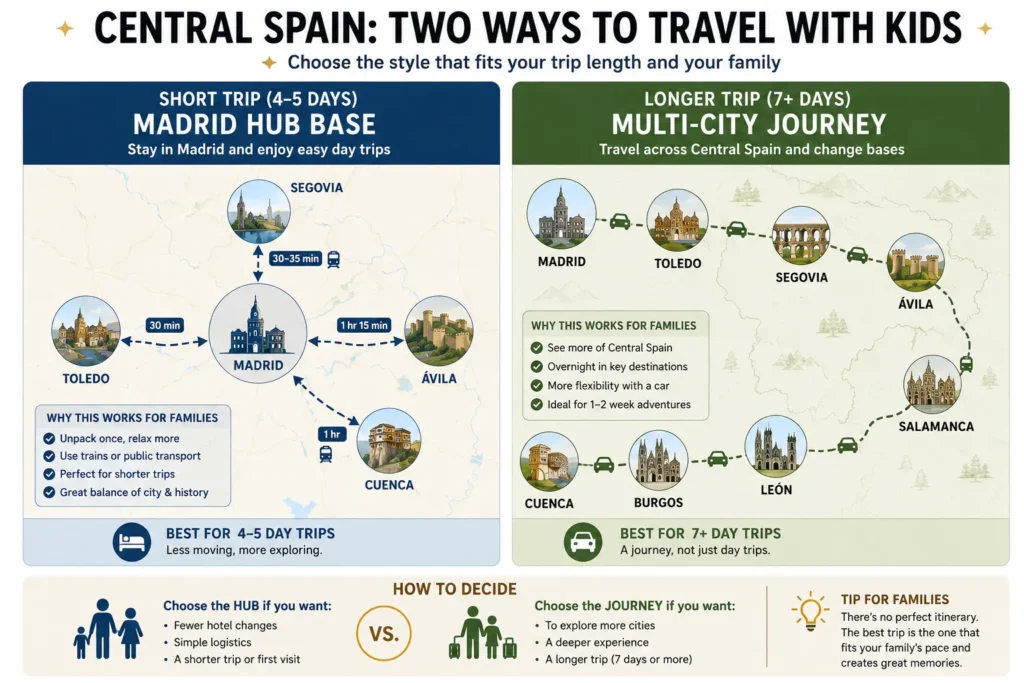
Choose the 4-Day Itinerary If…
This is your first time in Central Spain or Madrid is part of a larger Spain vacation.
Four days disappears quickly once arrival and departure time are included.
I would therefore spend most of the trip in Madrid and choose one major day trip.
For many families, that means deciding between Toledo and Segovia rather than trying to squeeze in both.
Toledo gives you winding historic streets, dramatic views, and layers of Christian, Jewish, and Islamic history.
Segovia offers a very different experience, with its Roman aqueduct and fairy-tale-like Alcázar providing two immediately recognizable highlights.
Neither needs to become another hotel stay on such a short trip.
Choose the 7–8-Day Itinerary If…
A week gives you much more freedom.
You can spend several proper days in Madrid, visit Toledo and Segovia, and still have time to extend the journey toward Ávila or Salamanca.
But this is also where itinerary planning becomes tricky.
It is easy to look at seven available days and think seven destinations.
I wouldn’t.
For families, three or four meaningful bases and excursions are usually better than seven places you barely have time to understand.
The extra days should create breathing room, not just a longer checklist.
Choose the 2-Week Itinerary If…
Two weeks changes the logic again.
At this point, I would stop treating Madrid as the base for everything.
There is little benefit in repeatedly returning to Madrid once your route has moved far enough west or north.
Instead, use Madrid at the beginning, then gradually turn the trip into a multi-city journey.
That allows you to include places such as Salamanca and potentially León or Burgos without spending half the holiday commuting back to the capital.
Cuenca requires a little more thought because it lies east of Madrid rather than along the western route.
I would therefore treat Cuenca as a deliberate extension of the trip—not as a city to squeeze between two unrelated destinations simply because it appears on a list of places to visit in Central Spain.
4 Days in Central Spain with Kids
Recommended Route
Madrid + ONE day trip: Toledo or Segovia
A realistic family schedule looks like this:
| Day | Base | Plan |
| 1 | Madrid | Arrival + easy neighborhood walk |
| 2 | Madrid | Main Madrid sightseeing day |
| 3 | Madrid | Toledo or Segovia day trip |
| 4 | Madrid | Flexible Madrid morning + departure |
This itinerary requires zero hotel changes after arrival.
For a four-day family trip, that is a major advantage.
Day 1: Arrive in Madrid and Don’t Try to Win the First Day
Arrival day should be easy.
After a flight or train journey, checking into accommodation, figuring out the neighborhood, and getting everyone fed already takes time.
I would not schedule a major museum immediately unless your family arrives early and genuinely wants to go.
Instead, use the first few hours to get oriented.
Walk through a central neighborhood, find somewhere to eat, and perhaps see one recognizable Madrid landmark without turning it into a full sightseeing circuit.
If everyone still has energy, continue.
If not, stop.
One of the easiest ways to make a four-day itinerary feel exhausting is to treat the arrival afternoon as if it were a full fifth day.
Day 2: Give Madrid a Full Day
Madrid deserves at least one uninterrupted day.
The challenge is deciding what not to do.
A family could easily fill several days with the Royal Palace, Retiro Park, major art museums, markets, plazas, neighborhoods, football, and food.
Trying to combine all of those into a single day misses the point.
Instead, choose one major experience and combine it with something less structured.
For example, a museum-heavy morning works much better when the afternoon includes a park or neighborhood walk rather than another long indoor attraction.
With younger children, I would be even more selective.
With teenagers interested in art, history, football, or food, you can build the day around whichever subject actually interests them.
That is more useful than assuming every child should follow the same “top 10 Madrid attractions” itinerary.
Day 3: Toledo or Segovia?
This is the most important decision in the four-day itinerary.
You can find tours that combine multiple historic cities in one long day.
That does not mean I would recommend doing that with children on a short family trip.
Choose one.
Choose Toledo If Your Family Wants…
- a dense medieval historic center
- dramatic city views
- religious and cultural history
- winding streets and an atmospheric old city
- a destination that feels completely different from Madrid
Toledo can be physically more demanding than it first appears.
The historic center includes slopes, stone streets, and plenty of walking, so leave more time than a simple list of attractions might suggest.
Do not plan the day around seeing every church, synagogue, museum, and viewpoint.
Pick what matters to your family.
Choose Segovia If Your Family Wants…
- a monumental Roman aqueduct
- a compact historic center
- a castle that immediately captures children’s attention
- an easier visual introduction to Spanish history
- a day that combines history with plenty of outdoor walking
Segovia’s advantage for many families is that its headline sights are easy to understand even before children know the history behind them.
You do not need a long explanation of Roman engineering to appreciate the scale of the aqueduct.
And you do not need to be studying medieval Castile to understand why the Alcázar is memorable.
For a first family visit, that immediate visual impact can matter.
So Which Would I Choose?
If your children are especially interested in castles, I would lean toward Segovia.
If your family enjoys layered history, old streets, and exploring a historic city rather than focusing on one or two monumental sights, I would lean toward Toledo.
There is no universally better choice.
The mistake is thinking you have failed to see Central Spain because you chose only one.
You haven’t.
You have simply left yourself a reason to return.
Day 4: Keep the Final Morning Flexible
Do not reserve your most important Madrid attraction for the morning you leave.
Check-out times, luggage storage, airport transfers, train schedules, and tired children can turn a supposedly free half-day into something much shorter.
Instead, use the final morning for something that can expand or contract.
A park walk, breakfast, neighborhood exploration, shopping, or returning to a place everyone enjoyed earlier in the trip all work well.
Then leave Madrid without needing to race back across the city for your luggage.
Do You Need a Car for 4 Days in Central Spain?
For this itinerary, I would not rent one.
Madrid is not a destination where most visiting families benefit from keeping a rental car parked for several days.
And both Toledo and Segovia can be reached from Madrid without turning the trip into a road trip.
Avoiding a car also means avoiding:
- city-center parking
- hotel parking costs
- unfamiliar traffic
- collecting and returning a rental vehicle
- driving when you could simply travel between cities
A car becomes more interesting when you start combining smaller destinations or moving through the region rather than returning to Madrid.
For four days, keep things simple.
7–8 Days in Central Spain with Kids
With a week, I would still resist turning the trip into a nightly hotel-changing route.
Instead, use Madrid as the first major base, then decide whether the second half of the trip should remain day-trip focused or move west toward Salamanca.
Recommended 7-Day Route
Madrid → Toledo → Segovia → Ávila → Salamanca
But that arrow does not mean you need five different hotels.
A more realistic family structure is:
| Day | Base | Plan |
| 1 | Madrid | Arrival |
| 2 | Madrid | Madrid |
| 3 | Madrid | Toledo day trip |
| 4 | Madrid | Madrid / slower day |
| 5 | Madrid | Segovia day trip |
| 6 | Salamanca | Travel via Ávila or continue directly |
| 7 | Salamanca | Salamanca + overnight |
| 8 | Salamanca / Madrid | Return to Madrid or continue onward |
This is the point where I would begin considering whether a rental car actually improves your trip.
For the first five days?
Probably not.
For the final Madrid → Ávila → Salamanca section?
Possibly.
That is a much more useful question than deciding before the trip that you either need a car for everything or should avoid driving entirely.
Days 6–7: Ávila and Salamanca
After several nights in Madrid, this is where I would finally consider changing bases.
You have two sensible options.
Option 1: Madrid → Ávila → Salamanca
Choose this if your family wants to see Ávila and you are comfortable making the transfer day part of the sightseeing.
Visit Ávila during the journey, then continue to Salamanca rather than checking into another hotel for a single night.
This keeps the itinerary moving in one direction.
Option 2: Madrid → Salamanca
Choose this if your family is already tired or if Ávila is not particularly high on your list.
Skipping a destination is sometimes the decision that improves a family itinerary most.
Arrive in Salamanca earlier, check in without rushing, and give the city the time you would otherwise have spent on another transfer and sightseeing stop.
For families, I prefer Option 1 only when Ávila is somewhere you genuinely want to visit.
Do not add it simply because it sits conveniently between other places on the itinerary.
Why Stay Overnight in Salamanca?
Salamanca is far enough from Madrid that I would not automatically treat it like another quick excursion, particularly when it forms part of a longer Central Spain trip.
More importantly, staying overnight changes the rhythm.
After several days of returning to Madrid, you finally move into another city and can experience it without constantly watching the clock for your trip back.
Use the first afternoon or evening to explore the historic center at a relaxed pace.
Then continue the following morning if you are on a seven-day trip, or stay longer if your schedule allows.
This is also why I would not add Cuenca to the end of this one-week route.
Cuenca lies in the opposite direction, east of Madrid.
Traveling west toward Salamanca and then racing across the region simply to fit Cuenca into the same week creates distance without necessarily creating a better family trip.
Save it for a longer itinerary or a different Madrid-based trip.
What If You Have 8 Days Instead of 7?
Add breathing room rather than another destination.
My first choices would be:
Option A — Add another Madrid day
Best for families interested in museums, football, parks, food, or simply having a slower start.
Option B — Add another Salamanca night
Best if you want the second half of the trip to feel less like an excursion from Madrid.
Option C — Give Segovia more time
Consider an overnight stay if your family wants to explore beyond the main sights rather than returning to Madrid immediately.
What I would not do is use Day 8 to bolt Cuenca onto the western route.
A free day is valuable.
You do not have to fill it with another city.
2 Weeks in Central Spain with Kids
Two weeks gives you enough time to stop thinking exclusively in terms of Madrid day trips.
You can still use Madrid efficiently at the beginning, but after that, I would build a route that gradually moves through the region.
There is one complication: Cuenca.
Most of the other destinations in this itinerary form a logical route west and north of Madrid. Cuenca lies east.
Rather than forcing it into the middle of the road trip, I would place it near the end, once the route naturally returns toward Madrid.
Recommended 14-Day Route
Madrid → Toledo → Segovia → Ávila → Salamanca → León → Burgos → Madrid → Cuenca
A realistic family version could look like this:
| Day | Base | Plan |
|---|---|---|
| 1 | Madrid | Arrival + easy evening |
| 2 | Madrid | Main Madrid day |
| 3 | Madrid | Toledo day trip |
| 4 | Madrid | Madrid |
| 5 | Segovia | Segovia + overnight |
| 6 | Salamanca | Ávila stop → Salamanca |
| 7 | Salamanca | Full Salamanca day |
| 8 | León | Travel + León |
| 9 | León | León / slower morning |
| 10 | Burgos | Travel + Burgos |
| 11 | Madrid | Return to Madrid |
| 12 | Madrid | Flexible/rest day |
| 13 | Cuenca | Cuenca excursion or overnight |
| 14 | Madrid / Departure | Return + departure |
This schedule deliberately includes slower days.
It could be made much more aggressive.
I don’t think it should be.
By the second week, children—and adults—often appreciate a morning without a tightly scheduled departure more than another attraction squeezed onto the list.
Days 1–4: Use Madrid as Your First Base
The first four days follow the same principle as the shorter itinerary.
Stay in Madrid.
Explore the capital without rushing and use Toledo as one day trip.
I would not add Segovia as another day trip this time because the longer itinerary gives you the luxury of staying there later.
That creates a different experience and prevents the first week from becoming a sequence of mornings spent commuting out of Madrid.
It also means you are not repeating the exact same itinerary simply because the trip is longer.
Day 5: Move to Segovia
Now leave Madrid and turn the trip into a multi-city journey.
Instead of seeing Segovia only between two train journeys, stay overnight.
This gives your family more freedom over when to explore the historic center and removes the pressure to fit everything around a fixed return time.
Segovia is compact enough that you do not need to fill every hour.
See the places that interest your family, allow time to eat properly, and enjoy having nowhere else to reach that evening.
That change of pace is one of the main reasons to stay overnight.
Day 6: Segovia → Ávila → Salamanca
This is a logical day to consider having a car.
Ávila works well as a stop between overnight bases because you can experience the historic center and walls without turning it into another check-in and check-out.
Then continue toward Salamanca.
However, this is also exactly the kind of day that can become overloaded.
If you leave Segovia late, spend several hours in Ávila, stop repeatedly, and expect to explore Salamanca that evening, everyone may arrive tired.
Treat Salamanca primarily as the destination.
Ávila is the optional experience along the way—not an obligation.
If the day starts going badly, skip it and continue.
A good itinerary should allow that decision without collapsing.
Day 7: Salamanca
Give Salamanca a full day.
After several transfer days and excursions, there is value in waking up knowing you are not changing hotels.
Rather than treating the city as another collection of monuments, use the day to explore its historic core at a family pace.
Older children may get more from the city’s university history and architecture.
Younger children may care much less about those details and much more about having enough breaks between walks.
Both are fine.
A family itinerary does not need everyone to enjoy a destination for exactly the same reason.
Days 8–9: León
Continue north to León and stay two nights.
At first glance, two nights may seem generous for a compact historic city.
That is precisely why it works.
You are now halfway through a two-week trip.
This is a useful place to reduce the pace before moving again.
Spend your main sightseeing time around the historic center and cathedral area, but leave room for long meals and unscheduled walking.
If everyone is ready to continue after one night, you can.
But I would rather design the itinerary with extra breathing room and remove it if necessary than assume a family will happily maintain maximum sightseeing speed for fourteen consecutive days.
Day 10: León → Burgos
Move east toward Burgos.
This is another deliberate change in the itinerary.
Burgos provides a different historic stop while also beginning to turn the route back toward Madrid rather than continuing farther north into the Northern Spain itinerary covered elsewhere on the site.
For a family trip, one night is enough unless Burgos itself is a major priority.
Arrive, explore the central area, have dinner, and continue the following day.
Not every destination needs two or three nights.
The important thing is knowing why a one-night stop is there.
Here, it helps shape the route back toward Madrid.
Days 11–12: Return to Madrid and Reset
Coming back to Madrid before Cuenca may look inefficient at first.
In practice, I like having a reset point near the end of a two-week family trip.
Return the car if you no longer need it.
Do laundry if necessary.
Repack.
Visit something in Madrid that you deliberately skipped during the first few days.
Or do very little.
Day 12 is intentionally flexible.
If the previous week went perfectly and everyone has plenty of energy, use it for Madrid.
If weather changed your plans, use it to recover something you missed.
If everyone is tired, let it be a slow day.
That is not wasted itinerary space.
It is what makes the rest of the itinerary more resilient.
Day 13: Cuenca
Now Cuenca makes more geographical sense.
From Madrid, it can be treated as a dedicated excursion rather than an awkward detour from Salamanca or León.
Families have two choices:
Visit Cuenca as a Day Trip
This keeps your Madrid accommodation and eliminates another hotel change.
It is the option I would favor if your departure on Day 14 is from Madrid.
Stay Overnight in Cuenca
Choose this if you want more time in the city and your departure arrangements allow it.
An overnight stay gives you more flexibility, but it also means another round of luggage, check-in, and onward travel.
At this stage of a two-week family trip, I would only make that change if Cuenca is one of your priority destinations.
Day 14: Departure Without a Final Sprint
The final day should be boring.
That is a compliment.
If you are flying from Madrid, arrange the previous night so you do not begin departure day with a long cross-country transfer.
Have breakfast, collect the luggage, and leave enough time for the airport or station.
There is no prize for fitting one final attraction between hotel checkout and an international flight.
Train or Rental Car in Central Spain?
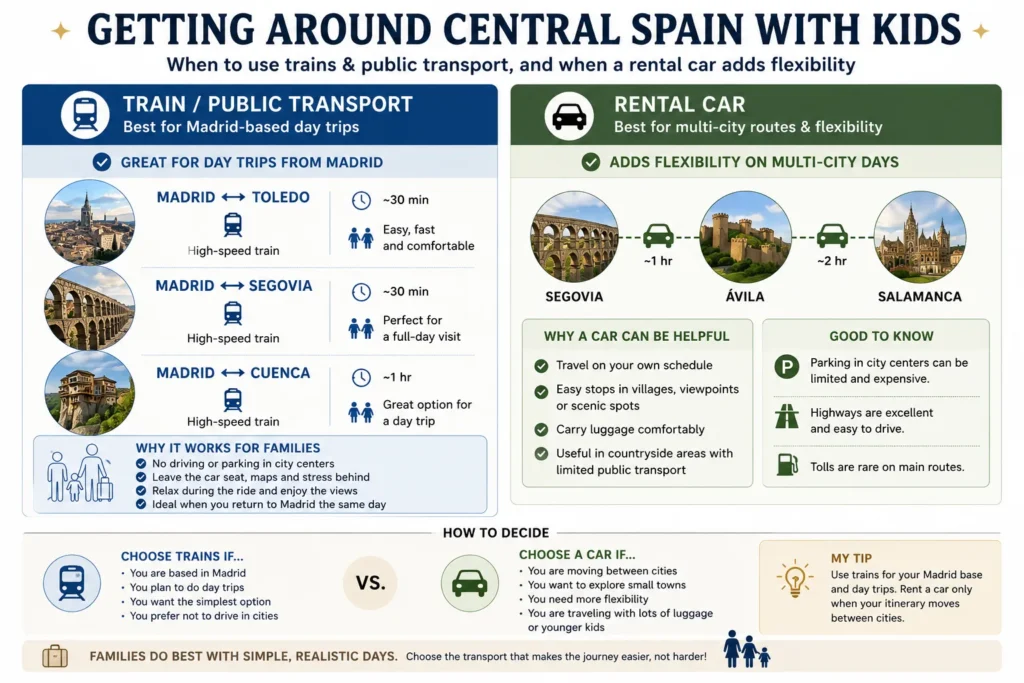
Central Spain is one of those destinations where the answer should not be train or car.
For many families, the best answer is both—but at different stages of the trip.
When I Would Use Trains
For a Madrid-based itinerary, trains and other public transport connections can remove a lot of unnecessary hassle.
They make particular sense when your day begins and ends in Madrid and you do not need a vehicle after arriving.
That can include trips such as:
- Madrid ↔ Toledo
- Madrid ↔ Segovia
- Madrid ↔ Cuenca
Exact services, stations, schedules, and fares can change, so check the journey you actually plan to take rather than assuming every destination uses the same Madrid station or train type.
When I Would Consider a Car
A rental car becomes more attractive when the itinerary changes from day trips to a route.
For example:
Segovia → Ávila → Salamanca
is the kind of section where having your own vehicle can make the journey more flexible.
It can also help families who want to add smaller towns or countryside stops that are awkward to reach using direct public transportation.
But I would not keep a rental car in central Madrid for days simply because I planned to use it later.
Rent it when it becomes useful.
Return it when it stops being useful.
That simple approach can reduce parking costs and unnecessary stress.
Where Should You Add an Extra Night?
If you have more than fourteen days, resist the urge to immediately add another city.
Add a night in Madrid if…
This is your first visit and your family has several specific interests there.
Madrid can absorb extra days much more easily than most stops on this route.
Add a night in Segovia if…
You want the trip to slow down earlier and prefer experiencing the city beyond a quick day-trip schedule.
Add a night in Salamanca if…
You enjoy historic cities and want more time without changing hotels.
Add a night around León or Burgos if…
You are extending the journey farther north.
At that point, however, consider whether you are beginning a different trip altogether.
If your journey continues north toward Asturias, Cantabria, or the Basque Country, you are really beginning a different kind of family trip. Rather than stretching this Central Spain route farther and farther, use our Northern Spain Family Itinerary: 4 Days, 7 Days & 2 Weeks with Kids to plan the next part of your journey, including where to stay, how long to spend in each region, and when having a car becomes more useful.
Where Would I Cut a Day?
If you have twelve or thirteen days, I would simplify rather than compress.
First candidate: Burgos.
You can remove the Burgos overnight if it does not particularly interest your family and adjust the return toward Madrid.
Second candidate: León.
If your main interests are Madrid and the classic Castilian cities, you do not have to travel as far north.
Third candidate: Cuenca.
Because it sits on the opposite side of Madrid from the western portion of the route, it is easy to save for another trip.
What I would not do is keep every destination and turn all the two-night stays into one-night stops.
The number of cities remains impressive.
The trip usually becomes worse.
Central Spain with Younger Kids vs. Teenagers
The destinations do not necessarily need to change because of your children’s ages.
The pace should.
Traveling with Younger Children
With younger children, I would make Madrid an even stronger base.
Returning to the same hotel can be valuable when your family needs familiar routines, earlier bedtimes, naps, or simply fewer mornings spent packing.
Keep day trips focused.
A full day in Toledo or Segovia already includes transportation, substantial walking, meals, and sightseeing. Adding another historic city simply because it is nearby can turn an enjoyable excursion into a very long day.
I would prioritize:
- fewer hotel changes
- one main destination per day
- parks and open spaces between historic sights
- predictable meal breaks
- flexible return times when possible
- accommodation that makes the next morning easier
Central Spain’s historic centers can also involve cobblestones, slopes, stairs, and long periods on foot.
Distance on a map does not always tell you how tiring the day will feel with a young child.
Traveling with Tweens and Teenagers
Older children can usually handle longer days, so the question becomes less about stamina and more about interest.
Central Spain can become repetitive if every day is presented as:
cathedral → old town → palace → another cathedral.
Change the story.
Roman engineering in Segovia feels different from Toledo’s multicultural history.
Salamanca can be approached through its university tradition.
Madrid can provide art, football, food, parks, neighborhoods, shopping, and contemporary city life between the historic destinations.
And give older children some control.
Let them choose a meal, an afternoon activity, or which of two destinations they would rather visit.
A teenager who helped choose Segovia is much more likely to engage with the day than one being transported through the seventh attraction on someone else’s checklist.
Common Central Spain Itinerary Mistakes with Kids
1. Treating Every Historic City as a Day Trip
Madrid is an excellent base.
That does not mean every destination should be visited from Madrid.
Toledo and Segovia fit naturally into shorter Madrid-based trips.
Once you start reaching farther toward Salamanca, León, or Burgos, repeatedly returning to the capital becomes less attractive.
Know when to stop using the hub-and-spoke strategy and start moving forward.
2. Trying to See Toledo and Segovia on the Same Day
It may be technically possible through organized transportation or a tightly planned route.
I still would not make it the default family itinerary.
Both destinations deserve enough time to walk, stop for food, explore, and react to what you actually find there.
Seeing fewer places can result in experiencing more.
3. Renting a Car for the Entire Madrid Stay
A car can be extremely useful later in the itinerary.
That does not automatically make it useful while you are staying in central Madrid.
Think of the rental car as a tool for a particular section of the journey rather than something you need from airport arrival to airport departure.
4. Underestimating the Walking
Historic centers can look compact on a map.
Then you add slopes, stone streets, stairs, summer heat, museums, and children.
Suddenly a short sightseeing route feels much longer.
Plan breaks before everyone desperately needs one.
5. Adding Cuenca Because There Is One Day Left
Cuenca is worth visiting because you want to see Cuenca.
It should not become the automatic answer to an empty square on the itinerary.
Its position east of Madrid makes it less natural to combine with a western route through Ávila and Salamanca.
Give it a dedicated day from Madrid or save it for another trip.
6. Assuming More Cities Mean Better Value
This is probably the biggest mistake.
Families sometimes feel pressure to maximize an expensive international trip by visiting as many destinations as possible.
But every additional city has a hidden cost:
packing, transportation, luggage storage, parking, check-in, finding food, learning another neighborhood, and getting everyone settled again.
A slower itinerary may contain fewer place names.
That does not make it a smaller trip.
FAQ: Planning a Central Spain Family Itinerary
How many days do you need for Central Spain with kids?
Four days works for Madrid plus one major day trip.
Seven to eight days gives families enough time for Madrid, Toledo, Segovia, and an extension toward Ávila or Salamanca.
Around two weeks allows you to turn the trip into a wider multi-city journey without changing hotels every night.
Is Madrid a good base for exploring Central Spain?
Yes, particularly for a shorter family trip.
Using Madrid as a base can reduce hotel changes while making destinations such as Toledo and Segovia practical excursions.
For longer itineraries, however, there comes a point when moving to another base makes more sense than repeatedly returning to Madrid.
Toledo or Segovia: which is better with kids?
Neither is universally better.
Segovia may have more immediate visual appeal for children interested in castles and the enormous Roman aqueduct.
Toledo can be particularly rewarding for families interested in medieval streets, viewpoints, art, and the city’s layered cultural history.
For a four-day trip, choose the one that better matches your family rather than rushing through both.
Do you need a rental car in Central Spain?
Not for every part of the trip.
Madrid and several major day-trip destinations can be explored using public transportation.
A rental car becomes more useful when you begin traveling between regional cities or want to include smaller stops along the way.
Can you visit Central Spain without changing hotels?
For a short trip, absolutely.
A four-day Madrid-based itinerary can involve no hotel changes at all.
For a week, you can still spend most of the trip in Madrid before moving to a second base such as Salamanca.
For two weeks, changing bases becomes more practical.
Is one week enough for Central Spain?
Yes.
A week is enough for a very satisfying family trip if you resist trying to visit every famous historic city.
Madrid plus Toledo, Segovia, and one western extension provides plenty of variety.
Is two weeks too long for Central Spain?
No, but the trip should change character.
Instead of spending fourteen days making excursions from Madrid, move through the region and stay overnight in several destinations.
The extra time should create slower travel, not simply a longer list of day trips.
Final Thoughts: Madrid Is Your Hub, Not Your Entire Itinerary
Central Spain does not need to become a road trip from the moment you arrive.
That is one of its biggest advantages for families.
With four days, stay in Madrid and choose Toledo or Segovia.
With a week, keep Madrid as your main base before extending west toward Ávila and Salamanca.
With two weeks, let go of the Madrid hub-and-spoke model and turn the journey into a genuine multi-city route.
Most importantly, do not measure the success of the trip by how many historic cities you manage to fit onto the map.
The child who remembers standing beneath Segovia’s enormous aqueduct does not care that you skipped Ávila.
The teenager who becomes interested in a painting in Madrid does not know that your original schedule allowed only 45 minutes in the museum.
And nobody returns home wishing they had spent more mornings packing suitcases.
Build the itinerary around the way your family actually travels.
Central Spain gives you enough extraordinary places that you do not have to see all of them at once.
Continue Planning Your Central Spain Family Trip
If you’re building a longer Central Spain itinerary, these family guides can help you plan individual stops in more detail:
- Madrid with Kids: A Family Travel Guide — Plan your main base with family attractions, parks, food, neighborhoods, and practical tips.
- Toledo with Kids: A Family Travel Guide — Decide what to prioritize on one of the most popular family day trips from Madrid.
- Segovia with Kids: A Family Travel Guide — Plan a family day around the Roman aqueduct, historic center, Alcázar, food, and practical travel tips.