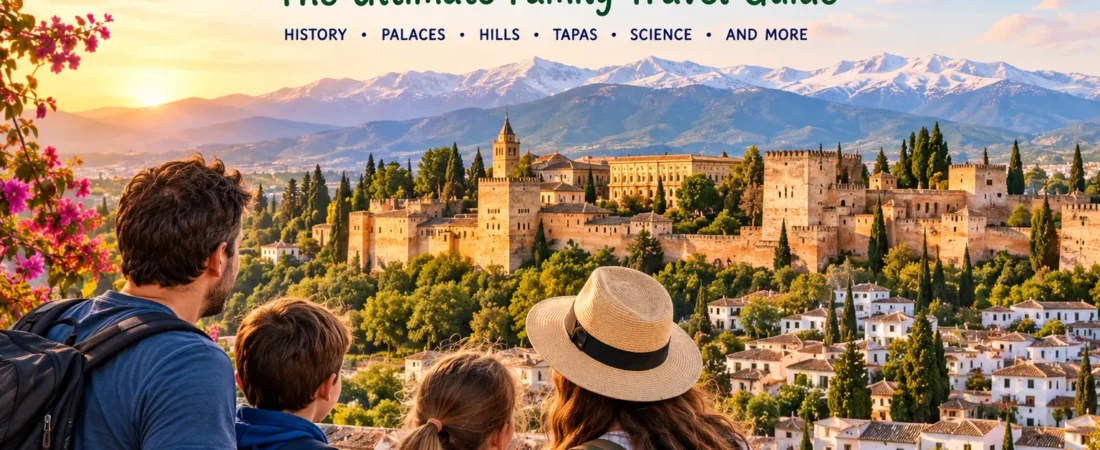
Granada is one of those cities that children may remember long after they have forgotten the names of individual museums and churches.
A palace sits above the city.
Snow-covered mountains can appear beyond the rooftops.
Narrow streets climb through old neighborhoods.
Caves hide inside hillsides.
Gardens surround medieval royal buildings.
And at sunset, the Alhambra can glow above the Albaicín while musicians play around a crowded viewpoint.
But Granada with kids also has two realities parents should understand before arriving.
The first is obvious:
the Alhambra needs planning.
The second becomes obvious after about twenty minutes of walking:
Granada has hills.
A lot of them.
This is not a city where I would look at Google Maps, see that something is 900 meters away and automatically decide:
We can walk.
Nine hundred meters horizontally tells you very little about Granada.
With children, the better questions are:
Is it uphill?
Are the streets cobbled?
How hot will it be?
Can we take a bus up and walk down?
Once you plan around those realities, Granada becomes one of Spain’s most rewarding family destinations.
Granada with Kids: Quick Family Guide
| Question | Recommendation |
|---|---|
| Ideal stay | 3 nights |
| Minimum worthwhile stay | 2 full days |
| Best for | Palaces, history, views, food, unusual neighborhoods |
| Best ages | School-age children and teenagers especially well suited |
| Getting around | Walking + buses + occasional taxi |
| Car needed? | No for a normal city stay |
| Biggest planning issue | Alhambra tickets |
| Biggest physical challenge | Hills + cobblestones |
| Essential attraction | Alhambra |
| Best outdoor experience | Generalife gardens |
| Best sunset experience | Albaicín viewpoints |
| Best family alternative to historic sights | Parque de las Ciencias |
| Food experience | Granada tapas culture |
| Ideal combination | Seville + Granada |
Granada does not need a long attraction checklist.
A strong family trip can revolve around:
Alhambra
Generalife
Albaicín
one spectacular viewpoint
Science Park
tapas
and enough free time to experience the city between them.
Granada’s UNESCO World Heritage Story
Granada’s most famous historical areas are connected through one UNESCO World Heritage property:
Alhambra, Generalife and Albayzín, Granada.
That combination matters.
The Alhambra shows the extraordinary palace and fortress complex created and developed under Granada’s Nasrid rulers and later transformed after the Christian conquest.
The Generalife provides the gardens and country estate associated with the Nasrid rulers.
Across the valley, the historic Albayzín — commonly written Albaicín in Spanish — preserves another side of Granada’s urban history.
For families, there is an easy way to make that relationship understandable.
Stand somewhere in the Albaicín and look across at the Alhambra.
Now the UNESCO site is no longer three names on a list.
Children can actually see how the historic landscape fits together.
One hill contains the palace.
The other contains the old neighborhood.
The valley separates them.
Granada’s geography becomes part of its history.
Before Anything Else: Book the Alhambra
This is the most important planning advice in this entire guide.
If the Alhambra is essential to your Granada trip — and for most first-time families it probably is — do not leave the ticket decision until after everything else is booked.
Before finalizing your Granada dates, check Alhambra availability for the days you are considering.
This is particularly important during busy travel periods.
Why This Matters
Imagine booking:
three nights in Granada,
a hotel,
train tickets,
and the next destination.
Then you discover that the Alhambra entry you wanted is unavailable for all three days.
The family can still enjoy Granada.
But you have created a completely avoidable problem.
A better sequence is:
1. Choose possible Granada dates
↓
2. Check Alhambra availability
↓
3. Secure the appropriate ticket
↓
4. Build the rest of Granada around that reservation
The Alhambra is the fixed point.
Everything else can move around it.
Understand What Your Alhambra Ticket Includes
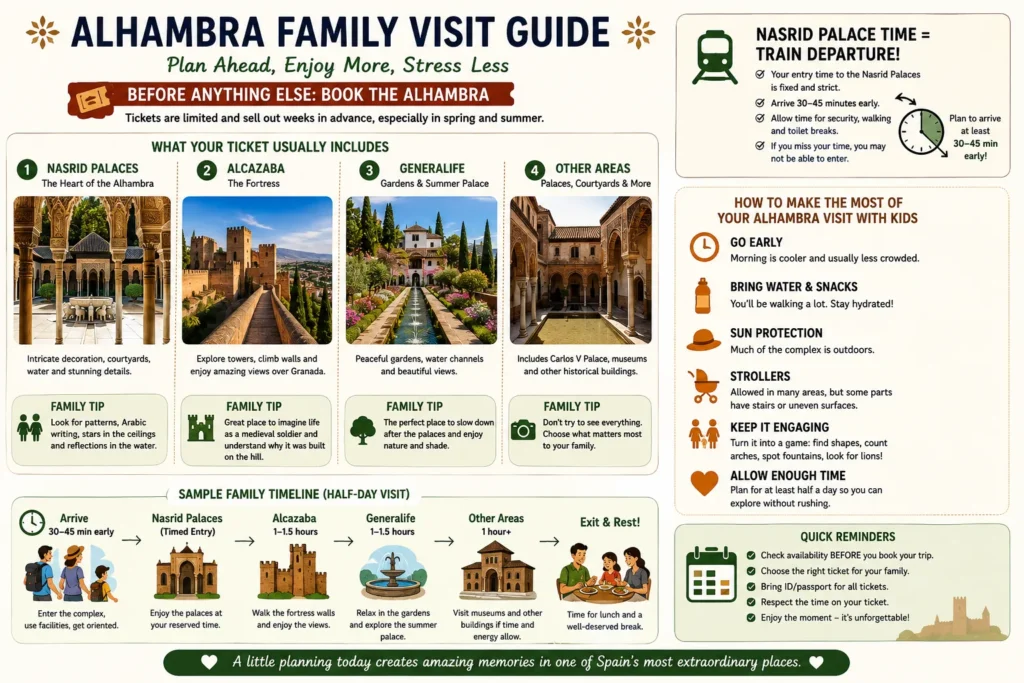
Do not assume every ticket gives identical access.
The Alhambra complex contains different areas, and ticket products and access conditions can vary.
The Nasrid Palaces are particularly important because access is typically tied to a specific entry time.
That time matters.
Missing it can be much more serious than arriving ten minutes late to a park.
Before purchasing, check the current official Alhambra information for:
ticket type,
included areas,
Nasrid Palaces access time,
identification requirements,
child tickets,
and current visitor conditions.
Parent Rule: Treat the Nasrid Palace Time Like a Train Departure
If your entry is at a specific time:
do not plan to arrive at the entire Alhambra complex at exactly that time.
The complex is large.
Security and walking take time.
Children take time.
Someone will need a toilet at precisely the wrong moment.
Build a buffer.
This is not the reservation where I would test how efficiently the family can move.
1. The Alhambra — Granada’s Essential Family Experience
The Alhambra is not simply one palace.
That is the first thing children should understand.
It is a large historical complex containing:
palaces,
fortifications,
courtyards,
gardens,
towers,
and buildings from different periods.
That variety is one reason it works so well with school-age children.
The family is not standing inside one gallery for three hours.
The environment keeps changing.
Explain the Alhambra Without Giving a History Lecture
For younger children, start simply:
“This was a royal city on top of a hill.”
Rulers lived here.
Soldiers defended it.
People worked here.
Water moved through the complex.
Gardens were designed around it.
Then let the questions develop naturally.
Older children can go deeper into:
Al-Andalus,
the Nasrid dynasty,
Granada as the final Muslim-ruled kingdom in Iberia,
the Catholic Monarchs,
1492,
and what happened after political control changed.
There is enough history here for an entire course.
A family visit does not need to become one.
2. Nasrid Palaces — The Part You Should Not Rush
For many visitors, the Nasrid Palaces provide the most extraordinary architectural experience within the Alhambra.
Courtyards.
Water.
Intricate plasterwork.
Arabic inscriptions.
Geometric patterns.
Decorative ceilings.
Arches.
Light.
This is where children can stop thinking of Islamic architecture as something described in a textbook and actually stand inside it.
Give Children a Visual Mission
Try asking them to find:
repeating geometric shapes,
Arabic writing,
reflections in water,
different arch shapes,
stars in ceilings,
and places where decoration seems almost impossibly detailed.
That works better than trying to explain every ruler responsible for every room.
Court of the Lions
The famous courtyard provides one of the Alhambra’s most recognizable scenes.
Children naturally notice the fountain.
Use that.
Water is one of the recurring themes throughout the Alhambra.
Ask:
Where does the water come from?
Why would water have mattered here?
Why put it in the middle of a palace?
Now decoration becomes engineering, climate and culture at the same time.
3. Alcazaba — The Fortress Side of the Story
After ornate palace rooms, the Alcazaba changes the mood.
This is the defensive part of the complex.
Walls.
Towers.
Military spaces.
Views.
Children interested in castles and fortifications may find this easier to understand immediately than some of the palace architecture.
It also helps explain why the Alhambra is where it is.
Look down at Granada.
Look toward the surrounding landscape.
A hilltop fortress suddenly makes sense.
Don’t Use All the Family’s Energy Here
Views and towers can encourage everyone to keep climbing.
Remember that the Alhambra visit is long.
If children are already tired, not every tower needs to become a challenge.
Save energy for the parts of the complex your family values most.
4. Generalife — Don’t Treat the Gardens as an Extra
The Generalife is sometimes mentally categorized as:
the gardens after the Alhambra.
With children, I would not think of it that way.
It is part of what makes the overall visit work.
After:
palace interiors,
historical explanations,
fortifications,
and crowds,
the environment changes.
Gardens.
Water.
Paths.
Plants.
Views.
Space.
Children get to move differently.
Why Water Matters
Granada’s summer climate makes the use of:
water channels,
fountains,
vegetation,
and shade
much easier to appreciate physically.
Instead of simply telling children that historic garden design responded to climate, let them experience the difference between standing in exposed sun and entering a shaded garden with water nearby.
History suddenly becomes practical.
How Long for the Entire Alhambra + Generalife?
This is not a one-hour attraction.
For many families, I would think in terms of roughly half a day, depending on:
ticket type,
children’s ages,
crowds,
how deeply the family explores,
and whether everyone remains interested.
Do not schedule another major historical attraction immediately afterward.
The Alhambra deserves space in the itinerary.
Family rating: ★★★★★
Best for: School-age children and teenagers
Planning level: High
Biggest rule: Secure tickets before building the rest of the Granada itinerary
What Should You Do After the Alhambra?
Not another museum.
At least, that would not be my default.
Lunch.
Hotel.
Rest.
Pool if you have one.
Something easy.
The Alhambra is not simply physically tiring.
Children have also spent several hours processing:
architecture,
history,
crowds,
instructions,
and movement.
Give the experience somewhere to settle.
5. Albaicín — Granada’s Historic Hill Neighborhood
Across the Darro valley from the Alhambra lies the Albaicín.
This is one of Granada’s most atmospheric areas.
Whitewashed buildings.
Narrow streets.
Small plazas.
Historic architecture.
Views toward the Alhambra.
And hills.
Again:
hills.
Don’t Navigate Albaicín Like a Flat City
This is where family travel planning can go wrong quickly.
A map might show:
hotel → viewpoint = 1.2 km.
That sounds easy.
But the route may include:
steep streets,
cobblestones,
stairs,
sun,
and a child asking to be carried.
Distance is not enough information.
My Preferred Family Strategy
Whenever practical:
transport up
and
explore down.
A local bus or taxi can sometimes save the family’s energy for the part of the neighborhood they actually came to experience.
There is no prize for completing every hill on foot.
Walk Without Trying to Complete the Neighborhood
The Albaicín is not one attraction.
Do not create a route containing twelve mandatory stops.
Walk.
Look.
Stop in a plaza.
Find a view.
Get something to drink.
Let children notice doors, tiles, cats, flowers and narrow streets.
The neighborhood works better when it feels exploratory.
6. Mirador de San Nicolás — The Famous Alhambra View
This is the viewpoint many visitors imagine when they think about Granada.
The Alhambra stretches across the opposite hill.
Behind it, on clear days, the Sierra Nevada can complete the scene.
Around sunset, the atmosphere can become particularly memorable.
It can also become extremely busy.
Should Families Go at Sunset?
If:
the weather works,
children still have energy,
and crowds do not bother your family,
sunset can be spectacular.
But do not become so obsessed with the “perfect sunset” that everyone spends the final hour of the day squeezed into a crowded viewpoint and miserable.
The Alhambra looks impressive at other times too.
Make Children Recognize What They Saw
This is one of my favorite reasons to place the viewpoint after visiting the Alhambra.
Now ask:
Can you find where we were this morning?
Where is the Alcazaba?
Where are the palace buildings?
Suddenly the morning’s enormous complex becomes understandable as a whole.
Family rating: ★★★★★
Best for: All ages
Cost: Free
Biggest issue: Hills + crowds at popular times
Other Albaicín Viewpoints Can Be Worth It
Mirador de San Nicolás is famous.
Famous does not automatically mean the family must remain there.
Granada has other places where families can encounter views toward the Alhambra and surrounding city.
If San Nicolás is uncomfortably crowded, keep exploring.
Sometimes a quieter view becomes the one the family remembers.
7. Sacromonte — Granada’s Cave Neighborhood
Continue beyond parts of the Albaicín and Granada changes again.
Sacromonte is strongly associated with:
cave dwellings,
Granada’s Gitano history,
and flamenco traditions, particularly zambra.
This gives older children and teenagers another perspective on the city.
Granada is not only palace history.
Different communities shaped different parts of it.
Cave Houses
The cave environment itself can be fascinating for children.
Why live inside the hillside?
What is the temperature like inside?
How were these spaces adapted?
Again, architecture becomes something children can understand physically.
Flamenco in Sacromonte
Families interested in flamenco may consider an appropriately timed performance or cultural experience here.
As with Seville, check:
minimum age,
start time,
duration,
transportation afterward,
and the specific venue.
Do not automatically book the latest show because it sounds more atmospheric.
A sleeping child experiences very little atmosphere.
A Note on Representation
Sacromonte’s Gitano culture should not be reduced to:
caves + flamenco photo opportunity.
With older children, this is an opportunity to discuss how communities can become part of a city’s tourist identity while also having histories and lives much more complex than the visitor experience suggests.
Travel becomes more interesting when places are treated as communities rather than scenery.
A Small Pop-Culture Connection
Some visitors may recognize Granada from the Korean drama Memories of the Alhambra, which used the city as an important setting.
For families with teenagers who know the series, recognizing streets and views can add another fun layer to the visit.
But Granada does not need a television connection to make these neighborhoods interesting.
The real city has a much longer story.
8. Parque de las Ciencias — The Attraction Families Should Not Overlook
This is the attraction that prevents Granada from becoming:
historic building → historic neighborhood → historic building → historic neighborhood.
Parque de las Ciencias provides a completely different kind of family day.
Interactive science.
Exhibitions.
Hands-on learning.
Different spaces and activities depending on current programming.
For children who have spent several days touring palaces, cathedrals and old towns across Spain, that change can be extremely valuable.
Who Will Enjoy It Most?
School-age children are obvious candidates.
But teenagers and adults may also find plenty to explore depending on current exhibitions.
The important point is that this is not simply:
something to do if it rains.
For science-interested children, it can legitimately become one of Granada’s major family attractions.
How Much Time?
Do not lock yourself into a fixed number before knowing your children.
Some families may spend a couple of hours.
Others may stay much longer.
If your child becomes fascinated by an exhibit:
let them.
You came to Spain to create experiences, not maintain spreadsheet accuracy.
Alhambra or Science Park?
This is not actually a useful competition.
For a first Granada visit:
Alhambra is the essential cultural experience.
Science Park is the balance.
If you have three nights, there is room for both.
That creates a much stronger family itinerary than trying to fill every available hour with historic monuments.
What I Would Prioritize With Kids
For a first Granada family trip, my priority order would be:
1. Alhambra + Generalife
↓
2. Albaicín
↓
3. Mirador with an Alhambra view
↓
4. Parque de las Ciencias
↓
5. Sacromonte according to family interest
That is already enough for an excellent visit.
Granada’s strength is not the number of attractions.
It is how dramatically different those experiences can feel.
The Granada Family Rhythm I Would Use
There is one final principle before we move into the practical half of the guide.
Do not schedule Granada like this:
Alhambra → Albaicín → Sacromonte → viewpoint → dinner.
That is a lot of:
history,
walking,
hills,
and stimulation
for one family day.
Instead:
major morning experience
↓
proper lunch
↓
rest
↓
one neighborhood or science experience
↓
evening viewpoint / food
Granada becomes much easier when parents stop treating every nearby place as something that belongs on the same day.
Where to Stay in Granada With Kids
Choosing where to stay in Granada is unusually important for families because accommodation location affects more than walking distance.
It affects elevation.
Two hotels may both appear to be ten minutes from a major attraction.
One may involve a comfortable walk.
The other may involve steep cobbled streets that feel very different while pushing a stroller or returning with tired children.
For a first family visit, I would prioritize:
easy transportation
manageable walking routes
restaurants nearby
air conditioning in summer
and
how easily the family can return for an afternoon break.
A spectacular hilltop view is wonderful.
Walking back to it every night is part of the price.
Centro — Best All-Round Choice for Most Families
For a first visit, central Granada is probably the easiest recommendation.
Staying around the central area gives families relatively convenient access to:
Granada Cathedral,
shops,
restaurants,
plazas,
transportation,
and routes toward both the Alhambra and Albaicín.
You are not sleeping inside the Alhambra.
You are not at the top of the Albaicín.
That can actually be an advantage.
Best for
First-time visitors, families using public transportation and travelers who want the easiest overall base.
Main trade-off
You sacrifice some of the romantic atmosphere of sleeping deep inside Granada’s historic hillside neighborhoods.
With children, convenience may be worth more.
Realejo — Best for Atmosphere Without Going Fully Into the Albaicín
Realejo, historically associated with Granada’s Jewish community, sits below the Alhambra and can provide a useful compromise between atmosphere and central convenience.
Families can find:
restaurants,
historic streets,
street art,
plazas,
and relatively convenient access to major parts of the city.
Best for
Families who want neighborhood character while remaining reasonably central.
Check before booking
The exact street.
Granada’s terrain changes quickly.
Do not choose accommodation based only on the neighborhood name.
Albaicín — Best for Atmosphere and Views
This is where accommodation photographs become dangerous.
Terrace.
Sunset.
Alhambra glowing across the valley.
Whitewashed historic buildings.
Book now.
Then the family arrives with luggage and discovers what the photograph did not show:
the hill.
Should Families Stay in the Albaicín?
Absolutely — for the right family.
It can be magical.
But I would be more enthusiastic with:
older children,
light luggage,
families comfortable with hills,
and travelers who value atmosphere enough to accept less convenient access.
With:
a large stroller,
several suitcases,
toddlers,
or mobility concerns,
I would examine the exact location very carefully.
Before booking, check:
taxi access,
stairs,
distance from the nearest useful bus stop,
elevator availability,
and the actual walking route.
Do not simply read:
“500 meters from the center.”
Five hundred Granada meters can be surprisingly ambitious.
Near the Alhambra — Best if the Alhambra Is the Absolute Priority
There are accommodation options around the Alhambra area that can make the major visit extremely convenient.
But remember:
Granada is more than the Alhambra.
Staying higher on the hill may make other parts of the city less convenient.
This can work particularly well for:
a short stay,
families prioritizing an early Alhambra visit,
or travelers who value quiet surroundings over central nightlife.
Again, check transportation rather than assuming you will walk everywhere.
Hotel or Apartment in Granada?
Both can work.
Choose a Hotel If You Want:
- reception assistance,
- luggage storage,
- housekeeping,
- breakfast,
- and easier short-stay logistics.
Choose an Apartment If You Want:
- separate sleeping spaces,
- kitchen facilities,
- laundry,
- more room,
- and flexibility around meals.
For a three-night family stay, either can be excellent.
But in warmer months I would check air conditioning before getting emotionally attached to a beautiful historic room.
Historic charm is considerably less charming at 02:00 when nobody can sleep.
Getting Around Granada With Kids
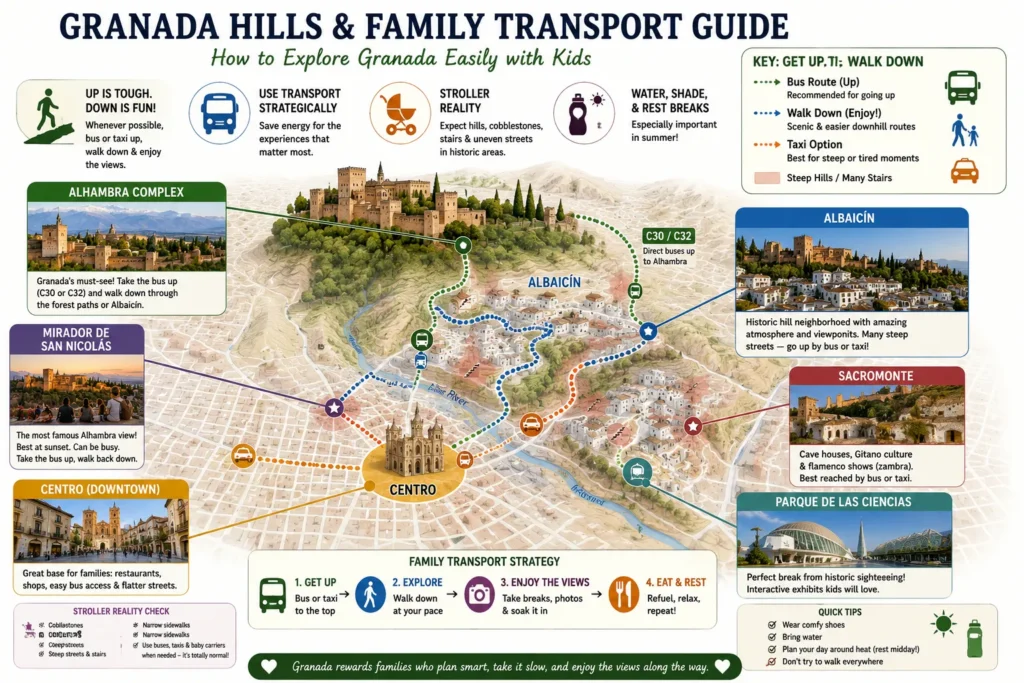
Granada is compact enough that walking will be part of almost every visit.
But it is not a city where I would insist on walking everywhere.
The hills make public transportation strategically useful.
Bus
Local buses are particularly valuable for reaching elevated neighborhoods and the Alhambra area.
Instead of thinking:
“The bus is only saving us 900 meters.”
think:
“How much uphill walking is the bus saving us?”
That is the useful measurement.
Routes and service arrangements can change, so check current local transport information for your travel dates.
Taxi
Granada is one of those cities where an occasional taxi can dramatically improve a family itinerary.
Consider one when:
children are exhausted,
you have luggage,
you are heading uphill,
it is extremely hot,
or you need to reach a timed Alhambra reservation without unnecessary stress.
This is not failing to experience Granada on foot.
You can walk down later.
Car
For central Granada sightseeing:
you generally do not need one.
Historic streets, access restrictions and parking make a car more complication than benefit for many visitors.
A car becomes more useful if Granada is part of a wider Andalusian road trip or the family plans excursions into surrounding areas.
Check current traffic restrictions and parking arrangements before driving into central areas.
Granada With a Stroller
This deserves a direct answer.
Can you visit Granada with a stroller? Yes.
Will every part be easy? No.
Expect:
cobblestones,
steep streets,
stairs,
uneven surfaces,
and historic buildings with varying accessibility.
A lightweight stroller can be much easier than a large travel system.
And Granada is a city where:
bus up → stroller/walk down
can be an excellent strategy.
For the Alhambra itself, check current official accessibility and stroller conditions before visiting because access rules and practical limitations can differ by area.
What to Eat in Granada With Kids
Granada has one enormous family-food advantage.
Trying local food does not always require committing to a full plate.
Tapas culture encourages tasting.
That can work extremely well with children.
Granada’s Free Tapas Culture
Granada is famous for bars where ordering a drink traditionally comes with a tapa.
This is one of the city’s best-known food traditions.
But I would be careful with the word:
free.
You are buying the drink.
The tapa accompanies it.
And practices vary between establishments.
Do not assume every restaurant or bar in Granada follows exactly the same system.
Why This Works With Families
Children can try small amounts of unfamiliar food without parents ordering an entire dish nobody eventually eats.
One drink order might introduce something new.
If they like it:
great.
If they do not:
the experiment was small.
This is one of my favorite ways for children to encounter regional food.
Try first. Decide later.
Can You Choose the Tapa?
Sometimes.
Sometimes not.
It depends on the establishment.
That uncertainty can actually become part of the experience with older children:
What are we getting this time?
For younger or selective eaters, make sure the family also has reliable food options rather than depending entirely on whatever arrives.
Pionono — Granada’s Famous Sweet
Granada’s most recognizable sweet specialty is associated with nearby Santa Fe:
pionono.
These small pastries traditionally combine rolled sponge, cream and a caramelized top.
This is a wonderfully uncomplicated family food experience.
Buy a few.
Share.
Compare opinions.
Not every cultural experience needs an admission ticket.
Other Granada Foods to Try
Depending on the restaurant and season, families may encounter dishes associated with Granada and wider Andalusian cuisine.
These can include:
habas con jamón — broad beans with ham,
remojón granadino — a traditional salad often combining orange with ingredients such as cod,
and regional meat, vegetable and stew dishes.
Do not turn local food into homework.
Order several things.
Share.
Let children discover what they actually like.
A Note About Eating With Children in Granada
Tapas culture sounds wonderfully spontaneous.
It can be.
But hungry children are not always interested in cultural spontaneity.
If everyone needs dinner:
feed them.
Do not keep moving from crowded bar to crowded bar because an adult travel guide said that is the authentic Granada experience.
One comfortable restaurant can be the right family decision.
Granada in Summer With Kids
Granada can become very hot in summer.
And unlike Seville, the city adds another challenge:
hills.
Heat plus uphill walking can change the day quickly.
The answer is not avoiding Granada automatically.
It is changing the schedule.
A Better Summer Rhythm
Morning
Use the coolest useful hours for the day’s most important activity.
If that is the Alhambra:
build the morning around it.
Lunch
Sit down.
Eat.
Drink.
Stop walking.
Early Afternoon
Hotel.
Pool.
Science Park.
Indoor activity.
Rest.
Late Afternoon
Restart when conditions become more manageable.
Evening
Albaicín.
Viewpoint.
Dinner.
Tapas.
Granada becomes much more enjoyable when families stop expecting the afternoon to function like the morning.
What About an Evening Alhambra Visit?
Depending on current ticket offerings and access arrangements, evening experiences may sometimes be available.
They can provide a completely different atmosphere.
But I would not automatically choose one for every family.
Consider:
children’s ages,
normal bedtime,
what areas are included,
and whether the family wants the first Alhambra experience to happen after a full sightseeing day.
Check current official ticket options rather than relying on old descriptions of night visits.
Best Time to Visit Granada With Kids
Spring
One of the strongest periods for:
walking,
gardens,
outdoor sightseeing,
and combining Granada with the rest of Andalusia.
Summer
Possible, but heat strategy becomes essential.
Alhambra reservations can also be under strong demand.
Autumn
Often excellent for walking and cultural sightseeing.
Winter
Granada can be cold.
The nearby Sierra Nevada makes this very different from the image some travelers have of permanently warm southern Spain.
That can also create interesting family combinations:
historic Granada below,
snow and mountain activities nearby.
Check weather conditions carefully because temperatures can vary significantly between city and mountain environments.
Sierra Nevada — Should Families Add a Mountain Day?
Granada’s location gives families access to another completely different environment.
The Sierra Nevada rises beyond the city.
Depending on season and current operating conditions, families may consider:
winter sports,
mountain scenery,
walking,
or simply experiencing a landscape completely different from Granada’s historic streets.
But I would add this only if the trip is long enough.
For a first three-night Granada visit, the city already has plenty.
For four or five nights, a mountain excursion becomes much easier to justify.
A Realistic 3-Day Granada Family Itinerary
This itinerary deliberately avoids putting the Alhambra and every historic neighborhood into one exhausting day.
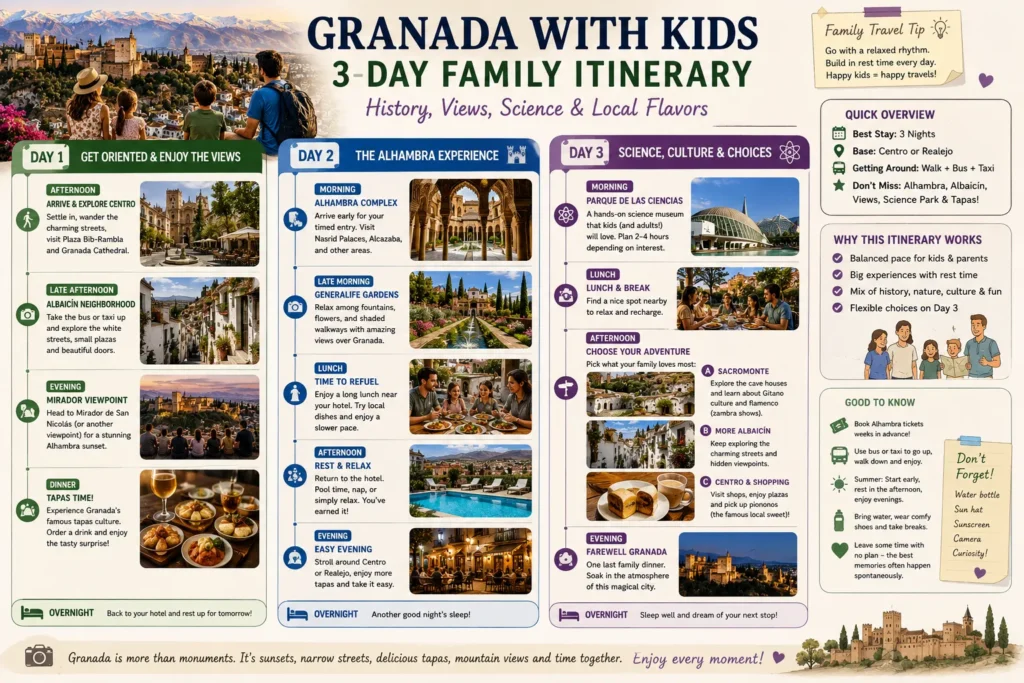
Day 1 — Arrive + Centro + Albaicín View
Afternoon — Arrive and Settle In
Check in.
Do not immediately climb the Albaicín with luggage-induced enthusiasm.
Eat.
Orient yourselves.
Walk around central Granada.
Late Afternoon — Albaicín
Use a bus or taxi strategically if useful.
Then explore on foot.
Evening — Alhambra View
Head toward a viewpoint such as Mirador de San Nicolás if family energy and conditions work.
See the Alhambra before entering it tomorrow.
Now children know:
That’s where we’re going.
Dinner
Try Granada’s tapas culture or choose a comfortable family meal.
Then stop.
Tomorrow is the important morning.
Day 2 — Alhambra + Generalife
This is the day around which the Granada trip is built.
Morning — Alhambra
Arrive with plenty of buffer before any timed Nasrid Palaces access.
Explore according to the ticket and route.
Nasrid Palaces.
Alcazaba.
Other included areas.
Do not rush simply because the complex is large.
Generalife
Give the gardens real time.
Do not treat them as the corridor toward the exit.
Lunch
After the visit:
stop.
This is not the moment for another major attraction.
Afternoon — Rest
Hotel.
Pool.
Long lunch.
Anything easy.
Evening — Family Choice
If everyone has recovered:
walk central Granada,
return to a favorite area,
try more tapas,
or simply have dinner.
A successful Alhambra day does not need a second headline attraction.
Day 3 — Science + Neighborhood Granada
After a history-heavy Day 2, change the subject.
Morning — Parque de las Ciencias
Let the children interact.
Explore.
Stay longer if they are genuinely interested.
This is why I like putting Science Park after the Alhambra rather than before it.
The contrast is enormous.
Lunch
Take another real break.
Afternoon — Choose According to the Family
Option A — Sacromonte
Best for families interested in:
cave culture,
flamenco history,
and another side of Granada.
Option B — More Albaicín
Perhaps everyone wants another view.
Go.
Option C — Centro + Food
Cathedral area.
Shopping.
Pionono.
Plazas.
Easy walking.
Option D — Do Less
Also valid.
Evening
Final Granada dinner.
Choose somewhere the family actually wants to be rather than somewhere that completes a checklist.
What If You Only Have Two Days?
Keep:
Alhambra + Generalife
and
Albaicín + viewpoint.
Then choose between:
Science Park,
Sacromonte,
or additional central Granada
according to the children.
Do not compress the entire three-day itinerary into forty-eight hours.
Cut something.
Granada With Younger Children
For toddlers and younger primary-school children, I would emphasize:
Alhambra gardens,
water,
fortress spaces,
short Albaicín exploration,
Science Park,
plazas,
and food.
Reduce:
long historical explanations,
unnecessary hill climbing,
and the number of interiors.
The Alhambra can still work extremely well.
Just let the experience be:
palace + fortress + gardens
before expecting it to become a lesson about Nasrid political history.
Granada With Teenagers
Teenagers can encounter a much deeper city.
Granada opens conversations about:
Al-Andalus,
Islamic art and architecture,
1492,
the Nasrid kingdom,
the Catholic Monarchs,
religious transformation,
Gitano culture,
tourism,
and how modern Spain remembers complicated parts of its history.
They may also appreciate:
photography,
sunset viewpoints,
tapás culture,
K-drama connections,
and mountain activities.
Granada can be one of the most rewarding Spanish cities for teenagers precisely because the history is not simple.
Granada or Seville With Kids?
This is not an easy choice because they offer different versions of Andalusia.
| Granada | Seville | |
|---|---|---|
| Essential monument | Alhambra | Royal Alcázar |
| Historic identity | Nasrid Granada + 1492 | Andalusian capital + royal/imperial history |
| Best neighborhood experience | Albaicín | Santa Cruz / Triana |
| Family outdoor highlight | Generalife | Plaza de España / María Luisa |
| Family science attraction | Excellent | More limited |
| Flamenco | Strong, especially Sacromonte | Exceptional |
| Walking challenge | Hills | Flatter central sightseeing |
| Summer challenge | Heat + hills | Extreme heat |
| Ideal first stay | 3 nights | 3 nights |
If You Can Visit Both
That is my preferred answer on a longer Andalusia trip.
Seville and Granada complement each other.
Seville gives families:
Plaza de España,
Royal Alcázar,
Cathedral,
Giralda,
flamenco,
and a larger-city Andalusian atmosphere.
Granada gives them:
Alhambra,
Generalife,
Albaicín,
Sierra Nevada views,
cave culture,
and another historical perspective on Spain.
One does not replace the other particularly well.
Planning to explore more of Andalusia? Our Southern Spain family itinerary connects Granada with Seville and other highlights without turning every few days into another rushed transfer.
How Granada Fits Into a Longer Spain Family Trip
Granada makes the most sense as part of an Andalusia section rather than something squeezed awkwardly into a short Barcelona-Madrid trip.
A strong longer route might be:
Barcelona → Madrid → Seville → Granada
Families with more time can add Córdoba or other Andalusian destinations without rushing every stop.
If you have around 10 days for a first Spain trip, I would still prefer the simpler Barcelona + Madrid structure rather than forcing Granada into two rushed nights.
With 12–14 days, Andalusia becomes much easier to add properly.
Families planning the wider country can compare destinations in our 15 Best Places to Visit in Spain with Kids guide.
For a first 10-day route built around fewer hotel changes, our Spain with Kids 10-Day Family Itinerary explains why Barcelona and Madrid work so well as the two main bases.
And families continuing through Andalusia can use our Seville with Kids family travel guide to plan the other major city in this pairing.
Common Mistakes Families Make in Granada
Booking Granada Before Checking Alhambra Tickets
Check the essential attraction first.
Then lock the rest of the trip.
Underestimating the Hills
Distance is not elevation.
Trying to Walk Everywhere
Use buses and taxis strategically.
Scheduling Too Much After the Alhambra
Half a day of major sightseeing is enough.
Treating Generalife as an Optional Add-On
The gardens help make the Alhambra experience work for families.
Staying in the Albaicín Without Checking Access
A beautiful terrace does not carry your luggage uphill.
Chasing the Perfect Sunset at All Costs
If the famous viewpoint is miserable, find another view.
Ignoring Science Park Because It Isn’t “Historic Granada”
Children do not need every hour of Spain to involve a monument.
Depending Entirely on Free Tapas for Children’s Meals
Sometimes everyone simply needs dinner.
What I Would Protect in a Granada Family Itinerary
If I had to protect only three things, they would not all be attractions.
I would protect:
the Alhambra reservation
the family’s energy
and
one evening with nowhere urgent to be.
The first is obvious.
The second and third are easier to sacrifice.
Granada tempts families into walking farther than expected because every hill seems to contain another view.
There is always:
another street,
another mirador,
another historic corner,
another place that looks close on the map.
I would rather take a bus uphill and have children happily explore the Albaicín for ninety minutes than insist on walking the entire way and arrive with everyone already wanting to leave.
That is not less authentic travel.
It is understanding the people you are traveling with.
The Alhambra Does Not Need to Be the Entire Granada Trip
There is another temptation.
The Alhambra is so famous that everything else can begin to feel like:
before Alhambra
or
after Alhambra.
But Granada becomes a much stronger family destination when the family also experiences the contrast.
Palace and science.
History and food.
Crowded monument and quiet plaza.
Islamic architecture and modern Granada.
Hilltop viewpoint and ordinary neighborhood life.
The Alhambra may be the reason many families decide to come to Granada. It does not have to be the only reason they remember it.
That is why I would protect time for the Albaicín.
That is why Science Park belongs in this guide.
That is why I would rather spend an evening eating tapas and walking without a destination than add another museum simply because there is room on the schedule.
Don’t Try to Make Children Appreciate Granada the Same Way You Do
Adults may arrive thinking about:
the Nasrid dynasty,
Islamic architecture,
the Reconquista,
1492,
UNESCO,
and centuries of political history.
A child may arrive and notice:
the water running through the Alhambra,
a cat in the Albaicín,
a strange pastry,
the mountains,
a cave house,
or the fact that the palace seems to glow at sunset.
That does not mean the historical experience failed.
It means children build memories differently.
I have become increasingly convinced that family travel works better when we give children the context but stop demanding the reaction.
Explain why the Alhambra matters.
Then let them decide what interests them.
Tell them why the Albaicín is historically important.
Then let them photograph a doorway.
Introduce them to Granada’s tapas culture.
Then accept that their favorite thing might be the pionono afterward.
The purpose of family travel is not to produce five identical interpretations of the same city.
One Evening I Would Deliberately Leave Almost Empty
If you have three nights in Granada, I would resist booking all three evenings.
Keep one largely open.
No mandatory flamenco reservation.
No timed attraction.
No restaurant on the opposite side of the city that everyone must reach at exactly 20:30.
Instead:
leave the hotel when everyone is ready.
Walk.
Find food.
Sit somewhere.
If the family wants another Alhambra view, find one.
If everyone wants dessert, get dessert.
If the children are tired, go back early.
Unscheduled time is not the absence of travel planning.
Sometimes it is the part of the itinerary that makes everything else possible.
Before You Book Granada: My Family Checklist
Before confirming the trip, I would check these in this order.
1. Alhambra Availability
Can you obtain the ticket and Nasrid Palaces access that works for the family?
If not, can the Granada dates move?
2. Accommodation Location
Look beyond distance.
Check hills, access and transportation.
3. Summer Cooling
If traveling during hot weather:
does the accommodation have effective air conditioning?
A pool is a meaningful bonus.
4. Transportation to the Alhambra
Know how you plan to get there before the morning of the reservation.
5. Albaicín Strategy
Are you walking up?
Taking a bus?
Taxi?
Do not decide after everyone is already tired.
6. Family Balance
Does the itinerary contain something besides historic monuments?
Science Park.
Pool.
Food.
Free time.
Something.
7. One Flexible Evening
Protect it.
You will probably be glad you did.
Is Granada Worth Visiting With Kids?
Absolutely.
But I would not describe Granada as the easiest family city in Spain.
Barcelona gives families a beach.
Madrid gives them Retiro Park and easy transportation.
Segovia provides immediately understandable Roman and castle stories.
Granada asks a little more from the family.
There are hills.
The Alhambra requires advance planning.
Historic neighborhoods are not always stroller-friendly.
Summer can be hot.
But Granada gives something equally valuable in return:
a sense of place that is extraordinarily difficult to confuse with anywhere else.
Children can walk through a Nasrid palace in the morning.
Look back at it from a centuries-old hillside neighborhood in the evening.
Eat tapas in between.
Visit a science museum the next day.
And see the Sierra Nevada beyond the city.
Few destinations combine those experiences so closely.
Final Thoughts: Granada Is Better When You Stop Trying to Conquer the Hills
Granada can tempt parents into making one simple mistake:
because the city looks compact, we assume we should walk everywhere and see everything.
I would do almost the opposite.
Choose the important experiences.
Book the Alhambra properly.
Give it half a day.
Use transportation when the hill adds effort but not value.
Let the Albaicín unfold slowly.
Give children something completely different at Science Park.
Try the tapas.
Buy a pionono.
Find an Alhambra view.
And leave some time with no objective at all.
A successful Granada family trip is not measured by how many hills everyone climbed.
It is measured by whether the family still has enough energy to look across the valley at the end of the day and understand why this city is extraordinary.
The Alhambra may be what brings you here.
But years later, the memory may be something much smaller.
Water moving through a palace courtyard.
Snow above the rooftops.
A narrow Albaicín street.
A cave in Sacromonte.
A plate that unexpectedly arrived with a drink.
Or children pointing across the valley and saying:
“We were up there this morning.”
That is Granada.
Not one monument.
A city where landscape, history and everyday life keep looking back at each other from opposite hills.