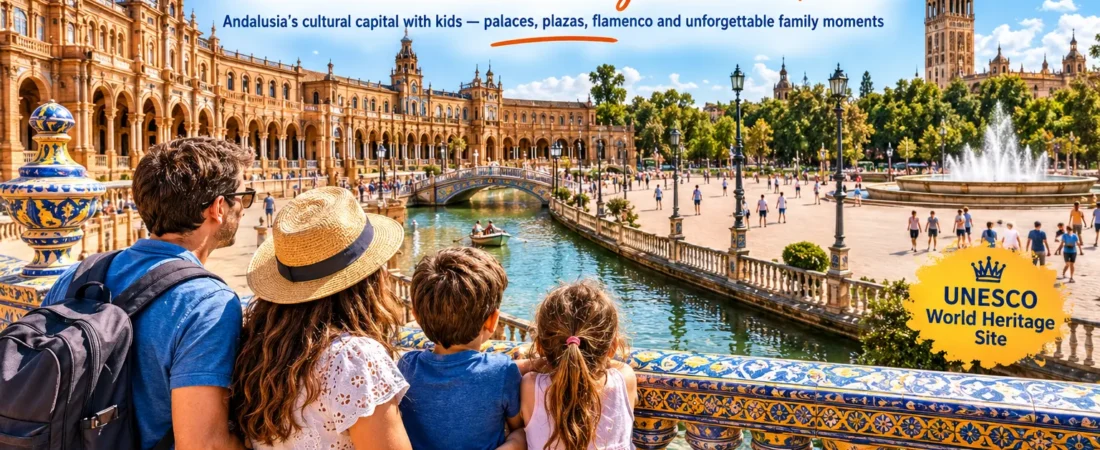
Seville feels different from Barcelona and Madrid almost immediately.
Orange trees line the streets.
Horse-drawn carriages pass historic buildings.
Flamenco appears in theaters, small venues and neighborhood culture.
Tapas bars spill onto plazas.
A vast royal palace hides gardens behind its walls.
And one of Spain’s most beautiful public squares seems almost designed to make children stop and look.
But Seville with kids also requires a different style of family travel.
Especially in summer.
This is not a city where I would plan:
Cathedral at 10:00 → Alcázar at 12:00 → Plaza de España at 15:00 → more sightseeing until dinner.
In July or August, that can turn a beautiful family trip into an endurance test.
Seville rewards families who understand its rhythm.
Sightsee in the morning.
Slow down around lunch.
Rest during the hottest part of the afternoon.
Come back outside when the city starts living again in the evening.
Once you accept that rhythm, Seville becomes one of Spain’s most memorable family destinations.
Seville with Kids: Quick Family Guide
| Question | Recommendation |
|---|---|
| Ideal stay | 3 nights |
| Minimum worthwhile stay | 2 full days |
| Best for | Palaces, history, flamenco, plazas, food |
| Best ages | School-age children and teenagers particularly well suited |
| Getting around | Mostly walking + occasional tram/bus/taxi |
| Car needed? | No |
| Biggest planning issue | Summer heat |
| Best first attraction | Plaza de España |
| Best major historic attraction | Royal Alcázar |
| Best family outdoor space | María Luisa Park |
| Best cultural experience | Family-appropriate flamenco performance |
| Signature food style | Tapas |
| Biggest advantage | Major sights concentrated in a walkable historic area |
Seville is not a city where families need twenty attractions.
A successful first visit can revolve around:
one palace
one cathedral
one extraordinary plaza
one flamenco experience
good food
and
time to enjoy the streets between them.
Seville’s UNESCO World Heritage Sites
Before looking at individual attractions, it helps to understand why three buildings at the center of Seville matter together.
The Cathedral of Seville, Royal Alcázar and Archivo de Indias form a UNESCO World Heritage property.
They represent different chapters of Seville’s extraordinary history.
The Alcázar reflects centuries of royal power and architectural transformation.
The cathedral became one of Christianity’s great monumental buildings.
The Archivo de Indias preserves documents connected with Spain’s administration of its overseas empire.
For children, you do not need to turn this into a long history lesson.
The simplest explanation is:
Seville became one of the world’s most important cities, and these buildings show different parts of that story.
Then let the architecture do some of the teaching.
Why Seville Works With Kids
Seville’s greatest family advantage is not that it contains attractions specifically designed for children.
It is that its history is highly visual.
Children can see:
a royal palace,
ornate Islamic-influenced decoration,
gardens,
a gigantic cathedral,
a bell tower,
horse carriages,
colorful ceramic tiles,
fountains,
and one enormous semicircular plaza.
The city does not require children to understand every historical detail before it becomes interesting.
And the Major Sights Are Relatively Concentrated
Royal Alcázar.
Cathedral.
Giralda.
Santa Cruz.
Archivo de Indias.
These major historic sights sit remarkably close to one another.
That reduces one of the most exhausting parts of family city travel:
transportation between every attraction.
But there is a trap.
Because everything looks close, parents may try to see everything in one day.
Don’t.
Short distances do not eliminate:
heat,
queues,
museum fatigue,
hunger,
or tired children.
Use Seville’s compactness to travel more slowly, not to fit in more attractions.
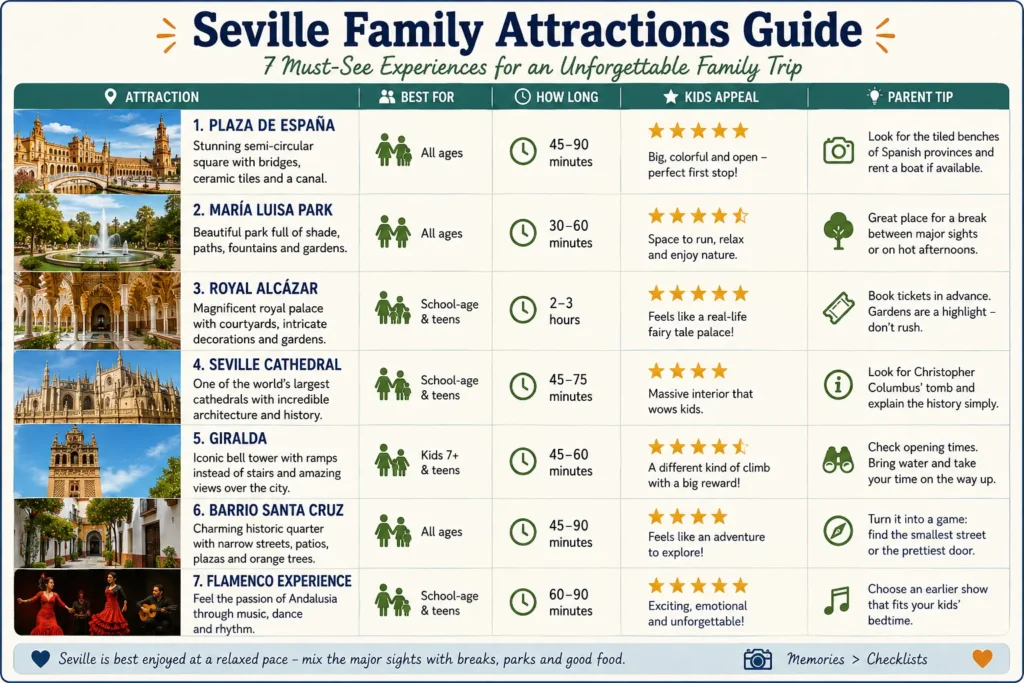
1. Plaza de España — My Favorite Place to Start With Kids
If I were introducing Seville to children for the first time, I would seriously consider starting here.
Plaza de España is enormous.
Colorful.
Open.
Easy to understand visually.
And unlike beginning the trip inside a museum, children immediately get space.
The semicircular building wraps around the plaza.
Bridges cross a canal.
Ceramic tiles decorate railings, walls and alcoves.
A large fountain sits in the center.
There is room to look around without whispering.
That makes it a very gentle introduction to Seville.
Look for the Provincial Tile Benches
Around the plaza are tiled alcoves representing Spanish provinces.
Turn them into a game.
Can the children find:
Madrid?
Barcelona?
The province you are visiting next?
A place the family has already visited?
Suddenly decorative ceramics become a map exercise.
What About the Boats?
Depending on current operations, small boats may be available on the canal.
Children may find this considerably more exciting than the architectural history of the plaza.
That is fine.
Always check current availability and conditions rather than building the entire visit around a seasonal or operational activity.
The Star Wars Connection
Older children and teenagers may recognize another reason Plaza de España looks familiar.
It was used as a filming location for Star Wars: Episode II – Attack of the Clones, representing part of Naboo.
This is a fun connection.
But the plaza does not need Star Wars to justify the visit.
Treat it as a bonus:
“You’ve actually seen this place before.”
How Long Should Families Allow?
Approximately:
45–90 minutes
works for many families, depending on whether you simply explore the plaza or spend additional time in the surrounding park.
And there is no entrance ticket required simply to enjoy the square.
Family rating: ★★★★★
Best for: All ages
Best feature: Huge visual impact without museum fatigue
Combine with: María Luisa Park
2. María Luisa Park — Don’t Treat It as Leftover Space
Plaza de España sits beside one of Seville’s most useful family spaces:
Parque de María Luisa.
This should not be treated as:
“We can walk through it if we have time.”
With children, the park can be part of the itinerary.
Shade.
Trees.
Paths.
Fountains.
Benches.
Space.
All become more valuable as the day gets warmer.
Why Parks Matter in Seville
In a cooler city, a park may simply be pleasant.
In Seville, shade can become itinerary infrastructure.
After children have spent an hour looking at architecture, give them somewhere that does not require historical appreciation.
Sit.
Walk.
Snack.
Let everyone reset.
Family rating: ★★★★★
Best for: All ages
Best use: Before or after Plaza de España
Cost: Free
3. Royal Alcázar of Seville — The Major Attraction I Would Prioritize
If a family has time for only one major paid historical attraction in Seville, I would put the Royal Alcázar extremely high on the list.
The experience changes constantly.
Courtyards.
Decorative arches.
Tilework.
Royal rooms.
Water.
Gardens.
Different architectural styles.
This variety is important with children.
Instead of spending the entire visit looking at paintings on walls, the family moves through changing spaces.
Explain the Alcázar Simply
The Alcázar has a long and complicated history.
You do not need to explain all of it before entering.
For younger children:
“Kings and rulers have used this place for centuries, and different generations kept changing it.”
That is enough to start.
Older children can explore the deeper story:
Islamic Seville.
Christian conquest.
Mudéjar architecture.
Royal power.
Architectural borrowing.
How cultures leave visible traces even after political control changes.
The Palace of Pedro I
This is where many families encounter some of the Alcázar’s most visually memorable decoration.
Intricate plasterwork.
Geometric patterns.
Arches.
Courtyards.
Tiles.
Ask children to look for patterns rather than dates.
How many shapes can they find?
Where does one design repeat?
What looks different from a Gothic cathedral?
Architecture becomes much easier when children have something specific to search for.
The Gardens May Be the Best Part for Kids
Do not rush through the gardens because the palace rooms are historically important.
The gardens are part of the experience.
Water features.
Paths.
Trees.
Pavilions.
Open spaces.
After interior sightseeing, children get to move again.
That contrast can turn a long historic visit into a successful one.
Game of Thrones
Some areas of the Alcázar were used as filming locations for Game of Thrones, representing parts of Dorne.
For teenagers familiar with the series, this may add another layer of interest.
Again:
fun connection.
Not the reason the building matters.
How Long Should Families Allow?
I would allow approximately:
2–3 hours
for palace and gardens without rushing.
Some families will stay longer.
Others with younger children may be ready to leave sooner.
Do not force a three-hour visit simply because the ticket was difficult to obtain.
Booking Matters
The Royal Alcázar is one of Seville’s major attractions.
For popular dates, advance planning is sensible.
Use the official visitor information to verify:
opening hours,
ticket categories,
current access conditions,
and any special areas requiring separate reservations.
Family rating: ★★★★★
Best for: School-age children and teenagers
Allow: Around 2–3 hours
Advance booking: Strongly recommended during busy periods
4. Seville Cathedral — Go Inside, but Don’t Turn It Into a Marathon
Seville Cathedral is enormous.
That is one of the first things children understand.
You do not need to explain architectural rankings.
Walk inside.
Look upward.
Let the scale do the work.
The cathedral occupies the site of an earlier mosque, and the Giralda itself preserves an especially visible connection with that Islamic past.
This makes the cathedral another excellent place to show children that Seville’s history did not begin again every time political power changed.
Buildings evolve.
Cities reuse.
Cultures leave traces.
Christopher Columbus
One feature likely to catch older children’s attention is the monumental tomb associated with Christopher Columbus.
That can lead to a much larger historical conversation.
Not simply:
“Columbus discovered America.”
Older children can discuss:
European exploration,
colonial expansion,
indigenous peoples,
wealth flowing through Seville,
and why historical figures can be both enormously influential and deeply controversial.
A family travel guide does not need to resolve that history in five minutes.
But it does not need to oversimplify it either.
How Long?
For many families:
45–75 minutes
inside the cathedral is enough before deciding whether to continue with the Giralda.
Remember that cathedral + tower is effectively one larger experience.
Do not budget them as if they require no energy from each other.
Family rating: ★★★★½
Best for: School-age children and teenagers
Allow: Around 45–75 minutes before Giralda
5. Giralda — A Tower Climb That’s Different From Most
The Giralda is one of Seville’s defining landmarks.
Its history is already interesting:
the lower portions originated as the minaret of the Almohad mosque, and the structure later became the cathedral’s bell tower.
But children may be more interested in something else:
How do we get up there?
Ramps Instead of a Conventional Spiral Staircase
One of the Giralda’s distinctive features is its system of ramps through much of the ascent.
Traditionally, these are associated with allowing riders on horseback to ascend the tower.
For children, the practical result is simple:
this does not feel exactly like climbing a conventional medieval spiral staircase.
There is still effort involved.
Do not tell tired children:
“It’s basically not a climb.”
It is.
But it is a different kind of climb.
Is It Worth It?
If:
the weather is reasonable,
everyone has enough energy,
and the tower is open under normal visitor conditions,
the view can become one of the highlights of the cathedral visit.
If the children are already exhausted after several hours at the Alcázar and cathedral:
skip it.
Seville still counts.
Family rating: ★★★★★ when everyone has energy
Best for: Children comfortable with the ascent
Biggest reward: Views across historic Seville
Do Alcázar and Cathedral on the Same Day?
You can.
They are practically neighbors.
That does not automatically mean you should.
For families with older children who enjoy history, a morning Alcázar followed by lunch and then the cathedral can work.
For younger children, that may become:
palace → historical explanation → lunch → cathedral → tower
which is a lot.
A better strategy may be:
Alcázar one morning
and
Cathedral + Giralda another morning.
You are staying three nights.
Use them.
6. Barrio Santa Cruz — Stop Navigating for a While
Santa Cruz is Seville’s old Jewish quarter and one of the city’s most atmospheric areas.
Narrow streets.
Small plazas.
Whitewashed buildings.
Orange trees.
Restaurants.
Hidden corners.
This is where I would put the phone away occasionally.
Not because getting lost is always romantic with hungry children.
But because Santa Cruz is not one attraction.
The neighborhood itself is the experience.
Give Children Something to Look For
Instead of saying:
“We’re going for a walk through a historic neighborhood.”
try:
Find the smallest street.
Find the prettiest tiled doorway.
Find an orange tree.
Find a hidden plaza.
Choose where we stop for something to drink.
Simple tasks give children ownership of an activity adults otherwise describe as “wandering.”
The Orange Trees
Seville’s orange trees are part of the city’s visual identity.
In spring, their blossoms — azahar — can fill streets with fragrance.
But the bitter oranges commonly growing along Seville’s streets are not the same thing as buying a sweet eating orange at a supermarket.
Do not encourage children to pick street fruit expecting a convenient snack.
When Santa Cruz Works Best
Early morning can be beautiful.
Evening is particularly atmospheric.
In the middle of a brutally hot summer afternoon?
That may be the time to be somewhere cooler.
Family rating: ★★★★½
Best for: All ages
Best time: Morning or evening
Best approach: Wander rather than checklist
7. Flamenco — The Cultural Experience Children May Actually Remember
Seville without any flamenco experience can feel like missing an important part of Andalusian culture.
But traveling with children changes how I would choose the performance.
I would not automatically book:
the longest,
latest,
most expensive,
or supposedly most “serious” show.
I would choose the one the family can actually enjoy.
Why Flamenco Can Work Surprisingly Well With Kids
Flamenco is visual and physical.
Children do not need fluent Spanish.
They can understand:
rhythm,
movement,
clapping,
footwork,
guitar,
voice,
emotion.
That makes it much more accessible than some cultural performances where children need substantial historical context.
What Should Parents Check?
Before booking, check:
start time
performance length
minimum age rules
whether food is included
seating arrangements
and
whether the venue is appropriate for your children’s ages.
A brilliant 22:30 performance is not brilliant if your eight-year-old has been asleep since the first guitar chord.
Tablao or Larger Performance?
There is no universal answer.
A smaller venue can feel intimate and powerful.
A larger performance may be easier for some families.
The goal is not to prove that you found Seville’s most authentic flamenco.
The goal is to introduce children to the art form in a way they can appreciate.
Don’t Reduce Flamenco to a Tourist Show
This matters particularly with older children.
Flamenco is not simply a colorful Spanish dance performed for visitors.
It is a complex Andalusian art form involving music, song, rhythm and dance, shaped by multiple cultural influences over time.
Even a short explanation before the performance can completely change how teenagers watch it.
Family rating: ★★★★★
Best for: School-age children and teenagers
Best strategy: Earlier, appropriately timed performance
Advance booking: Sensible for popular venues
The Seville Family Rhythm I Would Use
By now a pattern should be emerging.
Do not structure Seville like this:
attraction → attraction → attraction → attraction.
Structure it like this:
major morning attraction
↓
lunch
↓
rest / pool / indoor break
↓
late-afternoon outdoor experience
↓
evening food / flamenco / neighborhood
That rhythm becomes particularly important as temperatures rise.
And it is the key to the second half of this guide.
Where to Stay in Seville With Kids
Seville’s compact historic center means accommodation location can have an unusually large effect on the family experience.
Stay in the right area and many major sights become walkable.
Stay farther away to save a little money and you may add transportation at exactly the times children are hottest and most tired.
For a first family visit, I would prioritize:
walkability
easy access to food
a quiet enough room for sleep
and, especially in summer,
air conditioning.
That last one is not a luxury in Seville in July or August.
It can completely change the trip.
Santa Cruz — Best for First-Time Families Who Want Atmosphere
Santa Cruz puts families close to:
the Cathedral,
Giralda,
Royal Alcázar,
restaurants,
and some of Seville’s most atmospheric historic streets.
For a short stay, that convenience is extremely attractive.
You can finish sightseeing, return to the accommodation, rest, and come back outside later without crossing the city.
Best for
First-time visitors, short stays and families prioritizing the major historic attractions.
Main trade-off
Atmosphere attracts visitors.
Some streets can remain lively late into the evening.
Check recent accommodation reviews for:
noise,
stairs,
elevator access,
and the exact street.
A beautiful historic building is less charming when a sleeping child and three suitcases need to reach the fourth floor without an elevator.
El Arenal — Best Balance of Location and Convenience
El Arenal sits close to the cathedral and river while providing easy access to restaurants and central attractions.
For many families, this can be an excellent compromise.
You remain close enough to walk through historic Seville without necessarily sleeping in the narrowest streets of Santa Cruz.
Best for
Families wanting a central location with convenient access to both historic sights and the river.
Around Plaza de España / Prado de San Sebastián — Best for Space
Families who value:
parks,
slightly more breathing room,
and access to Plaza de España and María Luisa Park
may prefer accommodation toward this side of the center.
This can be particularly appealing with younger children.
Main trade-off
The Cathedral and Alcázar remain accessible, but you lose the feeling of stepping directly into the historic core every morning.
For some families, the additional space is worth that trade.
Triana — Best for a Different Side of Seville
Across the Guadalquivir River, Triana has a strong identity of its own.
Ceramics.
Food.
Flamenco connections.
Neighborhood streets.
River views.
Families staying several nights may enjoy being slightly removed from the densest concentration of central tourist sights.
Best for
Repeat visitors, longer stays and families interested in neighborhood atmosphere.
Main trade-off
You will walk farther or use transportation more often for some major attractions.
That is not necessarily a problem.
Just make the choice deliberately.
Hotel or Apartment in Seville?
Both can work well.
Choose a Hotel If You Want:
- reception assistance,
- luggage storage,
- housekeeping,
- breakfast,
- and easier short-stay logistics.
Choose an Apartment If You Want:
- separate sleeping spaces,
- a kitchen,
- laundry,
- more room,
- and flexibility around children’s meals.
For families staying three or four nights, an apartment can be particularly comfortable.
But in summer, I would check one detail before almost everything else:
Does the accommodation have effective air conditioning?
Not:
“fan available.”
Not:
“traditional cooling.”
Real air conditioning.
A room that never properly cools can make the entire family sleep badly.
Then tomorrow’s itinerary starts with everyone already tired.
Getting Around Seville With Kids
For most first-time visitors:
walking will be the main form of transportation.
Many of Seville’s major historic attractions are concentrated around the center.
That is one of the city’s great advantages.
But walking should not become an ideology.
If it is 39°C and the family is exhausted, take transportation.
Tram
Seville’s tram can be useful for certain central journeys, depending on the family’s route.
It is particularly convenient when it removes a hot or tiring walk without requiring complicated navigation.
Bus
The city bus network becomes more useful when traveling beyond the most compact historic areas.
Use current route information rather than memorizing transport advice from an old travel article.
Taxi
There are moments when a taxi is simply the sensible family decision.
Late evening.
Luggage.
Extreme heat.
Tired children.
An awkward cross-city route.
A short taxi ride that saves forty minutes of unhappy walking can be excellent value.
Do You Need a Car?
For a normal Seville city stay:
No.
A car introduces:
parking,
restricted access,
traffic,
and the difficulty of navigating historic streets.
Rent one when leaving for a road trip if necessary.
Do not rent one simply to explore central Seville.
Seville With a Stroller
Seville is manageable with a stroller, but historic surfaces and crowds can create challenges.
The major advantage is that much of the sightseeing area is relatively compact.
The disadvantage is that:
cobblestones,
busy pedestrian areas,
historic buildings,
and extreme heat
can complicate the experience.
A lightweight stroller can be extremely useful for younger children.
Check individual monuments for current accessibility conditions rather than assuming every centuries-old building will provide the same stroller access.
What to Eat in Seville With Kids
Seville is one of those cities where family dining becomes easier if parents stop thinking in terms of:
one person = one main course.
Tapas changes the equation.
Order several dishes.
Put them in the middle.
Everyone tries something.
Order more of whatever disappears first.
That is an excellent format for children who are curious but not necessarily ready to commit to an entire plate of unfamiliar food.
Salmorejo
A thick chilled tomato-based dish associated particularly with Andalusia.
In hot weather, it makes considerably more sense once you experience the climate.
Children who like tomato-based foods may find it surprisingly approachable.
Gazpacho
Another famous cold Andalusian preparation.
Even children who decide they dislike it have at least tried something strongly connected with the region.
That is enough.
Travel food does not require unanimous approval.
Croquetas
Croquetas are often one of the easiest shared tapas for cautious young eaters.
Fillings vary.
Order a portion.
See what happens.
Tortilla Española
Familiar ingredients.
Egg.
Potato.
Sometimes onion.
Another useful bridge between familiar food and Spanish eating culture.
Jamón Ibérico
Older children may enjoy learning that “ham” in Spain is an entire category rather than one standardized product.
Order a small plate for everyone to try rather than turning it into a lecture about curing classifications.
Espinacas con Garbanzos
Spinach with chickpeas is strongly associated with Seville’s traditional food culture.
It also gives families a local option that is not centered on meat.
Tapas With Kids: Don’t Turn Dinner Into a Restaurant Marathon
Adults sometimes hear:
Seville tapas culture
and imagine spending the evening moving through five bars.
That can be fun.
With tired children, it can also become:
sit down → order → eat → stand up → walk → find another table → repeat.
You do not have to perform tapas culture perfectly.
Find somewhere comfortable.
Order several things.
Stay.
Family travel is allowed to adapt traditions to the family.
What Time Should Families Eat?
Spain’s dining schedule can feel late for families accustomed to earlier meals.
Do not force children to remain hungry until a culturally impressive dinner hour.
Look for places serving when your family actually needs food.
Use snacks strategically.
And remember that a flamenco evening may require planning dinner around the performance.
The objective is not to prove that your children can eat on a Spanish adult schedule.
It is to enjoy eating in Spain.
Seville’s Biggest Family Challenge: Summer Heat
This deserves more than a small travel-tip box.
Seville can become extremely hot in summer.
For families, that changes the architecture of the entire day.
An itinerary that looks perfectly reasonable in April can become miserable in August.
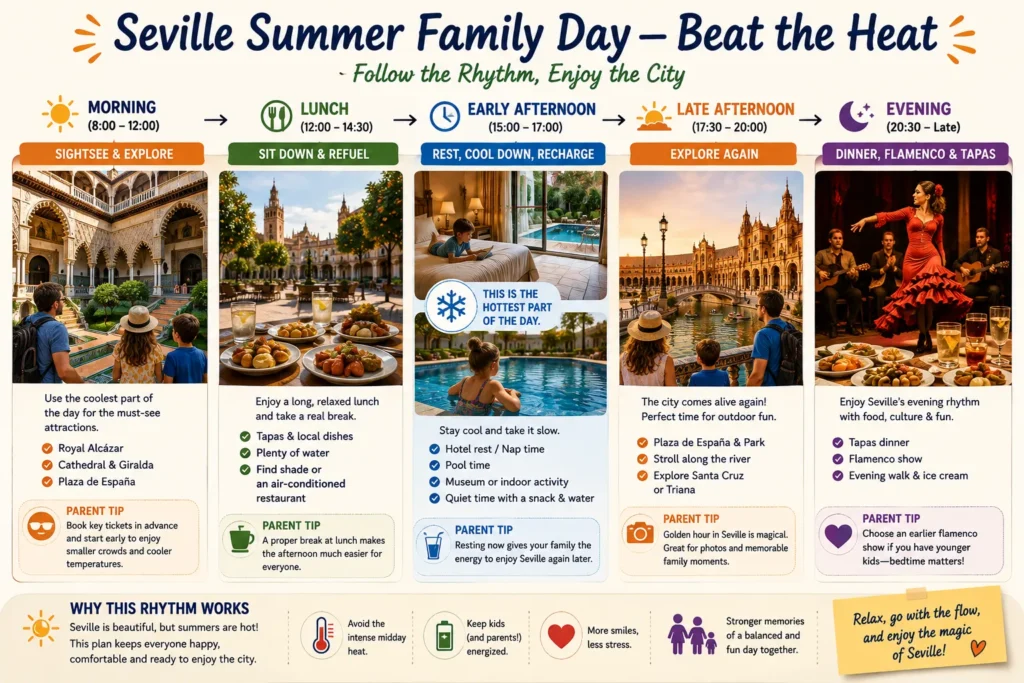
What I Would Do in July or August
Morning — Start With the Important Sight
Use the morning for:
Royal Alcázar,
Cathedral + Giralda,
or another major outdoor/historic experience.
Do not waste the coolest part of the day slowly deciding what everyone wants for breakfast.
Lunch — Stop
Sit indoors if possible.
Eat properly.
Drink.
Slow down.
Early Afternoon — Do Less
This is not the time I would schedule:
Plaza de España → María Luisa Park → long walk to Triana.
Instead:
hotel,
pool if available,
indoor attraction,
long lunch,
or rest.
Late Afternoon — Restart
When conditions become more manageable, go back outside.
Plaza de España can be wonderful later in the day.
So can the river.
So can Santa Cruz.
Evening — Use Seville’s Nightlife Rhythm
Dinner.
Flamenco.
Walking.
Plazas.
Ice cream.
The city does not stop simply because you took a long afternoon break.
That is the key.
A Hotel Pool Can Be Worth More Than Another Star
This is one of the rare European city trips where I would seriously consider a pool when choosing family accommodation in summer.
Not because the family is visiting Seville for a resort vacation.
Because a pool can turn:
15:00–17:00
from the worst part of the sightseeing day into something the children actively look forward to.
Then everyone goes out again.
Sometimes accommodation amenities change the itinerary more than accommodation luxury does.
Best Time to Visit Seville With Kids
Spring
For many families, this is one of the most attractive periods.
Temperatures can be much more comfortable for walking, gardens are enjoyable and orange blossom season can add another sensory dimension to the city.
But spring also includes major events and periods of very high visitor demand.
Semana Santa and Feria de Abril can completely change:
crowds,
accommodation prices,
transportation,
and the atmosphere of the city.
These events can be extraordinary experiences.
They are not ordinary sightseeing weeks.
If traveling around them, plan deliberately.
Summer
Possible?
Absolutely.
Would I use the same itinerary as April?
Absolutely not.
The family needs:
air conditioning,
water,
shade,
sun protection,
and a substantial midday slowdown.
Autumn
Often an excellent compromise for families prioritizing walking and historic sightseeing.
Winter
Seville can be particularly attractive compared with colder European destinations.
You lose the expectation of pool weather, but the city’s major cultural attractions remain.
Always check current opening schedules and weather conditions for your dates.
A Realistic 3-Day Seville Family Itinerary
The goal is not to fit every attraction into three days.
It is to give each day a different rhythm.
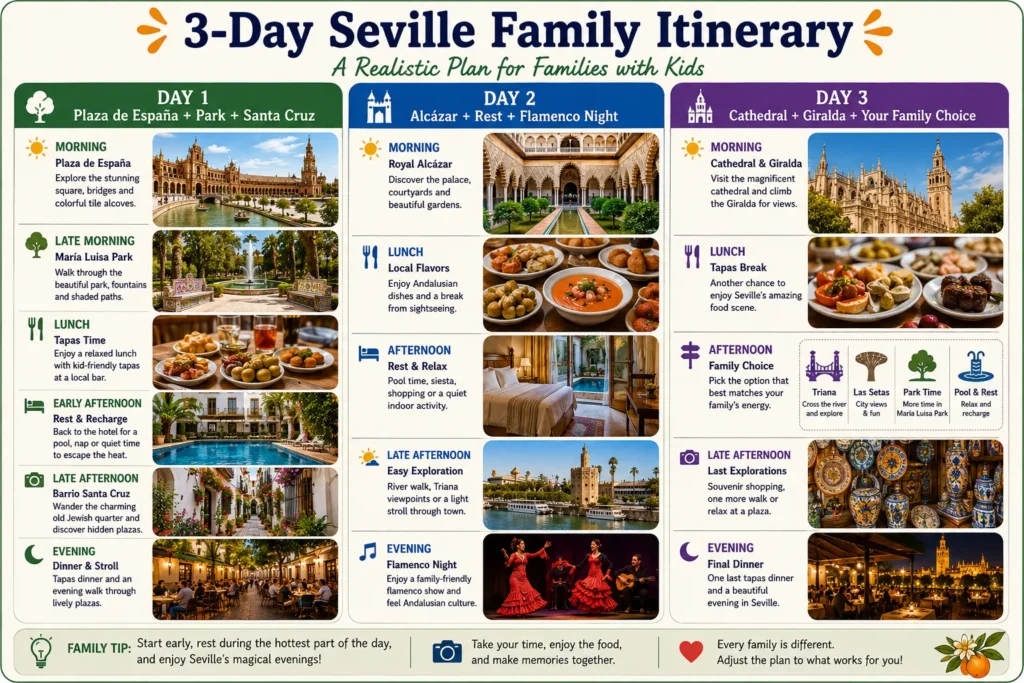
Day 1 — Plaza de España + Park + Santa Cruz
Morning — Plaza de España
Begin somewhere visually impressive and easy.
Explore the tiled provincial alcoves.
Walk the plaza.
If a current family activity such as boating appeals to everyone, consider it.
Late Morning — María Luisa Park
Do not rush immediately to the cathedral.
Walk through the park.
Let children decompress.
Lunch
Sit down.
Try a few tapas.
Early Afternoon
If it is hot:
rest.
Late Afternoon — Santa Cruz
Explore the neighborhood when walking becomes more pleasant.
Evening
Dinner.
No major ticket required.
Day 1 is deliberately gentle.
Day 2 — Royal Alcázar + Family Flamenco Night
Morning — Royal Alcázar
Make this the major reservation.
Give the palace and gardens enough time.
Do not add the cathedral immediately afterward simply because it is next door.
Lunch
Eat nearby.
Then stop.
Afternoon
Hotel.
Pool.
Rest.
Shopping.
Something easy.
Late Afternoon
Walk along the river or explore another central area depending on energy.
Evening — Flamenco
Choose a performance that works with your children’s ages and normal bedtime.
This becomes the day’s second major experience.
Two is enough.
Day 3 — Cathedral + Giralda + Triana or Family Choice
Morning — Cathedral
Visit while everyone is fresh.
Then decide whether the Giralda climb makes sense.
Lunch
Another proper break.
Afternoon — Choose
This is intentionally flexible.
Option A — Triana
Cross the river and experience another side of Seville.
Option B — More María Luisa Park
Particularly useful with younger children.
Option C — Metropol Parasol / Las Setas
Families interested in modern architecture and city views may enjoy the contrast with historic Seville.
Check current visitor access and ticket conditions.
Option D — Pool + Nothing Ambitious
In summer, this may genuinely be the best option.
Evening
Return to the family’s favorite area.
Have one last tapas dinner.
Walk.
Let Seville finish slowly.
Seville With Younger Children
With toddlers and younger primary-school children, I would reduce the number of major interiors.
Prioritize:
Plaza de España,
María Luisa Park,
Alcázar gardens,
short neighborhood walks,
and perhaps an appropriately timed flamenco experience.
The cathedral may still work.
The Giralda depends on the child.
And long historical explanations can wait.
Seville With Teenagers
Teenagers can engage with a completely different version of the city.
Islamic and Christian architecture.
Colonial history.
Flamenco as an art form.
Football.
Food.
Photography.
Game of Thrones locations.
Star Wars at Plaza de España.
And the historical consequences of Seville’s role in Spain’s overseas empire.
Give them context.
Then give them independence to notice things themselves.
Seville, Barcelona or Madrid With Kids?
All three belong in Spain’s strongest first-trip destinations.
But they solve different problems.
| Seville | Barcelona | Madrid | |
|---|---|---|---|
| Strongest identity | Andalusian culture | Gaudí + Mediterranean | Royal capital + museums |
| Best outdoor family space | Plaza de España / María Luisa | Beach / Montjuïc | Retiro |
| Major palace | Royal Alcázar | — | Royal Palace |
| Signature architecture | Mudéjar + Gothic | Modernisme / Gaudí | Royal / monumental |
| Beach | No | Yes | No |
| Flamenco | Excellent | Available | Available |
| Major summer challenge | Extreme heat | Heat + crowds | Heat |
| Day-trip base | Good | Very good | Excellent |
| Ideal first stay | 3 nights | 3–4 nights | 3–5 nights |
Families considering the Mediterranean option can compare this experience with our Barcelona with Kids family travel guide.
For Spain’s capital, our Madrid with Kids family travel guide covers the Royal Palace, museums, Retiro Park, football and family day trips.
Should Seville Replace Barcelona or Madrid?
For a short first Spain trip, I would not automatically try to fit all three.
If you have:
7 days
Barcelona + Madrid may already be enough.
If you have:
10 days
Barcelona + Madrid with Toledo/Segovia creates an efficient first itinerary.
If you have:
12–14 days
Seville becomes much easier to add properly.
That is the important word:
properly.
Do not add Seville for one rushed night just because the train network makes it technically possible.
How Seville Fits Into a Longer Spain Family Trip
Seville is the natural anchor for an Andalusia section of a family trip.
A longer route might look like:
Barcelona → Madrid → Seville → Granada
That gives the family:
Mediterranean Barcelona,
Central Spain,
Andalusia,
and Granada’s extraordinary historical landscape.
Families with enough time can also consider Córdoba between Madrid and Seville or as part of a wider Andalusia itinerary.
But again:
every additional destination should add something meaningful enough to justify another transfer.
Families still deciding which Spanish regions belong in their trip can start with our 15 Best Places to Visit in Spain with Kids guide.
If you are building a first Spain route around Barcelona and Madrid, our Spain with Kids 10-Day Family Itinerary shows how to visit Barcelona, Madrid, Toledo and Segovia with only two hotel bases.
Common Mistakes Families Make in Seville
Trying to Sightsee Continuously in Summer
The heat does not care how efficient your itinerary looked at home.
Change the schedule.
Booking Alcázar + Cathedral + Giralda Back-to-Back
Possible.
Not necessarily enjoyable.
Ignoring María Luisa Park
Outdoor reset time is part of the itinerary.
Choosing Accommodation Without Checking Air Conditioning
Especially in summer.
Booking Flamenco Too Late for the Children
A culturally perfect performance nobody stays awake for is not perfect.
Eating Too Late Because “That’s What Spain Does”
Feed your children.
Renting a Car for Central Seville
Usually unnecessary.
Adding Seville to a Short Trip Just to Collect Another City
Give Andalusia enough time to feel different.
What I Would Personally Protect in a Seville Family Itinerary
When I look at a city like Seville, I think the easiest mistake is trying to extract maximum value from every day.
The attractions are close together.
That creates the illusion that there is no reason not to visit another one.
But with children, I would protect three things before protecting another reservation:
the morning
the midday break
and
the evening.
Use the morning when everyone has energy.
Protect the afternoon when the heat is strongest.
Then let the evening become part of the trip.
I would rather miss one historic interior and have children excited to go back outside at 19:00 than complete every attraction and spend dinner with an exhausted family.
That is particularly true in Seville because the city itself is part of what you came to experience.
The streets.
The plazas.
The sound of flamenco.
People eating outside.
The light changing on old buildings.
Those things do not have ticket offices.
Don’t Let the Checklist Replace Andalusia
There is a broader reason I would slow Seville down.
Barcelona’s landmarks often announce themselves.
Sagrada Família.
Park Güell.
Madrid has institutions.
Royal Palace.
Prado.
Seville’s strongest memory may be less predictable.
Maybe it is Plaza de España.
Maybe the Alcázar gardens.
But it could also be:
the smell of orange blossom,
a child trying salmorejo,
a flamenco dancer’s footwork,
an evening walk through Santa Cruz,
or sitting outside after the temperature finally drops.
Family travel becomes more memorable when there is enough empty space for those moments to happen.
Final Thoughts: Seville Is Better When You Follow Its Rhythm
Seville is not a city I would try to conquer.
Especially with children.
Visit the Royal Alcázar.
See Plaza de España.
Enter the cathedral if it interests the family.
Climb the Giralda if everyone still has the energy.
Experience flamenco.
Eat tapas.
But between those things:
stop.
Find shade.
Sit in a plaza.
Walk through a park.
Go back to the hotel when the afternoon becomes too hot.
Come outside again later.
The family may technically see fewer attractions.
I think they will experience more of Seville.
Because this city is not only its monuments.
It is the rhythm of the day.
The shade after a hot walk.
The sound of conversation coming from a tapas bar.
The sudden opening of a tiny street into a beautiful plaza.
The orange trees.
The evening light.
The moment children realize that flamenco is much more powerful in person than it looked on a screen.
And the relief of discovering that nobody needs to rush anywhere for the next hour.
The more I think about family travel, the less interested I am in whether we managed to see everything.
What matters more is whether everyone still wants to keep exploring.
Seville makes that possible when you stop fighting the city’s rhythm and start traveling with it.
Give the family three nights.
Protect the hottest part of the day.
Choose the major attractions that genuinely matter.
Leave room for food, parks and wandering.
Then let Andalusia do the rest.
If the children leave remembering the palace gardens, the enormous Plaza de España, the sound of flamenco and one particularly good plate of tapas, that is enough.
They do not need to remember every date.
They do not need to remember every king.
They do not need to remember the architectural name of every arch they walked beneath.
They only need to remember that Seville felt different from everywhere else they visited in Spain.
And it will.