Planning a Spain family travel budget is harder than multiplying a daily travel cost by the number of people in your family.
A family of four can travel through Spain relatively affordably—or spend surprisingly quickly—depending on three decisions:
where you sleep, how often you move, and how many paid attractions you schedule.
And Spain is not one single price zone.
Barcelona during a busy travel period can feel expensive. A smaller inland city can change the budget considerably. A beach apartment with a kitchen creates a completely different spending pattern from a central hotel followed by three restaurant meals every day.
Accommodation prices have also continued rising. In the first half of 2026, the average daily hotel rate across Spain reached about €163 per room, while Barcelona averaged roughly €196 and Madrid €181. Those are market-wide averages rather than quotes for a particular family room, but they show why old “Spain is cheap” travel budgets can now be misleading.
So instead of promising that your family can visit Spain for exactly €150 or €300 per day, I would budget in ranges.
For this guide, I will use a family of four as the working example.
Quick Answer: What Should a Family of Four Budget for Spain?
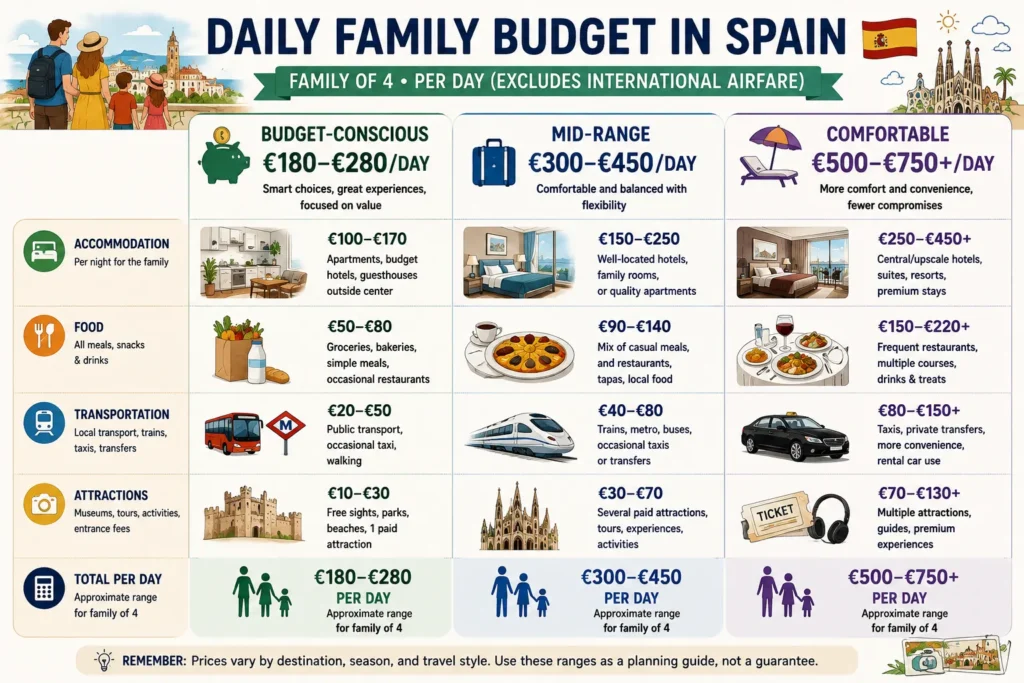
For a family of four traveling independently, I would use these as planning ranges rather than guaranteed prices:
| Travel Style | Approx. Daily Family Budget | What It Usually Means |
|---|---|---|
| Budget-conscious | €180–€280/day | Apartment or modest accommodation, groceries/simple meals, public transport, selective paid attractions |
| Mid-range | €300–€450/day | Comfortable family accommodation, restaurants mixed with casual meals, trains/local transport, regular paid attractions |
| Comfortable | €500–€750+/day | Central/upscale accommodation, frequent restaurants, taxis/private convenience, more paid experiences |
These figures exclude international airfare.
They are also not spending targets.
If you find an apartment for €130 and spend the afternoon at a free beach, you do not need to invent another €170 of spending simply because your budget allowed it.
Likewise, a Barcelona hotel during a high-demand period can push a supposedly “mid-range” family well above these ranges before anyone has eaten breakfast.
The useful question is not “What does Spain cost per day?” It is “Which parts of our Spain trip are actually driving the budget?”
For most families, the answer starts with accommodation.
1. Accommodation: Usually the Biggest Variable
A Spain family travel budget can change dramatically based on where and how you sleep.
For a family, the cheapest room advertised by a hotel is often irrelevant.
You need to know whether the room actually accommodates everyone.
That may mean:
- a family room
- two connecting or separate rooms
- an apartment
- an aparthotel
- a suite
- a resort unit
This is why a national average hotel rate should never be copied directly into a family budget and multiplied by the number of nights.
A Practical Accommodation Planning Range
For initial planning, I would start around:
| Destination / Style | Family Accommodation Planning Range |
| Smaller cities / budget stays | €100–€170/night |
| Madrid / Valencia / major cities | €150–€250/night |
| Barcelona / popular coastal destinations | €180–€300+/night |
| Resorts / peak season / larger family units | €250–€450+/night |
These are planning ranges, not fixed market prices.
Your dates can matter as much as your destination.
The 2026 hotel data illustrates the difference: Barcelona’s average hotel room rate in the first half of the year was about €195.50, compared with approximately €181.40 in Madrid, while the Balearic Islands recorded particularly strong year-over-year rate growth.
A family searching for a room that sleeps four may see very different prices from those averages.
Where I Would Spend More
I would pay more for accommodation when the location meaningfully reduces transportation and friction.
Saving €30 per night does not necessarily help if you then spend extra money—and an hour every morning and evening—getting the family into the city.
With children, location has a time value as well as a euro value.
Where I Would Try to Save
On longer stays, apartments and aparthotels become much more interesting.
A kitchen does not mean you need to cook dinner every night.
Even being able to handle breakfast, fruit, drinks, snacks, and an occasional simple meal can reduce restaurant spending substantially.
Laundry can also matter on a two-week family trip.
Paying slightly more for an apartment with a washing machine may allow you to pack less and make the trip easier.
2. Food: The Category Families Can Control Most Easily
Food is where families have enormous flexibility.
You can eat very well in Spain without turning every meal into a major restaurant event.
At the same time, four people ordering drinks, starters, mains, desserts, and snacks several times a day can push the budget up quickly.
For initial planning, I would use something like:
| Food Style | Approx. Family of Four / Day |
| Groceries + casual meals | €50–€80 |
| Mixed casual + restaurant meals | €90–€140 |
| Restaurant-heavy days | €150–€220+ |
Again, these are budgeting ranges, not menu-price promises.
Barcelona, Ibiza, resort areas, tourist-heavy locations, and particular restaurants can easily exceed them.
The Breakfast Rule
Breakfast is one of the easiest places to save money without making the trip feel cheaper.
If accommodation includes a worthwhile breakfast, great.
If not, I would not automatically pay hotel breakfast prices for four people every morning.
A bakery, café, supermarket breakfast, or apartment kitchen can dramatically change the weekly food total.
Save the money for meals the family actually cares about.
Don’t Budget Every Day the Same Way
One day might include a proper restaurant lunch and simple dinner.
Another might be a beach day with groceries and snacks.
Another could revolve around a food experience the family specifically wants.
That variation is normal.
I would rather budget generously for a few memorable meals than spend heavily three times a day simply because we are on vacation.
3. Transportation: The Number of Cities Matters
Transportation costs are not determined only by distance.
They are also determined by how often you move.
A family staying seven nights in Madrid with two day trips has a completely different transportation budget from a family sleeping in five cities during the same week.
That is one reason our Spain itineraries deliberately avoid unnecessary hotel changes.
Local Transportation
For city travel, create a modest daily allowance for:
- metro
- buses
- occasional taxis
- airport/station transfers
Families staying centrally and walking frequently may spend very little on some days.
Other days—especially arrival and departure days—can cost much more.
Intercity Trains
Spain’s rail network can make city-to-city family travel very practical, but high-speed train fares are dynamic enough that I would not put one permanent Madrid–Barcelona price into a long-term budget article.
Search your actual dates.
Booking timing, train type, ticket conditions, promotions, and passenger ages can all affect the total.
Spain also periodically runs specific discount programs. For example, Renfe’s 2026 Verano Joven program provides substantial summer discounts to eligible young people, but eligibility conditions apply, so it should not be treated as a universal tourist discount.
The budget lesson is simpler:
price your major intercity journeys before deciding how many cities belong in the itinerary.
Adding one city means more than another hotel.
It may mean four more train tickets, another station transfer, luggage storage, and additional local transportation.
Rental Car
A rental car can save money for some families and cost more for others.
Do not compare only:
train tickets vs. rental price.
Include:
- rental cost
- fuel
- tolls where applicable
- parking
- hotel parking
- child seats if needed
- one-way fees where applicable
- insurance choices
A car may offer excellent value for a rural road trip.
The same car sitting in a Barcelona or Madrid garage for three days may offer almost none.
4. Attractions: €20 Does Not Mean €20 for a Family
This is where family budgeting often goes wrong.
A €20–€30 admission does not sound enormous when reading an attraction guide.
Then you multiply it by several family members and repeat that process every day.
For example, the standard Sagrada Família admission is currently €26 for a general ticket, while children under 11 enter free; discounted categories and other ticket types have different prices.
That means family composition matters.
A family with two young children may pay very differently from a family traveling with two teenagers.
And attraction policies vary.
My Rule: One Expensive Anchor Attraction Is Often Enough
You do not need three ticketed headline attractions every day.
Choose the experience that matters.
Then combine it with:
- parks
- plazas
- beaches
- neighborhoods
- markets
- waterfront walks
- viewpoints
- free historic areas
This is not simply a money-saving strategy.
It often creates a better family day.
After two hours inside a major museum or historic complex, children may benefit more from a park than another €80 worth of tickets.
5. The Hidden Family Costs People Forget
These rarely appear in the first version of a travel budget.
Then they appear constantly during the trip.
Snacks and Drinks
One snack is cheap.
Four people buying drinks, ice cream, coffee, and snacks throughout a two-week trip is not.
I would create a small daily miscellaneous-food allowance rather than pretending these purchases will not happen.
Luggage
Low-cost flights can look extremely attractive until the family adds checked bags, seat selection, and other extras.
Compare the final family price, not the first fare displayed.
Laundry
For longer trips, budget for either laundry facilities or accommodation with a washing machine.
Parking
This can completely change the economics of a rental car in major cities.
Check hotel parking before booking the car.
Tourist Taxes
Depending on where you stay, local tourist taxes may apply and can vary by destination, accommodation category, age, and length of stay.
Do not assume the room price displayed during your first search is always the final accommodation cost.
Souvenirs
Give this its own budget.
Especially with children.
A souvenir budget of zero has a remarkable tendency to become a souvenir budget of something.
What Would a 4-Day Spain Family Trip Cost?
Now we can put the categories together.
For a family of four, excluding international airfare:
Budget-Conscious 4-Day Trip
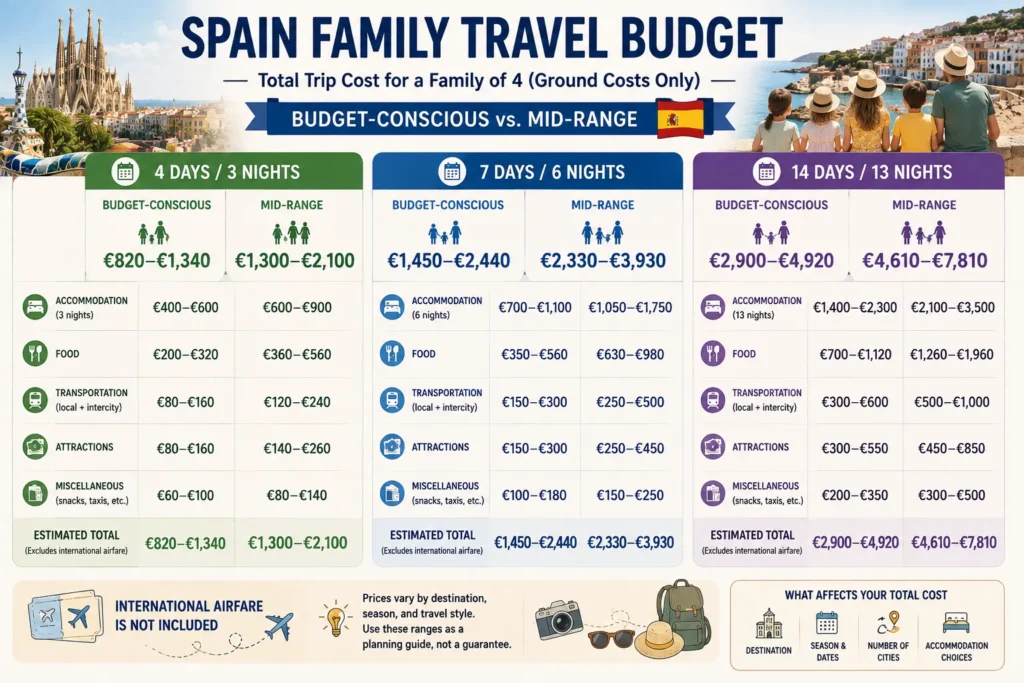
| Category | Approx. Total |
| Accommodation | €400–€600 |
| Food | €200–€320 |
| Local / intercity transport | €80–€160 |
| Attractions | €80–€160 |
| Miscellaneous | €60–€100 |
| Estimated Total | €820–€1,340 |
Mid-Range 4-Day Trip
| Category | Approx. Total |
| Accommodation | €600–€900 |
| Food | €360–€560 |
| Transportation | €120–€240 |
| Attractions | €140–€260 |
| Miscellaneous | €80–€140 |
| Estimated Total | €1,300–€2,100 |
The destination matters enormously.
Four days based in a smaller Spanish city and four days in Barcelona during a busy period should not be expected to cost the same.
What I Would Not Cut Just to Hit a Budget Number
Saving money is useful.
Making the trip substantially harder to save a small amount often is not.
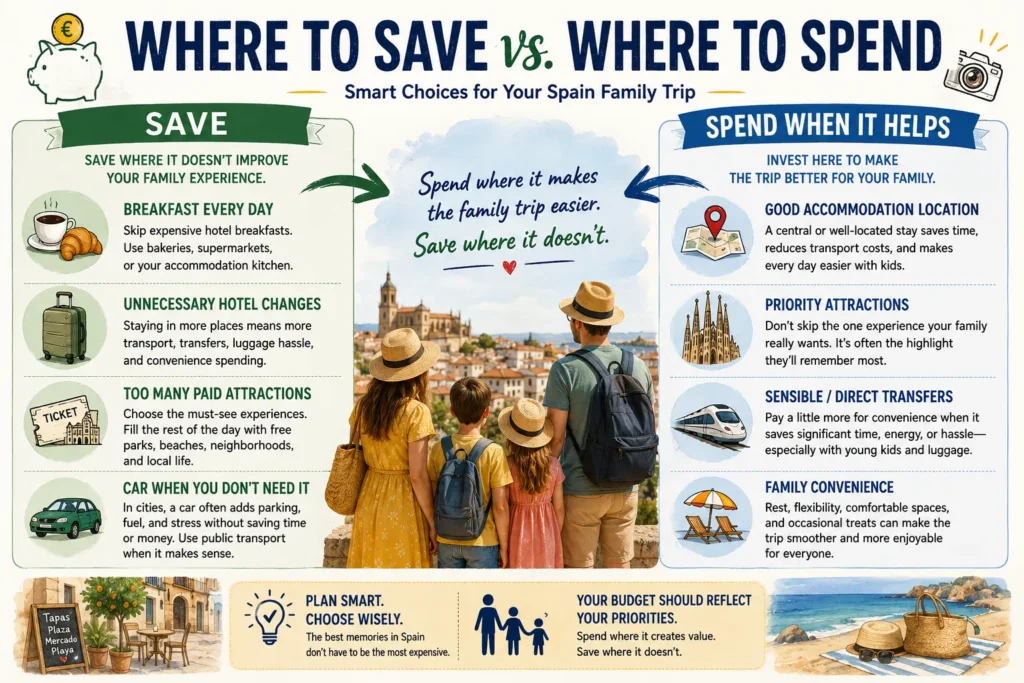
I would be cautious about cutting:
Accommodation Location
A cheaper room far outside the area you actually want to visit can cost the family time every single day.
A Priority Attraction
If your children have talked about one particular place for months, include it.
Cut three attractions nobody particularly cares about instead.
A Sensible Transfer
The absolute cheapest transport option is not always the best option with children and luggage.
Sometimes paying more for a direct journey is money well spent.
Rest
Do not fill a “free” afternoon with another paid attraction because doing nothing feels like wasting an expensive vacation.
A park, beach, pool, or slow evening can cost almost nothing and become one of the most useful parts of the itinerary.
Use the Itinerary to Control the Budget
The easiest way to reduce a Spain family travel budget is often not finding a coupon.
It is changing the route.
Every additional destination can create:
transport + transfer + luggage + hotel change + convenience spending
before you buy a single attraction ticket.
That is why the itinerary should come before the final budget.
If you are still deciding where to go, start with our Best Places to Visit in Spain with Kids guide to narrow the destination list before pricing hotels and transportation.
Once you know the region, use the appropriate family itinerary rather than trying to connect every famous Spanish city into one trip.
A shorter route does not automatically mean a smaller experience.
Quite often, it means a better budget and a better family vacation.
What Would a 7-Day Spain Family Trip Cost?
A week is where small daily spending differences start becoming significant.
An extra €30 per night for accommodation is €210 over seven nights.
An extra €40 per day on food is €280.
Add several unnecessary taxis, another paid attraction, and one extra intercity transfer, and a family can easily spend hundreds of euros more without feeling as though they chose a more luxurious vacation.
For a family of four, excluding international airfare, I would use these planning ranges.
Budget-Conscious 7-Day Trip
| Category | Approx. Total |
|---|---|
| Accommodation | €700–€1,100 |
| Food | €350–€560 |
| Local / intercity transport | €150–€300 |
| Attractions | €150–€300 |
| Miscellaneous | €100–€180 |
| Estimated Total | €1,450–€2,440 |
Mid-Range 7-Day Trip
| Category | Approx. Total |
|---|---|
| Accommodation | €1,050–€1,750 |
| Food | €630–€980 |
| Local / intercity transport | €250–€500 |
| Attractions | €250–€450 |
| Miscellaneous | €150–€250 |
| Estimated Total | €2,330–€3,930 |
A family staying primarily in one city can land near the lower end.
A family moving between Barcelona, Madrid, and another destination may spend considerably more on transportation and convenience.
This is why I would never budget a Spain trip by multiplying a generic “Spain costs €X per day” figure by seven.
The itinerary matters too much.
What Would a 2-Week Spain Family Trip Cost?
Two weeks is where accommodation strategy becomes especially important.
It is also where apartments become more attractive.
Being able to handle breakfast, snacks, laundry, and occasional meals at home can make a noticeable difference over fourteen days.
For a family of four, excluding international flights:
Budget-Conscious 14-Day Trip
| Category | Approx. Total |
|---|---|
| Accommodation | €1,400–€2,300 |
| Food | €700–€1,120 |
| Local / intercity transport | €300–€600 |
| Attractions | €300–€550 |
| Miscellaneous | €200–€350 |
| Estimated Total | €2,900–€4,920 |
Mid-Range 14-Day Trip
| Category | Approx. Total |
|---|---|
| Accommodation | €2,100–€3,500 |
| Food | €1,260–€1,960 |
| Local / intercity transport | €500–€1,000 |
| Attractions | €450–€850 |
| Miscellaneous | €300–€500 |
| Estimated Total | €4,610–€7,810 |
These ranges are wide because a two-week Spain trip can mean very different things.
Fourteen nights split between Barcelona, Mallorca, and another popular coastal destination during peak season will not resemble fourteen nights through smaller inland cities.
Likewise, a family changing hotels six times will probably spend differently from one using two or three bases.
The longer the trip, the more valuable good route planning becomes.
Budget vs. Mid-Range vs. Comfortable: What Actually Changes?
The difference is not simply cheaper hotels versus expensive hotels.
It is often about convenience.
Budget-Conscious Family Travel
A budget-conscious trip might include:
- apartments or modest family accommodation
- breakfast from supermarkets or bakeries
- casual lunches
- selective restaurant dinners
- public transportation
- fewer paid attractions
- fewer hotel changes
- free parks, beaches, plazas, and neighborhoods
This does not need to feel like a stripped-down vacation.
Spain is particularly well suited to combining paid experiences with public spaces and outdoor time.
Mid-Range Family Travel
This is probably where many families will feel most comfortable.
You can prioritize:
- well-located accommodation
- regular restaurant meals
- major paid attractions
- high-speed trains when useful
- occasional taxis
- some convenience spending
- a mixture of apartments and hotels
The biggest advantage is flexibility.
You do not need to choose the cheapest option every time.
Comfortable Family Travel
At this level, much of the extra spending buys convenience:
- larger or more central accommodation
- higher-end hotels
- frequent taxis or private transfers
- restaurant-heavy days
- premium experiences
- more flexible transportation
- resort stays
There is no problem with spending more if those things matter to your family.
But more expensive does not automatically mean more family-friendly.
A €500 hotel in the wrong location can still be less useful than a €220 apartment near the places your family actually wants to visit.
Barcelona vs. Madrid vs. Smaller Cities: Your Destination Changes the Budget
One national daily budget hides enormous differences.
Barcelona
I would budget conservatively for Barcelona.
Accommodation can be one of the largest expenses, particularly during high-demand dates, and many of the city’s famous attractions are ticketed.
This does not mean Barcelona needs to be avoided on a budget.
It means accommodation dates and priority attractions should be priced early.
Our Barcelona with Kids: A Family Travel Guide can help you decide which experiences actually deserve space in the itinerary before you start buying tickets for every famous attraction.
Madrid
Madrid can also become expensive, but it offers a wide range of ways to structure a family day.
You might spend heavily on one major experience and then use parks, neighborhoods, plazas, and walking for much of the rest of the day.
If Madrid is part of your route, our Madrid with Kids: A Family Travel Guide can help you prioritize what your family actually wants rather than budgeting for every headline attraction.
Smaller Historic Cities
Cities such as Toledo, Segovia, Córdoba, and others can change the spending pattern.
Accommodation may sometimes be lower than in the biggest tourism markets, although this varies considerably by date.
But do not automatically assume that staying overnight is cheaper than visiting as a day trip.
Compare:
hotel + transport + luggage logistics + meals + time
rather than accommodation prices alone.
Beach Trips and Islands Need a Different Budget
A Spain beach vacation can look inexpensive because beaches themselves are usually not ticketed attractions.
Then the accommodation bill arrives.
Popular coastal destinations and islands can have substantial seasonal price swings.
Your budget may also include:
- rental car
- parking
- beach equipment
- boat trips
- ferries
- resort meals
- airport transfers
- family activities
The Balearic Islands deserve particular attention because island hopping creates transportation costs that mainland itineraries do not have.
If Mallorca, Menorca, Ibiza, or Formentera are part of your plan, our Balearic Islands Family Itinerary: 4 Days, 7 Days & 2 Weeks with Kids explains why visiting fewer islands can sometimes save both money and valuable vacation time.
How Season Changes a Spain Family Travel Budget
There is no single “summer price” or “winter price” for all of Spain.
Seasonality depends on destination.
Beach destinations behave differently from inland cities.
Major events can change hotel demand.
School holidays affect when families travel.
Weekends can behave differently from weekdays.
That is why I would not build a budget around a claim such as:
“Travel in October and everything will be 30% cheaper.”
It may be.
It may not.
Instead, compare your actual dates.
If Your Dates Are Flexible
Check accommodation prices before deciding which week to travel.
Moving the trip by several days can sometimes matter more than finding a discount code later.
If Your Dates Are Fixed by School Holidays
Do not waste time searching endlessly for an imaginary low-season price.
Instead, focus on the variables you still control:
- destination mix
- number of hotel changes
- accommodation type
- how early you book
- paid attractions
- transportation
- restaurant frequency
A fixed travel date does not mean a fixed travel budget.
How I Would Save €500 on a One-Week Family Trip
Not by hunting for fifty €10 discounts.
I would look for one or two structural changes.
1. Remove an Unnecessary Hotel Change
This can reduce transportation, luggage storage, transfer costs, and convenience spending at the same time.
2. Compare Apartments with Family Hotel Rooms
Especially if a hotel requires two rooms.
3. Handle Breakfast Simply
Saving €25–€40 on family breakfast over several mornings adds up quickly.
4. Choose the Paid Attractions Before the Trip
Decide which experiences matter.
Do not buy tickets simply because every travel guide lists them.
5. Use Public Transportation Where a Car Adds Little Value
Then rent a car only for the part of the trip that benefits from one.
6. Add a Free Family Day
Beach.
Park.
Neighborhood.
Waterfront.
Market.
A day does not need an €80–€150 attraction bill to count as a travel day.
The point is not to make the vacation cheap.
It is to stop spending on things that do not improve it.
A €3,000 Spain Trip vs. a €5,000 Spain Trip
Imagine two families of four traveling for one week.
Family A — Around €3,000
They:
- stay in an apartment or mid-range family accommodation
- use two bases
- buy groceries for breakfast and snacks
- eat one substantial restaurant meal most days
- use trains and public transportation
- choose one major paid attraction on many sightseeing days
- spend free time in parks, plazas, neighborhoods, and beaches
Family B — Around €5,000
They:
- stay in more central or upscale hotels
- move between more destinations
- eat most meals in restaurants
- use more taxis and private transfers
- book several paid attractions or experiences
- prioritize convenience over minimizing cost
Neither family is traveling incorrectly.
The useful question is:
Which of Family B’s extra expenses would actually make your family happier?
If the answer is a central hotel because your young child needs an afternoon rest, spend there.
If the answer is a private transfer after a late flight, spend there.
If nobody particularly cares about a third paid attraction that day, don’t.
A budget should reflect priorities.
Build a 10–15% Buffer
I would not travel with a budget that only works if every estimate is correct.
Things change.
A train may cost more than expected.
Someone may need a taxi.
The family may find a restaurant everyone wants to try.
You may need pharmacy items, replacement clothes, extra luggage, or another transfer.
For a €3,000 ground budget, a 10% buffer is €300.
For €5,000, it is €500.
You do not need to spend it.
That is the point.
A travel budget works better when unexpected spending is inconvenient rather than catastrophic.
Sample Spain Family Budget: 7 Days, Family of Four
Here is how I would build a realistic mid-range planning example.
This is not a promise that your trip will cost exactly this amount.
It is a framework.
| Category | Example Budget |
|---|---|
| Accommodation: 7 nights | €1,400 |
| Food | €800 |
| Intercity + local transport | €350 |
| Attractions | €300 |
| Snacks / miscellaneous | €150 |
| Planned Spend | €3,000 |
| 10% Buffer | €300 |
| Working Budget | €3,300 |
International airfare remains separate.
If the actual accommodation comes in at €1,100, great.
Do not immediately redistribute the €300 to unnecessary spending.
Keep it available for the trip.
Sample Spain Family Budget: 14 Days, Family of Four
For a mid-range two-week trip:
| Category | Example Budget |
|---|---|
| Accommodation: 14 nights | €2,700 |
| Food | €1,500 |
| Intercity + local transport | €700 |
| Attractions | €600 |
| Snacks / miscellaneous | €300 |
| Planned Spend | €5,800 |
| 10% Buffer | €580 |
| Working Budget | €6,380 |
Again, airfare is separate.
A family using apartments, fewer bases, and more free activities may spend considerably less.
A family visiting expensive coastal destinations in peak season may spend considerably more.
The framework matters more than pretending €6,380 is some universal “cost of Spain.”
Common Spain Family Budget Mistakes
1. Budgeting Per Person Instead of Per Family
Some costs scale with every traveler.
Others do not.
Accommodation is the obvious example.
Build the budget category by category.
2. Forgetting That Children Age Into Different Prices
A five-year-old and a fifteen-year-old may not receive the same attraction, transportation, or meal pricing.
Check the actual age rules.
3. Pricing Only the Hotel’s Cheapest Room
Make sure it actually accommodates your family.
4. Forgetting Airport Transfers
Arrival and departure days often cost more for transportation than ordinary sightseeing days.
5. Comparing Base Airfares
Add bags, seats, and required extras before deciding which flight is cheaper for the family.
6. Overloading the Itinerary
More cities usually mean more transportation spending.
7. Forgetting the Buffer
A budget with no flexibility is a forecast, not a practical travel budget.
8. Assuming “Free Beach” Means “Free Day”
Transport, food, parking, chairs, activities, and snacks may still cost money.
That is fine.
Just budget for them.
FAQ: Spain Family Travel Budget
How much should a family of four budget per day in Spain?
As a planning range, roughly €180–€280 per day can work for a budget-conscious family, while €300–€450 per day is a more comfortable mid-range starting point.
Families choosing upscale accommodation, frequent restaurants, private transportation, or premium experiences can easily spend €500–€750 or more per day.
International airfare is not included in these ranges.
How much does one week in Spain cost for a family of four?
A budget-conscious seven-day ground budget might fall around €1,450–€2,440, while a mid-range trip may be closer to €2,330–€3,930, excluding international airfare.
Your destination and accommodation dates can move the total substantially.
How much does two weeks in Spain cost for a family?
For a family of four, a budget-conscious two-week trip might fall around €2,900–€4,920, while a mid-range trip could be approximately €4,610–€7,810, excluding international airfare.
Treat these as planning ranges rather than price guarantees.
Is Spain cheap for a family vacation?
Spain can offer good value, but describing it simply as “cheap” is increasingly misleading.
Barcelona, Madrid, the Balearic Islands, popular coastal destinations, and peak travel periods can all produce substantial family costs.
Smaller cities, apartments, public transportation, and slower itineraries can change the budget significantly.
Is it cheaper to stay in hotels or apartments in Spain?
It depends on your family size, destination, and dates.
Apartments become particularly attractive when a hotel would require two rooms or when a kitchen and laundry facilities reduce other trip expenses.
Always compare the final price and location.
Should we use trains or rent a car to save money?
Neither is always cheaper.
Trains can work very well between major cities, while a rental car can provide better value for certain regional or rural routes.
Compare the complete family cost, including parking, fuel, child seats, transfers, and train tickets.
How much extra money should we budget for Spain?
I would keep approximately 10–15% of the planned ground budget available as a buffer.
You may never use it, but it gives the itinerary room to change.
Final Thoughts: Spend on the Trip Your Family Actually Wants
A Spain family travel budget should not be a competition to produce the lowest possible number.
The cheapest hotel is not automatically the best value.
The cheapest train is not automatically the best departure time.
And a free afternoon at the beach is not somehow less valuable than an afternoon that required €100 in admission tickets.
Start with the family.
Then build the route.
Then price the route.
With four days, reducing unnecessary movement can matter more than finding tiny discounts.
With a week, accommodation and destination choices begin multiplying.
With two weeks, apartments, fewer bases, transportation strategy, and meal habits can change the total by thousands of euros.
If you are still deciding how long your Spain trip should be and which regions deserve your time, our Family Travel Europe: How to Plan a Europe Trip with Kids guide can help you step back and build the wider journey before locking in individual bookings.
Spend more where money makes the family trip meaningfully easier or better. Save where it doesn’t.
That is a much more useful travel budget than chasing a universal euro-per-day number.
Continue Planning Your Spain Family Trip
Once you have a working budget, these guides can help you turn the numbers into an actual family itinerary.
Best Places to Visit in Spain with Kids
Not sure which destinations deserve part of the budget? Use our Best Places to Visit in Spain with Kids guide to compare the major family destinations before paying for hotels and transportation.
How to Plan a Family Trip to Europe
If Spain is part of a larger European vacation, our How to Plan a Family Trip to Europe guide can help you decide trip length, route, transportation, accommodation, and pacing before the spending starts.
Family Travel Europe
For the broader planning picture, our Family Travel Europe guide brings together practical advice for building a Europe trip around the way families actually travel.