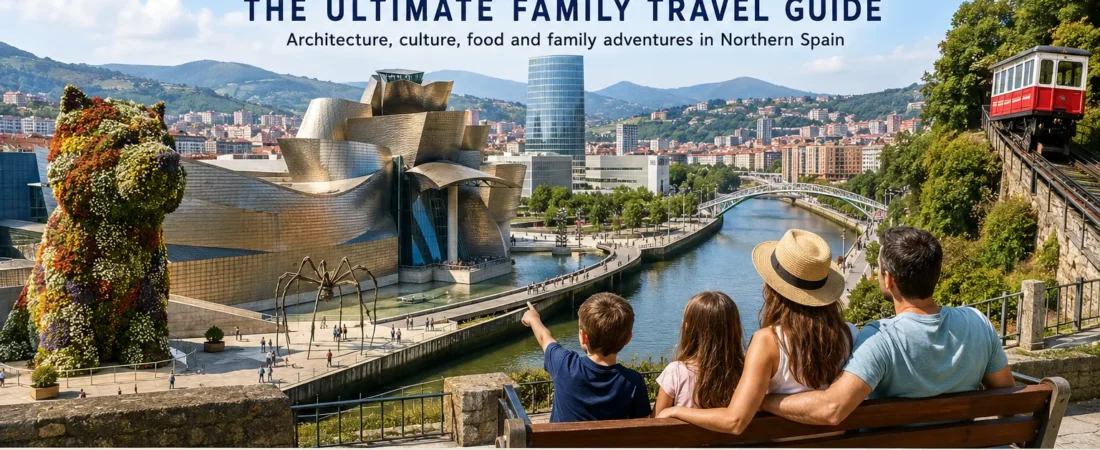
Bilbao is not the Spain many children expect.
There are no Mediterranean beaches beside the historic center.
No enormous Moorish palace dominates the skyline.
And compared with Barcelona, Madrid or Seville, relatively few first-time family itineraries begin with:
“We absolutely have to take the kids to Bilbao.”
That may be exactly why the city is so interesting.
Bilbao gives families something different.
A titanium museum that looks almost like a sculpture.
A giant flower-covered dog.
An enormous spider beside the river.
A funicular climbing above the city.
A medieval old town.
Basque food.
Green hills surrounding an urban landscape that was once far more industrial than the Bilbao visitors see today.
For families searching for Bilbao with kids, I think the most interesting question is not simply:
What should we see?
It is:
How did this former industrial city become one of Europe’s best-known examples of urban transformation?
And surprisingly, children can understand that story.
Bilbao with Kids: Quick Family Guide
| Question | Recommendation |
|---|---|
| Ideal first stay | 2–3 nights |
| Minimum worthwhile stay | 2 full days |
| Best for | Architecture, art, Basque culture, food, urban exploration |
| Best ages | School-age children and teens especially strong |
| Younger kids | Good with the right pacing |
| Essential first experience | Guggenheim exterior + river |
| Best family viewpoint | Artxanda |
| Best old-city experience | Casco Viejo |
| Best easy family transport | Metro + tram + walking |
| Car needed? | No for Bilbao itself |
| Biggest weather variable | Rain |
| Best rainy-day strength | Museums + indoor cultural spaces |
| Best nearby UNESCO experience | Vizcaya Bridge |
| Ideal family rhythm | Culture → outdoor reset → food |
| Biggest mistake | Treating Bilbao as only the Guggenheim |
If you have two days, do not try to turn Bilbao into an attraction marathon.
I would prioritize:
Guggenheim + river
↓
Artxanda
↓
Casco Viejo
↓
Basque food
Then add according to:
weather,
children’s ages,
and family interest.
Why Bilbao Works With Kids
Bilbao’s family appeal is not immediately obvious from a conventional attractions list.
That is because the city itself is part of the attraction.
Walk along the river and children can encounter:
historic buildings,
industrial traces,
modern architecture,
bridges,
public art,
parks,
and completely different neighborhoods.
The city keeps changing around them.
Bilbao Gives Parents Different Types of Experiences
This is particularly useful on a longer Spain trip.
Morning:
modern architecture.
Then:
giant outdoor sculpture.
Later:
funicular.
Then:
old town.
Then:
pintxos.
The next day can feel completely different again.
Family trips become easier when every attraction does not require the same kind of attention.
Bilbao does this very well.
The Bilbao Effect — Can One Museum Change a City?
Before showing children the Guggenheim, I would ask one question:
Can a museum change an entire city?
It sounds exaggerated.
But Bilbao became internationally associated with exactly that idea.
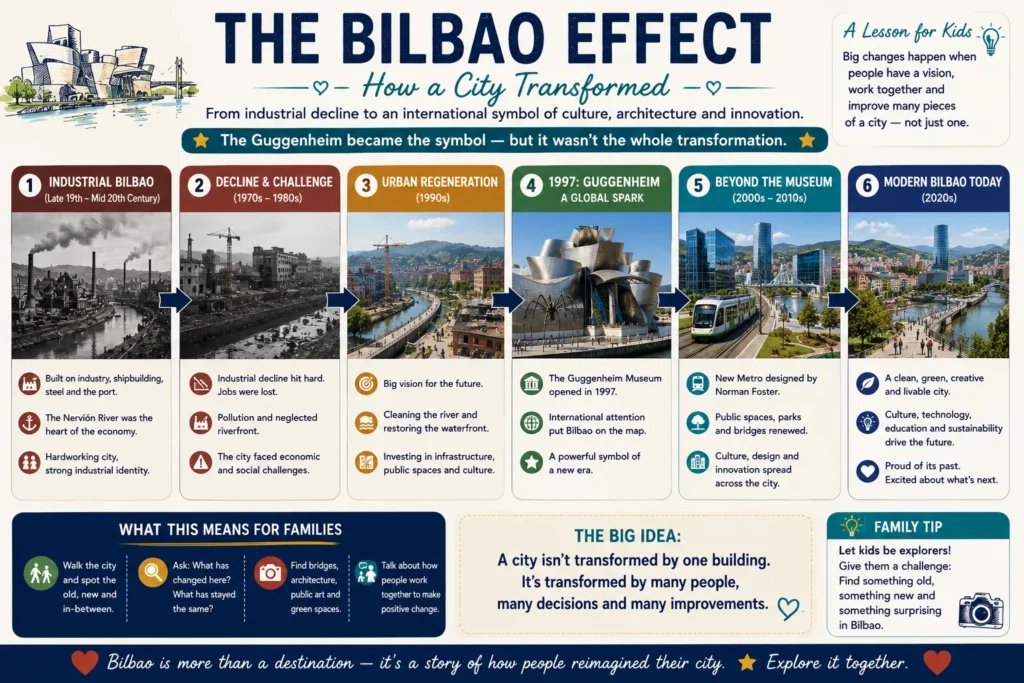
Bilbao Before the Guggenheim
Bilbao grew through:
industry,
shipbuilding,
port activity,
steel,
and commerce.
The river was fundamental to that development.
But industrial decline left the city facing major economic and urban challenges.
The Bilbao families walk through today is the result of a much broader transformation.
Then Came the Guggenheim
The Guggenheim Museum Bilbao opened in 1997.
Designed by architect Frank Gehry, the building became internationally recognizable almost immediately.
Its curving forms and titanium surfaces looked radically different from a conventional museum.
Visitors came.
International attention followed.
And Bilbao became one of the world’s most frequently cited examples of culture and architecture being used as part of urban regeneration.
But Don’t Tell Kids the Museum “Saved Bilbao”
That simplifies the story too much.
The Guggenheim was part of a much larger transformation involving:
transportation,
riverfront redevelopment,
environmental improvement,
public space,
architecture,
infrastructure,
and economic change.
That distinction actually makes the story better.
One spectacular building can become a symbol.
A city still needs much more than one spectacular building to transform itself.
Turn the Bilbao Effect Into a Family Game
As you explore Bilbao, ask children to find:
something that looks industrial,
something historic,
something very modern,
a bridge,
public art,
a green space,
and somewhere people now spend leisure time beside the river.
Then ask:
What do you think this area looked like 50 years ago?
Now the city becomes something to investigate.
1. Guggenheim Museum Bilbao — Start Outside
This may sound strange.
You have traveled to Bilbao.
The Guggenheim is the city’s most famous attraction.
And my first recommendation is:
don’t immediately go inside.
Start outside.
The building itself is part of the experience.
Let Children Look at the Building First
Do not immediately explain Frank Gehry.
Ask:
What does it look like?
A ship?
A fish?
Metal waves?
Something from the future?
Does everybody see the same thing?
There is no single correct answer.
That is precisely why this works so well with children.
Walk Around It
The building changes depending on:
where you stand,
the light,
the river,
and the angle.
Children who claim not to like museums may still find the architecture interesting because it does not initially require them to:
read labels,
stay quiet,
or understand modern art.
Is the Guggenheim a UNESCO World Heritage Site?
No.
This is worth stating clearly because descriptions of Bilbao sometimes use vague phrases such as:
“UNESCO-level significance.”
That can create the wrong impression.
The Guggenheim Bilbao is internationally important architecture, but it is not itself a UNESCO World Heritage Site.
Later in this guide, we will visit a genuine UNESCO World Heritage Site near Bilbao:
the Vizcaya Bridge.
Should Families Go Inside the Guggenheim?
Not automatically.
This depends heavily on the children.
Toddlers and Younger Children
The exterior experience may already provide:
architecture,
river,
Puppy,
Maman,
and open-air exploration.
If everyone is happy outside, you do not need to prove the family visited Bilbao properly by forcing a long museum session.
School-Age Children
This becomes more interesting.
Children may be ready to:
choose favorite works,
compare strange forms,
discuss materials,
and explore how contemporary art differs from traditional museums they may have seen elsewhere in Spain.
Teenagers
For:
art,
architecture,
design,
photography,
or culture-interested teenagers,
I would strongly consider going inside.
The museum can become one of the strongest parts of Bilbao.
Check the Current Exhibition Before Buying Tickets
This matters with contemporary art.
A temporary exhibition that fascinates one teenager may mean nothing to another child.
Before deciding how much time to allocate:
look at the current exhibitions,
family programming,
opening information,
and ticket conditions.
Then decide.
Famous museum does not mean identical family experience every month of the year.
2. Puppy — The Easiest Guggenheim Introduction
Outside the museum stands one of Bilbao’s most immediately recognizable public artworks:
Jeff Koons’ Puppy.
It is enormous.
It is covered in living flowers.
And it looks like a giant dog sitting outside one of Europe’s most famous contemporary-art museums.
Children do not need a degree in art history to have an opinion about that.
Ask Before Explaining
Why flowers?
Why a puppy?
Why put it here?
Would it feel different if the sculpture were made from stone?
Does it still count as the same artwork when the plants change?
Those questions are more useful than:
“This important work was created by…”
Start with curiosity.
Add information afterward.
3. Maman — The Giant Spider
On the river side of the Guggenheim, families encounter a completely different kind of sculpture:
Louise Bourgeois’ Maman.
A giant spider.
Tall legs.
Bronze body.
The museum behind it.
River nearby.
This Is Exactly Why Outdoor Art Works With Kids
Children can:
walk around it,
look underneath,
change perspective,
and react before anyone explains what it means.
Some children will think:
cool.
Some:
terrifying.
Some:
why is there a giant spider here?
All three responses are useful.
You Can Experience Guggenheim Bilbao Without Spending Hours Inside
This is an important family-planning point.
A successful Guggenheim experience can be:
Puppy
↓
building exterior
↓
Maman
↓
river walk
and then:
lunch.
That is still meaningful.
Families interested in the collection can add the interior.
The museum should adapt to the family, not the other way around.
4. Walk the Nervión River — See the New Bilbao
After the Guggenheim, I would continue along the river.
This is not filler between attractions.
The river helps explain the city.
Bilbao’s industrial development depended heavily on its relationship with the estuary and port.
Today, much of the riverfront tells a different story.
What Should Children Look For?
Bridges.
New buildings.
Old buildings.
Public spaces.
Art.
Transportation.
People walking and cycling.
Ask:
Which part looks oldest?
Which looks newest?
Which building would you design differently?
You are still exploring the Bilbao Effect without turning it into a lecture.
The River Walk Is Also a Reset
Museums require concentration.
Walking beside the river does not.
That makes this a useful transition after the Guggenheim.
Children can:
move,
talk,
look at boats,
take photographs,
and recover some energy.
This is a recurring principle in good family itineraries:
follow a high-attention experience with a low-attention one.
5. Zubizuri — A Bridge Children Can Judge
Continue exploring the river and Bilbao provides another piece of contemporary architecture:
Zubizuri.
Designed by Santiago Calatrava, the pedestrian bridge has become another recognizable element of Bilbao’s modern cityscape.
Don’t Tell Children Whether It Is Beautiful
Ask them.
Does it fit Bilbao?
Does it look futuristic?
Does it remind them of anything?
Which do they prefer:
the bridge
or
the Guggenheim?
Architecture suddenly becomes something they are allowed to judge.
That is much more interesting than memorizing the architect’s name.
Bilbao Is an Architecture City Even If Your Kids Don’t Know Architecture
This is one of the reasons I like the city for older children.
You can compare:
Gehry,
Calatrava,
historic Casco Viejo,
industrial heritage,
and newer redevelopment
without visiting five museums.
The buildings are already outside.
6. Funicular de Artxanda — Give the Kids a Different Kind of Attraction
After architecture and river walking, change the experience completely.
Go up.
The Artxanda Funicular connects the city with the hillside above Bilbao.
For adults:
transport to a viewpoint.
For many children:
funicular ride.
That distinction matters.
Why Artxanda Works So Well in a Family Itinerary
It provides three things at once:
transport experience
view
outdoor reset
No museum behavior required.
No long historical explanation.
No complicated route.
Look Down at the City You Just Explored
From above, families can begin connecting:
river,
Guggenheim,
city center,
surrounding hills,
and Bilbao’s geography.
Ask children to find the museum.
Then the river.
Then a bridge.
The city they walked through becomes a map.
How Long Do You Need?
This does not need to become a half-day expedition.
Go up.
Walk.
Enjoy the view.
Let children move around.
Return when ready.
Check the current funicular schedule before building the day around it.
Weather Matters
Bilbao weather can change the value of a viewpoint dramatically.
If clouds completely obscure the city or rain makes the experience unpleasant:
move Artxanda.
This is exactly why Bilbao benefits from a flexible itinerary.
Family rating: ★★★★★
Best for: All ages
Best combination: Guggenheim + river + Artxanda
My Favorite First Bilbao Family Day
This is already enough for a very good day:
Guggenheim exterior
↓
museum interior if wanted
↓
river walk
↓
lunch
↓
Artxanda Funicular
↓
view + outdoor time
↓
easy evening
Notice what is missing:
seven more attractions.
They are not necessary.
7. Casco Viejo — Change Centuries Completely
Modern Bilbao has dominated the day so far.
Now change the setting.
Casco Viejo — Bilbao’s historic old town — gives families narrow streets, plazas, traditional architecture, shops and food.
This is the counterpoint to the Guggenheim.
The Seven Streets
Bilbao’s historic core is closely associated with the Siete Calles — Seven Streets, the medieval streets around which the early town developed.
This gives children an easy historical concept.
Bilbao did not begin with the Guggenheim.
It began much smaller.
Ask Children to Imagine the Old Bilbao
Remove mentally:
metro,
modern bridges,
Guggenheim,
cars,
and contemporary buildings.
What remains?
A much smaller settlement associated with:
river,
trade,
church,
market,
and narrow streets.
Now compare that with the Bilbao they saw this morning.
Few cities make “old city versus transformed city” as easy to see in a single day.
Plaza Nueva — A Good Place to Stop
Families do not need to march continuously through Casco Viejo.
Plaza Nueva gives the old-town experience somewhere to pause.
This is also where Bilbao’s food culture begins to become part of the itinerary.
Pintxos.
Small portions.
Choice.
Sharing.
Exactly the kind of meal structure that can work well with children when parents do not turn it into a competition to visit the maximum number of bars.
Don’t Repeat the San Sebastián Pintxos Crawl
Bilbao has an excellent food culture.
But this is not our San Sebastián Pintxos Guide.
In Bilbao, I would keep the food experience simpler.
Choose a few places.
Try:
something familiar,
something Basque,
something the children choose,
and stop when everyone is satisfied.
The purpose of eating pintxos in Bilbao is to experience Bilbao, not to reproduce somebody else’s top-ten bar route.
Casco Viejo With Younger Children
This can work very well because:
walking distances can be flexible,
food stops are easy to incorporate,
and the streets themselves provide visual interest.
But strollers and historic surfaces can occasionally require patience.
Do not build the visit around covering every street.
Casco Viejo With Teenagers
Even better.
Give them some independence in choosing:
a pintxo,
shop,
photograph,
or street to explore.
Older children can also understand the historical contrast between:
medieval Bilbao
and
the post-industrial city around the Guggenheim.
That contrast is really the theme of this entire guide.
What I Would Prioritize So Far
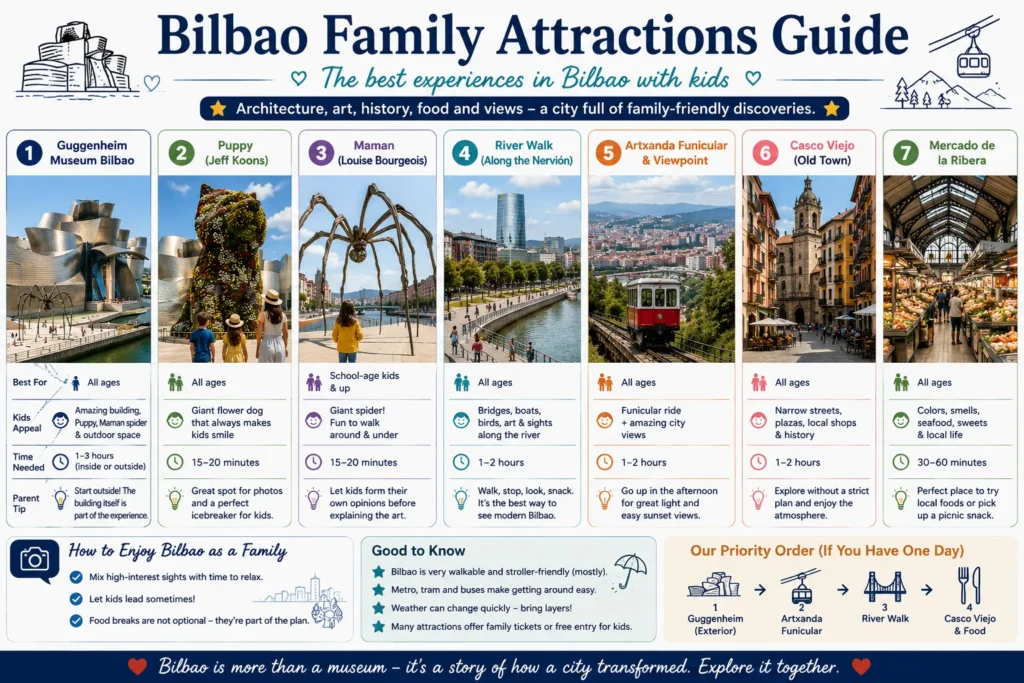
If a family had only one day in Bilbao, my priorities would now be:
Guggenheim exterior + river
↓
interior according to interest
↓
Artxanda
↓
Casco Viejo
↓
pintxos
That already explains a surprising amount of Bilbao.
But with two or three days, we can go further.
Because the next part of Bilbao’s story is not another famous architectural landmark.
It is:
food markets, green spaces, rainy-day strategy, neighborhoods and the question of whether Bilbao itself — rather than the Guggenheim — is what families actually remember.
8. Mercado de la Ribera — Let Food Explain Bilbao
At the edge of Casco Viejo, beside the river, Mercado de la Ribera gives families another way to understand Bilbao.
Not through architecture.
Not through a museum.
Through food.
Markets work particularly well with children because there is always something concrete to look at.
Fish.
Meat.
Cheese.
Vegetables.
Fruit.
Prepared food.
Things they recognize.
Things they absolutely do not.
Don’t Treat the Market Like a Museum
You do not need:
10:00–11:30 Mercado de la Ribera
written into the itinerary.
Walk through.
Look.
Ask questions.
Buy something if appropriate.
Eat if the current stalls and schedule work for the family.
Then continue.
Give Children a Market Challenge
Ask each child to find:
one food they already know
one thing they want to taste
one thing they cannot identify
and
the strangest-looking seafood
That is enough to turn walking through a market into an activity.
The Location Matters Too
Remember the Bilbao story from Part 1?
River.
Trade.
Old town.
Modern transformation.
The market’s location beside the historic center and river helps those pieces connect.
This is not an isolated food attraction.
It belongs to the city around it.
Check Current Hours Before Going
Markets operate differently from conventional tourist attractions.
Individual vendors and food areas may have their own schedules.
If eating there is important to the family, check current opening information rather than assuming every part of the market operates continuously all day.
Family rating: ★★★★
Best for: Food-curious families and a flexible Casco Viejo stop
Best combination: Casco Viejo + market + lunch
What Should Families Eat in Bilbao?
Bilbao is an excellent city for introducing children to Basque food because meals do not need to revolve around one enormous unfamiliar plate.
Pintxos allow:
small portions,
sharing,
comparison,
and experimentation.
But Bilbao’s food identity goes beyond pintxos.
Pintxos — Keep the Rules Simple
With children, I would use four rules.
Start with something familiar.
Share.
Try one new thing at a time.
Stop before dinner becomes a food endurance event.
That is enough.
Tortilla — The Easy Beginning
Spanish tortilla can be one of the easiest entry points for cautious children.
Potato.
Egg.
Familiar texture.
Different bars prepare it differently, which can also become part of the experience.
Try one.
Then move outward.
Croquetas — Another Useful Bridge
Croquetas can provide another relatively approachable option depending on the filling.
But do not assume every croqueta contains the same ingredients.
Ask.
Especially if the family is dealing with:
allergies,
dietary restrictions,
or a child expecting one filling and receiving another.
Bacalao — Bilbao’s Cod Tradition
Cod appears repeatedly in Basque cuisine.
Families may encounter preparations such as:
bacalao al pil-pil
or
bacalao a la vizcaína.
For children who already eat fish, this can be an excellent step into regional cuisine.
For children who do not:
share one.
Nobody needs an individual commitment to cod.
Bacalao al Pil-Pil
The dish is traditionally associated with cod, olive oil, garlic and the distinctive sauce created through the cooking process.
This can also become a small food-science lesson.
How did oil become a sauce?
Why does cooking technique matter?
Food becomes more interesting when children are allowed to investigate it.
Idiazabal Cheese
Families who enjoy cheese should look for Idiazabal, a Basque sheep’s-milk cheese.
It may be more strongly flavored than cheeses some children usually eat.
That makes it perfect for:
one small piece.
Taste.
Compare.
No pressure.
Txuleta — For the Meat-Loving Family
Basque steak culture can appeal to families with older children or teenagers who genuinely enjoy beef.
But this is not something I would automatically add to every family food checklist.
It can be:
large,
expensive,
and better suited to sharing.
If the family loves steak:
great.
If not:
Bilbao offers plenty of other ways to eat locally.
What About Gilda?
Older or more adventurous eaters may encounter the classic Gilda, traditionally associated with ingredients such as:
anchovy,
olive,
and pickled pepper.
This is exactly the kind of pintxo I would let a curious teenager choose.
For a cautious six-year-old?
Perhaps start somewhere else.
My Bilbao Food Progression With Kids
I would think:
Tortilla
↓
Croqueta
↓
Cheese
↓
Fish
↓
Something the child chooses
rather than:
“Tonight everyone is eating traditional Basque cuisine whether they like it or not.”
The first approach usually creates more curiosity.
Bilbao or San Sebastián for Pintxos?
San Sebastián deserves its reputation as one of Europe’s great food destinations.
But families do not need to leave Bilbao because they believe “real pintxos” only exist elsewhere.
Bilbao has its own excellent food culture.
If the wider trip includes both cities:
wonderful.
Let them feel different.
In San Sebastián, food may become one of the central attractions.
In Bilbao, I would let food become part of:
Casco Viejo + market + city life.
9. Doña Casilda Park — Children Sometimes Need a Park
This sounds obvious.
Yet family itineraries routinely contain:
museum,
historic district,
market,
church,
another museum,
dinner.
Then parents wonder why the children have stopped appreciating culture.
Parque de Doña Casilda de Iturrizar provides something much simpler.
Green space.
Paths.
Room to move.
A break.
Why I Would Use It After Culture
If the morning included:
Guggenheim,
architecture,
or another high-attention activity,
a park does not need to compete with those attractions.
It serves a different purpose.
Children can reset.
Parents can slow down.
Don’t Measure Every Stop by Tourist Importance
A child running around a park for 45 minutes may improve the next three hours of the trip more than another highly rated attraction.
That makes the park useful.
Family rating: ★★★★
Best for: Younger children and itinerary resets
Best strategy: Use when needed, not because a timetable says so
Bilbao’s Green Surroundings Are Part of the City
One of Bilbao’s visual characteristics is how close the surrounding hills feel.
This helps distinguish it from many larger Spanish cities.
Artxanda makes that geography obvious from above.
Parks and riverside spaces bring greenery into the everyday family experience.
Bilbao feels urban.
But not detached from landscape.
Rainy-Day Bilbao — Don’t Panic When You See Clouds
If you are planning northern Spain, you should not build the vacation around an assumption of uninterrupted sunshine.
Bilbao’s climate is different from:
Seville,
Córdoba,
Málaga,
or Mallorca.
Rain is part of the planning equation.
The good news?
Bilbao handles bad-weather days surprisingly well.
The Guggenheim Becomes an Obvious Rain Plan
If the family originally planned only to explore the exterior but the weather turns wet:
this may be the day to go inside.
Check current tickets and exhibitions.
Suddenly the weather has helped make the decision.
Azkuna Zentroa — A Different Kind of Cultural Space
Azkuna Zentroa – Alhóndiga Bilbao is another useful name for families to know.
The former wine warehouse was transformed into a contemporary cultural and leisure center.
That alone fits beautifully into our Bilbao theme.
Again:
old function → new city use.
Architecture and urban transformation continue beyond the Guggenheim.
Why It Can Work for Families
Depending on current programming, families may encounter:
exhibitions,
cultural activities,
cinema,
public spaces,
and other facilities.
But this is exactly the kind of place where current programming matters.
Check what is actually happening during your visit.
Do not go because an evergreen blog promised a specific children’s activity.
Museo de Bellas Artes — For Art-Focused Families
Bilbao’s Fine Arts Museum can provide another indoor cultural option depending on current access, exhibitions and reopening/renovation status at the time of the trip.
For an art-loving teenager, this may be much more valuable than adding another outdoor viewpoint.
For a preschooler desperate to jump in puddles?
Possibly not.
Choose according to the family.
Mercado + Food Can Also Save a Wet Day
Rain does not mean the family must spend six continuous hours inside museums.
Use:
market,
covered food stops,
cafés,
short walks,
and indoor attractions
to break the day into pieces.
My Rainy-Day Rule
Do not create a completely separate:
RAIN ITINERARY
unless the forecast requires it.
Instead, keep several interchangeable pieces.
Guggenheim interior.
Azkuna Zentroa.
Market.
Long lunch.
Museum.
Then move them according to weather.
Flexible itineraries outperform perfect itineraries when the weather refuses to cooperate.
Where Should Families Stay in Bilbao?
Unlike Mallorca or Ibiza, this decision is relatively easy.
Bilbao is compact enough that families do not need to obsess over choosing the perfect regional base.
Still, neighborhoods produce different experiences.
1. Abando — My Easiest First-Time Choice
For many first-time families, Abando provides a very practical central base.
You are positioned between major parts of the city and have convenient access to:
shopping,
restaurants,
transport,
riverfront,
and both modern and historic Bilbao.
Best For
First-time families.
Short stays.
Families who want to walk extensively.
Travelers arriving by train.
2. Ensanche — Modern Bilbao + Guggenheim Access
The wider central/Ensanche area can work particularly well for families prioritizing:
Guggenheim,
modern architecture,
shopping,
restaurants,
and easy central movement.
This is a strong option with older children and teenagers.
3. Casco Viejo — Atmosphere + Food
Staying in the historic center places families close to:
old streets,
Plaza Nueva,
pintxos,
market,
and historic atmosphere.
This can be excellent.
But check:
noise,
building access,
stairs/elevators,
and the exact street.
Historic Charm Has Practical Consequences
An atmospheric apartment on an upper floor is less charming when:
there is no lift,
the stroller is downstairs,
and someone fell asleep at dinner.
Always inspect the property details.
4. Near the Guggenheim?
Also perfectly reasonable.
Especially for:
art-focused families,
short trips,
and travelers who like the riverfront environment.
Again, Bilbao’s central scale means the choice does not need to become a major strategic problem.
My Bilbao Accommodation Rule
Prioritize:
walkability
quiet enough to sleep
easy transport
appropriate room size
and
actual family logistics
over being 200 meters closer to one attraction.
Getting Around Bilbao With Kids
This is one of Bilbao’s strengths.
For most family city trips:
do not rent a car.
Walking and public transportation handle the city very well.
Metro
Bilbao’s metro is particularly useful for:
moving across the metropolitan area,
reaching outer districts,
and excursions toward places such as Getxo and the coast.
It is also another piece of Bilbao’s architecture story.
The system’s design is closely associated with architect Norman Foster.
Older children can now start collecting architects:
Gehry.
Calatrava.
Foster.
Bilbao quietly becomes an architecture lesson.
Tram
The tram can be particularly convenient around central attractions and the riverfront depending on the family’s route.
With tired children, transportation that saves an unnecessary walk can be worth using even when the distance looks manageable on a map.
Bus
Useful for routes not covered conveniently by metro or tram.
Check current routes and fares rather than relying on static information in an evergreen guide.
Walking
Central Bilbao is highly walkable for many families.
But remember:
Artxanda is a hill.
That is why there is a funicular.
Use it.
Bilbao With a Stroller
Compared with many historic European destinations, much of modern central Bilbao can be relatively manageable.
Riverfront areas.
Modern streets.
Public transportation.
Open spaces.
Casco Viejo introduces more:
historic surfaces,
crowds,
and occasional accessibility complications.
Artxanda and individual attractions require their own assessment.
If accessibility is essential, verify the specific route and attraction before travel.
Do Families Need a Rental Car?
For Bilbao:
No.
For a larger Basque Country or northern Spain road trip:
possibly.
If the car will remain in a garage while the family uses:
metro,
tram,
and walking,
you may be paying for an expensive object to occupy a parking space.
Best Time to Visit Bilbao With Kids
Bilbao’s climate is one reason it feels so different from southern Spain.
You should plan for:
variable weather,
possible rain,
and generally greener surroundings.
Spring
Potentially excellent for:
city walking,
parks,
architecture,
and wider Basque exploration.
Bring rain strategy.
Summer
For families who dislike the extreme temperatures possible in inland and southern Spain, Bilbao can be attractive.
But summer does not guarantee dry weather.
Bring layers and check the actual forecast.
Autumn
Food.
Culture.
City walking.
Changing weather.
This can be a very appealing period, particularly for families who are not building the trip around swimming.
Winter
Bilbao can work as a:
museum,
food,
architecture,
and city-break destination.
Expect shorter days and wetter/cooler conditions than Mediterranean Spain.
The advantage is that the city does not depend on beach weather to function.
There Is No Bad Weather, Only—
No.
I am not going to tell parents that.
Sometimes weather is genuinely unpleasant.
If it is raining heavily:
go inside.
Eat.
Change the plan.
Return to the outdoor attraction later.
Family travel does not become more authentic because everyone remained outside getting soaked.
10. Vizcaya Bridge — The UNESCO Site Near Bilbao
Remember Part 1?
The Guggenheim is not a UNESCO World Heritage Site.
But Bilbao’s metropolitan area gives families access to one that is particularly interesting for children:
Vizcaya Bridge — Puente de Vizcaya.
It spans the Nervión estuary between Portugalete and Getxo.
And it is not an ordinary bridge.
What Makes the Vizcaya Bridge Different?
It is a transporter bridge.
Instead of simply driving across a conventional bridge deck, a suspended gondola transports passengers and vehicles across beneath the high structure.
For children, that immediately produces a question:
Why build a bridge like this?
Excellent.
Why Was It Designed This Way?
The challenge was to connect the two sides of the estuary while allowing maritime traffic to continue.
A conventional low bridge could interfere with ships.
The transporter design provided another solution.
Now engineering becomes understandable.
There was a problem.
Somebody designed a machine to solve it.
Why UNESCO?
The Vizcaya Bridge is recognized for its significance in the history of iron architecture and bridge engineering.
It opened in the late nineteenth century and became influential in the development of transporter bridges elsewhere.
This is exactly the kind of UNESCO site that can work surprisingly well with children because the important question is not:
“Which king lived here?”
It is:
“How does this thing work?”
Getxo + Vizcaya Bridge as a Half-Day Trip
This is where Bilbao’s metro becomes useful.
Families can travel toward the estuary and combine:
bridge,
waterfront,
Getxo/Portugalete exploration,
and potentially more coastal time
depending on:
weather,
season,
and family interest.
Do You Need a Car?
No.
That is part of the attraction.
A metro-based excursion can be much easier than:
rent car,
navigate,
park,
return car.
Should Every Family Go?
No.
If you have only:
two days
and the family still wants:
Guggenheim,
Artxanda,
Casco Viejo,
food,
and relaxed time,
stay in Bilbao.
If you have:
three days,
engineering-curious children,
teenagers,
or interest in UNESCO/industrial heritage,
the Vizcaya Bridge becomes much more compelling.
Bilbao’s Industrial Story Comes Full Circle Here
This is why I particularly like the bridge as an optional extension.
Part 1 began with:
Can architecture and infrastructure change a city?
The Guggenheim showed one chapter.
The river showed another.
The metro showed another.
Now the Vizcaya Bridge takes the family back toward Bilbao’s industrial and engineering history.
The trip starts making connections.
What I Would Prioritize After Two Days
At this point, a family has enough material for an excellent Bilbao trip without adding anything else.
Modern Bilbao
→ Guggenheim + river + architecture
Old Bilbao
→ Casco Viejo + market
Green Bilbao
→ Artxanda + parks
Food Bilbao
→ pintxos + Basque specialties
Industrial/engineering Bilbao
→ Vizcaya Bridge if time allows
That is a much richer city than:
“We went to Bilbao to see the Guggenheim.”
And now we can build those pieces into a realistic three-day family itinerary without forcing every family to experience all five versions at once.
A Realistic 3-Day Bilbao Family Itinerary
Three days is enough to understand why Bilbao is more interesting than a one-museum stop.
But I would not use the third day to double the number of attractions.
Instead, give each day a different identity.
Day 1 — Modern Bilbao
Day 2 — Old Bilbao + Food
Day 3 — Family Choice
That creates variety without turning the trip into a race.
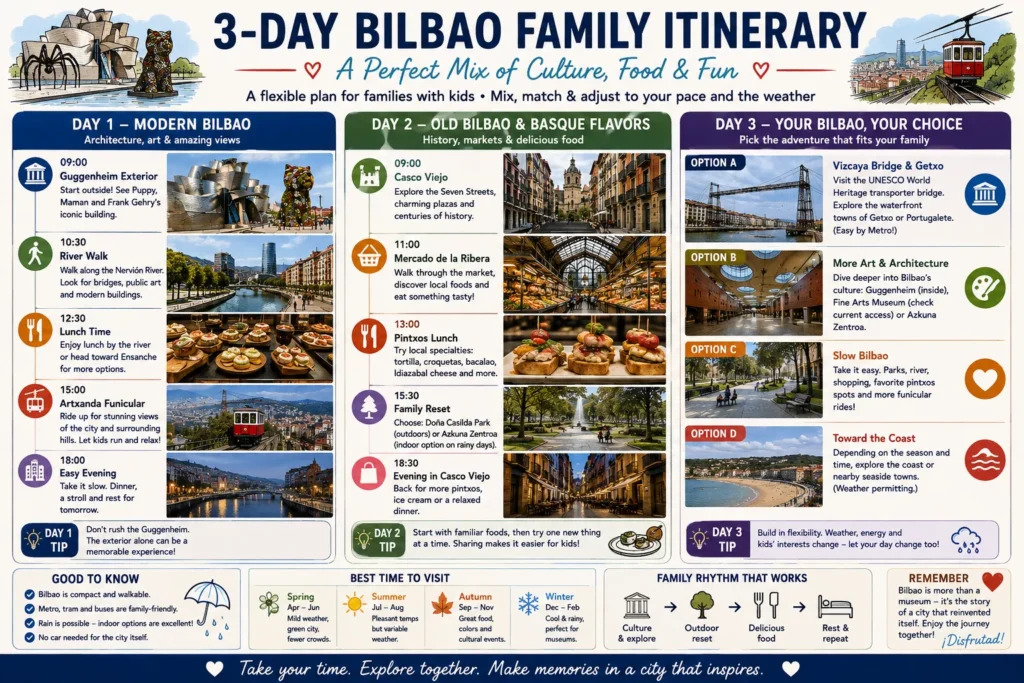
Day 1 — Guggenheim + River + Artxanda
This is the Bilbao most first-time visitors expect.
So start there.
Morning — Guggenheim Exterior
Begin outside.
See:
Puppy
↓
Frank Gehry’s building
↓
Maman
↓
the river
Let children react before explaining everything.
Should You Go Inside?
Decide according to:
children’s ages,
current exhibitions,
weather,
and actual interest.
With art-loving teenagers:
absolutely consider it.
With younger children already delighted by Puppy and the giant spider:
the exterior may be enough.
Late Morning — River Walk
Continue along the Nervión.
Look for:
bridges,
new architecture,
old structures,
public art,
and evidence of Bilbao’s transformation.
This is where the morning stops being:
“we visited a museum”
and becomes:
“we explored how a city changed.”
Lunch
Stop properly.
If children want pintxos:
great.
If they want a conventional sit-down meal:
also great.
There is no prize for completing the maximum number of bars before 14:00.
Afternoon — Artxanda Funicular
Change the experience.
Ride up.
Look over Bilbao.
Ask the children to find:
the Guggenheim,
river,
bridges,
and areas they walked through earlier.
Then let everyone relax.
Evening
Keep it easy.
Dinner.
Walk.
Hotel.
Do not add Casco Viejo simply because there are technically several hours left.
Day 1 already told a complete Bilbao story.
Day 2 — Casco Viejo + Market + Basque Food
Now change centuries.
Morning — Casco Viejo
Explore the historic core.
Walk the Siete Calles.
Find Plaza Nueva.
Let children compare:
street width,
architecture,
and atmosphere
with yesterday’s modern Bilbao.
Late Morning — Mercado de la Ribera
Walk through the market.
Use the food challenge from Part 2.
Find:
something familiar,
something strange,
something everyone wants to taste.
Lunch — Make Food the Activity
This is the day I would give pintxos more room.
But still:
fewer places, better experience.
Start with something approachable.
Tortilla.
Croqueta.
Then add:
Idiazabal,
bacalao,
or something the children choose.
Afternoon — Family Reset
Now choose according to the weather.
Option A — Doña Casilda Park
Best if everyone needs outdoor space.
Option B — Azkuna Zentroa
Useful when the weather turns.
Option C — Hotel Break
Completely legitimate.
Option D — More Casco Viejo
Only if everyone genuinely wants it.
Evening
Return to whichever part of Bilbao the family liked most.
There is no requirement to find a new neighborhood simply because it is Day 2.
Day 3 — Choose Your Bilbao
This is where the itinerary should branch.
Do not attempt all of these.
Option A — Vizcaya Bridge + Getxo
My choice for:
school-age children,
teenagers,
engineering-curious families,
and anyone interested in Bilbao’s industrial story.
Use public transportation.
See how the transporter bridge works.
Explore the estuary.
Return without adding another major attraction.
Option B — More Art + Architecture
For art-focused families:
Guggenheim if you skipped the interior,
Fine Arts Museum according to current access,
Azkuna Zentroa,
architecture walk,
or another current cultural experience.
Option C — Slow Bilbao
This may be the correct answer with younger children.
Park.
River.
Favorite pintxos place.
Funicular again.
Shopping.
Nothing ambitious.
Option D — Continue Toward the Coast
Depending on:
season,
weather,
transport,
and the wider itinerary,
families may use the third day to explore more of the Bilbao metropolitan coast.
But do not create a giant coastal loop just because you have one day remaining.
What About a San Sebastián Day Trip?
Possible?
Yes.
Would I automatically recommend it?
No.
This is where itinerary logic matters.
If the wider northern Spain trip already includes San Sebastián:
stay in Bilbao today.
If it does not, a day trip may sound tempting.
But San Sebastián deserves more than:
arrive,
La Concha,
pintxos,
leave.
If the wider itinerary has room, I would rather give San Sebastián its own stay.
Two Days or Three Days in Bilbao?
Two Days
Enough for a strong first visit.
Prioritize:
Guggenheim,
river,
Artxanda,
Casco Viejo,
market,
and food.
Three Days
Better if the family wants:
Vizcaya Bridge,
more museums,
slower pacing,
or weather flexibility.
Four Nights or More?
Now Bilbao can become a useful base for wider Basque exploration.
But that does not mean every extra day needs an excursion.
The city itself deserves some slow time too.
Bilbao With Toddlers
Bilbao would not be my first Spanish destination if the sole objective were toddler-specific attractions.
But it can still work very well as part of a wider family trip.
I would emphasize:
Puppy,
Maman,
river walks,
Artxanda Funicular,
parks,
short Casco Viejo exploration,
market,
and frequent food stops.
What I Would Reduce
Long museum sessions.
Detailed architecture explanations.
Multiple neighborhoods in one day.
Extended food crawls.
And any itinerary requiring a toddler to appreciate the economic consequences of post-industrial urban regeneration.
That lesson can wait.
Bilbao With School-Age Children
This may be the age where Bilbao starts becoming particularly interesting.
Children can understand:
old city
versus
new city.
They can ask:
Why does the Guggenheim look like that?
How does the Vizcaya Bridge work?
Why is there a giant spider outside a museum?
Why does the metro look different?
Why did Bilbao need to change?
Those questions turn the entire city into an educational experience without making the trip feel like school.
Bilbao With Teenagers
I think Bilbao becomes particularly strong with teenagers.
Architecture.
Art.
Photography.
Food.
Urban design.
Industrial history.
Basque culture.
Public transportation.
Independent exploration.
All work well at this age.
Give Teenagers Responsibility
Let them:
navigate one Metro journey,
choose a pintxo,
pick between two museums,
photograph their favorite architecture,
or decide whether Day 3 becomes Getxo or more Bilbao.
A compact, well-connected city is a good place to give teenagers slightly more ownership of the trip.
Bilbao or San Sebastián With Kids?
These cities are close enough that families naturally compare them.
They should not feel interchangeable.
| Bilbao | San Sebastián | |
|---|---|---|
| Main identity | Architecture + urban transformation | Beach + food + seaside city |
| Signature landmark | Guggenheim | La Concha |
| Best family ride | Artxanda Funicular | Monte Igueldo Funicular |
| Beach in core itinerary | Not essential | Essential |
| Art/architecture | Excellent | Very good |
| Food | Excellent | Exceptional destination identity |
| Historic area | Casco Viejo | Parte Vieja |
| Rainy-day strength | Excellent | Good |
| Younger children | Good | Excellent |
| School-age kids | Excellent | Excellent |
| Teenagers | Excellent | Excellent |
| Ideal first stay | 2–3 nights | 3 nights |
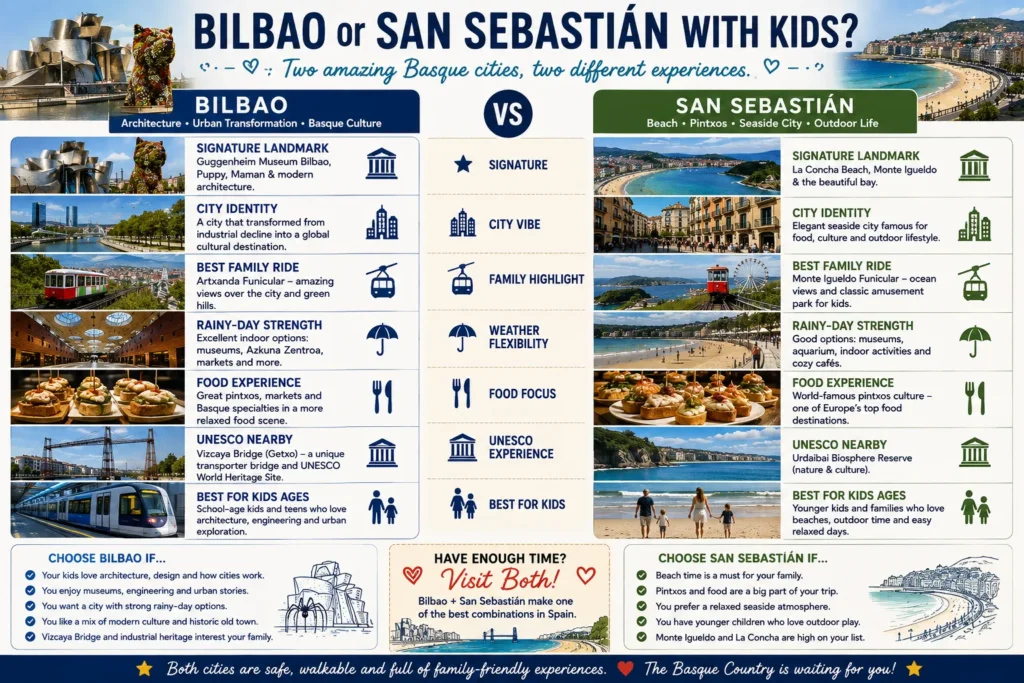
Which Would I Choose?
For younger children who primarily want:
beach,
funicular,
and easy outdoor time,
San Sebastián probably wins.
For older children or teenagers interested in:
architecture,
art,
engineering,
and how cities work,
Bilbao may be more interesting.
For food-focused families?
San Sebastián has the stronger international food-travel identity.
But Bilbao is hardly a consolation prize.
The Better Answer Is Often Both
A northern Spain family trip can combine the cities extremely well because they provide different experiences.
Bilbao:
urban transformation + architecture
San Sebastián:
coast + beach + pintxos
That is a much stronger combination than visiting two cities that feel like variations of each other.
Families continuing east can use our San Sebastián with Kids family travel guide for La Concha, Monte Igueldo, beaches, accommodation and a realistic three-day itinerary.
And families who want to go deeper into the region’s food culture can use our San Sebastián Pintxos Guide for signature dishes and family-friendly pintxos strategies.
How Bilbao Fits Into a Northern Spain Family Trip
Bilbao works particularly well as a gateway to the Basque Country and northern Spain.
A simple regional structure could be:
Bilbao
↓
San Sebastián
↓
continue through northern Spain according to available time
But do not turn northern Spain into:
one night,
drive,
one night,
drive,
one night,
drive.
The landscape may look beautiful through the windshield.
The children will still remember the windshield.
Give Bilbao Its Own Nights
I would avoid landing in Bilbao, seeing the Guggenheim for two hours and immediately leaving.
That reduces the city to exactly the stereotype this guide has tried to challenge.
Stay.
Walk the river.
Ride Artxanda.
Eat.
See Casco Viejo.
Then move on.
Families building the wider journey can use our Northern Spain family itinerary to connect Bilbao and San Sebastián with other destinations while keeping hotel changes and driving manageable.
Families still deciding where Bilbao belongs in their first Spain trip can also compare it with other destinations in our 15 Best Places to Visit in Spain with Kids guide.
Don’t Compare Bilbao With Barcelona
They both have:
famous architecture,
art,
food,
and strong regional identities.
That does not make them substitutes.
Barcelona is a huge international tourism destination with:
Gaudí,
Mediterranean beaches,
major attractions,
and a completely different scale.
Bilbao is smaller.
More concentrated.
More directly connected to its industrial transformation story.
Bilbao does not need to become a smaller Barcelona to justify visiting it.
Common Mistakes Families Make in Bilbao
Visiting Only the Guggenheim
The museum makes more sense when you understand the city around it.
Assuming the Guggenheim Is UNESCO
It isn’t.
Forcing Every Child Inside the Museum
The exterior can already be a substantial experience.
Skipping Artxanda Because It Is “Just a View”
The funicular + outdoor reset is exactly why it works with children.
Treating Casco Viejo as Only a Pintxos Zone
It is part of Bilbao’s historical story.
Planning as Though Northern Spain Has Southern Spain’s Weather
Bring flexibility.
Renting a Car for Central Bilbao
Usually unnecessary.
Going to San Sebastián as a Day Trip When It Already Has Its Own Place in the Itinerary
Give each city time.
Trying to Teach Children Everything
Choose one or two ideas.
They do not need a degree in urban planning by dinner.
The One Bilbao Question I Would Keep Asking
What changed here?
At the Guggenheim:
what changed?
Beside the river:
what changed?
On the Metro:
what changed?
In Casco Viejo:
what remained?
At Vizcaya Bridge:
what was this region built around?
That one question connects almost the entire trip.
What I Would Protect in a Bilbao Family Itinerary
If I had to protect four things:
Guggenheim from the outside
the river
Artxanda
and
Casco Viejo + food.
Everything else depends on the family.
Museum interior?
Interest.
Vizcaya Bridge?
Time.
More art?
Teenager.
Park?
Younger child.
Rain?
Move everything.
That flexibility is one of Bilbao’s strengths.
One Bilbao Afternoon I Would Leave Empty
On a three-day visit, I would protect one half-day from reservations.
Maybe it rains.
Maybe the children loved the Guggenheim.
Maybe they want Artxanda again.
Maybe Casco Viejo turns into a long lunch.
Maybe everyone wants to go toward Getxo.
You cannot know all of that while planning at home.
An empty afternoon is not missing itinerary content.
It is space for the destination to influence the itinerary.
Is Bilbao Worth Visiting With Kids?
Yes.
But I think its strongest audience is often underestimated.
Bilbao is particularly good for families with children old enough to begin asking:
Why does a city look like this?
That question opens everything.
Architecture.
Industry.
Economics.
Environment.
Transportation.
Art.
History.
Food.
With Younger Children?
Keep it physical.
Giant dog.
Giant spider.
Funicular.
River.
Park.
Food.
Done.
They do not need the Bilbao Effect.
With Older Children?
Now tell the story.
A city once strongly associated with heavy industry changes.
The river changes.
Infrastructure changes.
Architecture changes.
A spectacular museum becomes an international symbol.
Tourists arrive.
Bilbao’s image changes around the world.
Then ask:
Was it really just the museum?
Now you have a conversation worth traveling for.
How Many Nights Would I Book?
For a first family trip:
2–3 nights.
Two nights can cover the essentials.
Three gives:
weather flexibility,
Vizcaya Bridge,
more food,
and a much slower rhythm.
If Bilbao becomes a base for wider Basque exploration, stay longer.
Final Thoughts: Bilbao Is the Attraction
The Guggenheim may be why many families first put Bilbao on the map.
That is understandable.
It is extraordinary architecture.
Puppy is memorable.
Maman is unforgettable.
And the museum transformed Bilbao’s international image.
But if the family leaves thinking:
“Bilbao is where the Guggenheim is,”
I think they have missed the more interesting story.
Walk away from the museum.
Follow the river.
Cross a bridge.
Ride the funicular.
Look back at the city.
Then walk through streets that existed centuries before Frank Gehry arrived.
Eat in Casco Viejo.
Visit a market.
Take the Metro.
If time allows, go toward the Vizcaya Bridge and see another piece of the region’s engineering history.
Now the museum becomes part of a larger story.
Bilbao is not interesting because somebody dropped a famous building into an ordinary city.
It is interesting because architecture, transportation, environmental recovery, public space, culture and economic change became part of a much broader urban transformation.
Children do not need to remember those words.
They can remember:
the silver building,
the flower dog,
the spider,
the funicular,
the old streets,
the pintxos,
and the strange bridge that carries people underneath it.
Years later, they may understand how those pieces fit together.
That is enough.
Because the best educational family travel rarely feels educational while it is happening.
It feels like:
“Why does that building look like a ship?”
“How does that bridge work?”
“Why is there a giant spider?”
And eventually:
“Was Bilbao always like this?”
That final question is where the real trip begins.